
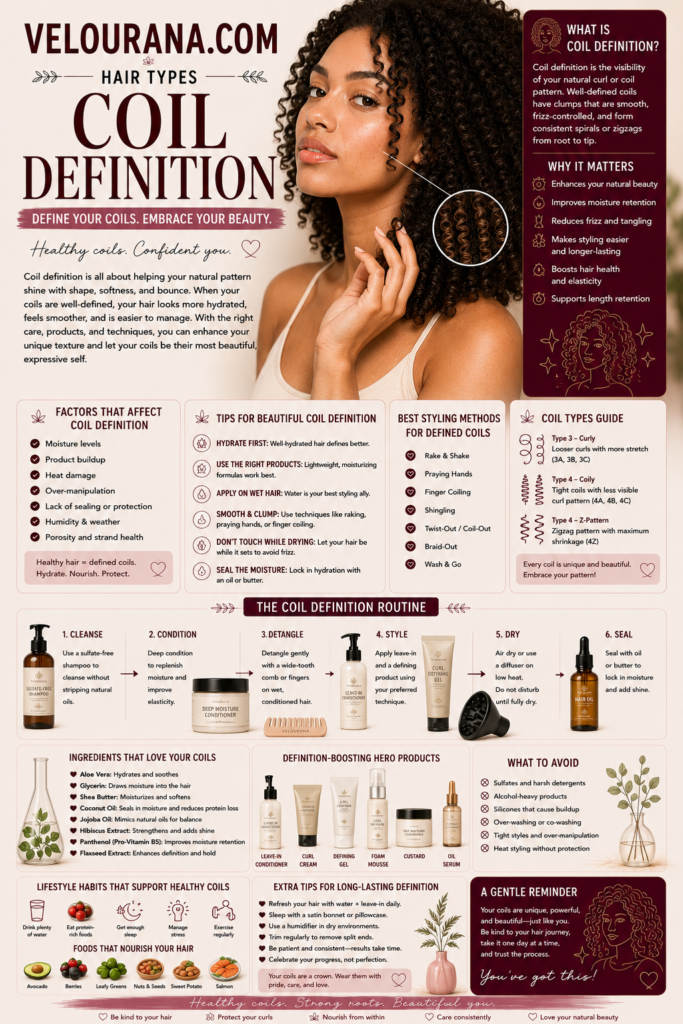
CATEGORY: Coil Definition
Coil definition is often judged by what appears in the mirror after styling: the sharpness of a spiral, the separation between neighboring sections, the smoothness of a surface, the degree of frizz, or the amount of shrinkage that remains visible. Yet the most important part of definition is not the final appearance. It is the process by which individual strands decide, temporarily, to behave together.
This process is clumping.
A visible coil is rarely a single strand displaying itself in isolation. More often, it is a small group of hairs that have aligned closely enough to create one recognizable form. When the group remains coherent, the coil appears strong and distinct. When individual hairs detach from it, the shape becomes softer, less polished, and eventually less visible.
The concept sounds simple, but clumping is influenced by almost every part of a textured-hair routine. Water changes flexibility. Cleansing changes the surface of the strand. Conditioning changes friction. Styling products influence slip and hold. Tools rearrange neighboring hairs. Drying determines whether the group remains together long enough to become stable. Weather and movement begin dismantling that arrangement almost as soon as it is created.
Understanding clumping makes coil definition far less mysterious.
Instead of asking why one product created better curls than another, it becomes possible to ask a more precise question: what helped the strands gather, and what allowed them to remain gathered?
That distinction is the foundation of predictable definition.
A Coil Is Often a Group, Not an Individual Strand
It is easy to imagine coily hair as thousands of tiny springs growing independently from the scalp.
Reality is less orderly.
Individual hairs emerge separately, but once they become wet and move against one another, neighboring strands may naturally gather into groups. Some follow very similar curves and remain closely associated. Others repeatedly cross and separate.
The finished visual pattern therefore depends partly on how many individual strands participate in each group.
A large clump can appear as one substantial coil even though it contains many hairs. A smaller clump may create a delicate spiral. Extremely small groups can produce a highly intricate, fluffy texture where individual forms are visible only at close range.
This is one reason the appearance of "definition" differs so much between people.
A person whose hair naturally forms relatively large groups may achieve obvious pattern with minimal styling. Someone whose strands form much smaller or more irregular groups may possess equally strong natural texture while producing a visually different result.
Density compounds the effect.
When numerous small coils overlap, the boundaries between them may be difficult to see, particularly near the roots. Photographs can exaggerate this difference because lighting, camera angle, and contrast determine how clearly one group can be distinguished from another.
Definition should therefore never be reduced to how closely the finished style resembles a reference image.
The underlying process is more individual than that.
The meaningful question is whether the hair is forming coherent groups appropriate to its own structure.
Water Allows Strands to Reorganize
For many people with coily hair, the most dramatic clumping occurs during washing.
Dry hair that appeared expanded and diffuse can transform as water penetrates the section. Neighboring strands begin gathering, the hair becomes heavier, and previously indistinct curves become more visible.
This happens because wetting changes the mechanical behavior of hair.
The strands become more flexible, temporary interactions within the fiber shift, and friction between adjacent hairs changes. Saturated hair can move and reorganize more easily than dry hair.
This reorganized state is the raw material of definition.
The amount of water present during styling matters because clumps are easier to form while the hair remains flexible enough to rearrange itself. When a section begins drying prematurely, individual strands become less cooperative. Product may sit unevenly across the surface, and the groups established during washing can fragment.
This is why two sections treated with the same product can dry very differently.
The first may have been styled while thoroughly wet. The second may have lost significant moisture while waiting. The product has not necessarily failed; the environment in which it was applied changed.
Rewetting restores some of that flexibility.
Yet soaking-wet hair is not universally ideal for every method. Some products become excessively diluted when applied over large amounts of water. Some people find that slightly removing excess water produces stronger hold and faster drying.
The useful principle is not that more water is always better.
It is that water is an active part of styling rather than something that simply happened during washing.
The correct amount allows the strands to move into groups while still permitting the chosen product to function effectively.
Surface Condition Influences Whether Strands Stay Together
Hair does not clump solely because it is wet.
The surface condition of the strand influences how neighboring hairs interact.
When hair is very tangled, rough, coated, or severely weathered, individual strands may resist orderly grouping. They catch on one another unpredictably or refuse to align smoothly.
Conditioning can improve this situation by reducing friction and making the hair easier to manipulate. Detangling allows strands to move into new relationships rather than remaining trapped inside knots.
This does not mean that every strand must become perfectly smooth.
Coily hair naturally contains complex geometry, and some degree of surface irregularity is normal. The objective is functional manageability rather than artificial smoothness.
Cleansing also plays a significant role.
Repeated styling leaves material behind. Oils, creams, gels, conditioners, environmental particles, and scalp-derived substances can accumulate to varying degrees. When buildup becomes substantial, the surface may behave differently from one wash to the next.
The hair may stop wetting evenly. Some sections may feel heavy while others feel rough. Products can distribute unpredictably.
Because the visible result is often poor definition, additional styling product is sometimes applied in response.
That can worsen the imbalance.
A clean enough surface allows water and conditioning products to interact with the strand more consistently. An adequately conditioned surface allows neighboring hairs to slide and align without excessive friction.
The balance between these two states is one of the foundations of reliable clumping.
Why Detangling Can Improve Definition
Detangling is usually discussed in relation to knots and breakage, but it also affects the visual organization of coils.
A tangled section contains hairs traveling in conflicting directions. Some strands may belong naturally to one clump but are caught inside another. Others wrap around neighboring groups and prevent them from separating cleanly.
When those tangles are removed carefully, the section gains freedom to reorganize.
This is particularly evident when detangling takes place on wet, conditioned hair. As knots are released, natural groupings may appear almost immediately.
The method matters.
Aggressive detangling can create its own problems by stretching the hair excessively, snapping vulnerable strands, or creating numerous shorter hairs that later contribute to a diffuse surface.
The objective is not to force every strand into perfect parallel alignment.
It is to remove obstacles that prevent the hair from arranging itself coherently.
Tools can be useful, but fingers can also provide information that a brush cannot. Fingers detect knots, rough areas, and changes in density. A tool provides speed and consistency.
Some people find that a wide-toothed comb or flexible detangling brush improves clumping dramatically. Others notice that certain tools separate their natural groups too much and must then reconstruct them during styling.
Neither experience is contradictory.
A tool is not inherently defining or anti-defining. Its effect depends on how it rearranges the specific hair.
Clump Size Changes the Entire Finished Style
One of the most powerful variables in coil definition is rarely discussed explicitly: the size of the clump.
Large clumps and small clumps create different visual outcomes even when the underlying hair remains unchanged.
Larger groups tend to look smoother because fewer boundaries are visible across the section. The resulting coils may appear substantial and polished. Because more hair is concentrated into each unit, the overall style can also look somewhat less voluminous.
Smaller groups create more visible detail.
They may produce a highly textured finish with greater fullness and movement. More boundaries exist between groups, however, which means more opportunities for individual hairs to sit outside a perfectly organized formation.
Neither clump size is inherently superior.
The appropriate size depends on the desired style.
Someone seeking highly polished definition may intentionally preserve broader groups during application. Someone seeking maximum volume may divide them more aggressively after drying. Another person may prefer natural variation, allowing large coils in one area and tiny ones elsewhere.
Styling methods alter clump size through the way they move through the hair.
Smoothing with the palms tends to keep neighboring strands together. Raking with separated fingers can divide them. A brush can organize hair into ribbons or smaller groups depending on its design, the amount of tension, and the size of the section.
Finger coiling often creates deliberately small, distinct units.
Once clump size is recognized as a choice, coil definition becomes easier to customize.
The question is no longer simply whether the hair is defined.
It becomes what kind of definition is being created.
Styling Products Help Groups Form and Stay Together
A styling product can serve several functions at once.
It may provide slip during application, helping strands align. It may contain conditioning ingredients that improve flexibility. It may reduce friction as neighboring hairs move against one another. Most importantly for lasting definition, it may form a film that helps preserve the clump during drying and wear.
These functions explain why two products with similar textures can perform very differently.
A cream may create beautiful wet clumps because it allows the hair to glide into place but provide relatively little lasting support. A gel may initially feel less luxurious but create a stronger film that preserves the groups for several days.
A custard or jelly may combine aspects of both.
The category name is less important than what the formulation actually does.
Application quantity matters because every strand within a clump needs sufficient contact with the product to participate in the finished structure. Too little can leave sections unsupported. Too much can make the hair heavy, sticky, excessively rigid, or slow to dry.
Distribution is therefore more important than saturation with product.
A modest quantity evenly spread often performs better than a large quantity concentrated on the surface.
This is especially significant in dense hair.
Product can appear to cover the section while the interior remains relatively untouched. Dividing the hair enough to reach internal layers helps create more consistent results.
The goal is not to coat every hair with a visible shell.
It is to create an environment in which neighboring strands can remain associated through the drying process.
Why Some Products Create Better Clumping Than Others
The sensation commonly described as "slip" is closely connected to clumping.
When a product allows strands to slide easily across one another, they can reorganize without catching prematurely. This makes it easier to smooth a section and encourage coherent groups.
But slip alone does not guarantee lasting definition.
A product can be extremely slippery while offering minimal hold after drying.
Other formulations provide little obvious slip but create a strong film once water evaporates. The style may look less impressive during application yet prove far more durable.
This is why evaluating products exclusively on wet appearance can be misleading.
The real performance emerges after drying.
Compatibility with other products also matters.
Layering a leave-in beneath a gel can sometimes improve flexibility and reduce stiffness. In other cases, the layers interfere with one another, weaken hold, or produce residue.
Adding an oil over or beneath certain stylers can alter how they spread and dry.
There is no universal layering formula because formulations vary enormously.
The most reliable approach is to evaluate the smallest effective routine first, then add complexity only when there is a clear reason.
If a single product provides adequate slip, conditioning, hold, and longevity, there is no technical requirement to use three additional layers simply because a popular routine includes them.
Clumping benefits from functional simplicity.
Raking, Smoothing, and Shingling Create Different Relationships
Many styling techniques are essentially different ways of deciding which strands will dry together.
Raking separates the fingers through a section, distributing product while dividing the hair into relatively small groups. It can be efficient and particularly useful when product needs to reach dense interior areas.
Smoothing keeps the hands flatter against the section, encouraging larger groups and reducing surface disruption.
Shingling works with smaller sections and often involves deliberately guiding individual coils or groups into place. It can produce extremely controlled definition but requires considerably more time.
None of these methods has exclusive ownership over good results.
Their value depends on the natural behavior of the hair and the desired finish.
Hair that naturally forms large clumps may need only light smoothing. Aggressive raking might unnecessarily divide groups that were already well organized.
Hair that tends to form bulky, tangled clusters may benefit from more separation.
The mistake is assuming that more technique automatically means more definition.
Often the best technique is the minimum intervention required to create an orderly structure.
The hair should be given enough guidance to form coherent groups, then allowed to do the rest.
Brushes Can Reorganize Clumps With Remarkable Precision
Brush styling has become closely associated with highly defined textured hair because certain tools can create very regular groupings.
As a brush passes through a wet, product-coated section, its teeth or bristles separate and align strands. When the section is released, the hair contracts into organized ribbons or coils.
The effect can be visually dramatic.
But brush definition is not simply about the brush.
Water level influences how freely the strands move. Product affects slip and hold. Tension changes elongation. Brush angle affects grouping. Section size determines how much hair is being organized at once.
The same brush can therefore produce completely different results on different days.
Excessive brushing can also become counterproductive.
Repeated passes may continue dividing and rearranging clumps after they have already reached a desirable state. Fine or fragile hair can experience unnecessary mechanical stress if the tool is used aggressively.
The useful moment to stop is when product is distributed and the desired groups have formed.
A styling tool should create order, not become a ritual that must be repeated regardless of what the hair is already doing.
Finger Coiling Reveals the Difference Between Natural and Constructed Definition
Finger coiling provides an especially clear example of how styling can influence pattern.
A small section is wrapped around the finger and guided into a spiral. The resulting formation can be extremely smooth and uniform.
This is beautiful styling, but it is important to distinguish it from an untouched natural pattern.
Finger coiling may encourage strands with slightly different curves to follow one collective spiral. It can make irregular sections appear more consistent. It can also exaggerate a spiral shape that would otherwise appear more angular or compact.
There is nothing artificial in the negative sense about this.
All styling modifies presentation.
The distinction matters only when people compare the finished result to their unstyled hair and conclude that their natural texture is somehow deficient.
A finger-coiled result is a designed arrangement.
Understanding that can remove unnecessary pressure to reproduce the same appearance with effortless wash-and-go styling.
Drying Locks in the Grouping Created While Wet
Once the strands have been organized, the style enters its most vulnerable stage.
Wet clumps are flexible and easily disturbed.
As water leaves the hair, the strand contracts and styling films begin to set. The shape created during application becomes increasingly stable.
If the groups remain intact during this transition, definition is likely to be strong.
If they are repeatedly disturbed, individual hairs detach before the arrangement is fully established.
This is why touching wet hair often creates a diffuse surface.
The effect is not mysterious "frizz" appearing from nowhere. It is partly the physical separation of strands from the groups in which they were intended to dry.
Controlled drying preserves those relationships.
Air drying works well when the hair can remain relatively undisturbed long enough.
Diffusing shortens the process and can help reduce the period during which the wet style is vulnerable. Airflow should generally support rather than violently rearrange the clumps.
Drying from the roots outward can be useful in dense hair because surface dryness is not always a reliable indicator that the interior has finished setting.
Fully dry hair behaves differently from hair that is ninety percent dry.
That final portion can determine whether a style survives subsequent manipulation.
The Cast Is a Temporary Scaffold
Some strong-hold stylers create a firm cast around the dried coil.
This cast can initially feel undesirable because the hair may seem stiff or crunchy.
Yet structurally, the cast performs an important role.
It acts as a temporary scaffold.
While the hair dries, the film surrounding the grouped strands helps prevent them from separating. Once the style is completely dry, the cast can often be softened through gentle compression or movement.
The underlying clump remains because the hairs dried in that organized relationship.
Breaking the cast too early removes the support before the group has fully stabilized.
This can shorten the life of the style.
The amount of cast someone chooses to remove depends on preference.
Leaving more can preserve strong definition. Breaking it thoroughly creates immediate softness and volume.
Again, coil styling is a balance rather than a single ideal state.
Shrinkage Can Strengthen the Appearance of the Coil
As coily hair dries, it often contracts significantly.
This shrinkage is sometimes treated as though it interferes with styling, but it can actually strengthen the visual expression of the coil.
When the strand returns toward its compact geometry, curves become tighter and more obvious. A loosely elongated wet clump may transform into a richly dimensional dry formation.
The challenge is that shrinkage also changes how clumps sit against one another.
Sections that looked separated while wet may overlap after drying. Roots become denser. The overall style occupies less vertical space and more apparent volume.
Trying to eliminate shrinkage completely can therefore alter the definition itself.
Stretching can produce greater visible length but may soften the compactness of the coil.
The appropriate amount of shrinkage is an aesthetic choice.
It should not be treated as evidence that the hair did something wrong.
Frizz Often Begins as a Strand Leaving the Group
Frizz is frequently described as a separate category of hair behavior.
From the perspective of clumping, it can often be understood more simply.
A strand that no longer follows its neighboring group becomes visually noticeable.
One strand has little effect. Hundreds create a soft halo.
This separation can occur for many reasons: insufficient hold, friction, manipulation, humidity, buildup, damage, or natural variation.
The cause matters because the solutions differ.
If surface hairs separate while the style is drying, reducing disturbance may help.
If they separate after sleeping, nighttime protection may be more relevant.
If humidity creates expansion outdoors, environmental response and product hold deserve attention.
If rough ends never join a group successfully, the physical condition of the ends may matter more than styling technique.
Frizz is therefore not a diagnosis.
It is an appearance that can arise from several processes.
Understanding clumping helps identify which process is actually occurring.
Natural Variation Creates Uneven Clumping Across the Head
A single head of coily hair may contain several different behaviors.
The crown may form tiny, compact groups. The sides may create broader spirals. The nape may be looser. The hairline may remain soft and diffuse.
These differences can persist even when the same water, product, and technique are applied everywhere.
The explanation is often simply biological variation.
Hair follicles are not manufactured to one exact specification. Differences in strand diameter, curvature, density, and growth direction create local variations.
This means that complete uniformity may require deliberate manipulation rather than naturally occurring clumping.
There is nothing wrong with choosing that manipulation for aesthetic reasons.
But understanding the natural variation prevents unrealistic expectations.
The goal can be a harmonious overall style rather than identical coils from every square centimeter of the scalp.
Clumps Can Become Too Large
While much textured-hair advice focuses on encouraging clumping, excessive grouping can create its own difficulties.
Very large wet clumps can dry slowly.
The interior may remain damp long after the surface appears finished. Sections may also become heavy, reducing root volume.
In some hair, oversized groups can conceal tangles because strands from different natural formations have merged together.
The solution is not necessarily to rake aggressively through the entire section.
A few carefully placed separations can divide a bulky clump while preserving the smooth groups around it.
The ideal clump size is therefore functional as well as visual.
It should create the desired pattern while allowing the hair to dry, move, and remain manageable.
Separating After Drying Changes Definition Into Volume
Once the hair is fully dry, clumps can be divided intentionally.
This is one of the simplest ways to increase volume.
A large coil may be separated into two or three smaller units, dramatically increasing the number of visible formations. Roots can be lifted. The overall shape expands.
The tradeoff is unavoidable.
Each separation creates another boundary, and every new boundary increases the possibility of individual hairs sitting outside a perfectly polished group.
This does not mean that separation ruins definition.
It transforms it.
The style moves from large, controlled clumps toward smaller, fuller texture.
Someone who understands this tradeoff can stop at the point that suits the desired finish.
Maximum separation is not required. Neither is preserving every original clump.
The process can be gradual and selective.
Preservation Is Really the Preservation of Groups
Nighttime routines, refreshing methods, and strong-hold products are all often discussed under the broad concept of preserving definition.
What they are actually preserving is clump integrity.
During sleep, the objective is to prevent groups from being crushed, stretched apart, or rubbed excessively against surfaces.
During refreshing, the objective is usually to reconstruct groups that have separated.
During humid weather, the role of hold is partly to help the hairs inside a group remain associated despite environmental changes.
This perspective makes preservation easier to troubleshoot.
A style does not necessarily require more moisture because it looks less defined.
It may simply require less disruption.
Likewise, adding another layer of product every morning may do less for longevity than improving how the hair is protected overnight.
Too Much Refreshing Can Rebuild the Hair Into Buildup
Refreshing seems harmless because it often involves small amounts of water and product.
Over several days, however, those small amounts accumulate.
A section treated repeatedly can begin carrying several generations of styling film. The hair may become sticky or heavy. Water may distribute differently. New product may no longer interact with the strand in the same way it did after cleansing.
At this stage, clumping can actually become worse despite increasing product use.
The solution is not necessarily a stronger refresh.
The style may simply have reached the end of its functional cycle.
Washing allows the hair to reset.
This is part of healthy styling rather than an admission that preservation failed.
Porosity Influences Clumping, but It Is Not the Whole Story
Porosity is frequently used to explain nearly every behavior of textured hair.
It can matter because the condition of the cuticle influences how quickly hair interacts with water and certain products.
But porosity should not become a universal answer.
Two people with similar porosity can have different densities, strand diameters, coil geometries, styling preferences, climates, and product routines.
Their clumping behavior may therefore differ significantly.
The same is true within one head of hair. Ends may behave differently from newer growth because they have experienced more cumulative wear.
Porosity is one variable among many.
Treating it as part of a broader picture produces more useful decisions than trying to build an entire styling philosophy around a single label.
Damage Can Make Clump Formation Less Reliable
When a strand becomes significantly weathered, chemically altered, or repeatedly exposed to excessive heat, its mechanical behavior may change.
Some sections may no longer contract in the same way. The surface may become rougher. Ends may split and separate.
These changes interfere with coherent grouping.
Conditioning and styling products can improve manageability, but they cannot permanently reconstruct a severely compromised fiber.
This is why persistent inconsistency deserves context.
If a section has always behaved differently, natural pattern variation may be the explanation.
If it changed after a period of repeated high-heat styling or chemical processing, physical alteration becomes more plausible.
The styling response should match the history rather than assuming that every irregular coil simply needs a stronger gel.
Definition Is Not a Health Test
Because clumping creates such visually satisfying results, it is easy to confuse highly defined hair with healthy hair.
The two can overlap, but they are not equivalent.
A skilled stylist can create beautifully defined coils on hair that is considerably weathered.
Healthy coily hair can also be worn brushed out, stretched, loosely separated, or deliberately voluminous with very little visible clumping.
Definition is an aesthetic arrangement.
Health relates to broader characteristics such as structural integrity, breakage, scalp condition, manageability, and the hair's ability to tolerate ordinary care.
Keeping those concepts separate prevents unnecessary anxiety.
A slightly frizzy section does not prove damage.
A perfect coil does not prove the absence of it.
The Best Clumping Routine Is Often the One With Fewer Interventions
Complex routines are attractive because every step appears to solve a specific problem.
One product moisturizes. Another seals. Another defines. Another controls humidity. A brush reorganizes the pattern. Finger coiling corrects irregular sections. Diffusing sets the style. Refreshing restores it.
All of these techniques can have legitimate uses.
But every additional intervention also creates another variable.
When results become inconsistent, it becomes difficult to identify why.
Simplifying the routine can reveal what the hair actually requires.
If cleansing, conditioning, one compatible styler, and controlled drying create excellent groups, additional steps may not improve the result.
If a specific problem remains, another technique or product can then be introduced deliberately.
Clumping responds particularly well to this approach because its central requirements are relatively straightforward: strands must move into coherent groups, those groups must be supported during drying, and unnecessary disruption must be minimized afterward.
Everything else is customization.
Coil Definition Becomes Easier When Clumping Is Understood
The appearance of defined coily hair can seem extraordinarily complex.
Hundreds of visible formations overlap. Some spiral tightly. Others bend sharply. Some gather into large groups while others remain tiny. Roots expand differently from ends. The entire arrangement changes as the hair dries.
Yet beneath this visual complexity lies a remarkably consistent principle.
Definition is organized cooperation between neighboring strands.
Water makes that cooperation possible by increasing flexibility.
Cleansing creates a more responsive surface.
Conditioning reduces unnecessary friction.
Detangling releases strands from conflicting arrangements.
Styling technique determines which hairs gather together.
Products support those groups.
Drying stabilizes them.
Friction, humidity, manipulation, and time gradually separate them.
Seen through this framework, the pursuit of coil definition becomes less about finding a magical product and more about understanding relationships.
The hair already contains the geometry.
Styling determines how clearly that geometry becomes visible.
Some days that may mean large, polished coils. Other days it may mean hundreds of smaller formations surrounded by soft volume. A few strands may sit outside every group. Roots may remain expansive. The pattern may become looser as the days pass.
None of this contradicts definition.
It demonstrates that definition is not one fixed appearance but a continuum between organization and separation.
The most successful routine is therefore not necessarily the one that creates the most rigidly controlled result.
It is the one that allows the natural structure of the hair to become visible without demanding more manipulation than the hair or the person wearing it needs.
When clumping is understood, coil definition stops looking like a cosmetic trick.
It becomes what it has always been: the visible expression of thousands of strands temporarily choosing to move together.
The End Velourana
 Discover More From Our Family of Websites
 ZodiacBearing (Astrology, Tarot, Numerology, Angel Numbers & Spiritual Guidance)
 Velourana (Beauty, Makeup, Hair Care, Skincare & Beauty Tips)
 HavenBearing (Home, Living, Organization, Décor & Everyday Inspiration)
 PawBearing (Pet Care, Dog Breeds, Animal Health, Training & Pet Products)
 PsyCatherine (Notes From the Journal of a Psychologist on Real Life)

