
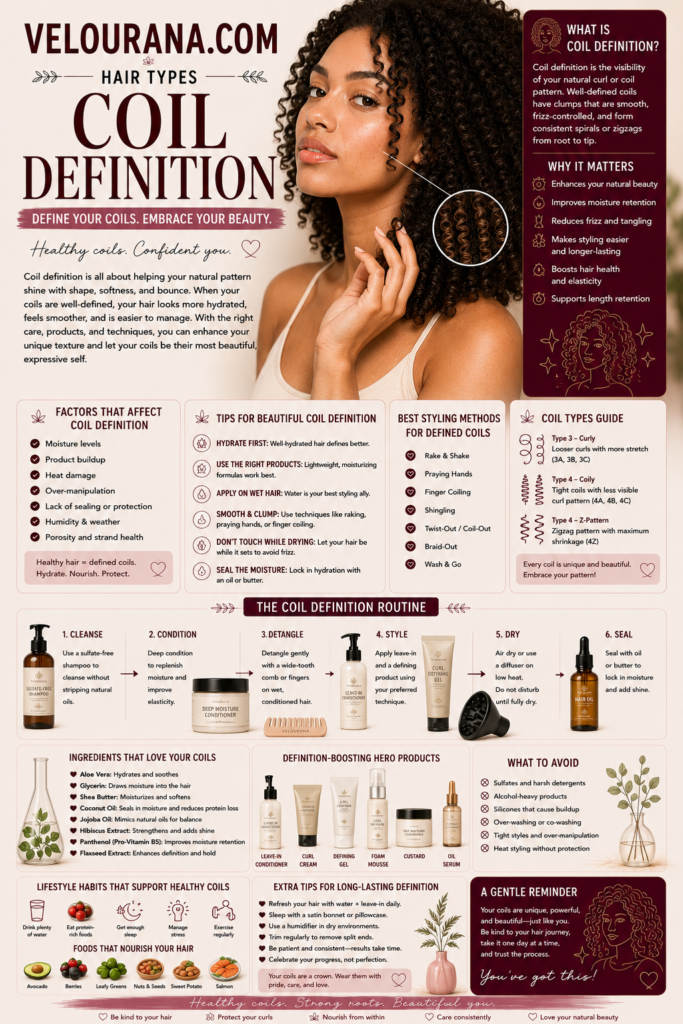
CATEGORY: Coil Definition
A coil can look almost architectural when it is freshly styled. Individual curves appear distinct, neighboring strands gather into recognizable formations, and the hair seems to possess an extraordinary level of order. Several hours or several days later, that precision may have softened. The roots have expanded. Some sections have merged while others have separated. A halo has appeared around the surface. What once looked like an intricate collection of tiny shapes has become fuller, less uniform, and perhaps considerably less defined.
It is tempting to describe this simply as definition being "lost." The phrase makes the change sound mysterious, as though definition were a temporary substance that somehow escaped from the hair.
What is actually happening is more interesting.
A defined coil is the visible result of many strands temporarily maintaining a particular relationship with one another. Water, conditioning, styling products, tension, drying, and handling help establish that relationship. Once the hair encounters humidity, friction, movement, compression, stretching, additional moisture, or simple passage of time, the arrangement begins to change.
This means that loss of definition is not one problem with one solution. A coil can become less distinct because its strands separated, because neighboring coils became entangled, because the styling film weakened, because the hair absorbed environmental moisture, because it was disturbed before it finished drying, or because its physical condition makes orderly grouping difficult.
Understanding those differences changes the entire approach to textured-hair styling. Instead of responding to every imperfect section with more product, it becomes possible to identify what actually disrupted the pattern.
The question is no longer merely how to make coils defined. It is how definition is preserved, why it changes, and when trying to preserve it becomes less useful than allowing the hair to evolve naturally.
A Defined Coil Is a Temporary Arrangement
The first important idea is that definition is not a permanent state of the hair.
The underlying texture is structural, but the polished appearance created on wash day is temporary. A group of strands may naturally share a similar curvature, yet they do not remain permanently attached to one another. Styling encourages them to align, while drying helps preserve that alignment for a period of time.
Imagine several extremely fine ribbons following similar curves. When they are wet, smoothed together, and allowed to dry in contact, they can appear almost like one larger ribbon. If those same ribbons are rubbed, compressed, pulled apart, or exposed to conditions that alter their shape, the collective form becomes less obvious.
Coily hair behaves far more intricately than ribbons, but the principle helps explain why definition changes.
The visible coil is often a collective structure.
This is why two styles created on the same head of hair can look dramatically different without any change to the underlying texture. One routine may produce substantial, smooth clumps. Another may separate the hair into hundreds of smaller formations. A third may deliberately break those formations apart to create volume.
Definition therefore depends partly on boundaries. The eye needs to be able to distinguish one group from another. When those boundaries become blurred by frizz, tangling, compression, or separation, definition appears reduced even though the individual hairs remain coily.
This also explains why the language of "training" hair into a permanent curl pattern can be misleading when used too broadly. Repeated styling may make a routine easier because technique improves, hair condition changes, or the stylist becomes better at recognizing natural groupings. But temporary styling does not simply rewrite the fundamental architecture of every strand.
The distinction matters because it creates realistic expectations.
A wash-day arrangement is designed to change.
The objective is not to prevent change indefinitely. It is to understand which changes are desirable, which are avoidable, and which indicate that the hair or routine deserves closer attention.
The First Hours Determine More Than They Seem
Many definition problems that become visible the following morning actually began while the hair was drying.
Wet coils are highly impressionable. They may look beautifully organized immediately after styling, but the arrangement has not yet become stable. Water is still evaporating, the hair is contracting, and any film created by the styling product is still developing.
Touching the hair repeatedly during this period can separate strands from their groups.
The effect may initially seem insignificant. A hand passes through the roots to create volume. A section is moved away from the face. The hair brushes repeatedly against clothing. A wet coil is pulled apart because it appears too large. Yet every disturbance changes the arrangement that will eventually dry into place.
The result becomes especially noticeable when different parts of the head dry at different speeds.
The outer layer may feel dry while dense interior sections remain damp. Someone may assume the style has finished setting and begin fluffing the roots, only to discover later that the underlying sections have expanded considerably.
Sleeping with partially wet coily hair can have an even greater effect. Instead of drying while suspended in the intended arrangement, coils are compressed against a pillow. Some flatten, others stretch, and neighboring damp sections can dry against one another.
The morning result may be blamed on the styling product when the product was never given a fair opportunity to perform.
Drying is therefore not passive waiting. It is the stage during which the wet arrangement becomes the dry hairstyle.
This does not mean that hair must remain completely motionless for hours. Practical life rarely allows that. It does mean that the more definition matters to the desired result, the more valuable controlled drying becomes.
A diffuser can shorten the vulnerable period. Air drying can work equally well when sufficient time is available. Some people combine the two, allowing the style to settle briefly before finishing with controlled airflow.
The exact method matters less than the principle: establish the pattern, then allow it to stabilize before deliberately disturbing it.
Friction Quietly Dismantles Definition
Friction is one of the least dramatic yet most persistent forces acting on defined coils.
Hair encounters fabric constantly. Pillowcases, scarves, hats, coat collars, sweaters, car headrests, upholstered furniture, and even other sections of hair create repeated contact. One instance may have little visible effect. Hundreds of small interactions accumulate.
Coily hair is particularly vulnerable to this type of disruption because individual strands repeatedly curve away from and back toward neighboring hairs. When surfaces rub against those curves, strands can be lifted away from their clumps.
This is one reason the back of a defined style may deteriorate more quickly than the front.
The front is visible and often handled deliberately. The back repeatedly touches chairs, pillows, clothing, and headrests without attracting the same attention. Someone may conclude that the texture at the back is inherently impossible to define when the actual difference is partly environmental.
Nighttime protection attempts to reduce this repeated friction.
Smooth sleep surfaces and suitable coverings can help preserve the organization created during styling, but they are not magical barriers. Hair can still be compressed, stretched, or displaced during sleep. A protective method that is too tight may preserve surface smoothness while altering the shape of the coils themselves.
Length changes the problem as well.
Short coily hair may remain relatively stationary during sleep but experience direct compression. Longer hair can move more freely and may become trapped beneath the shoulders or body. Very dense hair may need different arrangements from fine or lower-density hair.
Preservation therefore works best when it protects without excessively reorganizing the style.
The aim is not to package the hair so tightly that it cannot move. It is to reduce unnecessary rubbing and crushing while allowing the pattern to remain reasonably close to the shape established on wash day.
Humidity Changes the Relationship Between Hair and Style
A perfectly defined hairstyle created indoors does not exist independently of the atmosphere.
Hair interacts with environmental moisture. When humidity changes, the balance between the hair, the water already associated with it, and the surrounding air can change as well. Styling products may influence this interaction, but no cosmetic product can make hair completely independent of its environment.
This helps explain a familiar experience: a style looks exceptionally smooth before leaving home, then becomes progressively fuller outdoors.
The response is not identical for everyone.
Hair condition, porosity, product formulation, degree of damage, natural texture, and the difference between indoor and outdoor conditions all influence what happens. Some styles tolerate humid weather surprisingly well. Others expand rapidly.
The common interpretation is that humidity "caused frizz," but that description hides several processes.
Individual hairs may move away from established clumps. The shape of the strand may shift. Roots can expand. Previously smooth surfaces may become less uniform. In tightly packed hair, small changes across thousands of strands can transform the overall silhouette.
Trying to compensate with enormous quantities of product is not always successful.
More hold can sometimes improve resistance, but excessive application may leave the hair coated, heavy, flaky, or difficult to refresh. A stronger styling film can help preserve grouping, yet the hair remains a responsive biological fiber rather than a waterproof sculpture.
Climate-aware styling is therefore partly about expectation.
On a very humid day, the most practical goal may be controlled definition with room for expansion rather than an immovable finish. In dry conditions, the challenge may shift toward maintaining flexibility and avoiding a brittle or rough sensation.
A routine becomes more reliable when it is allowed to respond to weather instead of assuming that one exact product quantity and technique should behave identically throughout the year.
Product Hold Has a Life Cycle
Styling products are often judged at the moment they are applied, but hold reveals itself over time.
A product may create excellent initial clumping because it provides slip and allows the strands to align easily. Once dry, however, the style may begin separating quickly because the formulation offers relatively little lasting hold.
Another product may feel unimpressive during application but create a durable film as it dries. The coils may initially feel firm, then become softer with gentle movement while maintaining their structure for several days.
This difference is particularly important when comparing moisturizing stylers with products designed primarily for hold.
Softness and durability are related but not identical objectives.
A rich cream can make hair feel conditioned and supple while offering limited resistance to friction or humidity. A gel may provide stronger structural support but feel less emollient. Layering the two can work well when their formulations and quantities cooperate, but it is not automatically necessary.
The idea that every coily routine requires a leave-in, cream, oil, and gel can lead to unnecessary complexity.
Each additional layer changes how subsequent products contact the hair. Heavy layering may dilute hold, slow drying, encourage residue, or create combinations that flake after the hair is manipulated.
Conversely, using too little product can leave some sections without sufficient coverage to maintain the intended clumps.
The useful quantity is therefore not the largest or smallest possible amount. It is the amount that distributes adequately and produces the desired balance of flexibility, appearance, and longevity.
This balance can differ across the head.
Dense areas may require more careful distribution. Finer areas may become weighed down quickly. Sections exposed to greater friction may benefit from stronger hold. The perimeter may behave differently from the crown.
Learning this variation is more valuable than following a universal measurement.
A successful styling product should ultimately be judged by the entire cycle: application, drying, first-day appearance, overnight preservation, subsequent days, buildup, and eventual cleansing.
The first photograph tells only part of the story.
Buildup Can Disguise Itself as Dryness
When coils stop defining as easily as they once did, dryness is often the first explanation.
The natural response is to add more conditioning product, more oil, more cream, or more leave-in. Sometimes that is appropriate. At other times, the hair is already carrying too much material.
Buildup can be deceptive because coated hair does not necessarily feel obviously greasy.
It may feel dull, heavy, strangely rough, sticky, overly soft, or resistant to water. Products that once distributed smoothly may seem to sit on the surface. Coils may become less responsive during washing and less springy after styling.
Adding further layers can intensify these characteristics.
The distinction between dryness and accumulation cannot always be made by appearance alone. It requires observing how the hair behaves during cleansing and saturation.
Does water spread easily through the section? Does the hair feel clean after washing? Has the routine involved repeated applications of rich stylers without periodic thorough cleansing? Does definition improve unexpectedly after a more effective wash?
These clues can be more informative than the assumption that coily hair always needs more product.
Cleansing has sometimes been positioned as the enemy of textured hair because harsh washing can indeed leave hair unpleasantly stripped. But insufficient cleansing creates its own difficulties.
The goal is not maximum removal at every wash. It is appropriate removal.
A routine should cleanse the scalp and hair sufficiently for subsequent conditioning and styling to function predictably. How often stronger cleansing is needed depends on product use, scalp characteristics, lifestyle, water conditions, and individual response.
Definition often improves when the hair is neither stripped nor coated.
That middle ground may be less glamorous than an elaborate product ritual, but it is fundamental to consistent results.
Damage Alters the Way a Coil Expresses Itself
Sometimes a loss of definition is not primarily a styling problem.
Hair fibers accumulate wear. The oldest lengths have survived countless cycles of wetting, drying, detangling, sleeping, styling, environmental exposure, and friction. Chemical processing and excessive heat can add further stress.
As the fiber becomes weathered, its surface and mechanical behavior can change.
The practical result may be visible as ends that no longer gather smoothly, sections that remain unusually stretched, increased tangling, breakage, roughness, or inconsistent response to products.
No amount of gel can permanently reverse structural damage to a hair fiber.
Conditioning products can improve feel, reduce friction, temporarily smooth the surface, and make damaged hair easier to manage. Certain treatments may improve particular properties temporarily. But styling should not be confused with biological repair.
This is particularly important when one section of the head behaves very differently from the rest.
The cause is not automatically damage. Natural pattern variation is extremely common in coily hair. Areas may have different curl diameters, density, porosity, or growth directions.
The clue is change.
If a section that previously formed compact coils becomes persistently straighter or more fragile after repeated heat exposure or chemical treatment, the history matters. If the ends remain thin and diffuse regardless of styling technique, their physical condition deserves attention.
Trimming significantly compromised ends can sometimes make the overall pattern look dramatically more coherent, not because trimming changes the texture growing from the scalp, but because the most weathered portions are no longer interrupting the visual shape.
This reinforces a central principle: definition reflects both styling and condition.
When the structure itself has changed, the solution cannot be found entirely in technique.
Over-Manipulation Can Destroy the Result It Tries to Perfect
Coily hair invites close attention because every section can appear different.
One coil seems too large, so it is divided. Another looks irregular, so it is recoiled. A root appears flat, so it is lifted. A section begins to frizz, so more product is smoothed over it. Then another section no longer matches.
A styling session can gradually become an attempt to correct the hair into uniformity.
The paradox is that repeated correction often creates the very loss of definition it is intended to prevent.
Every time a dried or partially dried clump is pulled apart, individual strands are given another opportunity to separate. Every additional pass with a tool introduces friction and tension. Every application of wet product to a nearly dry section changes its state relative to the surrounding hair.
There is a point at which intervention stops improving the style.
Recognizing that point is a skill.
It requires accepting that different sections may dry differently. One side may contain smaller coils. The crown may naturally produce more volume. The hairline may be softer. A few strands may refuse to participate in any obvious clump.
Leaving these variations alone can produce a more harmonious overall result than repeatedly attempting to correct them.
This is particularly relevant after the hair is dry.
Fluffing can create beautiful volume, but it intentionally reduces some definition. Separating coils can increase fullness, but every separation changes the boundaries established during styling. Picking the roots can improve shape while also disturbing the lower portions if the tool is pulled too far through the hair.
These are not mistakes when performed deliberately.
They become problematic only when someone expects to gain maximum volume without surrendering any definition.
Styling involves choices.
Once those tradeoffs are understood, manipulation becomes purposeful rather than corrective.
Refreshing Can Rescue a Style—or Exhaust It
The idea of refreshing seems straightforward: restore definition without repeating the entire wash-day process.
In practice, refreshing is one of the easiest stages to overcomplicate.
A few flattened coils do not necessarily require the entire head to be sprayed, coated, brushed, and dried again. Doing so may temporarily recreate first-day definition, but repeated cycles of partial wetting and additional product can gradually make the hair feel coated and inconsistent.
Targeted refreshing is often more efficient.
A small section that has lost its shape can be dampened sufficiently for the strands to reorganize, then given a modest amount of compatible product if necessary. The section can be allowed to dry while the remainder of the style stays intact.
The amount of water matters.
A superficial mist may create surface frizz without making the section wet enough to reform. Thoroughly wetting a small problematic area can sometimes be more effective than lightly misting the entire head.
But not every change needs refreshing.
Expanded roots may simply represent the natural progression of the hairstyle. Slightly separated coils can contribute attractive volume. A style that has become softer and larger may still be functioning perfectly well even though it no longer resembles wash day.
There is also a point when refreshing becomes inefficient.
If large portions of the hair are tangled, heavily coated, uncomfortable at the scalp, or difficult to reshape, another layer of product may postpone rather than solve the problem. Cleansing and resetting may be the more effective choice.
A sustainable routine therefore includes knowing when not to rescue a style.
Longevity is valuable, but extending a hairstyle indefinitely is not necessarily better hair care.
Root Expansion Changes the Silhouette Before the Coils Disappear
One of the reasons definition can appear to deteriorate dramatically is that the eye judges the hairstyle as a whole.
The individual coils may remain relatively intact while the roots expand. Because the overall silhouette becomes larger and less controlled, the style can seem far less defined even though most of the lengths still possess clear pattern.
Root expansion occurs for several reasons.
The root area is influenced by new growth, scalp movement, natural oils, sweat, sleeping, and the weight and direction of the surrounding hair. It is also difficult to coat every root strand with the same precision as the lengths without placing considerable product near the scalp.
For many coily styles, some root expansion is therefore inevitable.
It can also be desirable.
Perfectly compact roots may produce strong pattern visibility but reduce fullness. Expanded roots create lift and can transform a tightly set style into a more dramatic shape.
This is why definition and volume should not be treated as opposites in a simplistic way. They exist in a changing balance.
The lengths can remain strongly defined while the roots become airy. Individual coils can be separated selectively while their shape remains recognizable. A style can become significantly larger without becoming shapeless.
Learning to evaluate the silhouette rather than inspecting every strand often produces a more realistic understanding of how well the style is actually lasting.
The Ends Reveal Problems First
When definition begins to deteriorate, the ends frequently show it before the rest of the hair.
This is not surprising. They are the oldest part of every strand.
Ends experience repeated friction against clothing and other hairs. They are manipulated during detangling, exposed during styling, and often receive less natural lubrication than areas closer to the scalp. Over time, cumulative wear can make them less smooth and more prone to tangling.
A defined coil with a rough, separated end looks less polished even when the majority of the strand remains beautifully organized.
This can lead to an endless attempt to smooth the tips with additional product.
Sometimes temporary smoothing is enough. At other times, persistent knotting, splitting, or severe weathering indicates that the problem is physical rather than cosmetic.
Maintaining the ends is therefore part of maintaining definition.
Gentle detangling, reducing unnecessary friction, avoiding excessive mechanical stress, and trimming when appropriate can influence the appearance of the entire hairstyle.
There is also an aesthetic dimension.
Freshly maintained ends can make coil groups appear more intentional because their boundaries remain clear from root or mid-length through the tip. When many ends split into tiny irregular branches, the eye reads the entire section as less defined.
The ends may occupy only a small percentage of total length, but visually they complete the shape.
Density Can Be Mistaken for Poor Definition
Dense coily hair contains a great deal of visual information.
Hundreds or thousands of small formations overlap. Coils sit behind other coils. Shadows create depth. Roots may be difficult to see. Even highly organized hair can therefore appear less individually defined than lower-density hair photographed under the same conditions.
This is not necessarily a styling deficiency.
Definition becomes harder to perceive when many structures occupy the same visual space.
Sectioning can help during application because it ensures that water and styling product reach interior areas rather than coating only the surface. Yet making sections excessively small can turn a routine into an unnecessarily long process.
The appropriate section size is the largest size that still permits adequate saturation, detangling, and distribution.
This varies substantially.
Very dense hair may require deliberate access to interior sections. Lower-density hair may become overworked if divided too finely. Fine strands can be overwhelmed by product quantities that thicker strands tolerate easily.
This is another reason copying routines by hair type alone often disappoints.
Two people may possess similarly shaped coils but radically different density. Their finished styles will not necessarily look alike, and their product requirements may differ considerably.
The visible pattern must always be interpreted within the architecture of the entire head.
When More Hold Is Useful—and When It Is Not
If a style consistently loses definition much sooner than desired, increasing hold is a reasonable experiment.
But hold should solve a hold problem.
If definition disappears because the hair was manipulated while wet, stronger gel may not address the primary cause. If buildup prevents even distribution, adding a heavier styler may make matters worse. If damaged ends refuse to group, coating them more aggressively may only disguise the problem temporarily.
Stronger hold is most useful when the hair forms the desired pattern successfully but cannot preserve it long enough.
In that situation, a product capable of forming a more durable film may improve longevity. The difference can be especially noticeable in weather, during sleep, or on hair that naturally expands quickly.
Even then, application matters.
A strong-hold formula distributed unevenly can create rigid patches beside barely coated sections. Sufficient water and deliberate distribution help ensure that hold supports the entire clump rather than sitting unpredictably on its surface.
Once dry, some strong stylers leave a noticeable cast. That temporary firmness can protect the pattern during the vulnerable drying stage. Softening the cast after complete drying can restore movement without necessarily destroying the organization beneath it.
The desired result should determine how far this process goes.
Someone seeking several days of highly visible definition may preserve more of the cast initially. Someone who values immediate softness and volume may break it more thoroughly.
Again, there is no single ideal finish.
There is only the relationship between the style someone wants and the amount of structure required to maintain it.
The Difference Between Lost Definition and an Evolving Style
Perhaps the most important change in understanding coil definition is recognizing that not every transformation represents deterioration.
First-day coils often have the strongest separation and the least volume. By the second day, roots may lift. By the third, individual groups may divide into smaller formations. Later, the style may become expansive, soft, and increasingly textured.
This progression can be beautiful.
If every stage after wash day is evaluated against the first hour of styling, the hair will always appear to be moving away from success.
But textured hair is not static.
The more useful measure is whether the hairstyle remains manageable, comfortable, visually satisfying, and compatible with the person's routine.
Definition can gradually become volume.
A tightly controlled set can evolve into a softer silhouette. Individual coils can remain visible inside a larger mass of texture. Eventually, the arrangement may become too tangled or inconsistent to continue comfortably, and the cycle begins again with cleansing.
Seen this way, wash day is not the creation of a perfect state that must be defended at all costs.
It is the beginning of a hairstyle's life cycle.
Definition Lasts Longer When the Routine Solves the Right Problem
When coils repeatedly lose definition, the most productive response is diagnosis rather than escalation.
If the pattern disappears during drying, examine drying.
If it looks excellent until bedtime, examine nighttime friction and compression.
If humid weather transforms it rapidly, consider environmental response and the level of hold.
If the hair feels coated and products no longer behave predictably, consider cleansing and accumulation.
If the ends remain diffuse regardless of technique, examine their condition.
If definition survives but the roots expand, decide whether the issue is truly loss of pattern or simply a change in silhouette.
If the entire routine requires constant correction, consider whether the desired standard is unnecessarily rigid.
These distinctions prevent the common cycle in which every difficulty leads to another purchase.
Coily hair does not necessarily need more products when something changes. Often it needs a clearer interpretation of what is happening.
Definition is created through cooperation between the strand's natural architecture and a temporary styling arrangement. That arrangement is influenced by water, conditioning, product films, drying, weather, friction, manipulation, and time. Once these forces are understood, the apparent unpredictability of coily hair becomes considerably more logical.
Some definition will always change.
That is not a flaw in the hair and not automatically a failure of the routine.
The real skill lies in preserving the aspects of the style that matter while allowing enough flexibility for the hair to remain what it is: a living-looking, responsive arrangement of thousands of individual fibers rather than a fixed pattern.
A defined coil does not have to remain untouched to remain beautiful.
Sometimes its gradual expansion is not the end of the style at all.
It is simply its next form.
The End Velourana
 Discover More From Our Family of Websites
 ZodiacBearing (Astrology, Tarot, Numerology, Angel Numbers & Spiritual Guidance)
 Velourana (Beauty, Makeup, Hair Care, Skincare & Beauty Tips)
 HavenBearing (Home, Living, Organization, Décor & Everyday Inspiration)
 PawBearing (Pet Care, Dog Breeds, Animal Health, Training & Pet Products)
 PsyCatherine (Notes From the Journal of a Psychologist on Real Life)

