CATEGORY: Coil Definition
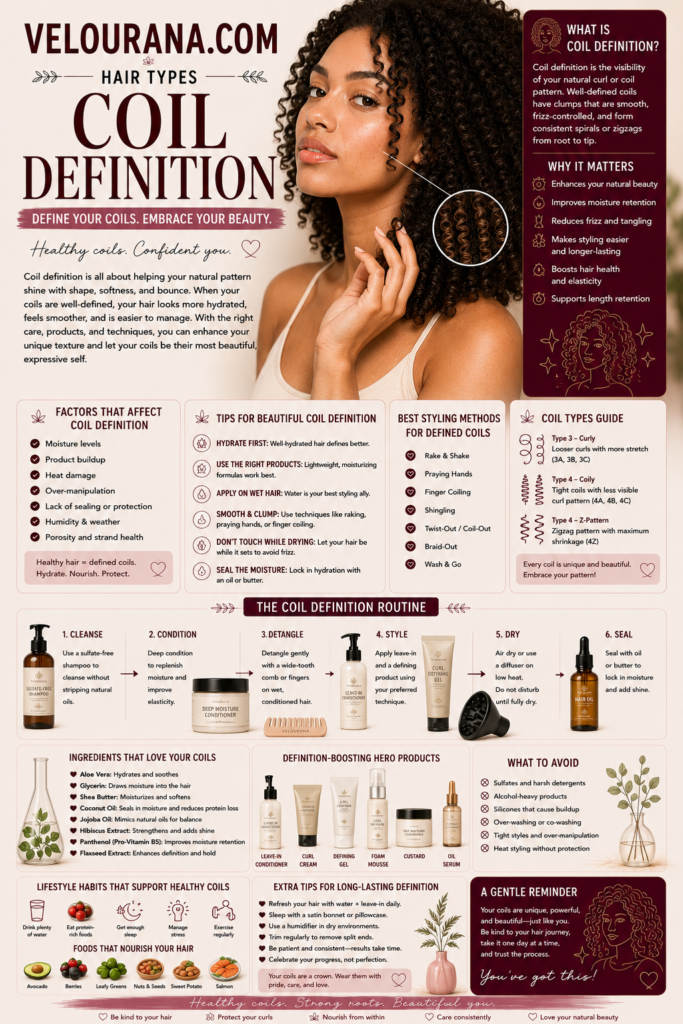
Coil definition is often discussed as though it were something applied to the hair: a finish created by the right cream, a styling technique mastered through repetition, or a polished effect that appears when every strand finally behaves. Yet defined coils are not manufactured by styling. They are revealed by it.
Coily hair already possesses an intricate architecture. Its bends, turns, spirals, loops, angles, and variations exist before a styling product ever touches the strand. What changes from one wash day to another is how clearly that architecture can be seen. Hydration influences flexibility. Condition affects surface smoothness. Product distribution changes the way neighboring strands gather. Drying determines whether those groups remain intact or separate into softness and volume. Manipulation can preserve definition or gradually dismantle it.
This distinction matters because the pursuit of coil definition can otherwise become an exhausting attempt to force hair into a visual standard it may not naturally produce. Some coils form tiny, unmistakable rings. Others create compact zigzags, elongated curves, irregular spirals, or densely interlocking patterns. One head of hair may contain several of these structures simultaneously. Definition therefore does not mean making every section identical. It means allowing the hair's own pattern to become legible while preserving the qualities that make coily hair resilient, expressive, and individual.
Understanding coil definition begins not with styling tricks, but with the relationship between structure, water, condition, technique, and expectation.
Definition Begins With the Natural Geometry of the Hair
Coily hair changes direction repeatedly along the length of each strand. Depending on the individual, those directional changes may appear rounded, angular, extremely compact, relatively open, or almost invisible until the hair is wet or deliberately grouped. This geometry is responsible for much of the extraordinary visual character of coily hair, but it also influences how the hair behaves during cleansing, conditioning, styling, and drying.
A straighter strand allows light, natural oils, water, and products to travel along a comparatively direct surface. A tightly coiled strand presents a more complex route. Every bend changes orientation. Neighboring strands may cross one another repeatedly, while sections of hair can contract dramatically as they dry.
This helps explain why definition cannot be separated from condition. A coil is easier to perceive when its surface is sufficiently smooth and flexible for neighboring strands to align into coherent groups. When the hair is excessively dry, tangled, damaged, coated with residue, or repeatedly disturbed, those groups become less orderly. The underlying pattern has not necessarily disappeared; its visual clarity has changed.
There is also considerable variation within coily textures. Hair typing systems can provide useful vocabulary, but they cannot describe every structural characteristic that determines styling behavior. Two people assigned the same broad hair type may experience completely different levels of shrinkage, density, porosity, strand thickness, weather response, and natural clumping.
For that reason, successful definition depends less on reproducing someone else's routine than on learning what allows a particular head of hair to organize itself.
The goal is not geometric perfection. It is structural cooperation.
Why Water Changes Everything
Few moments reveal the behavior of coily hair as clearly as saturation.
When water thoroughly enters and surrounds the hair, strands become heavier and more flexible. Temporary interactions within the fiber shift, compact sections may elongate, and individual coils often become easier to distinguish. Hair that looked cloudlike or densely compressed before washing may suddenly display an elaborate network of curves.
This wet state offers valuable information.
It shows how the hair naturally wants to gather. Some sections immediately form substantial clumps. Others separate into very small coils. Certain areas may appear looser, tighter, more irregular, or more resistant to grouping. Rather than treating these differences as problems, they can be read as a map of the hair itself.
Water, however, is not the same thing as lasting hydration.
Hair can be thoroughly wet and still feel rough after drying. Likewise, repeatedly spraying dry hair with water does not automatically solve every problem associated with dryness or poor definition. The important issue is how cleansing, conditioning, styling products, environmental conditions, and drying interact with the strand.
During styling, sufficient water can make distribution dramatically easier. A small amount of product spread through properly wet hair may coat strands more evenly than a much larger quantity applied to hair that has already begun to dry.
This is one reason definition sometimes deteriorates while styling is still taking place. The first section is treated while saturated, but subsequent sections gradually lose water. The same product is then applied under different conditions and behaves differently.
Rewetting sections when necessary is not merely a convenience. It helps maintain consistency.
Yet more water is not always better indefinitely. Some styling formulations perform beautifully on soaking-wet hair, while others gain stronger hold when excess water has first been removed. Learning the correct water-to-product balance is therefore part of understanding the individual hair rather than following an absolute rule.
The most useful question is not simply whether the hair is wet. It is whether it is wet enough for the chosen styling method to work as intended.
Condition Determines How Clearly Coils Can Organize
Definition is a visual result, but much of the work behind it happens before styling.
Cleansing removes material that may interfere with the way strands interact. Conditioning improves manageability and helps reduce friction. Detangling allows sections to move without being trapped within unnecessary knots. These stages establish the environment in which definition will later form.
When buildup accumulates, the hair may behave unpredictably. Styling products can sit on top of older films rather than distributing evenly. Water may appear to bead or disappear unevenly. Sections that normally clump can become dull, sticky, limp, or strangely resistant.
The instinctive response is often to add more styling product.
That can intensify the problem.
Coily hair frequently benefits from rich formulations, but richness and accumulation are not the same thing. A product can be useful when applied appropriately and troublesome when repeatedly layered without sufficient cleansing. Definition requires enough conditioning and lubrication to support flexibility without so much residue that the hair loses responsiveness.
The condition of the ends is particularly important. Ends are the oldest portion of the hair and have experienced the greatest cumulative exposure to washing, manipulation, friction, weather, and styling. When they become significantly weathered or split, a coil may appear smooth near the root but diffuse toward the tip.
No styling technique can permanently reconstruct a split strand.
Regular attention to damaged ends can therefore improve the overall appearance of definition even when the coil pattern itself has not changed.
The deeper principle is that styling cannot be completely separated from hair care. Definition is easiest to create when the strand is being asked to display its natural structure rather than conceal accumulated stress.
Clumping Is the Visual Language of Definition
A defined hairstyle is rarely a display of thousands of completely isolated strands. What the eye interprets as a coil is usually a small group of strands behaving as a unit.
This phenomenon is commonly described as clumping.
When neighboring hairs align and follow similar curves, the collective shape becomes visually distinct. Light reflects from the grouped surface differently, the boundaries between coils become clearer, and the overall pattern appears more deliberate.
The size of these groups strongly influences the finished result.
Larger clumps can create a smoother, more substantial pattern and may visually reduce overall volume. Smaller groups can produce greater intricacy and fullness but require more separation. Neither result is inherently more defined. They represent different interpretations of the same underlying texture.
Product application techniques influence clump size because they determine how much neighboring strands remain together.
Smoothing sections between the palms may encourage broader alignment. Working product through with the fingers can create more separation. Brushing or combing during styling can temporarily organize strands into highly regular groups, depending on the tool, tension, section size, and natural pattern.
But the technique should serve the hair rather than dominate it.
If repeated brushing separates naturally established groups only to reconstruct artificial ones, the process may become unnecessarily complicated. Conversely, hair that tends to form uneven or tangled clusters may respond beautifully to deliberate distribution with a suitable styling tool.
Observation is more useful than allegiance to one method.
The important moment occurs when the wet hair begins to show coherent shapes. Once desirable clumps have formed, excessive handling often becomes counterproductive. Continually touching, combing, separating, or rearranging them can undo the organization that styling was intended to create.
At a certain point, definition requires restraint.
The Relationship Between Moisture and Hold
One of the central challenges in defining coily hair is balancing softness with structural persistence.
A moisturizing or conditioning styler may leave the hair flexible and pleasant to touch but provide insufficient support to preserve the wet pattern through drying, sleeping, weather, and ordinary movement. A strong-hold product may maintain impressive separation but feel too rigid when used excessively or on hair that has not been adequately conditioned.
These are not opposing philosophies. They are different functions.
Products commonly described as creams, milks, lotions, custards, mousses, gels, and jellies vary enormously within their categories, so the label alone cannot predict performance. What matters is the formulation and how it interacts with the individual hair.
For some people, one well-formulated gel over conditioned hair provides everything necessary. Others prefer a lighter leave-in followed by hold. Dense or extremely dry-feeling hair may respond well to a cream beneath a compatible styler. Fine coily hair may lose movement when several rich layers are applied.
Compatibility also matters.
Layering multiple products can occasionally produce residue, flaking, tackiness, or small visible particles when formulations do not interact well. More layers do not automatically create more hydration or stronger definition.
The most effective routine is often simpler than expected.
A useful way to evaluate a product is to look beyond the first hour after styling. Does the hair remain flexible? Does definition survive overnight? Does residue appear? Does the scalp feel comfortable? Does the hair become progressively coated after repeated use? How does it respond when refreshed?
A product that creates spectacular wet definition but poor longevity may not be the best choice for someone who wants a style to last several days.
Definition should be evaluated across the life of the hairstyle, not only in the mirror immediately after application.
Technique Changes the Pattern We See
Styling technique can reveal natural texture, exaggerate particular aspects of it, or create a more deliberately organized pattern.
For relatively effortless definition, product may simply be distributed through wet sections while allowing the hair's existing clumps to remain intact. Gentle smoothing and controlled scrunching can reinforce what is already present without significantly restructuring it.
More deliberate techniques alter the presentation.
Finger coiling wraps small sections around the finger, encouraging them into a clearly recognizable spiral. The finished appearance can be exceptionally polished, particularly in areas where the natural pattern is irregular. Yet finger coils are partly constructed. They should not be treated as proof of what untreated hair is supposed to look like.
Brush styling can also produce striking definition. The interaction between tension, product, water, and the tool can separate the hair into organized ribbons that recoil after release. Results vary according to section size and brush design, but also according to the natural tendency of the strands to remain grouped.
Other techniques rely on twisting, shingling, raking, praying-hands motions, or combinations of these movements.
The terminology can make coil definition sound technically intimidating. In reality, most methods manipulate three variables: distribution, grouping, and tension.
Distribution determines whether water and product reach the section evenly.
Grouping determines which strands dry together.
Tension temporarily elongates and organizes the strand before it contracts.
Understanding those principles makes it easier to adapt techniques instead of memorizing routines.
It also prevents a common misconception: that a more labor-intensive method must necessarily produce a better result. A forty-minute technique is not superior to a ten-minute technique when both produce the desired appearance and longevity.
Efficiency is part of a sustainable hair routine.
Shrinkage Is Not the Enemy of Definition
Shrinkage is one of the most characteristic behaviors of coily hair, yet it is frequently treated as a defect to overcome.
As wet coils dry, they return toward their natural compact configuration. Depending on the pattern, the visible length can decrease dramatically. A strand that stretches far beyond the shoulder may appear several inches shorter once fully dry.
This contraction is not evidence that styling has failed.
In many cases, strong shrinkage accompanies a clearly expressed coil pattern. The same geometry that produces dramatic curves also allows the strand to occupy less vertical space.
Problems arise when length becomes the primary standard against which definition is judged. The hair is then repeatedly stretched, pulled, brushed, heated, or manipulated to make it appear longer, while simultaneously being expected to retain compact, pristine coils.
Those goals can conflict.
There are ways to influence the balance. Larger clumps may create a slightly heavier, more elongated appearance. Product weight can affect contraction. Drying the roots in a stretched position may increase visible length. Gentle stretching after the hair is completely dry can alter the silhouette while preserving some pattern.
But every intervention involves a tradeoff.
The more a coil is elongated, the less compact its original shape may appear. The more it is separated, the more volume increases while highly polished clumping decreases.
Neither direction is wrong.
The important shift is to stop interpreting maximum shrinkage, maximum elongation, maximum volume, and maximum definition as objectives that must all be achieved simultaneously.
Coily hair is dynamic. Styling is partly the art of deciding which qualities to emphasize on a particular day.
Drying Is Part of Styling, Not What Happens After It
A beautifully defined wet set can change dramatically during drying.
At the moment styling is complete, the arrangement of the hair is still fragile. Water provides weight, strands are temporarily elongated, and styling products have not necessarily formed their final film or structure. The drying stage determines how much of that arrangement survives.
Air drying requires minimal equipment but can take considerable time in dense coily hair. During that period, touching, leaning against furniture, putting on clothing, going outdoors, or manipulating the roots can disturb sections before they are stable.
Diffusing can accelerate drying, but technique matters. Strong airflow directed chaotically through wet coils can separate clumps and create surface frizz. Controlled airflow and limited disturbance generally preserve the wet arrangement more effectively.
Heat level deserves attention as well. The objective is efficient drying, not exposing the hair or scalp to unnecessary heat.
Whatever method is chosen, allowing the hair to become genuinely dry before significant manipulation is one of the simplest ways to protect definition.
This is particularly important when a gel forms a temporary firm cast.
That cast can make the hair feel hard or unusually structured while drying. Once completely dry, gentle compression or movement may soften the cast while leaving the organized pattern beneath it intact. Breaking it prematurely can reduce longevity because the film has not finished setting.
Roots deserve separate consideration. Dense hair can feel dry at the surface while remaining damp close to the scalp. Manipulating or sleeping on it at this stage can flatten sections and disrupt definition.
Patience during drying may contribute more to the final result than another layer of styling product.
Frizz Is Not the Opposite of Healthy Hair
Few words in textured-hair styling carry as much emotional weight as frizz.
It is often described as evidence of failure: proof that the wrong product was chosen, that moisture is missing, or that the technique was imperfect. Yet some degree of separation and halo texture is entirely normal, particularly in dense, tightly coiled hair.
Not every strand will remain inside a perfectly organized clump.
Humidity can influence the interactions between hair and the surrounding environment. Friction can separate strands. New growth and shorter hairs may sit outside larger groups. Natural differences in pattern can create areas that appear less uniform.
The pursuit of absolutely frizz-free hair can therefore become disproportionate to the problem.
It may encourage excessive product use, repeated brushing, constant touching, or frequent restyling. Ironically, the attempt to eliminate every irregular strand can create more manipulation and potentially more breakage.
A more useful distinction is between normal texture and a meaningful change in hair behavior.
If hair that usually styles easily suddenly becomes unusually rough, tangled, brittle, coated, or difficult to manage, it is worth examining the routine. Cleansing frequency, product buildup, environmental exposure, mechanical damage, chemical processing, and general condition may all be relevant.
But a soft halo around otherwise healthy, defined coils is not automatically a warning sign.
Definition exists on a spectrum.
A style can be highly defined and still possess volume, softness, movement, and visible texture. Indeed, those qualities often prevent defined coily hair from looking rigid or artificially arranged.
Definition Does Not Need to Begin at the Root
One of the most persistent expectations surrounding coil definition is that every centimeter of hair should display an identical pattern from scalp to ends.
Real hair rarely behaves this way.
At the root, gravity, density, growth direction, scalp oils, section placement, and the weight of surrounding hair can influence how the pattern appears. Some people naturally have visibly defined roots. Others have roots that look comparatively soft or expanded before the coil becomes obvious farther down the strand.
Trying to force extreme root definition can reduce volume considerably.
Heavy product applied directly near the scalp may also create buildup or discomfort for some people. Aggressive brushing at the root can introduce unnecessary tension, particularly when repeated frequently.
The desired silhouette should determine how much root organization is useful.
For a sleek, highly controlled finish, greater root definition may be appropriate. For a fuller shape, allowing some expansion near the scalp can create balance while the lengths remain distinctly coiled.
This demonstrates an important truth about textured-hair aesthetics: definition is not merely a technical achievement. It is a design choice.
The same head of hair can be styled into compact coils with controlled roots one week and expansive, separated texture the next. Neither presentation reveals the hair more authentically than the other.
Both are expressions of the same structure.
Preserving Definition Beyond Wash Day
The true test of a definition routine often begins after the first day.
Freshly styled coils may look exceptional, but a routine that requires complete washing and restyling every morning can quickly become impractical. Preservation therefore matters both aesthetically and mechanically.
During sleep, hair encounters pressure and friction. Coils can become compressed against the pillow, particularly around the back and sides of the head. Protective nighttime arrangements attempt to reduce that disruption without excessively stretching or tangling the hair.
The best method depends strongly on length and density.
Some hair can be loosely gathered upward. Shorter coils may be better left relatively undisturbed beneath a smooth covering. Very dense hair may require several loose sections rather than one large arrangement.
The objective is not to freeze the hairstyle in exactly the same configuration. That is unrealistic. Instead, preservation reduces unnecessary disturbance so that only limited adjustment is needed the following day.
Morning refreshing should also be proportional to the problem.
If only a few coils have lost shape, saturating the entire head may be unnecessary. Individual sections can sometimes be lightly dampened and reorganized. If the whole style has expanded but remains attractive, embracing greater volume may be preferable to reconstructing first-day definition.
Repeatedly adding product deserves caution. Layering more cream or gel every morning can gradually create buildup, particularly when the original application was generous.
Often the most effective refresh is less intervention, not more.
As the days pass, definition naturally changes. Coils separate, roots expand, and the silhouette becomes fuller. This evolution need not be treated as decline. Many people prefer second- or third-day hair precisely because the initial polish relaxes into greater volume and movement.
A durable routine allows the hairstyle to evolve gracefully instead of demanding that it remain visually frozen.
When Definition Suddenly Becomes Difficult
Hair routines are not static because hair itself is not static.
A technique that worked reliably for months can begin producing different results. Products may appear less effective. Sections may refuse to clump. Drying may take longer. Ends may look diffuse. The immediate temptation is to search for a new styling product, but the cause may lie elsewhere.
Buildup is one possibility, particularly when multiple conditioning and styling layers are used regularly. A more thorough cleansing routine may restore responsiveness when the hair feels coated.
Changes in length can also alter behavior. As coily hair grows, additional weight may stretch some sections while increasing tangling in others. A styling method suited to short hair may become cumbersome on longer hair.
Damage can affect pattern expression. Repeated high heat, aggressive manipulation, certain chemical processes, and cumulative weathering may reduce the strand's ability to behave as it once did. If particular sections remain unusually straight, fragile, rough, or prone to breaking despite changes in routine, cosmetic styling alone may not resolve the underlying issue.
Environmental conditions matter too. A routine perfected during a dry season may perform differently in humid weather. Water quality and travel can change the way hair feels. Even a reformulated product can alter results without an obvious change in technique.
This is why troubleshooting works best when approached methodically.
Changing five products and three techniques simultaneously makes it almost impossible to identify what mattered. Altering one meaningful variable at a time creates clearer information.
Coily hair responds to patterns of care, not isolated miracles.
The Psychological Trap of Perfect Definition
The visual culture surrounding textured hair has transformed enormously, bringing greater visibility to coils that were historically pressured toward straightening or concealment. Yet a new standard can emerge even inside a movement intended to celebrate natural texture.
The perfectly defined coil can become its own form of expectation.
Online images frequently show hair immediately after styling, under favorable lighting, from selected angles, after substantial preparation. The viewer sees the finished frame rather than the entire process or the ordinary evolution of the style.
This can subtly redefine what "natural hair" is supposed to look like.
But naturally coily hair does not remain permanently arranged into thousands of identical, glossy spirals. It moves. It contracts. It expands. Individual strands escape groups. Weather affects it. Sleep changes it. Different regions behave differently.
Definition is one aesthetic possibility within that reality.
It can be satisfying because it highlights pattern and creates visual structure. It can make detangling and section management easier for some routines. It can provide a predictable foundation for several days of styling.
It should not become a measure of whether coily hair is properly maintained.
Healthy-looking hair may be worn defined, stretched, twisted, braided, picked out, softly separated, or allowed to form a voluminous cloud. The visual presence of individual coils is not a health score.
This distinction can make styling considerably more enjoyable.
Instead of asking, "How do I make my hair perfectly defined?" the more useful question becomes, "How much definition do I want, and what am I willing to do to maintain it?"
That question leaves room for personal preference.
Learning the Hair Instead of Fighting It
The most sophisticated coil-definition routine is not necessarily the one containing the greatest number of products, tools, or techniques. It is the one built around accurate observation.
Notice what the hair does when fully saturated.
Notice which sections clump without encouragement and which require more deliberate organization. Notice whether the hair responds better to styling while soaking wet or merely damp. Observe how much product produces flexibility without residue, how long drying actually takes, and what the style looks like several days later rather than only immediately after completion.
Over time, these observations create something more valuable than a universal formula: familiarity.
That familiarity makes it possible to distinguish between a genuine problem and ordinary variation. It becomes easier to recognize when the hair needs cleansing rather than another moisturizer, when a section needs water rather than more gel, when an imperfect coil can simply be left alone, and when a style has reached the end of its useful life.
Coily hair often appears complex because its visual behavior is extraordinarily rich. Yet the principles behind definition are surprisingly coherent.
Water allows the pattern to reveal itself. Conditioning and careful handling support flexibility. Styling determines how strands group. Hold preserves those groups. Drying stabilizes them. Time gradually loosens the arrangement.
Everything else is refinement.
The most compelling definition does not erase the irregularity of coily hair. It makes that irregularity intelligible. Tiny spirals can coexist with angular bends. Compact sections can sit beside looser ones. Roots can remain expansive while lengths form intricate patterns. A little frizz can surround beautifully organized coils without diminishing them.
Once definition is understood in this way, the objective changes.
The hair no longer needs to be disciplined into proof that a routine has succeeded. Styling becomes a collaboration with an architecture that was already present.
And perhaps that is the most useful definition of coil definition itself: not the creation of perfect coils, but the careful revelation of the ones the hair was designed to make.
The End Velourana
 Discover More From Our Family of Websites
 ZodiacBearing (Astrology, Tarot, Numerology, Angel Numbers & Spiritual Guidance)
 Velourana (Beauty, Makeup, Hair Care, Skincare & Beauty Tips)
 HavenBearing (Home, Living, Organization, Décor & Everyday Inspiration)
 PawBearing (Pet Care, Dog Breeds, Animal Health, Training & Pet Products)
 PsyCatherine (Notes From the Journal of a Psychologist on Real Life)