
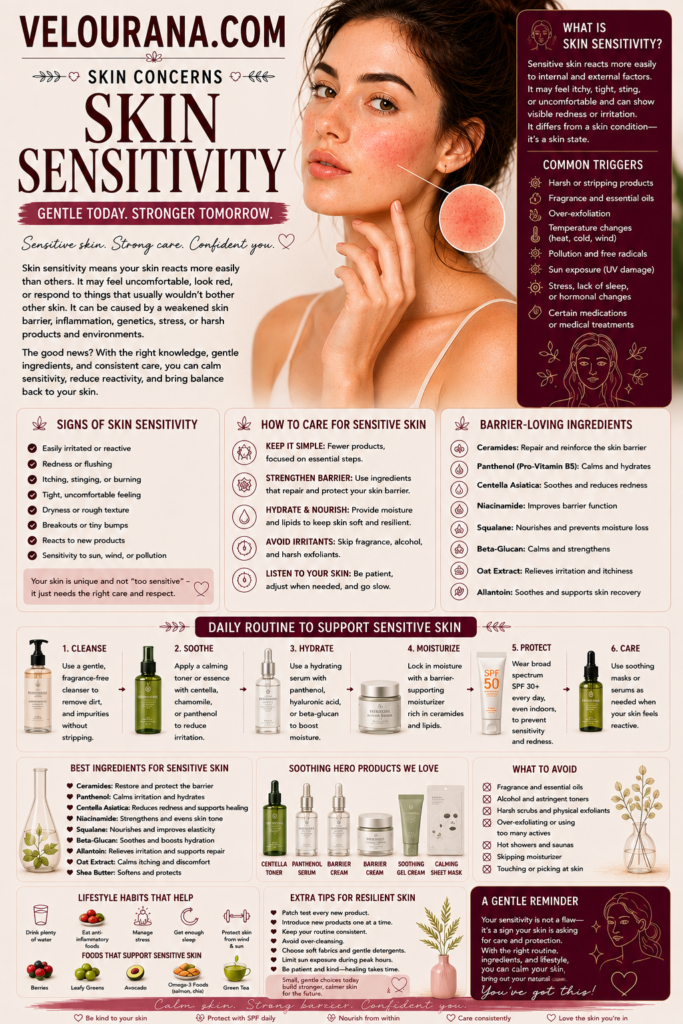
CATEGORY: Skin Sensitivity
Sensitive skin can change the relationship a person has with their face. What begins as an occasional sting after cleansing or a flush during cold weather can gradually become a state of constant observation. Every new product is approached cautiously. Every patch of redness is examined. A slightly warm cheek becomes evidence that something may be wrong. The skincare routine, once ordinary or enjoyable, begins to feel like a continuous negotiation.
This vigilance is understandable. Unpredictability encourages control, and skincare offers countless ways to attempt it. There are products for strengthening the barrier, reducing redness, soothing irritation, restoring hydration and improving resilience. There are routines designed around recovery, ingredients promoted for calming and increasingly detailed rules about what sensitive skin should never encounter.
Yet a strange thing can happen when sensitivity becomes the organising principle of an entire routine: the effort to protect the skin can make it impossible to discover what the skin actually tolerates.
Products are removed before their effects can be understood. Others are added immediately after a minor reaction. Routines change every few days. Normal physiological flushing is interpreted as damage. Temporary dryness becomes a reason to rebuild the entire skincare system.
The path toward calmer skin often requires something more subtle than constant correction. It requires learning to distinguish genuine warning signals from ordinary variation, creating enough stability to observe patterns and allowing the skin to demonstrate its own capacity for recovery.
Sensitive skin needs respect.
It does not always need fear.
Sensitivity Does Not Mean Fragility
The language surrounding sensitive skin can unintentionally make it sound defective.
Skin is described as fragile, weak, compromised or unable to defend itself. Some of these terms may accurately describe particular temporary conditions, especially when barrier function has been disrupted, but they can become misleading when applied permanently to every person who experiences sensitivity.
Skin remains a living, adaptive organ.
Its outer layers continually renew. Barrier structures are maintained and repaired. Inflammatory responses begin and resolve. Blood vessels respond to temperature and emotion. Sensory nerves communicate information about the environment.
Sensitivity exists within these normal biological systems.
The difference may be that certain responses occur more easily or intensely.
A person whose cheeks flush rapidly in heat does not necessarily have unhealthy skin. Someone who cannot comfortably tolerate frequent exfoliation does not have inferior skin. An individual who needs a simpler routine has not failed at skincare.
This distinction matters because the goal should not be to force sensitive skin to behave like someone else's.
The goal is to understand its individual range of tolerance and work intelligently within it.
Normal Skin Is Not Completely Silent
Perfectly calm, colourless, sensation-free skin is often presented as the ideal.
Real skin is more dynamic.
Faces become warmer during exercise. Cheeks may redden in cold wind. Skin can feel temporarily tight after prolonged exposure to dry air. A strong treatment may produce mild transient sensations even when it is ultimately tolerated.
The challenge is deciding when these experiences represent ordinary responses and when they signal meaningful irritation.
Duration provides useful information.
A brief flush that resolves as body temperature normalises differs from redness that persists for hours and is accompanied by burning. Slight temporary dryness differs from progressive scaling and cracking. A fleeting sensation after applying a treatment differs from intense or worsening pain.
Patterns matter as well.
If the same product repeatedly produces discomfort, that consistency deserves attention. If reactions occur only when several treatments are combined, the interaction may be more important than any individual product.
Sensitive skincare becomes less anxious when observations become specific.
“Everything irritates me” is difficult to act upon.
“My cheeks burn for several hours whenever I use this exfoliant more than once a week” provides information that can guide a decision.
The Barrier Is Dynamic, Not a Permanent Diagnosis
The skin barrier is now central to beauty language.
This increased awareness has been useful because excessive cleansing and treatment can genuinely disrupt the outer skin layers. But the concept is sometimes treated as though a damaged barrier were a permanent identity.
Barrier condition changes.
A period of over-exfoliation may temporarily reduce tolerance. Cold weather can increase dryness. A cosmetic procedure may require a recovery period. Once the provoking factors are reduced and appropriate care is maintained, the skin can improve.
This is why temporary sensitisation should not automatically lead to a lifetime of avoiding every active ingredient.
Recovery should be followed by reassessment.
What can the skin tolerate now?
Can a previously useful treatment be reintroduced at a lower frequency?
Does the routine still need every recovery product that was added during the irritated period?
Skincare should evolve with the condition of the skin rather than remain permanently frozen at the moment when sensitivity was worst.
Recovery Requires Enough Time to Become Visible
The desire for rapid improvement can undermine recovery.
When irritated skin feels better for two days, there is a temptation to declare the problem solved and immediately restart exfoliation, retinoids and every treatment that was suspended.
If sensitivity returns, the treatment is blamed or the recovery routine is considered ineffective.
The missing variable may simply be time.
Visible comfort can return before the skin has fully regained its previous tolerance. Reintroducing several demanding steps simultaneously can recreate the conditions that caused the original problem.
A more deliberate recovery allows stability to establish itself before testing the boundaries again.
This is not passive skincare.
It is controlled skincare.
The difference is important because doing less can feel psychologically unsatisfying. Applying a treatment creates the sensation of actively solving a problem. Waiting does not.
Yet biological recovery is active even when the person is not constantly intervening.
Skin does not stop working when the skincare routine becomes simple.
Resilience Is Built Through Sustainable Exposure
There is an important difference between protecting sensitive skin and attempting to shield it from every possible stimulus.
Avoiding known irritants is sensible.
Avoiding every ingredient, every active treatment and every environmental variation because a reaction might occur can become unnecessarily restrictive.
For some people, resilience means gradually identifying levels of exposure the skin can comfortably sustain.
A retinoid may be tolerated twice weekly rather than every night. An exfoliant may work well occasionally but not as a daily step. A fragranced moisturiser may cause no problem while a particular essential oil does.
These distinctions can only be discovered through careful observation.
Universal prohibition lists are attractive because they simplify decision-making, but sensitive skin is too individual for absolute rules to capture every experience.
What matters is evidence from the skin itself.
Product Labels Cannot Predict Individual Tolerance
“Hypoallergenic,” “dermatologist tested,” “for sensitive skin,” “gentle” and “soothing” are reassuring phrases.
They are not guarantees.
A product marketed specifically for sensitivity can still be uncomfortable for an individual. Conversely, a product without sensitive-skin branding may be perfectly well tolerated.
Formulation matters, but individual response remains decisive.
This does not make product claims meaningless. Formulators can deliberately avoid certain common irritants, design products for compromised skin or test formulas within particular populations.
But no label can eliminate biological variation.
This is why the front of the package should never override what repeatedly happens on the face.
Sensitive skin requires observation more than allegiance to marketing categories.
Ingredient Fear Can Become Its Own Problem
When someone experiences repeated reactions, searching ingredient lists for explanations is logical.
The difficulty begins when ingredients are judged without context.
Online discussions frequently divide cosmetic ingredients into heroes and villains. Alcohol, fragrance, preservatives, silicones, sulfates, acids and countless other categories are discussed as though the presence of a word on an ingredient list can predict exactly how every formulation will behave.
Formulation science is more complicated.
Concentration matters. Chemical form matters. The complete formula matters. How a product is used matters. The condition of the skin matters.
An ingredient that is problematic for one individual may be tolerated by another.
This does not mean known personal triggers should be ignored. If professional testing identifies an allergy, avoidance becomes important. If repeated use of a specific product reliably causes irritation, that experience is meaningful.
The problem is indiscriminate fear.
Eliminating broad groups of ingredients without evidence can make skincare unnecessarily difficult while failing to identify the actual cause of sensitivity.
Fragrance Illustrates the Need for Nuance
Fragrance is one of the most debated elements in sensitive skincare.
Fragrance ingredients can cause allergic contact dermatitis in sensitised individuals, and some people with reactive skin prefer fragrance-free products because they find them easier to tolerate.
That is a legitimate choice.
But the conversation becomes less useful when it shifts from individual risk to universal certainty.
Not every person using a fragranced cosmetic will develop irritation. Not every fragrance-free product will be tolerated. Other components of a formulation can also cause problems.
For someone with persistent unexplained reactions, simplifying a routine and reducing potential irritants may help clarify the picture.
For someone who comfortably uses a fragranced product without recurring symptoms, there is no need to manufacture a problem simply because online discourse declares the ingredient unacceptable.
Sensitive skincare should reduce uncertainty, not create new anxieties.
The Skin Journal Can Be More Valuable Than Another Serum
When sensitivity appears random, memory can be unreliable.
People remember dramatic reactions but often forget the surrounding circumstances. They recall that a moisturiser burned on Tuesday but not that Tuesday followed a long day in the sun and an exfoliating treatment the previous evening.
A simple record can reveal patterns.
This does not need to become an elaborate spreadsheet documenting every facial sensation. A few observations about significant reactions may be enough: what products were used, whether active treatments were involved, environmental conditions and how long the symptoms lasted.
Over time, recurring relationships may become visible.
Perhaps reactions cluster after exfoliation.
Perhaps winter weather consistently lowers tolerance.
Perhaps sensitivity appears primarily after shaving.
Perhaps one product repeatedly causes itching regardless of the surrounding routine.
This type of information is far more useful than vague impressions.
It can also be valuable during professional assessment because it provides a clearer history.
Stability Makes Experimentation Safer
Experimentation is not the enemy of sensitive skin.
Uncontrolled experimentation is.
A stable baseline makes new products easier to assess because fewer variables are changing simultaneously.
If a cleanser, moisturiser and sunscreen have been comfortable for several weeks, introducing one additional treatment creates a relatively clear experiment.
If irritation develops soon afterwards and repeatedly follows use, the new variable deserves scrutiny.
Compare this with a complete routine overhaul involving a new cleanser, toner, serum, moisturiser and exfoliant.
Even if the skin reacts immediately, the information gained is minimal.
The excitement of transformation has produced diagnostic confusion.
Sensitive skincare rewards patience because patience creates clarity.
The Best Routine May Contain Fewer Treatment Days
There is a widespread assumption that active ingredients must be used as frequently as possible to produce meaningful results.
This ignores adherence.
A treatment used aggressively for ten days, abandoned for three weeks because of irritation and then restarted may ultimately provide less consistent exposure than a treatment used comfortably at a moderate frequency for months.
Sensitive skin makes this trade-off especially important.
The maximum tolerated frequency is not necessarily the optimal frequency.
There may be value in leaving a margin.
If a product can technically be tolerated four times weekly but the skin remains significantly more comfortable at three, pushing to four simply because it is possible may provide little practical advantage.
Sustainable skincare includes reserve capacity.
The routine should be able to survive an unexpectedly cold week, a sunny afternoon or an occasional disruption without immediately collapsing into irritation.
Age Can Change What the Skin Tolerates
A routine that worked at twenty-five may not feel identical at forty-five or sixty-five.
Skin changes throughout life. Sebum production, hydration, barrier characteristics and recovery patterns can evolve. Hormonal changes can also influence skin behaviour.
This means sensitivity can appear later even in someone who previously considered their skin exceptionally resilient.
The correct response is not necessarily to search for a single product that “caused” the transformation.
The baseline may have changed.
Skincare should be allowed to change with it.
Perhaps cleansing needs to become gentler. Perhaps exfoliation frequency should decrease. Perhaps richer moisturisation becomes useful during certain seasons.
Adapting is not surrendering to sensitivity.
It is responding to current biology rather than maintaining loyalty to an outdated routine.
Sensitive Skin Can Still Pursue Ageing, Pigmentation and Texture Goals
Once sensitivity becomes stable, broader cosmetic goals can return.
This is important because advice for reactive skin sometimes becomes so conservative that it implies people must choose between comfort and visible improvement.
The better approach is sequencing.
A stable foundation allows targeted treatments to be introduced strategically.
Someone concerned with pigmentation may choose one well-tolerated treatment rather than layering several brightening products. Someone addressing signs of ageing may use a retinoid at a frequency compatible with their skin rather than forcing nightly application. Someone interested in texture may exfoliate occasionally instead of combining multiple exfoliating steps.
Sensitive skin does not prohibit ambition.
It requires precision.
Redness Is Information, but Not Every Redness Is Damage
Facial redness has become one of the most closely monitored signs of sensitivity.
Yet redness can represent many different physiological processes.
Heat dilates blood vessels. Exercise increases circulation. Embarrassment produces flushing. Cold weather can alter vascular responses. Sun exposure can cause inflammation. Rosacea may produce persistent or recurrent redness. Irritant and allergic reactions can also create visible changes.
The colour alone cannot identify the mechanism.
This is why context matters.
How long does the redness last?
Does it burn or itch?
Is it accompanied by swelling, scaling, bumps or visible blood vessels?
Does it appear after a specific product?
Has the pattern changed over time?
These details determine whether ordinary skincare adjustments are reasonable or professional assessment is appropriate.
Treating every flush as barrier damage can lead to unnecessary intervention.
Ignoring persistent redness because flushing is sometimes normal can create the opposite problem.
Intelligent sensitive skincare lives between those extremes.
When Professional Diagnosis Changes Everything
There comes a point when cosmetic experimentation stops being efficient.
Persistent redness, significant itching, recurrent swelling, rash-like changes, cracking, substantial scaling, painful skin or eye symptoms deserve medical attention.
Conditions such as rosacea, eczema and allergic contact dermatitis can overlap with everyday descriptions of sensitivity but may require specific management.
Professional patch testing can also help investigate suspected contact allergy when clinically appropriate.
A diagnosis can simplify a routine dramatically because it replaces speculation with direction.
Someone who has spent months eliminating random ingredients may discover a specific allergen. Another person assuming they have a damaged barrier may actually have a condition requiring treatment.
Knowing when to move beyond cosmetics is one of the most important skills in sensitive skincare.
Confidence Comes From Predictability
The psychological burden of sensitive skin is rarely discussed in beauty routines.
Unpredictable reactions can make people afraid to try products, wear makeup or deviate from familiar habits. An important event becomes a reason not to experiment. Travel creates anxiety because the environment will change. A new skincare purchase remains unopened for weeks.
Predictability reduces this burden.
Knowing that a simple baseline routine is reliably comfortable creates somewhere to return when experimentation goes wrong.
Knowing personal triggers makes them easier to manage.
Knowing that temporary irritation can recover prevents every reaction from feeling catastrophic.
And knowing when symptoms deserve professional evaluation removes some of the pressure to solve everything alone through cosmetic trial and error.
Confidence does not come from finding products that guarantee the skin will never react.
No such guarantee exists.
It comes from knowing what to do when it does.
The Mature Sensitive-Skin Routine
A mature routine is not necessarily an age-related concept.
It is a routine that has stopped chasing novelty for its own sake.
Its foundational products are dependable. Treatments have defined purposes. New products enter slowly. Irritation leads to investigation rather than panic. Environmental changes are anticipated. Optional steps can be removed without the entire routine feeling incomplete.
Most importantly, the person using it understands that skincare is adjustable.
There are periods when the skin can tolerate more and periods when it benefits from less.
That flexibility is a form of sophistication.
Rigid routines often fail because skin is not rigid.
From Control to Collaboration
Sensitive skin becomes easier to live with when the objective changes from control to collaboration.
Control demands that the skin remain perfectly consistent regardless of weather, treatment intensity, stress, age or environment.
Collaboration accepts that skin provides feedback.
A treatment that repeatedly burns is feedback.
Winter tightness is feedback.
Comfort after simplifying the routine is feedback.
A moisturiser that has worked reliably for years is feedback too.
Listening does not mean reacting dramatically to every sensation. It means identifying patterns and responding proportionately.
That is the difference between vigilance and awareness.
Vigilance searches continuously for danger.
Awareness notices meaningful change.
Resilience Is Quieter Than Perfection
The most resilient sensitive skin may still flush.
It may still dislike certain products.
It may require more moisturisation in winter or fewer active treatments after prolonged sun exposure.
Resilience does not mean becoming immune to irritation.
It means recovering appropriately, maintaining a stable baseline and avoiding repeated cycles of unnecessary damage.
This definition is far more realistic than cosmetic perfection.
It also creates a healthier measure of progress.
Success may be a month without unexplained burning.
It may be finding an exfoliation frequency that improves texture without causing peeling.
It may be travelling without the routine collapsing.
It may simply be forgetting about the skin for most of the day because nothing feels uncomfortable.
These achievements are quiet.
But quiet is precisely what sensitive skin has been asking for.
The Skin Does Not Need to Win a Tolerance Competition
Beauty culture constantly introduces new ingredients, stronger formulations and increasingly elaborate routines. There will always be another product promising to optimise something.
Sensitive skin provides a useful counterargument.
Not everything beneficial needs to be used.
Not every tolerated ingredient needs to be used frequently.
Not every visible fluctuation needs treatment.
Not every new product deserves a place in an already successful routine.
The skin's value is not measured by how many interventions it can endure.
A face that remains comfortable with four carefully chosen products is not receiving inferior care to one using twelve.
The quality of a routine is determined by its relationship with the skin, not by its size.
Trust Is the Final Layer
After months or years of unpredictable sensitivity, trust may be the hardest thing to restore.
Trust means believing that a temporary flush can resolve without immediate intervention.
It means knowing that an irritated period does not necessarily represent a permanent transformation.
It means introducing a treatment carefully rather than assuming in advance that the skin will reject it.
It also means trusting persistent symptoms enough to seek professional help instead of continually covering them with new cosmetic experiments.
This relationship develops gradually.
The skin becomes predictable because the routine becomes predictable. Personal thresholds become clearer. Environmental triggers become familiar. Products are judged by repeated experience rather than marketing promises or online fear.
Eventually, sensitivity stops being the central drama of skincare.
It becomes one characteristic among many.
The skin may remain reactive, but the person caring for it is no longer reacting to every reaction.
That distinction is where long-term resilience begins.
Sensitive skin does not ask for endless correction. It asks for proportion, consistency and enough attention to recognise when something genuinely changes.
Once those principles are established, skincare becomes quieter.
And for sensitive skin, quiet can be one of the most meaningful results of all.
The End Velourana
 Discover More From Our Family of Websites
 ZodiacBearing (Astrology, Tarot, Numerology, Angel Numbers & Spiritual Guidance)
 Velourana (Beauty, Makeup, Hair Care, Skincare & Beauty Tips)
 HavenBearing (Home, Living, Organization, Décor & Everyday Inspiration)
 PawBearing (Pet Care, Dog Breeds, Animal Health, Training & Pet Products)
 PsyCatherine (Notes From the Journal of a Psychologist on Real Life)

