
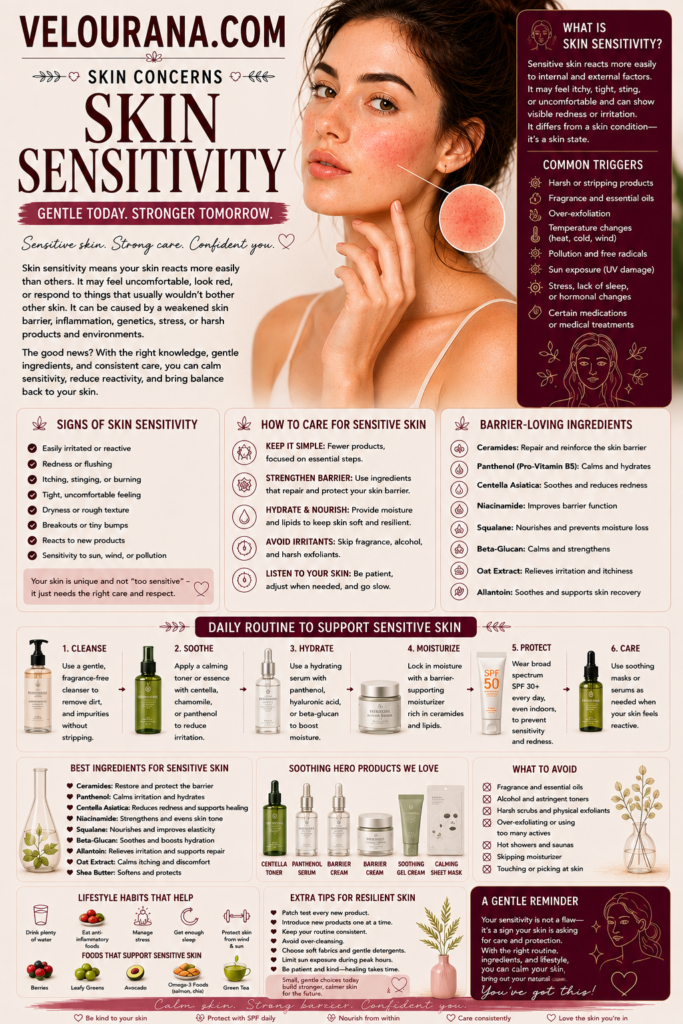
CATEGORY: Skin Sensitivity
Sensitive skin is often described through the things it cannot tolerate. A cleanser stings. A moisturiser suddenly feels uncomfortable. Cold air leaves the cheeks burning, while a warm room brings an immediate flush. A product that seemed perfectly acceptable for weeks begins to provoke redness without any obvious change in the routine. Even water, friction from a towel, or the simple act of applying skincare can occasionally feel more intense than it should.
Yet skin sensitivity is more complex than a collection of reactions. It is better understood as a state in which the skin responds unusually strongly to influences that would ordinarily cause little or no discomfort. Redness may accompany that response, but sensitivity is not defined by redness alone. Some sensitive skin looks completely calm while producing persistent sensations of stinging, burning, tightness or itching. Other skin becomes visibly flushed before any discomfort is noticed.
This distinction matters because visible redness can tempt us into treating the colour rather than understanding the condition of the skin beneath it. The instinct is often to find something stronger, faster or more corrective. Sensitive skin frequently benefits from the opposite approach: fewer unnecessary challenges, greater consistency and enough time for the skin's protective systems to recover their equilibrium.
Understanding sensitivity therefore begins not with searching for a miracle ingredient, but with recognising that skin has thresholds. When those thresholds become lower, ordinary experiences can suddenly feel extraordinary.
Sensitivity Is a Pattern of Response, Not a Skin Type in the Simplest Sense
People commonly describe their skin as dry, oily, combination or sensitive, as though these categories were mutually exclusive. In reality, sensitivity can occur alongside almost any underlying skin type. Oily skin can be sensitive. Dry skin can be sensitive. Acne-prone skin may also react easily, and skin that has historically tolerated almost everything can become temporarily sensitive after irritation or excessive treatment.
This is one reason sensitivity can be confusing. Someone who has always considered their skin resilient may assume that a sudden period of stinging means they have developed an allergy or that a particular product must be inherently harsh. Sometimes a specific ingredient is responsible, but sensitivity can also emerge because the skin itself has changed.
The condition of the protective barrier, environmental exposure, the number and intensity of products being used, friction and existing inflammation can all influence how readily sensations are triggered. The same formula may therefore feel completely different on healthy, comfortable skin than it does on skin whose tolerance has already been reduced.
Sensitive skin is consequently best viewed through behaviour. How quickly does it react? What kinds of situations provoke discomfort? How long does the reaction last? Does redness accompany the sensation? Does the skin recover when the routine becomes simpler?
These patterns are often more informative than attaching a permanent label to the skin.
The Protective Barrier Changes What the Skin Experiences
The outermost layers of the skin perform an extraordinary task. They create a boundary between the living tissues beneath and an environment filled with water loss, temperature changes, pollutants, microorganisms, friction and countless substances that come into contact with the body every day.
When this barrier functions effectively, it helps retain moisture while limiting the penetration of potential irritants. It does not make the skin impermeable, but it helps regulate the relationship between the body and its surroundings.
When barrier function becomes compromised, that relationship changes.
Water can escape more readily from the skin, contributing to dryness and tightness. Substances applied to the surface may penetrate differently or reach areas where they provoke greater irritation. Sensory nerves may become easier to stimulate, making ordinary products feel surprisingly intense.
This explains one of the most familiar experiences of sensitivity: the mysterious sting of something that previously felt harmless.
It is tempting to conclude that the product itself has suddenly become dangerous. Sometimes discontinuing a problematic product is appropriate, but the broader context should also be considered. If several unrelated products begin stinging at approximately the same time, the common factor may be the condition of the skin rather than every individual formula.
A period of aggressive exfoliation, frequent cleansing, retinoid overuse, harsh weather or excessive experimentation can gradually reduce tolerance. Once that happens, adding more corrective products may perpetuate the problem.
The skin may need less intervention before it needs more.
Why Sensitive Skin So Often Looks Red
Redness and sensitivity frequently occur together because irritation and inflammation can influence the superficial blood vessels within the skin. As these vessels dilate, more blood becomes visible near the surface, particularly in areas where the skin is naturally thinner or vascular responses are easily seen.
This does not mean that every flush indicates damaged skin. Human skin is dynamic. Exercise, heat, emotional responses, hot beverages and rapid temperature changes can temporarily increase facial blood flow. Such reactions can be completely physiological.
Sensitivity becomes more relevant when redness appears disproportionately easily, persists longer than expected or occurs alongside burning, itching, stinging or tenderness.
The challenge is that redness has many possible causes. A reactive barrier is only one of them. Rosacea, eczema, allergic contact dermatitis, irritant reactions, sun exposure and other dermatological conditions may also produce redness.
The visible colour alone therefore cannot tell us precisely what is happening.
This is particularly important when people attempt to diagnose their skin from photographs or compare themselves with images online. Lighting, natural complexion, camera processing and the distribution of blood vessels can dramatically alter the appearance of redness. The sensation, duration, triggers and accompanying changes often provide essential context.
For everyday skincare, the useful principle is straightforward: recurring redness accompanied by discomfort deserves gentleness rather than increasingly aggressive attempts to suppress its appearance.
The Sensory Side of Sensitive Skin
One of the most interesting aspects of skin sensitivity is that what a person feels can be more significant than what anyone else sees.
The skin contains an extensive network of sensory nerves designed to detect temperature, pressure, pain, itch and other environmental information. These systems protect us by warning when something may be harmful. In sensitive skin, sensory responses can sometimes become unusually easy to trigger.
This helps explain why a face can look relatively normal while feeling intensely uncomfortable.
A person may describe warmth without obvious flushing, tightness despite applying moisturiser, or stinging immediately after contact with water. These experiences should not be dismissed merely because there is little visible evidence.
The relationship between barrier function, inflammation and sensory signalling is complex, and sensitivity does not necessarily arise from one isolated mechanism. Several processes may reinforce one another. Barrier disruption can increase exposure to irritants; irritation can encourage inflammation; inflammation may heighten sensory responses; discomfort can then encourage additional cleansing or treatment, creating further disruption.
Breaking this cycle often requires restraint.
Sensitive skin can make people intensely aware of every change, encouraging constant adjustments to the routine. A new sensation leads to a new product; the new product creates another variable; another reaction follows; and soon it becomes almost impossible to identify what the skin actually tolerates.
Consistency becomes valuable precisely because it removes some of that uncertainty.
When Skincare Becomes Part of the Problem
Modern skincare encourages active participation. Exfoliating acids, retinoids, vitamin C preparations, masks, peels, cleansing systems and concentrated treatments can all have legitimate roles in a routine. The difficulty arises when enthusiasm exceeds the skin's capacity to tolerate simultaneous intervention.
Sensitivity is sometimes created or amplified by accumulation rather than by one obviously unsuitable product.
A cleanser may be reasonable on its own. An exfoliant may be appropriate at a sensible frequency. A retinoid may be tolerated when introduced gradually. But combining several potentially irritating steps, applying them too frequently and changing products repeatedly can create a level of cumulative stress that the skin struggles to accommodate.
More sophisticated skincare does not necessarily require more products.
For sensitive skin, sophistication may mean knowing what not to use at a particular moment.
When persistent stinging or unexplained redness develops after an increasingly complicated routine, simplification can provide useful information. Removing unnecessary variables allows the skin to settle and makes it easier to observe which products are genuinely essential.
This does not mean abandoning effective skincare permanently. It means respecting timing. Treatment goals such as improving texture, pigmentation or signs of ageing become difficult to pursue successfully when the underlying skin is continually irritated.
Tolerance is part of effectiveness.
Cleansing Should Leave the Skin Clean, Not Stripped
Cleansing is such an ordinary part of skincare that its influence on sensitivity is easily underestimated.
The purpose of cleansing is to remove unwanted material from the surface of the skin. Problems arise when cleansing also removes too much of what the skin needs to remain comfortable.
Sensitive skin may respond poorly to repeated washing, very hot water, aggressive rubbing or cleansing products that leave a pronounced feeling of tightness. That squeaky, extremely degreased sensation is sometimes interpreted as evidence of exceptional cleanliness, but for reactive skin it can be a warning that cleansing has gone beyond what was necessary.
Temperature also matters. Very hot water can encourage flushing and may intensify discomfort in people who already react strongly to heat. Vigorous towels, cleansing brushes and repeated rubbing introduce mechanical stress on top of whatever chemical exposure is already occurring.
A gentler cleansing experience is less dramatic. The skin simply feels clean and comfortable afterwards.
That lack of drama is desirable.
Sensitive skincare is often successful when individual steps become almost uneventful. Cleansing does not sting. Moisturising does not burn. Sunscreen does not create immediate discomfort. The routine stops demanding attention because the skin is no longer constantly announcing its presence.
Moisture and Barrier Support Are About Stability
Moisturising sensitive skin is sometimes treated as little more than relieving dryness, but maintaining hydration can also support the physical conditions in which the barrier functions effectively.
When the skin loses water excessively, it can feel tight, rough and uncomfortable. Dryness can also make already reactive skin less tolerant of environmental exposure and skincare products.
A suitable moisturiser therefore does more than create temporary softness. It can help reduce water loss and support the outer layers of the skin while they maintain their protective role.
For sensitive skin, however, complexity is not automatically an advantage. Long ingredient lists are not inherently bad, just as short ones are not automatically superior, but every additional product introduced into a reactive routine creates another variable.
The most useful moisturiser is ultimately one the skin tolerates consistently.
Texture also influences practical success. A product that feels unpleasant is unlikely to be used regularly, while a formula that suits both the skin's needs and the person's preferences is easier to maintain.
This is where skincare becomes individual rather than ideological. Sensitive skin does not require everyone to use exactly the same texture, routine or ingredient philosophy. It requires attention to response.
Comfort is information.
The Environment Can Lower the Skin's Tolerance
Sensitivity does not exist independently of the world around us.
Cold weather, low humidity, wind, strong sun, indoor heating and air conditioning can alter how the skin feels and behaves. Someone may tolerate a routine perfectly during one season and find the same routine uncomfortable during another.
Rapid temperature transitions can be particularly noticeable in redness-prone skin. Moving from winter air into a heavily heated room, taking a very hot shower or spending prolonged periods in intense heat can encourage visible flushing.
Sun exposure adds another dimension. Ultraviolet radiation can produce inflammation and damage even before a dramatic sunburn becomes visible. Skin that is already sensitive may feel particularly uncomfortable after excessive exposure.
Environmental management therefore belongs within a thoughtful approach to sensitivity. Skincare cannot control the weather, but routines can be adjusted to avoid unnecessarily increasing the burden placed on already reactive skin.
Sometimes the most effective adjustment is surprisingly ordinary: less heat, less friction, fewer unnecessary treatments and more consistent protection.
Fragrance, Botanicals and the Myth of “Natural” Gentleness
Sensitive skincare is surrounded by reassuring language. Products may be described as natural, clean, botanical, calming or suitable for delicate skin. These descriptions can influence expectations, but they do not guarantee individual tolerance.
Natural origin does not mean biologically inactive.
Plants contain complex mixtures of chemical compounds. Fragrant botanical extracts and essential oils may be pleasant to use, but some individuals find them irritating or develop allergic reactions to particular substances. Synthetic ingredients, meanwhile, are not automatically harsher simply because they were produced or purified through industrial processes.
For sensitive skin, the useful question is not whether an ingredient sounds natural or technological. It is whether the finished formulation is appropriate and tolerated.
Fragrance deserves particular attention because people with very reactive skin sometimes find fragranced products uncomfortable. This does not mean every fragranced cosmetic will irritate every person, but someone experiencing unexplained sensitivity may find a simpler, fragrance-free routine easier to evaluate.
Marketing categories should never replace observation.
The skin does not read the front of the bottle.
Irritation and Allergy Are Not the Same Thing
One of the most important distinctions in sensitive skincare is the difference between irritation and allergic contact dermatitis.
Irritation can occur when a substance or combination of exposures directly overwhelms or damages the skin's protective capacity. The likelihood often depends on concentration, frequency, duration and the condition of the skin at the time.
Allergic contact dermatitis involves an immune response to a substance to which the individual has become sensitised. Once sensitisation exists, relatively small exposures may provoke a reaction.
From the perspective of someone standing in front of a mirror, both situations can involve redness, itching or discomfort, making them difficult to distinguish without professional assessment.
This is why repeatedly testing suspected products on already inflamed facial skin can be counterproductive. When reactions are persistent, severe or recurring without a clear explanation, dermatological evaluation may provide far more useful information than endless trial and error.
Patch testing performed within appropriate medical assessment can sometimes help identify contact allergens when allergic contact dermatitis is suspected.
The larger lesson is that “sensitive skin” should not become a catch-all explanation that prevents investigation of persistent symptoms.
Rebuilding Tolerance Requires Patience
Skin recovery rarely follows the emotional timetable we would prefer.
When a routine has caused irritation, there is a natural desire to repair the problem immediately. That desire can lead to another round of products promising barrier restoration, redness correction and rapid soothing. The routine becomes complicated again before the skin has had an opportunity to stabilise.
A quieter strategy is often more informative.
Reducing unnecessary active treatments, cleansing gently, moisturising appropriately and protecting the skin from excessive environmental stress creates a stable baseline from which tolerance can be observed.
When the skin becomes comfortable again, additional products can be introduced deliberately rather than all at once. This makes it easier to identify whether a particular step is beneficial or problematic.
Patience also changes expectations. Sensitive skin does not need to become invulnerable to prove that a routine is working. Some people naturally remain more reactive to temperature, certain ingredients or environmental changes.
The objective is not necessarily to eliminate every moment of flushing or sensation. It is to reduce unnecessary irritation and create a routine the skin can live with comfortably over time.
Knowing When Redness Needs More Than Skincare
There is an important boundary between cosmetic skincare and medical care.
Occasional mild sensitivity after an obvious trigger may resolve once that trigger is removed. Persistent redness, however, deserves more attention, particularly when it is accompanied by significant itching, swelling, pain, scaling, cracking, bumps, eye symptoms or repeated episodes that become progressively more severe.
Rosacea, eczema and contact dermatitis are examples of conditions that may initially be interpreted simply as “sensitive skin.” They require proper identification because management depends on the underlying cause.
Sudden swelling, blistering or severe reactions should not be managed through cosmetic experimentation.
Professional assessment is also worthwhile when sensitivity begins interfering with normal life. If almost every product burns, the skin remains chronically inflamed, or avoiding suspected triggers has failed to improve the situation, there is little value in continuing an endless cycle of self-testing.
A dermatologist can examine patterns that a cosmetic label cannot explain.
Recognising that boundary is not a failure of skincare. It is part of using skincare intelligently.
Sensitive Skin Benefits From a Different Definition of Success
Beauty culture often presents skincare as transformation. Texture should become smoother, pores less visible, pigmentation brighter and signs of ageing progressively corrected. Sensitive skin introduces another measure of success that is quieter but no less important: stability.
Skin that no longer burns after cleansing is improving.
Skin that can move through a cold day without prolonged discomfort is improving.
A routine that can be followed for weeks without creating another cycle of irritation is succeeding even if nothing dramatic appears to happen overnight.
This perspective can be liberating because it shifts attention away from constant correction. Sensitive skin does not always need another intervention. Sometimes it needs protection from the accumulation of interventions already being imposed upon it.
The most effective routine may therefore look surprisingly simple from the outside. Its intelligence lies not in the number of products involved but in the understanding behind their use.
Sensitivity teaches an important principle that applies far beyond reactive skin: skincare works best when treatment respects biology rather than attempting to overpower it.
Redness, stinging, burning and tightness are forms of information. They indicate that the relationship between the skin and its environment has become uncomfortable. Listening to those signals does not mean becoming afraid of skincare. It means becoming more selective about what the skin is asked to tolerate.
When sensitivity is approached this way, gentleness stops being a compromise. It becomes a strategy.
The End Velourana
 Discover More From Our Family of Websites
 ZodiacBearing (Astrology, Tarot, Numerology, Angel Numbers & Spiritual Guidance)
 Velourana (Beauty, Makeup, Hair Care, Skincare & Beauty Tips)
 HavenBearing (Home, Living, Organization, Décor & Everyday Inspiration)
 PawBearing (Pet Care, Dog Breeds, Animal Health, Training & Pet Products)
 PsyCatherine (Notes From the Journal of a Psychologist on Real Life)

