
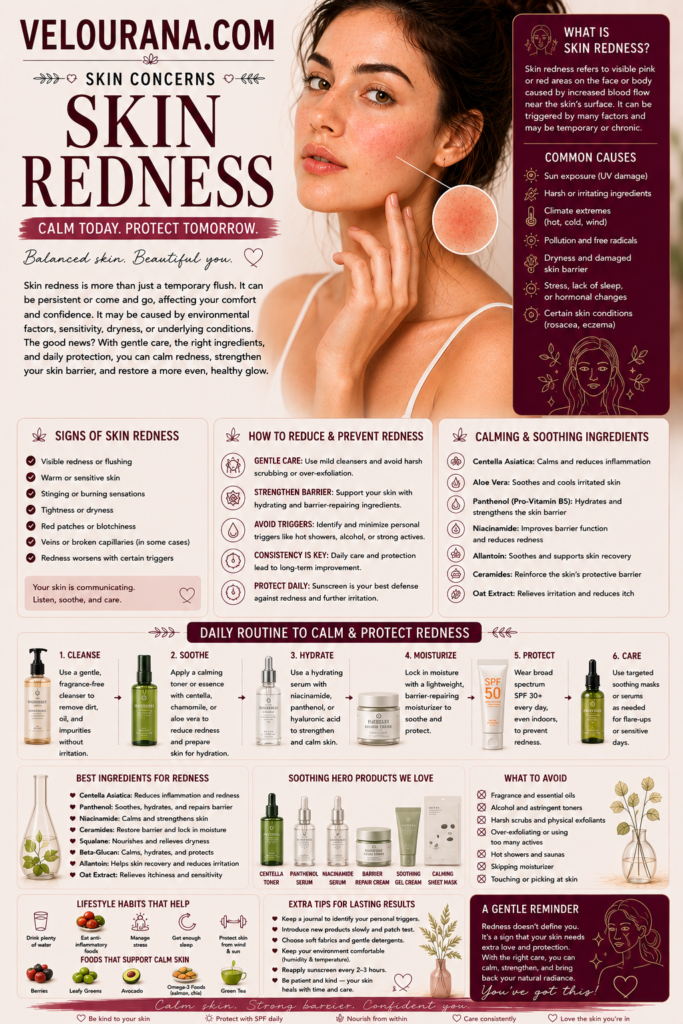
CATEGORY: Skin Redness
Facial redness is often treated as though it were one condition with one solution. In reality, it is a visible outcome produced by many different processes.
A complexion may turn red because blood vessels widen temporarily. It may remain red because the skin barrier has been repeatedly disturbed. Redness may accompany inflammation, dryness, acne, contact irritation, environmental stress, or an underlying dermatological condition. Some people experience dramatic flushing while their skin otherwise feels comfortable. Others barely flush yet live with constant burning, tightness, and sensitivity.
The surface appearance can therefore be misleading.
Two people can look equally red and need entirely different approaches.
This is why the language used around redness matters. Terms such as sensitive, reactive, irritated, inflamed, flushed, sensitized, and redness-prone are frequently used interchangeably, but they do not always describe the same thing.
Understanding the distinctions does not require diagnosing the skin at home. It means becoming better at observing patterns.
Does the redness appear suddenly and disappear quickly? Is it persistent? Does it burn? Does it itch? Is there visible flaking? Does it develop after skincare? Does it worsen in heat? Are there bumps, swelling, or visible vessels?
The more precisely redness is described, the easier it becomes to decide whether the skin needs less stimulation, better barrier support, trigger management, cosmetic camouflage, or professional evaluation.
Redness Is an Appearance, Not an Explanation
The word redness tells us what the skin looks like, not why it looks that way.
This distinction is fundamental.
A person running uphill on a warm afternoon may become intensely flushed because superficial blood vessels are helping release body heat. Someone who has applied too much exfoliating acid may look similarly red because the skin is irritated and inflamed.
The color may overlap.
The biology does not.
One reaction is primarily physiological and temporary. The other reflects tissue under stress.
This is why simply searching for an “anti-redness ingredient” can be unsatisfying.
Before deciding what the complexion needs, it helps to understand what kind of behavior the skin is showing.
Flushing: When Redness Comes and Goes
Flushing generally describes redness that develops relatively quickly and later fades.
Heat is one of the most familiar triggers.
Exercise, warm rooms, hot showers, saunas, spicy meals, emotional stress, and rapid temperature changes can all increase facial blood flow in susceptible people.
The redness may appear across the cheeks, nose, forehead, ears, neck, or chest.
What makes flushing distinct is movement.
The complexion changes.
It may go from normal to red in minutes and then gradually return toward baseline.
This does not automatically mean the skin is sensitive.
Someone may flush intensely during exercise while tolerating skincare products perfectly well.
Conversely, another person may rarely flush but react strongly to cosmetics.
The two traits can coexist, but they should not be confused.
For people with frequent flushing, patterns matter more than isolated episodes.
If heat reliably causes redness but the skin settles afterward, the response may largely reflect vascular reactivity.
If flushing becomes increasingly easy to trigger, lasts much longer than expected, burns significantly, or is accompanied by other persistent symptoms, professional evaluation may be appropriate.
Sensitive Skin: A Tendency Toward Discomfort
Sensitive skin is a broad term.
People often use it to describe a complexion that stings, burns, itches, or becomes uncomfortable in response to products or environmental conditions that other people tolerate easily.
This sensitivity can exist with visible redness, but not always.
A person may experience burning with skincare while showing little obvious color change. Another may become visibly pink without much discomfort.
This illustrates an important principle: sensation and appearance are related but not identical.
Sensitive skin may react to cleansing, exfoliating ingredients, fragrance, environmental dryness, wind, temperature change, or friction.
Yet sensitivity itself does not automatically reveal the underlying cause.
Some people appear to have an inherently lower threshold for certain stimuli.
Others become temporarily sensitive because their barrier has been disrupted.
That distinction leads to another commonly used term: sensitized skin.
Sensitized Skin: When Tolerance Changes
Sensitized skin is often used to describe skin that has become more reactive because of external stress or excessive treatment.
Imagine someone who has used the same moisturizer comfortably for a year.
They then introduce a strong exfoliating acid, increase retinoid frequency, begin double cleansing aggressively, and spend several sunny afternoons outdoors.
Suddenly the familiar moisturizer stings.
The formula has not necessarily changed.
The condition of the skin has.
This pattern is characteristic of acquired sensitivity.
The complexion may feel tight, burn with water or products, become flaky, or remain persistently red.
The key clue is often historical.
The skin used to tolerate more.
Something changed.
In these situations, simplifying the routine and reducing irritation can sometimes restore much of the previous tolerance.
That does not happen instantly, but it demonstrates why sensitivity should not always be treated as a permanent skin identity.
Irritated Skin: When the Routine Becomes the Trigger
Irritation is especially common in modern skincare because consumers have access to increasingly powerful active ingredients.
Acids, retinoids, exfoliating masks, acne treatments, brightening products, scrubs, cleansing devices, and highly efficient cleansers can all be useful in the right context.
Problems arise when too many are combined or used too frequently.
Irritated skin often communicates clearly.
It may burn.
It may sting.
It may become tight after cleansing.
It may appear shiny yet dehydrated.
Fine flaking may develop around the mouth or nose.
Applying a normally comfortable product can suddenly feel unpleasant.
Redness associated with irritation often persists rather than disappearing immediately.
The solution is rarely to add another treatment layer.
The more rational response is to reduce the total burden placed on the skin.
Inflammation: Redness With Biological Activity Behind It
Inflammation is broader than irritation.
It is part of the body's biological response to perceived injury, infection, allergens, or other forms of stress.
Inflamed skin may become red because local blood flow increases.
It may also feel warm, swollen, tender, itchy, or painful.
Many skin conditions involve inflammation.
Acne lesions are inflammatory. Eczema can be inflammatory. Contact dermatitis involves inflammation. Sunburn is inflammatory.
This is why the phrase “inflamed skin” should not be treated as a diagnosis.
It describes a biological state that can arise for many reasons.
Persistent inflammation deserves more attention than a simple transient flush because the appropriate treatment depends on the cause.
When redness is accompanied by swelling, crusting, persistent itching, recurrent lesions, significant pain, or progressive worsening, cosmetic troubleshooting has limitations.
Barrier-Compromised Skin: When Protection Becomes Less Effective
The skin barrier plays a central role in tolerance.
The outermost portion of the epidermis helps limit excessive water loss while reducing penetration of environmental substances.
When this protective structure is disturbed, skin may become drier and more reactive.
Water escapes more easily.
Products may penetrate differently.
Ingredients that were previously tolerated can begin causing discomfort.
The resulting redness is often accompanied by tightness, sensitivity, or flaking.
Barrier disruption is particularly common after over-exfoliation, aggressive cleansing, excessive use of active ingredients, prolonged environmental dryness, friction, or combinations of several factors.
The phrase “damaged barrier” is sometimes used too casually online, but the general concept is valid: skin can become less effective at maintaining its protective function.
The important part is not the label.
It is recognizing the behavioral pattern.
If the complexion suddenly reacts to everything after a period of aggressive skincare, additional aggression is unlikely to help.
Dryness and Redness Often Travel Together
Dry skin is not always red, and red skin is not always dry.
But the two often overlap.
When the skin lacks sufficient lipids or loses water too rapidly, its surface can become rough, tight, and more vulnerable to irritation.
Wind and cold weather may intensify the problem.
The cheeks can look flushed while simultaneously feeling dry.
Around the nose and mouth, fine scaling may appear.
The mistake is to interpret every rough area as something that needs exfoliation.
Dryness can create texture.
Exfoliating dry, irritated skin may temporarily remove flakes while worsening the underlying vulnerability.
This is another example of why appearance alone can be deceptive.
Dehydrated Skin Can Look Red Without Being Truly Dry
Dryness and dehydration are frequently confused.
Dry skin generally refers to insufficient oil or lipid content, while dehydration refers more broadly to insufficient water within the outer skin layers.
Any skin type can become dehydrated, including oily skin.
A dehydrated complexion may feel tight, look dull, and become more reactive.
Fine lines can appear more noticeable.
When dehydration accompanies irritation, redness may become more pronounced.
This is especially common in routines designed aggressively for oily or acne-prone skin.
The person sees oil and assumes the complexion should be stripped more thoroughly.
A harsh cleanser is used.
Exfoliation increases.
The skin becomes dehydrated and irritated while continuing to produce oil.
Now the complexion is oily, tight, and red at the same time.
The contradiction is only apparent.
Oil production and water retention are not the same process.
Reactive Skin: When Small Triggers Cause Large Responses
Reactive skin is another broad term, often used for complexions that respond dramatically to relatively minor stimuli.
The trigger may be heat, wind, skincare, emotional stress, or friction.
The reaction may include flushing, burning, stinging, or discomfort.
What makes reactive skin challenging is unpredictability.
A product may be tolerated one week and uncomfortable the next.
Weather changes can produce large differences.
Stress may appear to alter tolerance.
Someone may begin feeling that virtually everything causes a reaction.
When this happens, simplification becomes especially useful.
A complicated routine makes it impossible to know whether the skin is reacting to one ingredient, a combination, accumulated irritation, or environmental conditions.
A smaller routine creates a clearer baseline.
Persistent Redness Is Different From Temporary Reactivity
Temporary redness is generally easier to interpret because there is a beginning and an end.
Persistent redness requires more careful consideration.
If the cheeks remain red even when the person is cool, rested, and not using irritating products, other causes may need to be considered.
Visible surface vessels may contribute.
A chronic inflammatory condition may be involved.
Long-term environmental exposure may play a role.
There may also be several factors at once.
Persistent central facial redness, especially when accompanied by recurrent flushing, bumps, burning, or visible vessels, is one example of a pattern that may justify dermatological assessment.
The important point is not to diagnose the condition at home.
It is to recognize when ordinary cosmetic sensitivity no longer explains the full picture.
Contact Irritation and Allergy Are Not the Same
Skincare reactions are often called allergies, but irritation and allergic contact reactions are different processes.
Irritant reactions can occur when a substance or combination of exposures directly overwhelms the skin's tolerance.
This can happen to many people if exposure is strong enough.
Allergic contact dermatitis, by contrast, involves an immune response to a substance to which the person has become sensitized.
The appearances can overlap.
Redness, itching, burning, swelling, and rash-like changes may occur.
This is one reason persistent or significant product reactions can be difficult to interpret without professional assessment.
A reaction that repeatedly returns after exposure to the same type of product deserves more attention than ordinary transient tingling.
Patch testing performed under professional guidance may sometimes be used when allergic contact dermatitis is suspected.
What should not happen is endless home experimentation with increasingly complicated products while symptoms continue to worsen.
Acne Redness Is Its Own Category
Acne frequently produces redness because inflammatory blemishes increase local inflammation and blood flow.
A red pimple is therefore not the same thing as diffuse facial flushing.
The distribution provides clues.
Inflammatory acne tends to create distinct lesions, although surrounding redness may also occur.
The difficulty arises when other inflammatory conditions create bumps that resemble acne.
This is where aggressive self-treatment can become counterproductive.
Someone sees red bumps and assumes stronger acne treatments are needed.
More exfoliation follows.
The skin becomes more irritated.
If the underlying condition was not acne, the strategy may worsen rather than improve the problem.
When the appearance is unusual, persistent, or resistant to sensible acne care, diagnosis matters more than escalation.
Post-Blemish Redness Can Remain After the Pimple Is Gone
Sometimes a blemish heals but the redness remains.
This residual color can make acne appear more active than it truly is.
A flat red or pink mark after inflammation has resolved is different from an active raised lesion.
The distinction is important because repeatedly treating a flat residual mark as though it were still a pimple can create unnecessary irritation.
Sun protection becomes particularly relevant during recovery because ultraviolet exposure can make post-inflammatory discoloration more persistent or noticeable.
Time also matters.
The skin's visible recovery from inflammation can be slower than the resolution of the original lesion.
Patience is often part of management.
Rosacea-Like Patterns Should Not Be Self-Diagnosed
Rosacea is frequently mentioned whenever facial redness is discussed.
It can involve persistent central facial redness, recurrent flushing, visible vessels, inflammatory bumps, and sometimes eye symptoms.
However, several other conditions can resemble aspects of rosacea.
Self-diagnosis based on photographs or social media comparisons is therefore unreliable.
What is useful is recognizing patterns that deserve assessment.
Repeated central facial flushing, persistent redness, worsening sensitivity, visible vessels, recurrent inflammatory lesions, or eye involvement are examples.
A dermatologist can evaluate the skin directly and determine whether rosacea or another condition is involved.
The distinction matters because targeted medical treatments may be available.
Cosmetics can support comfort and appearance, but they cannot replace diagnosis.
Eczema and Dermatitis Can Present With Redness
Eczema and various forms of dermatitis may also involve redness.
Itching is often an important clue.
The skin may become dry, flaky, rough, cracked, or inflamed.
But again, appearance varies.
Seborrheic dermatitis, for example, commonly affects characteristic facial areas and may include scaling.
Contact dermatitis may appear where a product or substance touches the skin.
Treating every flaky red patch with more exfoliation is therefore risky.
Scaling does not automatically mean excess dead skin that needs to be removed.
Sometimes it is a sign that the skin is inflamed and needs a very different approach.
Sunburn Is Redness With a Clear Cause
Sunburn is one of the easiest forms of redness to identify because the relationship to ultraviolet exposure is usually obvious.
The skin becomes red, warm, tender, and sometimes swollen.
More severe burns can blister.
Sunburn is not merely a cosmetic problem.
It represents acute ultraviolet injury.
Once it occurs, the priority is not aggressive exfoliation or immediate cosmetic correction.
Further sun exposure should be avoided while the skin recovers, and severe burns may require medical attention.
Prevention remains more valuable than treatment.
Consistent sun protection reduces both acute burning and cumulative ultraviolet stress.
Cold and Wind Can Mimic Product Sensitivity
A person may blame a moisturizer for winter redness when the larger problem is environmental.
Cold air, wind, low humidity, and indoor heating can all increase skin dryness and discomfort.
A routine that felt perfect during summer may suddenly feel insufficient.
The complexion may become red after going outdoors and then flush again upon entering a heated building.
This pattern can look like product sensitivity.
Sometimes the product is not the problem.
The environment has simply increased the skin's needs.
Recognizing seasonal context prevents unnecessary product switching.
Hot Water Can Exaggerate Almost Every Redness Pattern
Hot water can intensify flushing through vasodilation.
It can also make already irritated skin feel more uncomfortable.
For redness-prone complexions, very hot showers may therefore create two simultaneous problems: immediate vascular redness and additional stress on an already vulnerable surface.
This is why lukewarm water is frequently a better choice.
The goal is not to make washing unpleasantly cold.
It is simply to avoid unnecessary extremes.
Friction Can Create Redness Without Any Product Reaction
Mechanical irritation is easy to overlook.
A rough towel, vigorous cleansing brush, repeated rubbing with cotton pads, aggressive makeup removal, or frequent touching can all redden the skin.
The product may receive the blame because redness appears during skincare, when the technique is actually responsible.
This is especially relevant around the nose and eyes, where people may rub repeatedly.
Gentler technique reduces one variable immediately.
The face rarely needs to be scrubbed into cleanliness.
Cosmetic Redness and Medical Redness Can Overlap
One of the reasons facial redness becomes confusing is that ordinary cosmetic irritation can coexist with a dermatological condition.
Someone with naturally reactive skin may over-exfoliate.
A person with rosacea may also use an irritating cleanser.
Someone with eczema may develop contact irritation from a cosmetic.
The presence of one cause does not exclude another.
This makes simplistic advice unreliable.
If a basic routine improves the skin significantly but persistent redness remains, the residual pattern may reveal something that was previously hidden beneath the irritation.
This is one reason stabilizing the routine can be useful even before professional evaluation.
It removes noise from the picture.
How to Observe Redness More Intelligently
The most valuable tool is not always a product.
Sometimes it is observation.
Notice location.
Notice duration.
Notice sensation.
Notice triggers.
Notice whether the skin returns to baseline.
A red face after a run is informative in one way.
A red face that wakes up red every morning is informative in another.
Redness that appears only after a particular serum creates another pattern.
Photographs taken under similar lighting can help track changes over time.
A brief written record can reveal associations with weather, products, sun exposure, exercise, or stress.
The objective is not obsessive monitoring.
It is pattern recognition.
When Simplifying the Routine Makes Sense
If irritation seems likely, simplification is often the most rational first step.
A basic routine usually centers on cleansing, moisturizing, and daytime sun protection.
Products causing obvious discomfort can be removed.
Strong exfoliants and multiple active treatments may be paused while the complexion settles.
The purpose is not to create a permanently minimal routine for everyone.
It is to establish a stable baseline.
Once the skin feels comfortable again, additional products can be introduced selectively if they serve a clear purpose.
This method gives each change meaning.
When Simplification Is Not Enough
A minimalist routine is not a universal cure.
Persistent redness can continue despite excellent skincare.
Visible vessels will not necessarily disappear because the cleanser becomes gentler.
An underlying inflammatory condition may require prescription treatment.
Allergic contact dermatitis may require identification of the responsible allergen.
This is why skincare humility matters.
Cosmetics have limits.
When redness persists, worsens, becomes painful, repeatedly swells, affects the eyes, develops unusual lesions, or otherwise causes concern, professional evaluation should replace further experimentation.
Makeup Can Correct Color Without Claiming to Treat It
There is nothing wrong with wanting redness to look less visible while its cause is being managed.
Makeup can provide immediate cosmetic correction.
Green-toned correctors may reduce the visual intensity of red areas.
Foundation and concealer can create a more even finish.
The technique should remain gentle.
Heavy rubbing can provoke additional temporary flushing.
Comfort also matters.
Makeup should not burn or worsen irritation simply because it provides good coverage.
Cosmetic correction and skin treatment are separate functions.
Confusing them creates unrealistic expectations.
The Best Label Is the One That Leads to Better Decisions
Whether someone calls their skin sensitive, reactive, irritated, sensitized, or redness-prone matters less than what the description helps them understand.
Good language should improve decisions.
If the skin flushes only in heat, focus on vascular triggers.
If it burns after active products, examine irritation.
If it feels tight and flaky, consider barrier stress and dryness.
If redness is persistent and accompanied by other symptoms, seek appropriate evaluation.
Labels become useful when they organize information.
They become harmful when they encourage self-diagnosis or rigid assumptions.
Redness Becomes Easier to Manage When It Becomes More Specific
The phrase “red skin” contains too little information to guide intelligent care.
The better question is what kind of red skin.
Transient or persistent?
Comfortable or painful?
Smooth or flaky?
Diffuse or localized?
Triggered by heat, skincare, weather, exercise, or nothing obvious?
Accompanied by bumps, itching, swelling, visible vessels, or eye symptoms?
Each answer narrows the possibilities.
That does not mean every person should become their own dermatologist.
It means they can become a more accurate observer of their own skin.
Once redness is described more precisely, management becomes more rational.
Some forms need nothing more than time.
Some improve when irritation is reduced.
Some benefit from better barrier support.
Some can be cosmetically neutralized.
And some deserve professional diagnosis.
The color itself is only the beginning.
Understanding the behavior behind it is what turns redness from a vague frustration into something that can be approached with clarity.
The End Velourana
 Discover More From Our Family of Websites
 ZodiacBearing (Astrology, Tarot, Numerology, Angel Numbers & Spiritual Guidance)
 Velourana (Beauty, Makeup, Hair Care, Skincare & Beauty Tips)
 HavenBearing (Home, Living, Organization, Décor & Everyday Inspiration)
 PawBearing (Pet Care, Dog Breeds, Animal Health, Training & Pet Products)
 PsyCatherine (Notes From the Journal of a Psychologist on Real Life)

