
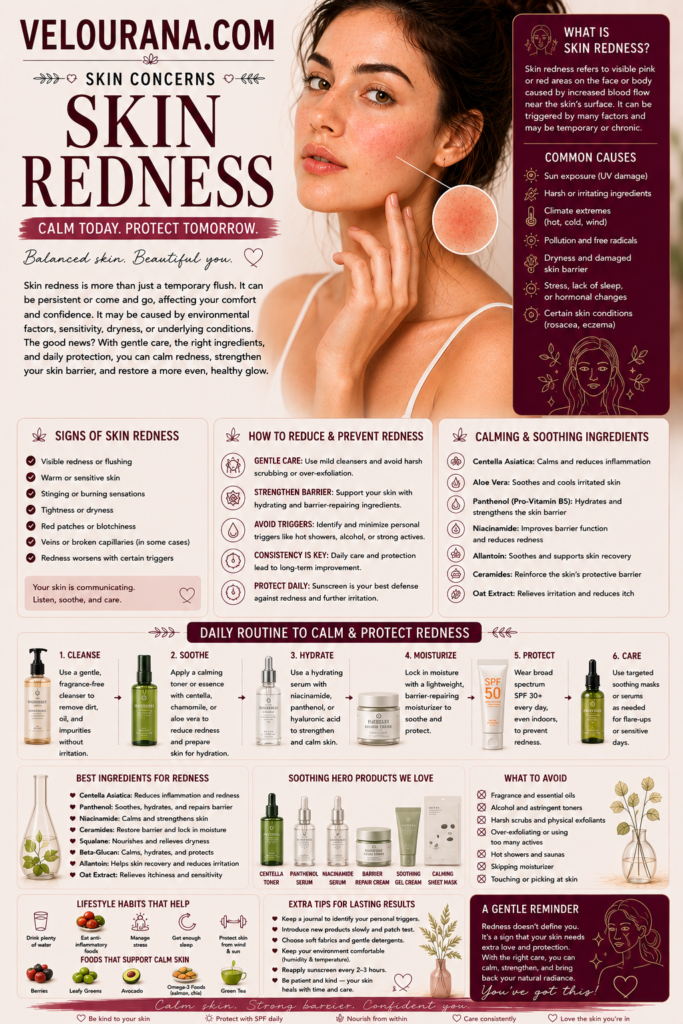
CATEGORY: Skin Redness
Skin redness becomes more difficult to understand when it stops behaving like a temporary event.
A brief flush after exercise or a sudden change in temperature is easy to explain. The trigger is obvious, the response is short-lived, and the skin returns toward its usual appearance. Chronic or frequently recurring redness is different. It may remain across the cheeks for most of the day, appear around the nose regardless of weather, worsen every evening, or flare unpredictably after products, stress, heat, or sun exposure.
At that point, redness is no longer simply an isolated visual change. It becomes a pattern.
Patterns matter because persistent redness is rarely caused by one dramatic event alone. More often, several influences begin to overlap: vascular reactivity, barrier weakness, environmental exposure, repeated irritation, inflammatory skin tendencies, and habits that keep the complexion from fully recovering.
The frustrating part is that these influences can reinforce one another.
A weakened barrier makes skin more reactive. Reactive skin becomes inflamed more easily. Inflamed skin tolerates active products less well. The user interprets the redness as a problem requiring stronger treatment. Stronger treatment produces more irritation, and the cycle continues.
Breaking that cycle requires a different philosophy.
Instead of asking what can remove redness fastest, it is more useful to ask what is preventing the skin from returning to equilibrium.
The Difference Between Frequent Redness and Constant Redness
Not all chronic redness looks the same.
Some people experience repeated episodes. Their complexion may appear relatively calm in the morning, flush after coffee or heat, settle, then flare again after exercise or skincare. Others have redness that is always present to some degree but becomes more intense under particular conditions.
These distinctions offer clues.
Episodic flushing suggests that vascular responsiveness and triggers may play a substantial role. Constant redness may indicate persistent inflammation, visible vascular changes, barrier disruption, an underlying dermatological condition, or a combination of these.
The location matters as well.
Redness concentrated around the nose may have different implications from diffuse redness across the cheeks. Redness accompanied by flaky areas around the eyebrows or hairline may follow a different pattern from smooth, warm central facial redness. Redness combined with inflammatory bumps introduces another layer of complexity.
Sensations provide additional information.
Does the skin burn? Itch? Feel tight? Become swollen? Feel hot even in a cool room? Sting when moisturizer is applied?
A purely visual description misses much of what makes chronic redness clinically and practically meaningful.
The question should therefore become more specific than “Why am I red?”
A more useful question is: “What kind of redness am I experiencing, and what consistently surrounds it?”
How Redness Can Become Self-Perpetuating
One of the most important features of chronic redness is that the original trigger may not be the only thing maintaining it.
Imagine a complexion exposed to excessive exfoliation for several weeks. The initial problem is clear: too much treatment.
The skin becomes irritated, barrier function declines, and redness appears.
The exfoliant is stopped, but the person continues using a harsh cleanser, hot water, a fragranced toner, and multiple active serums. Each step is less irritating than the original exfoliant, but together they prevent complete recovery.
The redness lingers.
Now the skin is more vulnerable than before, so products that once seemed harmless begin to sting. The user interprets this as increasing sensitivity and starts changing products frequently. More variables are introduced.
What began as one obvious insult becomes a sustained environment of low-grade stress.
This is why chronic redness can persist long after someone believes they have removed the cause.
Recovery requires more than stopping the worst offender. It often requires reducing the total burden placed on the skin.
Barrier Damage Does Not Always Look Dramatic
Barrier impairment is often described online as though the skin suddenly becomes visibly destroyed.
In reality, the early signs can be subtle.
A complexion may become slightly tighter after washing. Makeup may begin catching around the mouth. A serum that was comfortable for months may start tingling. The cheeks may appear shinier while simultaneously feeling dry. Fine flaking may develop near the nose.
None of these changes alone proves significant barrier disruption, but together they can indicate that the skin is operating with less resilience.
The protective barrier is not a wall that is either completely intact or completely broken.
Its function exists along a continuum.
This is an important concept because it explains why someone can still have apparently normal-looking skin while experiencing increasing reactivity.
It also explains why recovery may be gradual.
Hydration, lipid organization, inflammation, and tolerance do not always normalize simultaneously. The skin may look better before it feels completely comfortable, or feel better while some visible redness remains.
Expecting instant normalization can encourage premature reintroduction of strong active ingredients.
The Problem With “Pushing Through” Irritation
Many skincare routines fail because discomfort is interpreted as evidence of effectiveness.
This mentality is especially common with acids, retinoids, peels, acne treatments, and brightening products.
A little transient sensation can occur with some ingredients, but persistent burning, repeated redness, peeling, or worsening sensitivity should not be treated as a badge of commitment.
Skin does not become stronger simply because irritation is ignored.
In fact, repeatedly exceeding tolerance can make the complexion harder to manage.
The most effective use of a potent ingredient is not the most aggressive schedule someone can survive. It is the schedule that produces meaningful benefit without repeatedly destabilizing the skin.
This distinction matters for chronic redness because frequent micro-irritation may never become dramatic enough to force someone to stop treatment entirely.
Instead, the skin remains in a permanently suboptimal state.
Slightly red.
Slightly tight.
Slightly reactive.
Never fully comfortable.
That state can become normalized until the person believes they simply have “bad sensitive skin.”
Sometimes the routine has quietly trained the complexion into constant irritation.
Heat as a Chronic Trigger
Heat deserves special attention because it is both ordinary and difficult to avoid.
Warm weather, exercise, hot showers, heated rooms, cooking, hairdryers, saunas, and even intense sun exposure can increase facial warmth and vascular dilation.
For someone with redness-prone skin, the repeated effect can be substantial.
This does not mean that every source of warmth should be eliminated.
The aim is not to build a lifestyle around avoiding normal physiology.
Instead, obvious unnecessary extremes can be moderated.
A very hot shower can be replaced with comfortably warm water. Long exposure to steam can be reduced. Exercise can continue while attention is paid to hydration, environmental temperature, and post-exercise cooling.
The distinction is between living normally and repeatedly creating conditions that provoke disproportionate flushing.
If heat reliably produces severe, painful, or long-lasting redness, that pattern is worth discussing with a dermatologist.
Why Sun Exposure Matters Even Without Sunburn
Many people think of sun damage only in terms of visible burning.
But ultraviolet exposure can influence redness without producing an obvious sunburn.
Repeated exposure contributes to inflammation and structural changes in the skin. It may also worsen several redness-associated conditions.
This means chronic facial redness and sun protection should be discussed together.
A sunscreen used only at the beach does not provide the same pattern of protection as consistent everyday use when exposure occurs.
The challenge is finding a formula that the skin tolerates.
Redness-prone skin may reject certain sunscreens because of stinging, heaviness, dryness, or eye irritation. This can make people abandon sunscreen entirely.
That is rarely the best conclusion.
Formulation differences are considerable, and a product that irritates one complexion may be completely comfortable on another.
The practical goal is consistency.
A sunscreen that is slightly less elegant but reliably tolerated may be more useful than a theoretically perfect formulation that remains unused.
The Role of Weather and Seasonal Change
Chronic redness often fluctuates with the seasons.
Winter introduces cold air, wind, and low humidity. Indoor heating adds another layer of dryness. The skin may become more dehydrated, and the barrier may feel less resilient.
Summer introduces heat, sweat, increased ultraviolet exposure, and more frequent cleansing.
Spring and autumn can bring rapid temperature swings that repeatedly challenge vascular stability.
This explains why a routine should not necessarily remain identical throughout the year.
The skin's needs change with context.
Someone who tolerates a lightweight moisturizer during humid summer weather may need a richer product in winter. Exfoliation frequency that feels comfortable in one season may become excessive in another.
Adaptation does not mean constantly rebuilding the entire routine.
Small seasonal adjustments are often enough.
Friction Is an Underrated Source of Redness
Mechanical irritation receives far less attention than ingredients, but it can matter.
Rubbing with towels, aggressive makeup removal, exfoliating cloths, cleansing brushes, facial massage tools, repeated wiping, and touching the skin throughout the day all create friction.
Even shaving can contribute when technique or products are irritating.
For healthy, resilient skin, moderate friction may cause little problem. For already reactive skin, the threshold is lower.
The effect becomes particularly important around areas that are cleaned repeatedly, such as the nose or mouth.
Gentler handling is one of the simplest ways to reduce unnecessary stimulation.
Pat rather than scrub.
Remove makeup efficiently rather than repeatedly.
Allow cleansers to do their job without turning cleansing into mechanical exfoliation.
The goal is not to treat the face as fragile glass.
It is simply to stop adding friction where it serves no useful purpose.
Product Complexity Can Hide the Real Cause
A ten-step routine creates ten possible variables.
When redness develops, identifying the cause becomes difficult.
Was it the new serum? The exfoliating toner? A stronger cleanser? The combination of retinoid and acid? A fragranced mask? A sunscreen that becomes irritating only when layered over another product?
Complexity makes troubleshooting harder.
This is why routine simplification is such a valuable diagnostic tool.
A basic regimen allows the skin to establish a clearer baseline. If redness improves after several unnecessary products are removed, that information is useful.
Products can later be reintroduced one at a time.
This process may feel slow, but it is far more informative than replacing several products simultaneously and hoping for improvement.
The beauty market rewards novelty.
The skin often rewards consistency.
Chronic Redness and the Psychological Pressure to Fix It
Visible facial redness can become psychologically intrusive.
Because the face is central to social interaction, persistent color changes may feel more significant than similar irritation elsewhere on the body.
People may worry that others assume they are embarrassed, overheated, drinking alcohol, ill, or distressed.
This can create urgency.
The person wants the redness gone before a meeting, photograph, event, or conversation.
That urgency can fuel over-treatment.
Stronger products are added. Makeup is layered heavily. Skin is scrubbed because texture looks uneven.
The result may be more irritation.
Recognizing this cycle matters because emotional discomfort can directly influence skincare behavior.
Immediate cosmetic correction and long-term skin management are different goals.
Makeup can address appearance temporarily.
A skincare routine should prioritize stability and health over rapid visual suppression.
Using Makeup Without Aggravating Chronic Redness
Makeup can be entirely compatible with redness-prone skin when chosen and applied thoughtfully.
The first priority is comfort.
A foundation that looks beautiful but burns throughout the day is not a good match for reactive skin.
Color correction can reduce the need for heavy coverage. Green-toned products may visually neutralize red areas when used sparingly.
The key is precision.
Applying correction only where redness is strongest often produces a more natural result than covering the entire complexion.
Application technique also matters.
Aggressive buffing can temporarily increase redness through friction. Gentle pressing or light blending may be more comfortable.
Removal should be efficient rather than harsh.
Long-wearing formulas sometimes require an oil-based or balm-type first cleanse, followed by a gentle second cleanse if necessary. The goal is complete removal without prolonged scrubbing.
Makeup should solve the appearance problem for the day without creating a larger skincare problem for tomorrow.
When Moisturizer Becomes the Most Important Product
In highly reactive routines, moisturizer can seem almost boring compared with active treatments.
Yet it often becomes central.
A well-tolerated moisturizer helps reduce water loss, improve comfort, and support the skin's protective environment.
The best moisturizer is not necessarily the one with the longest ingredient list.
Texture matters.
Someone with oily but dehydrated skin may prefer a lighter formula. Dry, compromised skin may need something richer.
Application frequency matters as well.
Applying moisturizer only after the skin already feels extremely tight may be less effective than maintaining more consistent hydration.
The phrase “barrier repair” is used widely in marketing, sometimes too loosely. No cosmetic can instantly rebuild every aspect of compromised skin.
But regular moisturization remains one of the most practical ways to support recovery when dryness and irritation contribute to redness.
When Active Ingredients Can Return
Simplifying a routine does not mean permanently abandoning every active ingredient.
Once the skin becomes comfortable and stable, treatments can be reintroduced selectively.
The sequence matters.
Introduce one product at a time.
Use conservative frequency.
Observe not only redness but also stinging, tightness, flaking, and overall comfort.
If irritation returns, frequency may need to be reduced or the product may simply be unsuitable.
The goal should never be to recreate the exact routine that caused the problem.
Recovery is an opportunity to build a more sustainable one.
Chronic Redness Can Require Medical Treatment
Not all persistent redness is caused by skincare mistakes.
This is one of the most important boundaries in cosmetic advice.
Rosacea, eczema, contact dermatitis, seborrheic dermatitis, infections, inflammatory conditions, and other disorders can all involve redness.
Persistent visible blood vessels may require professional procedures if treatment is desired.
Redness around the eyes or significant ocular symptoms deserves particular attention.
A dermatologist can assess distribution, associated symptoms, triggers, and medical history in ways that online advice cannot.
Professional evaluation becomes especially important when redness is worsening, painful, associated with swelling, recurrent bumps, crusting, or other persistent changes.
Seeking diagnosis early can prevent months of unnecessary product experimentation.
Why Recovery Is Often Slower Than the Damage
Skin can become irritated quickly.
A strong peel, overuse of an acid, or several days of aggressive treatment may trigger visible redness in a short period.
Recovery can take longer.
This asymmetry frustrates people.
They stop the offending product and expect immediate normalization.
When the skin remains red after several days, they assume the simplified routine is not working and add more products.
That can restart the cycle.
Barrier function, inflammation, hydration, and vascular reactivity may all require time to settle.
Patience is not passive.
It means maintaining a low-irritation environment consistently enough for the skin's normal recovery processes to operate.
The Value of a Redness Diary
For people with recurring redness, a simple record can be surprisingly useful.
Note major skincare changes.
Record unusually hot or cold weather.
Notice heavy sun exposure, stressful events, intense exercise, alcohol, or spicy foods if they appear relevant.
The purpose is not to track every minute detail.
It is to identify repeated associations.
Memory is unreliable when symptoms fluctuate.
A written pattern may reveal that redness consistently worsens after a particular exfoliating night, after long hot showers, or during a specific season.
That information can guide more rational adjustments.
It can also be useful during professional consultation.
Building a Long-Term Redness Strategy
Chronic redness is best managed through a hierarchy of priorities.
First, remove obvious irritation.
Second, establish a stable basic routine.
Third, protect against environmental stress.
Fourth, reintroduce treatment products slowly.
Fifth, seek professional evaluation when the pattern suggests more than cosmetic sensitivity.
The order matters.
Jumping directly to treatment without creating stability often produces confusion.
The complexion becomes a testing ground for one solution after another.
A stable skin environment provides the best foundation for evaluating what actually helps.
The Goal Is Resilience, Not Perfection
The final objective is not a face that never changes color.
Healthy skin still responds to heat, exercise, emotion, weather, and circulation.
The goal is resilience.
Resilient skin reacts proportionately.
It returns toward baseline.
It tolerates ordinary daily care.
It is not constantly burning, flaking, or recovering from yesterday's treatment.
When redness becomes chronic, the most useful question is not “How do I erase this immediately?”
It is “What is keeping my skin in a state of reaction?”
That shift changes everything.
It moves attention away from quick cosmetic suppression and toward the deeper conditions that allow the skin to become stable again.
Sometimes that means fewer products.
Sometimes it means better protection.
Sometimes it means avoiding a clear trigger.
Sometimes it means professional treatment.
But in every case, the path back to calm begins with understanding that chronic redness is rarely random.
It is usually a pattern.
And patterns can be studied, simplified, and managed with far greater precision than panic allows.
The End Velourana
 Discover More From Our Family of Websites
 ZodiacBearing (Astrology, Tarot, Numerology, Angel Numbers & Spiritual Guidance)
 Velourana (Beauty, Makeup, Hair Care, Skincare & Beauty Tips)
 HavenBearing (Home, Living, Organization, Décor & Everyday Inspiration)
 PawBearing (Pet Care, Dog Breeds, Animal Health, Training & Pet Products)
 PsyCatherine (Notes From the Journal of a Psychologist on Real Life)

