
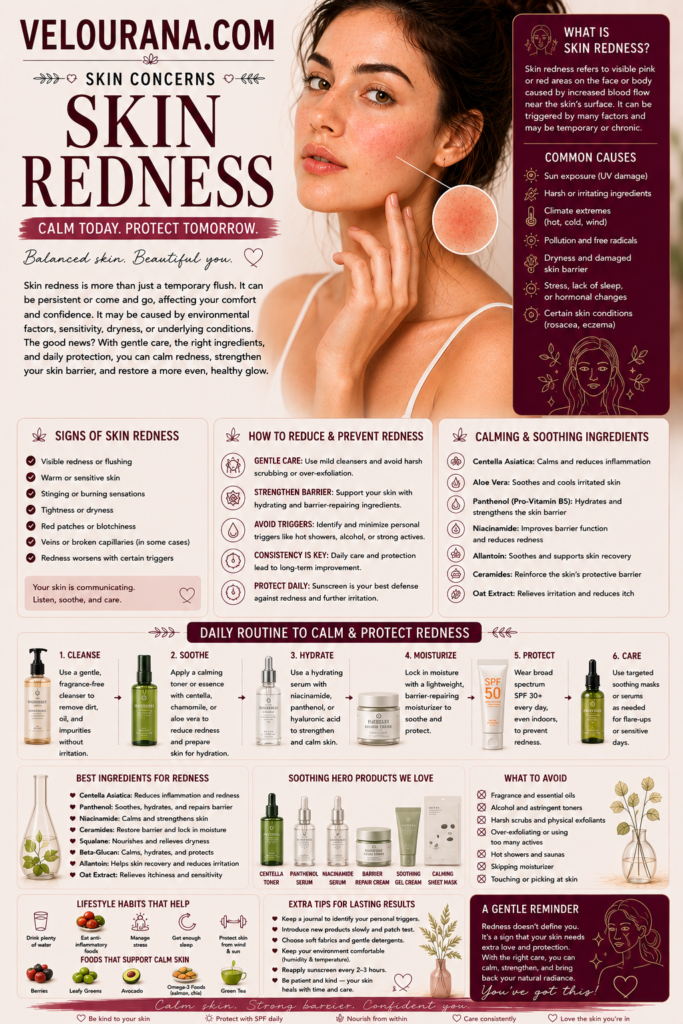
CATEGORY: Skin Redness
A face can change color remarkably quickly. Step into a hot room, finish a difficult workout, become embarrassed, drink something hot, or apply the wrong skincare product, and a previously even complexion may become visibly flushed within minutes. At other times, redness develops almost imperceptibly. The cheeks begin looking slightly pinker each week, the area around the nose seems permanently colored, or a complexion that once tolerated almost anything becomes increasingly reactive.
Because the visible result is similar, it is tempting to treat every red face as the same problem. Yet facial redness can arise through several different biological pathways. Blood vessels may temporarily widen. Inflammation may increase circulation in irritated tissue. The protective skin barrier may become compromised, allowing ordinarily tolerable substances to provoke discomfort. Immune responses may become involved. Repeated environmental exposure can influence both inflammation and visible vascular changes. In some people, an underlying dermatological condition produces a persistent tendency toward redness and flushing.
Understanding these mechanisms matters because effective skin care depends less on the color itself than on what is producing it.
Redness after a run does not require the same response as redness caused by repeated over-exfoliation. Skin that burns whenever moisturizer is applied presents a different problem from cheeks that flush after entering a warm restaurant. Persistent redness accompanied by visible vessels or recurring bumps deserves a different level of attention again.
The face may look red in all of these situations, but the skin is telling several different stories.
The Blood Vessels Beneath the Complexion
The skin contains an extensive network of blood vessels responsible for supplying oxygen and nutrients, removing metabolic waste, supporting healing, participating in immune responses, and helping regulate body temperature.
Many of these vessels are microscopic, but changes in their diameter and blood flow can influence what we see at the surface.
When superficial vessels widen, more blood occupies the area. Depending on skin tone and the depth and distribution of the vessels, this can become visible as pinkness, redness, or flushing.
The technical process of blood-vessel widening is known as vasodilation.
Vasodilation is not automatically evidence of a skin problem. It is a normal physiological tool. When the body becomes hot, increasing blood flow near the surface helps transfer heat away from deeper tissues. This is one reason the face may become red during exercise or in warm weather.
Emotion can also influence vascular activity. Embarrassment, anxiety, anger, excitement, and other intense states can activate nervous-system responses that alter facial blood flow. The resulting blush can occur so rapidly that it seems almost disconnected from conscious control.
In many circumstances, it is.
This helps explain why telling someone not to blush is about as useful as telling them not to sweat. These responses are influenced by systems that operate largely outside voluntary control.
The important distinction is what happens afterward.
Normal physiological flushing generally diminishes once the trigger passes and temperature, circulation, or emotional arousal returns toward baseline. When flushing becomes unusually frequent, intense, uncomfortable, or slow to disappear, other factors may be contributing.
Why Heat Makes Redness So Visible
Temperature is among the most powerful everyday influences on facial color.
When the body needs to release heat, blood vessels near the skin can widen. The face contains a rich vascular network and may therefore show the effect dramatically.
Exercise combines several redness-promoting factors at once. Body temperature rises, heart rate increases, circulation changes, and sweat production increases. A red face during vigorous exercise can consequently be completely ordinary.
The same basic process can occur in a hot shower, sauna, steam room, overheated building, or sunny outdoor environment.
The intensity varies considerably between individuals.
Some people finish a workout with barely noticeable pinkness. Others become bright red across the cheeks, forehead, ears, neck, and chest. The difference does not automatically indicate that the second person has unhealthy skin.
Problems arise when normal vascular responses overlap with existing sensitivity or inflammatory tendencies. Heat can intensify burning or discomfort in already irritated skin. It can also be a prominent trigger for people with certain redness-associated conditions.
Extremely hot water deserves particular attention because it combines heat with a skincare activity performed directly on the face. Someone may carefully select gentle products yet wash with water hot enough to provoke intense flushing every morning and evening.
The solution is not necessarily ice-cold water.
Extreme cold can be uncomfortable and may produce its own vascular responses. Comfortable lukewarm water is generally a more sensible choice for redness-prone or reactive skin.
Temperature moderation is rarely glamorous enough to become a beauty trend, but it can matter more than another bottle marketed as a redness solution.
Inflammation Changes More Than Color
Not all redness is simply a matter of blood vessels responding to temperature.
Inflammation is another fundamental pathway.
Inflammation is part of the body's protective response to injury, infection, irritation, and other perceived threats. It involves complex signaling between skin cells, blood vessels, and immune components.
Increased local blood flow is part of this response, which is why inflamed tissue often appears red and feels warm. Swelling, tenderness, itching, burning, or pain may occur depending on the cause and severity.
In skincare, mild inflammation can be surprisingly easy to provoke.
A strong exfoliating treatment may irritate the skin. A cleanser may remove more protective lipids than the complexion comfortably tolerates. Friction from repeated rubbing can produce mechanical irritation. A product may trigger contact dermatitis. Sunburn creates an inflammatory response after excessive ultraviolet exposure.
The resulting redness may look superficially similar to ordinary flushing, but accompanying sensations often provide clues.
A physiologically flushed face after exercise may feel hot because the entire body is hot, yet it should generally settle. Irritated skin may feel persistently tight, sting when products are applied, become rough or flaky, and remain red after the original trigger is gone.
Inflammation also changes skin behavior.
Products that normally feel comfortable may begin to sting. Makeup can sit differently on dry or rough areas. Cleansing may become uncomfortable. Wind and cold can suddenly feel harsher.
This is why treating only the color misses the point.
When inflammation is driving redness, the priority is not simply to make the complexion appear less red. It is to identify and reduce whatever is keeping the inflammatory process active.
The Skin Barrier and the Threshold of Tolerance
The outer surface of the skin may look simple, but it performs an extraordinarily sophisticated protective function.
The stratum corneum, the outermost layer of the epidermis, consists of specialized cells embedded within an organized lipid environment. Together, they help reduce excessive water loss and limit penetration of external substances.
This protective barrier influences how resilient the skin feels.
When it is functioning well, the complexion can often tolerate ordinary cleansing, weather changes, cosmetics, and active ingredients without excessive reaction. When it becomes compromised, the threshold for irritation can fall dramatically.
This explains a phenomenon that confuses many skincare users: the routine has not changed, but suddenly everything burns.
The product may be exactly the same.
The skin receiving it is not.
Barrier disruption can develop through repeated exposure to irritating products, over-cleansing, excessive exfoliation, environmental dryness, friction, sun exposure, or combinations of several stressors.
A common pattern begins innocently.
Someone wants smoother skin and introduces an exfoliating acid. Results are encouraging, so the product is used more frequently. A retinoid is then added for another concern. A strong cleanser is already being used because the skin is considered oily. Perhaps an exfoliating mask appears once or twice a week as well.
Each individual product may be entirely legitimate.
The combined routine may exceed the skin's tolerance.
Initially there may be mild tightness. Then moisturizer begins to sting. The nose becomes flaky. Foundation catches around the mouth. Finally, the cheeks remain red throughout the day.
At that stage, searching for another powerful treatment can perpetuate the problem.
The skin's tolerance threshold has been crossed.
Restoring stability often requires reducing the burden rather than adding another intervention.
Why Over-Exfoliation Creates a Characteristic Kind of Redness
Exfoliation occupies an unusual place in skincare culture because visible effects can appear quickly.
Removing or loosening surface cells can make skin feel smoother and look brighter. This immediate reward encourages frequent use.
But exfoliation is not a process that becomes indefinitely more beneficial as intensity increases.
Chemical exfoliants such as alpha hydroxy acids and beta hydroxy acids can be useful when matched appropriately to the skin and concern. Physical exfoliation can also alter surface texture. Problems arise when frequency, concentration, combinations, or mechanical pressure become excessive.
Over-exfoliated skin may appear shiny in an unhealthy, tight way rather than naturally luminous. It may become red, sensitive, dry, flaky, or unusually reactive. Products can sting. Areas around the mouth and nose may become particularly uncomfortable.
One of the traps is that irritated surface texture can itself feel rough.
The person then exfoliates again because the skin feels uneven, intensifying the cycle.
This illustrates why texture should never be interpreted in isolation.
Roughness can arise from accumulated surface cells, but it can also accompany dryness and irritation. Treating both situations identically is unlikely to produce the same outcome.
A useful skincare routine respects the possibility that a treatment can be effective at one frequency and irritating at another.
There is no prize for reaching the highest concentration or using an active ingredient every night.
The best frequency is the one that produces the intended benefit while remaining sustainable for the individual skin.
Cleansing Can Alter the Entire Redness Picture
Cleansing rarely receives the same attention as serums and treatments, yet it establishes the conditions into which every subsequent product is applied.
A cleanser interacts with oils, sweat, sunscreen, makeup, environmental particles, and components of the skin's surface. Surfactants help lift and disperse oily material so it can be rinsed away.
The challenge is selectivity.
Cleansing should remove what needs to be removed without unnecessarily disrupting the protective surface environment.
For redness-prone skin, several aspects of cleansing can become relevant at once: formulation, frequency, water temperature, duration, and physical technique.
A perfectly reasonable cleanser can become irritating when used too frequently. A gentle formula can still be accompanied by vigorous rubbing. A carefully designed routine can be undermined by extremely hot water.
The feeling immediately after cleansing is informative.
Skin does not need to feel coated or greasy, but persistent tightness, burning, or an urgent need to apply moisturizer may suggest that cleansing deserves reconsideration.
Morning cleansing is particularly individual.
Some people prefer a full cleanse because they produce significant oil overnight or use products that they want to remove in the morning. Others with dry, reactive skin may find that rinsing gently with water or using a minimal cleansing approach is more comfortable.
The point is not to establish a universal rule.
It is to stop assuming that more cleansing automatically means better hygiene or healthier skin.
For a complexion struggling with redness, every repeated source of unnecessary irritation matters.
Why the Same Product Affects Different People Differently
Skincare discussions often treat ingredients as though they have fixed personalities.
An ingredient is described as soothing, harsh, hydrating, irritating, safe, or dangerous.
Reality is more conditional.
Concentration matters. Formulation matters. pH may matter. The delivery system matters. Other ingredients in the formula matter. Frequency matters. The condition of the skin matters. Individual susceptibility matters.
This is why two people can use the same product and report completely different experiences without either person being mistaken.
One may find a formula exceptionally comfortable. Another may experience stinging and redness.
The same person can even have different experiences with the same product at different times.
A moisturizer applied to healthy skin may feel completely neutral. Applied after excessive exfoliation or sun exposure, it may sting because the skin is more vulnerable.
This variability makes simplistic ingredient blacklists unreliable.
It also explains why a product described as being for sensitive skin is not guaranteed to suit every sensitive complexion. Such positioning can be useful, particularly when the formulation has been designed to minimize common sources of irritation, but individual tolerance still matters.
The practical lesson is more moderate: observe the skin rather than forcing it to conform to the reputation of an ingredient.
If a celebrated product repeatedly causes significant discomfort, its popularity does not make the reaction irrelevant.
If a supposedly ordinary product keeps the skin comfortable and stable, it does not need fashionable ingredients to justify its place in the routine.
Sunlight Can Influence Both Immediate and Long-Term Redness
Sun exposure deserves a central place in any serious discussion of facial redness.
Ultraviolet radiation can produce acute inflammation when exposure becomes excessive. Sunburn is the obvious example: the skin becomes red, hot, painful, and sometimes swollen or blistered.
But the relationship between sunlight and redness extends beyond obvious burning.
Repeated ultraviolet exposure contributes to changes in the skin over time, including alterations that can make surface vessels more noticeable. Sun exposure may also aggravate certain inflammatory skin conditions.
This makes daily photoprotection particularly relevant for people concerned about persistent facial redness.
Sunscreen is the most obvious topical component, but practical sun protection is broader. Shade, hats, clothing, and decisions about when and how long to remain in strong sunlight all reduce exposure.
For sensitive skin, sunscreen can itself become a source of frustration.
Some formulas sting, particularly around the eyes or when applied to compromised skin. Others feel heavy, dry, or uncomfortable. This sometimes leads people to conclude that sunscreen is incompatible with reactive skin.
More often, it means the specific formulation is incompatible with that particular person.
Finding a sunscreen that is comfortable enough to use consistently can require experimentation. The most theoretically elegant formula offers little practical protection if someone avoids applying it because the experience is unpleasant.
Comfort and adherence are part of effectiveness.
Cold Weather Produces a Different Kind of Stress
Winter redness can seem contradictory.
The air is cold, yet the cheeks may burn and look intensely red.
Several factors can converge.
Cold outdoor air is often dry. Wind increases environmental exposure. Indoor heating lowers humidity further. The skin may lose water more readily, contributing to dryness and barrier stress.
Then comes the transition from cold outdoors to warm interiors.
Blood vessels adjust rapidly to the temperature change, and flushing may become pronounced.
Repeated throughout the day, this cycle can leave reactive skin feeling uncomfortable even when no new skincare products have been introduced.
Winter routines may therefore need to emphasize barrier support and protection from environmental exposure more than summer routines.
This does not necessarily require completely replacing every product twice a year. Sometimes a richer moisturizer, reduced exfoliation frequency, or more careful attention to cleansing is sufficient.
The larger lesson is that skin exists in an environment.
A routine that worked beautifully in humid summer conditions may become inadequate during a cold, dry winter. The change does not mean the products suddenly became poor quality.
The context changed.
Stress, Emotion, and the Nervous System
Facial flushing has an unusually intimate relationship with emotion.
Embarrassment is the classic example, but anxiety, anger, excitement, social pressure, and stress can all influence facial color.
This can become psychologically difficult because redness itself may create additional self-consciousness.
A person notices that the face is becoming red, worries that other people can see it, becomes more anxious, and flushes more strongly. The biological reaction and emotional interpretation begin reinforcing each other.
The solution is not to tell someone that the redness is imaginary.
It is visibly real.
But understanding the mechanism can reduce the tendency to interpret every emotional flush as evidence of damaged skin.
Nervous-system activity can alter vascular behavior rapidly. A complexion that flushes during a presentation and returns to normal afterward may be demonstrating physiological reactivity rather than a skincare failure.
Persistent stress can also influence habits indirectly. People may sleep poorly, touch the face more frequently, change routines impulsively, or neglect consistent skincare.
Separating emotional flushing from inflammatory irritation helps prevent inappropriate treatment.
An acid cannot exfoliate away a nervous-system response.
Nor should someone attempt to suppress every normal physical sign of emotion in pursuit of an artificially static complexion.
Food, Drink, and Individual Triggers
Certain foods and beverages are frequently discussed in connection with facial flushing.
Spicy foods, hot drinks, and alcohol are commonly reported triggers in susceptible individuals. Yet the degree of response varies enormously.
A person who notices no relationship between a particular food and their complexion has little reason to eliminate it simply because it appears on a generic list of redness triggers.
This principle matters because trigger avoidance can become excessive.
Once someone begins searching for the cause of persistent redness, almost everything can start looking suspicious: coffee, tomatoes, dairy, chocolate, spices, exercise, sunlight, hot showers, cold weather, stress, skincare, makeup.
A long list is not the same as an explanation.
Patterns should be personal and reproducible.
If the complexion repeatedly flushes after the same trigger under similar circumstances, that information is useful. If the relationship appears once and never again, coincidence remains possible.
Dietary restriction should not become the default cosmetic treatment for unexplained redness.
When food-related symptoms are significant, complex, or associated with other health concerns, professional guidance is more appropriate than constructing a restrictive diet from beauty advice.
Persistent Redness and Visible Blood Vessels
Temporary vasodilation explains many episodes of flushing, but some vascular changes become more persistent.
Fine visible vessels may appear around the nose, cheeks, or other areas of the face. They are sometimes casually described as “broken capillaries,” although the everyday phrase does not precisely describe every visible vascular change.
Topical skincare has limitations here.
A moisturizer can improve dryness surrounding visible vessels. Sunscreen can help reduce additional ultraviolet stress. Gentle skincare can prevent irritation from making the surrounding complexion appear even redder.
But a cream cannot simply erase established visible vessels in the way makeup can temporarily conceal them.
Professional procedures may be considered in appropriate cases, depending on the type of vascular change, skin characteristics, medical history, and professional assessment.
This is an important example of realistic skincare expectations.
Consumers can spend enormous amounts of money trying progressively more expensive serums because advertising implies that persistent vascular redness should disappear with topical treatment.
Sometimes the biology of the concern lies outside what cosmetics can reasonably change.
Knowing those limits is not pessimistic.
It prevents wasted effort and repeated irritation.
When Redness Appears With Bumps or Breakouts
Redness and acne often overlap because inflammatory blemishes are themselves red.
But not every red bump is acne.
This distinction becomes particularly important in the central face, where several inflammatory conditions can resemble one another superficially.
A person may see red bumps and respond with increasingly aggressive acne products: stronger exfoliation, drying cleansers, benzoyl peroxide, multiple acids, or frequent spot treatments.
If acne is truly the problem, appropriately selected treatments may be useful.
If another condition is responsible, aggressive self-treatment can intensify irritation.
Distribution, symptoms, persistence, and professional examination can help distinguish these possibilities.
The same caution applies when redness is accompanied by scaling.
Flaking around the nose, eyebrows, scalp margins, or other characteristic areas may have different causes from generalized dryness. Applying more and more exfoliant because the skin is flaky can again worsen the underlying problem.
Appearance provides clues, but not certainty.
When symptoms repeatedly return despite sensible routine adjustments, diagnosis becomes more valuable than experimentation.
A Rational Way to Investigate Unexplained Redness
When facial redness begins without an obvious explanation, the most useful response is systematic rather than dramatic.
Consider what changed before the problem appeared.
A new cleanser may have been introduced. Exfoliation frequency may have increased. A retinoid may have been added. The weather may have become colder. A holiday may have involved substantial sun exposure. A new foundation, fragrance, hair product, or laundry product may be contacting the skin.
Sometimes several changes occurred simultaneously.
This is one reason introducing many new skincare products at once makes troubleshooting difficult.
Simplification creates clarity.
A basic routine of gentle cleansing, moisturizer, and appropriate daytime sun protection can reduce unnecessary variables while allowing irritated skin to settle. Products that are clearly associated with irritation can be stopped.
The goal is not to permanently abandon every active ingredient.
It is to establish whether the skin improves when unnecessary stressors are removed.
Once stability returns, products can be reintroduced thoughtfully where appropriate.
If redness does not improve, repeatedly returns, or is accompanied by symptoms suggesting an underlying condition, professional assessment becomes increasingly important.
This approach replaces guesswork with observation.
Why “Anti-Redness” Should Not Mean Anti-Skin
The desire to remove redness can become so strong that the complexion is treated as though visible circulation itself were a defect.
That is an impossible standard.
Healthy living skin responds.
It changes temperature. It changes blood flow. It reacts to sunlight. It participates in immune defense. It communicates injury through inflammation. It flushes during physical exertion and sometimes during emotion.
The objective of redness care is therefore not to prevent every visible change.
It is to distinguish proportionate responses from problematic ones.
A temporary flush after exercise belongs to normal physiology. Persistent burning after cleansing suggests irritation. Increasing sensitivity following an aggressive active routine suggests that tolerance may have been exceeded. Long-standing central facial redness with recurrent flushing may justify dermatological evaluation.
Once these distinctions are understood, skincare becomes more intelligent.
Instead of asking only how to remove the color, we begin asking what process produced it.
Understanding the Signal Changes the Strategy
Redness is best understood as a visible signal generated by systems beneath the surface.
Sometimes that signal says the body is hot.
Sometimes it reflects emotion.
Sometimes the skin barrier has been stressed.
Sometimes inflammation is active.
Sometimes environmental exposure is contributing.
Sometimes persistent vascular or dermatological changes are involved.
And sometimes several mechanisms operate together.
This complexity is precisely why a universal redness remedy does not exist.
The most effective strategy begins by respecting the skin's biology. Cleanse without unnecessary aggression. Protect the barrier rather than constantly challenging it. Introduce active ingredients according to tolerance rather than ambition. Take sun exposure seriously. Notice environmental and personal triggers without allowing trigger avoidance to become obsessive.
Above all, recognize when the pattern has moved beyond ordinary cosmetic sensitivity.
Persistent, painful, worsening, or otherwise concerning redness deserves appropriate professional evaluation rather than endless experimentation with products.
A red face is not automatically unhealthy, just as an even complexion is not automatically healthy.
What matters is the behavior of the skin: whether reactions are temporary or persistent, comfortable or painful, understandable or unexplained.
Once the mechanism becomes the focus, redness stops being merely a color to correct.
It becomes information.
And reading that information carefully is one of the most useful things anyone with redness-prone skin can learn to do.
The End Velourana
 Discover More From Our Family of Websites
 ZodiacBearing (Astrology, Tarot, Numerology, Angel Numbers & Spiritual Guidance)
 Velourana (Beauty, Makeup, Hair Care, Skincare & Beauty Tips)
 HavenBearing (Home, Living, Organization, Décor & Everyday Inspiration)
 PawBearing (Pet Care, Dog Breeds, Animal Health, Training & Pet Products)
 PsyCatherine (Notes From the Journal of a Psychologist on Real Life)

