
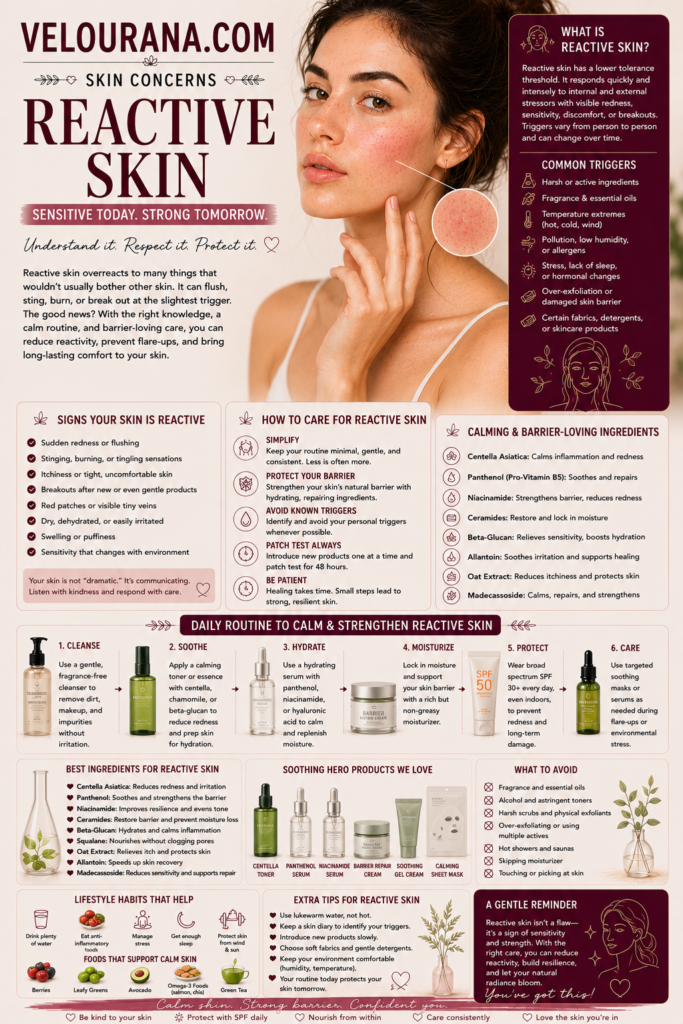
CATEGORY: Reactive Skin
Reactive skin can make ordinary skincare feel strangely unpredictable. A cleanser that seemed perfectly comfortable last month suddenly leaves the cheeks warm. A moisturizer that has been used without difficulty begins to sting. Cold wind produces redness within minutes; entering a heated room intensifies it. A new serum causes discomfort before there is anything dramatic to see in the mirror. Sometimes the reaction is obvious, with flushing, dryness or visible irritation. At other times, the skin looks almost unchanged while burning, tingling, itching or tightness makes it very clear that something is wrong.
This unpredictability is one of the defining frustrations of reactive skin. It encourages people to think of their complexion as temperamental, inconsistent or somehow impossible to understand. Yet reactivity is rarely as random as it appears. The difficulty is that skin is responding not to a single variable but to the accumulated circumstances surrounding it: the condition of its barrier, the products recently applied, environmental exposure, temperature, cleansing habits and individual sensitivity.
Sensitive-skin research reflects this complexity. Sensitive skin is generally described as a syndrome involving unpleasant sensations such as stinging, burning, pain, itching or tingling in response to stimuli that would not ordinarily be expected to provoke those sensations. Visible changes may accompany them, but they are not required. Research also suggests that barrier function, cutaneous nerve signalling and other mechanisms can contribute, while triggers vary considerably among individuals.
Understanding reactive skin therefore begins with abandoning the expectation that every episode must have one obvious culprit. The more useful question is not simply, What product caused this? It is, What condition was my skin in when this happened, and what combination of exposures may have pushed it beyond what it could comfortably tolerate?
That shift changes skincare from a constant search for miracle ingredients into something quieter and considerably more useful: learning the limits of the skin in front of you.
Reactive Skin Is a Pattern, Not a Personality
Calling skin “reactive” is useful because it describes behaviour. It does not, by itself, identify a single medical condition or one universal biological state.
A reactive complexion is one that responds readily to exposures that other people—or the same person at another time—may tolerate without difficulty. Those responses can include redness, warmth, burning, stinging, itching, tightness and general discomfort. Some people notice mainly visible flushing. Others experience sensations much more strongly than visible redness.
This distinction matters.
People often judge irritation entirely through appearance. If the skin is not dramatically red, swollen or peeling, they assume that a product must be harmless. But sensation can be meaningful even when the mirror reveals very little. Sensitive-skin literature specifically recognizes that unpleasant sensory experiences can occur without visible lesions.
The opposite is also important. Redness does not automatically mean “reactive skin.” Persistent or recurrent facial redness can occur in conditions including rosacea, eczema, seborrhoeic dermatitis and contact dermatitis. The American Academy of Dermatology notes that rosacea can be mistaken for other skin problems and recommends dermatological assessment when its characteristic symptoms are suspected.
Reactive skin is therefore best approached initially as a pattern that needs interpretation rather than a diagnosis that explains everything.
That pattern may be relatively stable in one person and highly changeable in another. Someone may know that wind reliably makes their cheeks sting. Another person may tolerate almost everything during summer but become extremely reactive during winter. Someone else may react primarily when several active products are combined.
This variability explains why copying another person's “sensitive skin routine” is often disappointing. Two complexions can produce similar redness for entirely different reasons and therefore have very different tolerances.
The goal is not to discover the single routine that all reactive skin should follow. It is to understand what repeatedly increases or decreases your skin's tolerance.
The Skin Barrier and the Threshold of Tolerance
The outermost layers of skin are frequently discussed as though the skin barrier were simply a wall. The analogy is useful, but incomplete.
Healthy skin has to perform two seemingly contradictory jobs. It must provide protection from the external environment while simultaneously interacting with that environment. It helps limit excessive water loss while encountering cleansers, cosmetics, sweat, pollution, microorganisms, ultraviolet radiation, changing humidity and changing temperatures.
When this protective system is functioning comfortably, everyday exposures may pass almost unnoticed. When its condition is compromised, experiences that previously seemed trivial can become irritating.
This is why reactive skin is often better understood through the idea of a tolerance threshold.
Imagine that the skin can comfortably accommodate a certain amount of stress. Gentle cleansing may use a little of that capacity. Cold weather may use more. Dry indoor heating may add another burden. An exfoliating product might still be tolerated when everything else is calm.
But combine all of them at once and the situation changes.
The cleanser has not necessarily become harsher. The weather has not necessarily become extreme. The exfoliant has not necessarily become intrinsically unsuitable. The cumulative exposure has simply exceeded what the skin could tolerate at that particular moment.
This helps explain one of the most confusing experiences in skincare: “I have used this product for months. Why does it suddenly sting?”
Previous tolerance does not guarantee present tolerance.
Skin condition changes. Weather changes. Product combinations change. Frequency of cleansing changes. Sun exposure changes. The use of exfoliating acids or retinoids changes. Even the amount of friction involved in removing makeup can vary from one evening to another.
Research on sensitive skin also indicates that barrier abnormalities may be associated with the condition, although the biology is more complicated than simply equating sensitive skin with a damaged barrier. Neural mechanisms appear relevant as well.
That nuance is important because “repair your barrier” has become such a common skincare phrase that it can sound like a complete explanation for every episode of sensitivity.
It is not.
Barrier-conscious care is extremely useful, but reactive skin cannot always be reduced to one structural defect waiting to be repaired. The experience may involve interactions among barrier function, sensory nerves, environmental triggers and individual physiology.
What the threshold model does provide is a practical way to think.
When skin becomes unusually reactive, the first response does not always need to be adding something. Often the more intelligent move is reducing the total amount of stress being placed upon it.
Why Reactions Can Feel So Immediate
One of the distinctive characteristics of reactive skin is speed.
A product touches the face and within moments there is tingling. Cold air reaches the cheeks and they begin to sting. A warm room produces flushing. Sunscreen that seemed promising causes an uncomfortable burning sensation almost immediately.
These experiences can make it tempting to interpret every sensation as an allergy.
Yet irritation, sensitivity and allergy are not interchangeable concepts.
Sensitive skin can involve rapid unpleasant sensations after exposure to physical or chemical triggers. A systematic review examining sensitive-skin triggers found cosmetics particularly prominent, while temperature changes, heat, cold, wind, sunlight, air conditioning, humidity, dry air, water, pollution and emotional factors were also reported.
An allergic contact reaction is different and involves an immune response to a particular substance. Determining the cause can sometimes require formal patch testing by a dermatologist.
This distinction matters because otherwise people can end up constructing enormous personal “allergy lists” based on every product that ever caused discomfort. A formula may sting because the skin was already irritated. Another may be intrinsically too aggressive for that individual. Another reaction may relate to fragrance or another ingredient. Still another may coincide with an underlying dermatological condition.
The sensation is real; the explanation requires more care.
Reactive skin is also one reason why the familiar skincare idea that tingling means a product is “working” deserves skepticism.
There are situations in which certain ingredients can produce expected transient sensations, but discomfort should not automatically be interpreted as evidence of effectiveness. Burning is not a performance indicator. Persistent irritation is not proof that the skin is being transformed more rapidly.
For someone whose skin already has a low threshold for stimulation, deliberately tolerating repeated discomfort can make it harder to determine what the complexion actually accepts.
Comfort is not laziness in skincare.
For reactive skin, comfort is useful information.
The Environment Is Part of Your Skincare Routine
A bathroom shelf receives most of the attention when people investigate reactive skin, but the surrounding environment may be equally important.
Wind can increase discomfort. Cold conditions can make skin feel dry and tight. Heat can encourage flushing. Air conditioning and dry indoor environments may contribute to discomfort. Rapid transitions between temperatures can be particularly noticeable for some people.
These environmental associations are well documented in sensitive-skin research.
This means that a skincare routine cannot always be evaluated independently of season and location.
A routine that feels beautifully balanced during a mild spring may become insufficient during a windy winter. A rich routine that feels protective in cold weather may feel uncomfortable during a hot summer. Someone travelling between different climates may suddenly believe their products have stopped working when the more important change is environmental.
Sun exposure deserves particular attention when redness is involved. Ultraviolet exposure can aggravate several redness-prone conditions, and dermatological guidance for rosacea places substantial emphasis on daily sun protection. The American Academy of Dermatology recommends broad-spectrum SPF 30 or higher for rosacea-prone skin and notes that mineral filters such as zinc oxide and titanium dioxide may be less irritating for some sensitive complexions.
This does not mean every reactive complexion must use exactly the same sunscreen formula. Sunscreen tolerance is highly individual, and an elegant formula that someone will actually apply consistently is more useful than a theoretically perfect product that feels unbearable.
The broader lesson is that protection matters.
Reactive skin often benefits from reducing unnecessary exposure rather than constantly trying to correct the consequences afterwards. Shade, appropriate clothing and sensible sun habits can therefore belong to the same strategy as cleanser and moisturizer.
The environment cannot be eliminated, but its effects can be anticipated.
That is an important distinction. Reactive skin becomes much easier to live with when skincare moves from repeatedly extinguishing flare-ups to recognizing the circumstances in which they are most likely to occur.
When an Elaborate Routine Becomes Too Much
Modern skincare culture celebrates abundance.
There is always another serum, another acid, another toner, another mask, another treatment and another ingredient promising a more refined complexion. For people who enjoy skincare, experimentation can be part of the pleasure.
Reactive skin changes the equation.
Every additional formula introduces another set of ingredients and another interaction with the skin. Every additional cleansing or application step introduces more physical handling. Every new active makes it slightly more difficult to identify the source of a reaction if something goes wrong.
Complexity therefore has a hidden cost: diagnostic noise.
Suppose someone uses a cleanser, exfoliating toner, antioxidant serum, hydrating essence, treatment serum, moisturizer, facial oil and sunscreen in the morning. By evening, redness and stinging appear.
Which product caused it?
Perhaps none of them independently.
Perhaps one did.
Perhaps two otherwise tolerable products became irritating together.
Perhaps the skin had been exposed to wind.
Perhaps yesterday's exfoliation lowered today's tolerance.
Perhaps the cleanser was used with water that was much hotter than usual.
With eight products in the equation, finding the answer becomes difficult.
A simpler routine gives reactive skin something valuable: clarity.
This does not mean minimalism must become a permanent ideology. It means that when the skin is unstable, reducing variables makes its behaviour easier to interpret.
A mild cleanser, moisturizer and appropriate sun protection can form a useful baseline. Additional products can then earn their place gradually rather than being assumed necessary from the beginning.
This approach also challenges the belief that every skin concern must be treated simultaneously.
Someone may want brighter skin, smoother texture, fewer blemishes, less pigmentation, smaller-looking pores, firmer skin and fewer fine lines. Those goals are understandable. Trying to attack all of them aggressively while the skin is actively reactive may be counterproductive.
Stability can be a skincare objective in its own right.
Once the complexion is comfortable and predictable, there is more room for strategic treatment. When it is repeatedly burning and flushing, chasing five secondary goals at once often creates more confusion than progress.
Cleansing Without Turning Cleanliness Into Aggression
Cleansing is necessary, but reactive skin often exposes the difference between cleaning skin and repeatedly stripping it.
The face accumulates sunscreen, makeup, oil, sweat and environmental residue. These need to be removed appropriately. Yet the sensation of extreme squeaky cleanliness is not necessarily evidence of superior cleansing.
For reactive skin, it can instead be a warning.
Very hot water, aggressive surfactants, prolonged washing, cleansing brushes, rough washcloths and vigorous towel drying can transform an ordinary hygiene step into repeated mechanical and chemical stress.
Dermatological guidance for redness-prone rosacea similarly emphasizes gentle cleansing with fingertips and avoiding rubbing, scrubbing, facial sponges and other forms of unnecessary friction.
Technique therefore matters almost as much as formula.
Consider how differently the same cleanser can be used. One person massages it gently for a short period with lukewarm water and pats the skin dry. Another uses hot water, massages vigorously, repeats the cleanse and rubs the face with a towel.
The bottle is identical.
The experience of the skin is not.
This is particularly relevant for people who respond to irritation by cleaning more aggressively because they assume something “bad” must be sitting on the surface. Unless there is a specific reason to remove a substance, repeatedly washing already irritated skin may simply add another stressor.
Reactive skin often responds better to precision than force.
Use enough cleansing to accomplish the purpose. Remove the cleanser thoroughly. Handle the skin gently. Then stop.
That principle sounds almost too simple for an industry filled with elaborate routines, yet simplicity is precisely what makes it powerful.
Moisturizing as Support Rather Than Rescue
Moisturizer is often treated as the least glamorous member of a skincare routine.
Actives transform. Serums target. Exfoliants resurface. Moisturizer merely moisturizes.
For reactive skin, that hierarchy deserves reconsideration.
A well-tolerated moisturizer can support hydration, reduce uncomfortable dryness and provide an environment in which the skin is exposed to fewer unnecessary challenges. Dermatologists also recommend regular moisturizing as part of gentle care for rosacea-prone sensitive skin.
The best moisturizer for reactive skin, however, is not automatically the richest or the one carrying the longest list of “soothing” ingredients.
Tolerance matters more than marketing language.
A beautifully formulated cream containing numerous botanical extracts may still be unsuitable for a particular person. A relatively plain moisturizer may perform exceptionally well precisely because it asks little of the skin.
Texture matters too.
Some people with reactive skin are also dry and appreciate richer creams. Others are oily or acne-prone and dislike heavy occlusion. Sensitive skin can occur alongside different underlying skin types, which is another reason that “sensitive” should not be treated as though it automatically means “dry.”
What matters is whether the moisturizer leaves the skin feeling comfortable without introducing recurring burning, itching, congestion or other problems.
There is also value in resisting the temptation to switch constantly.
When someone finds a basic moisturizer that is consistently tolerated, it can become an anchor product—a reliable constant against which other changes can be judged.
That reliability is particularly useful during periods of reactivity.
When the skin is upset, familiarity can be more valuable than novelty.
Learning Your Triggers Without Becoming Afraid of Everything
Reactive skin can gradually make someone suspicious of skincare itself.
After enough disappointing experiences, every ingredient begins to look dangerous. Ingredient lists are examined as though they are crime scenes. Entire families of ingredients are eliminated because one formula once caused redness.
Caution is useful. Fear is not.
The objective is to identify patterns with enough discipline that genuine triggers become clearer.
One of the best ways to do this is to change fewer variables at a time.
When introducing a new product, resist introducing three others during the same week. If irritation appears, you want the investigation to be manageable.
Patch or usage testing can also provide useful information. The American Academy of Dermatology recommends testing a new skincare product on a small area twice daily for seven to ten days before broader use, while noting that formal dermatological evaluation may be necessary when the cause of reactions remains unclear.
Even testing has limitations. Facial skin may behave differently from the arm, and delayed or cumulative irritation is possible. But methodical introduction is still far more informative than applying an entirely new routine at once.
Keeping a simple mental or written record can reveal associations that would otherwise be missed.
Did the redness begin after introducing a product?
Was the weather unusually cold?
Had the skin been exfoliated the previous evening?
Was there prolonged sun exposure?
Did the reaction occur immediately or the following day?
Did stopping the suspected product improve things?
Did the same reaction happen when the product was tried again?
Patterns matter more than isolated events.
This is also why ingredient avoidance should be individualized. Fragrance, alcohol, menthol, camphor and certain exfoliating ingredients are among substances dermatologists may advise rosacea patients to avoid because they can be irritating. But an ingredient's presence does not tell the entire story of a formula, and not every reactive complexion responds identically.
A personal trigger is more useful information than an internet blacklist.
The purpose of observation is not to reduce the routine until nothing remains. It is to create enough stability that choices become informed rather than anxious.
The Temptation to Treat Redness Aggressively
Visible redness creates urgency.
When the face looks inflamed, people naturally want to do something. This can lead to rapid product switching, masks, exfoliation, spot treatments and multiple “calming” serums applied one after another.
Reactive skin often needs the opposite mindset.
Before treating redness, consider whether the skin is asking for treatment or simply for fewer provocations.
If a reaction follows the introduction of an optional cosmetic product, discontinuing that product may be more sensible than layering several additional formulas over it. If over-exfoliation appears to be contributing, another active is unlikely to compensate for the excess.
This is where skincare restraint becomes surprisingly sophisticated.
Doing less is not the same as doing nothing.
It can mean continuing gentle cleansing when necessary, maintaining moisturization, protecting the skin from ultraviolet exposure and temporarily reducing optional steps while observing what happens.
The idea is to lower the number of competing variables.
When the skin becomes comfortable again, products can be reconsidered gradually.
This strategy also prevents a common cycle:
The skin reacts.
More products are added to calm it.
One of the new products irritates it further.
More products are added.
Soon the original trigger is impossible to identify.
Reactive skin can turn skincare into a feedback loop unless someone deliberately interrupts it.
Sometimes the most effective intervention is subtraction.
When “Reactive Skin” May Be Something More
There is an important boundary between cosmetic guidance and medical diagnosis.
Persistent facial redness, repeated swelling, pronounced itching, scaling, painful burning, acne-like eruptions, visible blood vessels or symptoms affecting the eyes should not automatically be dismissed as ordinary sensitivity.
Rosacea is one example. It may begin with frequent flushing and can include persistent facial color changes, sensitive or burning skin, visible blood vessels and acne-like breakouts.
Contact dermatitis is another possibility when a particular substance produces an irritant or allergic reaction. Eczema and seborrhoeic dermatitis can also produce redness and discomfort.
This matters because the appropriate treatment for an underlying dermatological condition may be very different from simply purchasing products labelled for sensitive skin.
A dermatologist can examine the distribution and character of the reaction, review triggers and products, and determine whether additional investigation is appropriate. When allergic contact dermatitis is suspected, patch testing may help identify responsible allergens.
Seeking professional assessment is particularly sensible when reactions are severe, recurrent, progressively worsening, difficult to explain or resistant to a consistently gentle routine.
There is no prize for solving every skin problem through cosmetics alone.
Skincare is valuable, but it has limits. Recognizing those limits is part of taking skin seriously.
Building a Routine Around Predictability
The most successful relationship with reactive skin is rarely built around finding one extraordinary product.
It is built around predictability.
You know how your cleanser behaves.
You know how your moisturizer behaves.
You know which sunscreen your skin accepts.
You know that certain weather conditions require more protection.
You know that introducing multiple active products together is a bad experiment.
You know what early irritation feels like before it develops into a larger problem.
This knowledge accumulates slowly, but it is extremely valuable.
A stable routine can then become a platform rather than a prison. Once the skin is comfortable, additional products can be introduced thoughtfully according to genuine priorities.
Perhaps pigmentation is the next concern.
Perhaps fine lines matter.
Perhaps acne requires attention.
The difference is that these concerns are now being approached from a stable baseline.
This is especially important with ingredients that can be irritating when introduced too quickly. Potent skincare does not need to be abandoned forever simply because skin is reactive. But frequency, concentration, formulation, combination and individual tolerance matter.
The question becomes less absolute.
Instead of asking, “Can sensitive skin use this ingredient?” ask, “Does my skin tolerate this particular formula, at this frequency, alongside the rest of my routine?”
That is a much better skincare question because it acknowledges reality.
Products do not exist in isolation.
Neither does skin.
Reactive Skin Rewards Consistency More Than Constant Correction
Perhaps the most important change is psychological.
Reactive skin can make someone feel that they must constantly intervene. Every flush needs an answer. Every patch of tightness demands a new product. Every uncomfortable evening seems to require a complete redesign of the routine.
But constant correction creates constant change, and constant change makes patterns difficult to see.
Consistency gives skin—and the person caring for it—information.
If a simple routine is tolerated for several weeks, that becomes useful knowledge. If redness reliably appears after a certain type of exposure, that becomes useful knowledge. If a particular product repeatedly produces discomfort after otherwise stable periods, that becomes useful knowledge.
Over time, reactive skin becomes less mysterious because its patterns become more visible.
This does not mean every reaction can be prevented. Environmental conditions change. Bodies change. Dermatological conditions can emerge. Products themselves can be reformulated.
The aim is not perfect control.
It is a calmer relationship with uncertainty.
Sensitive-skin research itself supports the idea that reactivity is multifactorial and individualized rather than governed by one universal mechanism or management strategy. Expert literature emphasizes personalized management and avoidance of identified triggers rather than a single treatment suitable for everyone.
That may sound less exciting than a revolutionary ingredient, but it is considerably more empowering.
You do not need to make reactive skin completely unreactive in order to care for it well.
You need to understand what raises its burden, what lowers it, which products consistently feel comfortable and when symptoms deserve medical attention.
A Quieter Philosophy of Skincare
Reactive skin teaches an unexpectedly valuable lesson about skincare as a whole: more intervention is not automatically better care.
Skin does not measure the seriousness of a routine by the number of bottles involved.
It responds to what actually touches it, how often, in what combination and under what environmental circumstances.
For someone prone to redness and sensitivity, a sophisticated routine may therefore look surprisingly simple. Gentle cleansing. Reliable moisturization. Consistent sun protection. Carefully selected additional treatments. Thoughtful testing. Attention to environmental triggers. Less friction. Fewer simultaneous experiments.
Behind that simplicity is not a lack of ambition but a deeper understanding of what reactive skin requires.
The complexion that burns after an ordinary product is not necessarily being inexplicable. The cheeks that suddenly flush when moving between temperatures are not behaving without reason. The moisturizer that stings one week after months of comfortable use has not necessarily transformed overnight.
Skin exists in context.
Once that context becomes part of skincare, reactivity becomes easier to interpret.
And interpretation matters, because the long-term goal should not be to wage a permanent campaign against sensitive skin. It should be to create conditions in which the skin is asked to defend itself against fewer unnecessary challenges.
For reactive skin, progress may not announce itself dramatically.
It may appear as fewer evenings spent wondering what caused the burning.
Fewer products abandoned after one confusing week.
Fewer cycles of irritation followed by aggressive correction.
Less persistent redness.
More confidence about what the skin accepts.
More stability.
In a beauty culture that often equates transformation with intensity, reactive skin makes a persuasive argument for another kind of sophistication: knowing when enough is enough.
The End
Velourana
Batch Progress: 1/5
 Discover More From Our Family of Websites
 ZodiacBearing (Astrology, Tarot, Numerology, Angel Numbers & Spiritual Guidance)
 Velourana (Beauty, Makeup, Hair Care, Skincare & Beauty Tips)
 HavenBearing (Home, Living, Organization, Décor & Everyday Inspiration)
 PawBearing (Pet Care, Dog Breeds, Animal Health, Training & Pet Products)
 PsyCatherine (Notes From the Journal of a Psychologist on Real Life)

