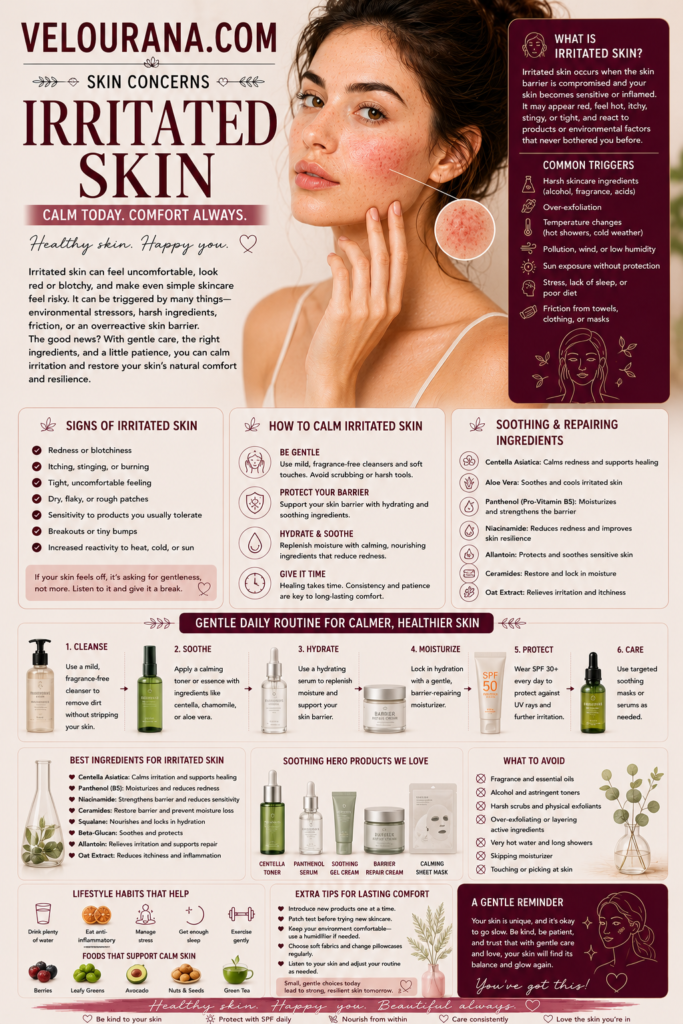
CATEGORY: Irritated Skin
Skincare is usually introduced as an act of improvement. Cleanse more effectively, exfoliate more precisely, correct pigmentation, support collagen, refine texture, hydrate deeply, brighten dullness, control oil, protect against environmental stress. Each objective sounds reasonable on its own.
The problem begins when skin is asked to pursue all of them at once.
Over-treatment rarely starts with recklessness. It often starts with enthusiasm. A routine grows gradually: one active ingredient for texture, another for pigmentation, another for acne, an exfoliating cleanser, a weekly peel, a clarifying mask, perhaps a facial tool. Because each product has a legitimate purpose, the routine can look sophisticated rather than excessive.
Then the skin changes.
It feels tighter after cleansing. Moisturizer begins to sting. Makeup catches on rough patches. The face appears unusually shiny but also dry. Redness lingers longer after washing. An acid that once felt uneventful suddenly burns. A sunscreen that has been used for months becomes uncomfortable around the nose.
At this point, many people assume they need a more advanced product to repair the damage.
Often what they need is a reset.
Over-treated skin is not necessarily unhealthy in a permanent sense, nor is it necessarily evidence of an underlying dermatological condition. It may simply be skin whose tolerance has been exceeded. The barrier has been stressed, the surface is more vulnerable, and the routine is demanding more than the skin can comfortably process.
The solution is less glamorous than the problem.
It is to identify excess, reduce stimulation, rebuild predictability, and then reintroduce treatments only at a level the skin can actually sustain.
How a Routine Becomes Too Intense Without Looking Extreme
Most people do not wake up one morning and decide to damage their skin barrier.
Over-treatment develops through accumulation.
A cleanser containing exfoliating acids may be followed by a toner with another acid. A retinoid is used in the evening. A vitamin C serum is applied in the morning. Once or twice per week, a peel is added for “extra glow.” A clay mask is used when pores look congested. A facial brush is used for deeper cleansing.
No single step necessarily seems unreasonable.
The issue is total exposure.
Skin does not care that one product is marketed for acne and another for brightness. It receives all of them as chemical and physical stimuli. Their effects overlap.
Exfoliation is especially easy to duplicate unintentionally.
An acid cleanser, exfoliating toner, peel pads, enzyme mask, scrub, and resurfacing serum may all belong to different product categories, yet all can contribute to the same broad objective: removing or loosening surface cells.
When several are used together, the routine may become much more aggressive than the packaging suggests.
The same can happen with actives intended for different concerns.
Retinoids, benzoyl peroxide, alpha hydroxy acids, beta hydroxy acids, strong vitamin C formulations, acne treatments, and prescription therapies can each be useful, but combining too many at once can increase irritation risk.
The routine does not have to look dramatic to become excessive.
It only has to exceed the individual's threshold.
The Barrier Does Not Announce Failure All at Once
One of the reasons over-treatment continues is that barrier stress often develops gradually.
The earliest signs can be subtle.
Cleansing may leave a little more tightness than usual.
A serum might tingle for longer than before.
The cheeks may become slightly pink after a shower.
Foundation may settle into tiny flakes around the mouth.
There may be increased sensitivity to wind or cold.
These changes are easy to ignore because they do not look severe.
A person may even interpret them as evidence that active ingredients are working.
Then tolerance declines further.
Moisturizer starts to sting. The skin feels dry even after applying several hydrating products. Red patches appear. Exfoliation produces burning rather than mild tingling. The face may feel both oily and dehydrated because sebum production and surface water loss are separate processes.
By the time the signs become obvious, the routine may have been too intense for days or weeks.
This is why early recognition matters.
If intervention happens when the skin merely feels unusually tight, the reset can be simple.
If the routine continues until the face is visibly inflamed, recovery can take longer and become more complicated.
Why “More Hydration” Does Not Always Solve It
When irritated skin feels tight or dry, the natural response is to add hydrating products.
Hydrating toners, essences, serums, masks, mists, and creams can all provide comfort.
But adding moisture does not automatically remove the source of irritation.
If someone continues exfoliating daily while layering multiple hydrating products afterward, the routine may simply be treating one consequence of over-treatment while preserving the cause.
This can create a deceptive cycle.
The skin feels dry, so a hydrating serum is added.
The serum temporarily improves comfort.
The exfoliating routine continues.
The skin becomes dry again.
Another hydrating product is introduced.
Eventually the routine contains five soothing layers and the same aggressive treatment schedule that created the need for them.
Barrier recovery works best when both sides of the equation are considered.
Support the skin.
Reduce what is stressing it.
Moisture is part of recovery.
Subtraction is often the other half.
The Difference Between Dryness and Barrier Stress
Dry skin and irritated skin can overlap, but they are not identical.
A naturally dry complexion may simply produce less oil or struggle to retain moisture effectively. It can feel tight and rough without necessarily burning or becoming inflamed.
Barrier-stressed skin may show dryness plus other signs: unusual stinging, redness, increased reactivity, roughness that appears suddenly, sensitivity to products previously tolerated, or discomfort from water and environmental exposure.
The distinction matters because someone with ordinary dryness may benefit from richer moisturization without needing to abandon their active routine.
Someone whose skin has become irritated after over-treatment may need both richer moisturization and fewer actives.
Again, context is the deciding factor.
Did the problem appear after increasing exfoliation?
Did it follow a new retinoid?
Did several products change simultaneously?
Was there significant sun exposure?
Did the skin become reactive immediately after a peel?
If yes, temporary barrier stress becomes more plausible.
If dryness has been present for years with no significant stinging or sudden change, the pattern is different.
Why Roughness Can Be Misread as a Need for More Exfoliation
One of the most common mistakes in irritated skincare is treating roughness automatically as excess dead skin.
The logic seems persuasive.
The surface feels uneven, so the uneven layer should be removed.
But roughness can also result from dehydration, dryness, inflammation, or barrier disruption.
In those cases, exfoliating the surface more aggressively may temporarily smooth the texture while worsening the underlying problem.
This creates an especially frustrating pattern because the immediate cosmetic result can feel rewarding.
After a peel, the face may look smoother.
Two days later, flaking returns.
Another peel is used.
The skin becomes more reactive.
The person interprets the recurrence as proof that exfoliation is still needed.
What is actually happening may be the opposite.
The skin is repeatedly being stripped before it has fully recovered.
This is why texture should not be evaluated in isolation.
If roughness appears together with stinging, redness, tightness, or sudden sensitivity, the safest interpretation is not automatically “more exfoliation.”
It may be “less.”
Cleansing Can Quietly Become the Main Irritant
People often focus on treatments when trying to identify the cause of irritation, but cleansing deserves equal attention.
It happens every day.
Sometimes twice.
Sometimes more often after exercise, makeup, swimming, or hot weather.
A cleanser that removes too much oil or requires prolonged rubbing can contribute significantly to discomfort.
The problem may be the formula.
It may also be the technique.
Very hot water, cleansing brushes, rough washcloths, repeated double cleansing, prolonged massaging, or aggressively wiping away makeup can make the process more stressful than necessary.
The goal of cleansing is not to make the face feel sterile.
A “squeaky clean” sensation is not evidence of superior hygiene.
For over-treated skin, a good cleanser should remove what needs to be removed while leaving the face relatively comfortable afterward.
If washing produces immediate tightness every time, the routine deserves reconsideration.
The Reset: Why Less Becomes More Useful Than Better
When the skin becomes clearly irritated, the most effective first step is often simplification.
Not upgrading.
Not replacing ten products with ten products marketed for sensitive skin.
Simplifying.
The reset does not have to be identical for everyone, but the philosophy is consistent.
Keep the routine focused on essential functions.
Cleanse gently.
Moisturize sufficiently.
Protect the skin from excessive sun exposure.
Pause non-essential treatments that are likely to intensify irritation.
This often includes exfoliating acids, scrubs, strong retinoids, peel pads, clarifying masks, and other resurfacing products until the skin becomes comfortable again.
The exact pause depends on the severity of irritation and the product involved.
Prescription treatments should not be stopped or restarted without considering medical guidance where relevant.
For ordinary cosmetic over-treatment, however, there is little value in forcing active ingredients onto skin that is visibly protesting.
The reset should feel deliberately boring.
That is its purpose.
Why Familiar Products Are Often Better During Recovery
Irritation creates a temptation to shop.
A person begins searching for the best barrier cream, best redness serum, best recovery mask, best ceramide treatment.
Some of these products may be excellent.
But introducing several new formulas during an active flare creates a diagnostic problem.
If the skin worsens, which new product caused it?
If it improves, which one helped?
The more variables added, the harder it becomes to understand what is happening.
Familiar, previously tolerated products often have an advantage.
They provide a baseline.
If a basic moisturizer has been used for a year without difficulty, it may be more useful during recovery than an exciting new product containing twelve soothing botanicals.
Predictability has value.
In reactive periods, known tolerance can matter more than theoretical superiority.
Moisturizer Should Reduce Drama, Not Create It
A recovery moisturizer does not need to do everything.
It does not need to brighten, exfoliate, resurface, firm, refine pores, control acne, or deliver multiple high-performance actives.
Its central purpose is comfort and support.
Creams or ointments may be useful for very dry or compromised areas because they help reduce water loss. Lighter formulations may suit people who dislike heavy textures.
Ingredients such as glycerin, ceramides, petrolatum, and other established moisturizing components are often associated with barrier-supportive routines.
But formula matters more than any single ingredient.
A product containing ceramides can still be irritating if the overall formulation does not suit the individual.
Similarly, a very simple moisturizer without fashionable barrier claims may work beautifully.
The correct product is the one the skin tolerates and the person will use consistently.
Sunscreen Still Matters, but Comfort Matters Too
Sun exposure can make irritated skin more uncomfortable and may worsen visible redness or pigmentation after inflammation.
Protection therefore remains important.
But sunscreen can also become one of the most difficult steps during a reactive period.
Some formulas sting compromised skin.
Others feel drying.
Some are uncomfortable around the eyes.
The solution is not to abandon sun protection permanently.
It is to find a formulation that can be used consistently without significant discomfort.
During severe irritation, minimizing unnecessary sun exposure through shade, hats, and behavioral protection can reduce the burden on the skin while a tolerable sunscreen is identified.
Once again, the objective is not theoretical perfection.
It is a workable routine.
Recovery Does Not Have to Be Fast to Be Successful
One of the most damaging expectations in skincare is that every problem should improve overnight.
Barrier stress does not always behave that way.
Minor irritation may settle quickly.
More significant over-treatment can take longer.
The speed depends on severity, individual skin, environmental conditions, and whether the trigger has truly been removed.
This creates a dangerous moment several days into recovery.
The skin looks better but is not fully stable.
The person becomes impatient.
Active products return.
The irritation returns too.
The cycle restarts.
A better measure of recovery is sustained comfort.
Is washing comfortable?
Does moisturizer no longer sting?
Has tightness reduced?
Are flakes becoming less noticeable?
Does the face tolerate ordinary environmental exposure better?
If these improvements remain stable, the skin is moving in the right direction.
One good morning is not the same as complete recovery.
Reintroducing Actives Should Be Treated Like an Investigation
Once the skin is comfortable again, active ingredients can be reintroduced gradually.
This is not only gentler.
It is more informative.
Add one treatment back.
Observe.
Then add another.
If irritation returns, the sequence provides clues.
Perhaps the active itself is poorly tolerated.
Perhaps frequency is too high.
Perhaps it becomes problematic only when combined with another product.
Perhaps the skin needs more recovery time.
Without gradual reintroduction, none of this is visible.
If five treatments restart on the same evening and burning returns, the entire diagnostic value of the reset is lost.
Skincare does not need to become obsessive, but it benefits from basic experimental discipline.
Change one variable when possible.
Frequency Is Often More Important Than Product Choice
People frequently respond to irritation by abandoning an ingredient entirely.
Sometimes that is appropriate.
But in other cases, the problem is not the ingredient itself.
It is frequency.
A retinoid tolerated twice weekly may become irritating when used nightly.
An acid used once per week may be comfortable while daily use causes redness.
A clarifying cleanser may work well after heavy makeup but become too drying when used morning and night.
The difference between a useful product and an irritating product can sometimes be scheduling.
This is important because beauty routines are often designed around maximum frequency.
If a label says “use daily,” people assume daily use is the goal.
It is not.
The goal is the frequency that produces benefit without persistent irritation.
For some people, that may be daily.
For others, once or twice weekly.
Both can be correct.
Layering Creates Hidden Intensity
Modern routines are often discussed one product at a time.
The skin receives them together.
This makes layering one of the hidden sources of irritation.
Imagine a morning routine containing an exfoliating cleanser, acidic vitamin C serum, niacinamide treatment, fragranced moisturizer, and sunscreen.
The evening includes double cleansing, an exfoliating toner, retinoid, and rich cream.
None of the products is necessarily inappropriate.
But the total routine may be too intense for one person's skin.
The problem becomes even harder to identify if products are alternated unpredictably.
This is why building a routine around a few clear priorities is often more sustainable than trying to maximize every possible benefit.
Skin can only benefit from a treatment if it tolerates the routine long enough for that treatment to be used consistently.
“Repair” Products Can Also Be Overused
Barrier repair has become a major skincare category.
This is useful because consumers are paying more attention to skin tolerance.
But the category can create a new form of excess.
People sometimes layer several barrier serums, creams, oils, sleeping masks, and balms simultaneously because the skin is irritated.
Even soothing products can create problems if they contain ingredients the skin does not tolerate or if heavy layering traps heat and feels uncomfortable.
More repair products do not automatically mean faster repair.
The same principle applies.
Use enough.
Not everything.
When Acne and Irritation Exist Together
Over-treatment is especially common in acne-prone skin.
Breakouts create urgency.
A new blemish appears, so spot treatment is added.
Oiliness encourages stronger cleansing.
Congestion encourages exfoliation.
Persistent acne may lead to retinoids or benzoyl peroxide.
The routine can quickly become aggressive.
Then irritation appears.
The difficult part is that acne does not disappear simply because the skin is irritated.
People continue treating it aggressively because they are afraid that pausing will worsen breakouts.
This creates a conflict between acne control and barrier recovery.
The correct balance depends on severity and treatment plan.
For mild cosmetic routines, reducing unnecessary exfoliation and simplifying care may improve tolerance without abandoning all acne management.
For prescription acne treatment, irritation should be discussed with the prescribing professional rather than managed through random product changes.
Healthy acne treatment is not the maximum amount of dryness a person can tolerate.
Persistent irritation can make adherence worse and complicate the entire routine.
Anti-Aging Routines Are Another Common Source of Excess
Anti-aging skincare encourages stacking.
Retinoid.
Vitamin C.
Peptides.
Acids.
Exfoliating masks.
Firming treatments.
Pigmentation correctors.
Sunscreen.
Each addresses a different aspect of visible aging, so using all of them can seem logical.
But long-term results depend heavily on consistency.
A routine that repeatedly irritates the skin and requires recovery breaks may be less sustainable than a simpler one used comfortably for years.
This is particularly relevant as skin becomes drier or more reactive with age.
A routine tolerated at thirty may feel very different at fifty.
Adjustment is not failure.
It is normal adaptation.
Seasonal Resets Can Be Useful
Skincare tolerance changes with climate.
A winter routine may need more moisturization and less exfoliation.
A summer routine may require lighter textures, more frequent sunscreen application, and consideration of sweat and heat.
People who use the exact same active schedule year-round sometimes find that irritation appears predictably during seasonal transitions.
This can be interpreted as mysterious sensitivity.
It may simply reflect changing environmental stress.
A seasonal reset does not require abandoning the entire routine.
It may involve reducing exfoliation temporarily, changing moisturizer texture, or paying more attention to cleansing frequency.
The broader lesson is that routines should respond to conditions.
Skin is dynamic.
Skincare should be too.
The Role of Stress and Lifestyle Is Usually Indirect
It is tempting to explain every skin problem through lifestyle.
Stress, sleep, diet, hydration, exercise, alcohol, and hormones are frequently blamed for almost anything that happens to the face.
Their influence can be real, but the relationship is often more complicated than simple cause and effect.
For over-treated skin, the most direct explanation is often still the routine.
However, lifestyle can change the context.
Stress may increase touching or picking.
Lack of sleep may encourage more makeup.
Exercise can increase sweat and washing frequency.
Travel can expose the skin to dry aircraft cabins and unfamiliar water.
Cold weather can increase hot showering.
These factors may not independently create the problem, but they can influence the skin's tolerance.
The useful approach is not to search for one grand explanation.
It is to understand the total environment.
Why Picking and Touching Make Everything Harder
Once skin becomes rough or flaky, it becomes difficult not to touch.
A tiny scale feels removable.
A dry patch looks like it could be peeled away.
A blemish seems easier to squeeze than ignore.
These actions provide immediate satisfaction.
They can also prolong irritation.
Picking creates mechanical damage.
It may increase redness.
It can interfere with healing.
In acne-prone skin, squeezing can increase the risk of marks or scarring.
The simplest rule during a reset is to reduce manipulation.
Let flakes detach naturally.
Avoid repeatedly checking texture with fingertips.
Do not squeeze areas already inflamed.
The less physical trauma added to chemical irritation, the easier the recovery environment becomes.
When the Problem May Not Be Over-Treatment
Not every irritated complexion is the result of skincare excess.
This point is essential.
Persistent redness, itching, scaling, burning, bumps, or recurring rashes can reflect dermatological conditions that deserve evaluation.
Rosacea.
Atopic dermatitis.
Seborrheic dermatitis.
Allergic contact dermatitis.
Irritant contact dermatitis.
Perioral dermatitis.
Other inflammatory conditions.
A person can simplify skincare perfectly and still need treatment.
This is why recovery should have a diagnostic boundary.
If the skin does not improve, repeatedly returns to the same pattern, or shows significant symptoms, continuing to blame the routine indefinitely becomes less useful.
At that stage, professional assessment is the more intelligent next step.
The Goal Is Not Maximum Tolerance
There is a subtle competitive element in skincare culture.
People compare routines.
One person uses a strong retinoid nightly.
Another exfoliates every morning.
Someone layers multiple acids without difficulty.
This can create the idea that tolerant skin is superior skin.
It is not.
Individual variation is normal.
The goal is not to train the face to endure the most aggressive routine possible.
The goal is to achieve the desired cosmetic benefits while maintaining comfort and function.
If one person gets excellent results from a retinoid twice weekly, that routine is not inferior to someone else's nightly schedule.
More is not automatically better.
Tolerance defines the useful dose.
A Reset Can Improve the Whole Routine
An irritation episode can be frustrating, but it can also reveal unnecessary complexity.
After a reset, many people discover that several products were contributing little.
Perhaps the third hydrating serum was unnecessary.
Perhaps two exfoliants were doing the work of one.
Perhaps a harsh cleanser was making moisturizer seem less effective.
Perhaps acne treatment could be used less frequently with similar results.
Perhaps the expensive recovery mask was simply compensating for an overly aggressive routine.
Simplification creates clarity.
And clarity often improves consistency.
Building Back With Purpose
The best routine after irritation is not necessarily the same routine as before.
It should be rebuilt deliberately.
Start with the foundation.
A cleanser the skin tolerates.
A moisturizer that maintains comfort.
Reliable daytime protection.
Then add treatments according to actual priorities.
If pigmentation matters most, choose a targeted approach.
If acne is the main issue, build around acne management.
If anti-aging is the objective, prioritize the most useful treatment rather than stacking everything associated with aging.
The routine becomes easier to understand because each product has a clear reason to exist.
This also makes future irritation easier to investigate.
Complexity hides cause.
Purpose reveals it.
The Difference Between an Advanced Routine and an Intelligent One
Advanced skincare is often imagined as complicated skincare.
That is a mistake.
An intelligent routine can be very simple.
What makes it intelligent is that the products are chosen appropriately, used at suitable frequencies, and adjusted according to the condition of the skin.
An intelligent routine recognizes that actives can be effective without being used every day.
It understands that moisturization is not an afterthought.
It notices early signs of irritation rather than pushing through them.
It changes with climate.
It does not confuse burning with progress.
It knows when to stop experimenting.
And it understands when a dermatologist is more useful than another serum.
The Reset Is Not a Step Back
There can be a strange sense of failure in removing active ingredients from a routine.
Someone who has spent months building a sophisticated regimen may feel that returning to cleanser, moisturizer, and sunscreen is abandoning progress.
It is not.
Recovery protects the ability to use effective treatments later.
Continuing to irritate the skin can lead to longer interruptions and more confusion.
A temporary reset is therefore strategic.
It preserves long-term consistency.
What Over-Treated Skin Is Really Asking For
When skin becomes irritated after skincare, its message is rarely mysterious.
The routine has exceeded current tolerance.
That does not necessarily mean every product is bad.
It does not mean active ingredients are dangerous.
It does not mean the skin must remain on a minimalist routine forever.
It means the balance needs to change.
Reduce the variables.
Pause unnecessary stimulation.
Cleanse gently.
Moisturize consistently.
Protect the skin.
Allow comfort to become stable.
Then rebuild slowly enough to understand what the skin can actually handle.
The most useful skincare routine is not the one that looks most impressive on the bathroom shelf.
It is the one that can be sustained without repeatedly forcing the skin into recovery.
Once that principle becomes clear, irritation stops being an unpredictable failure.
It becomes feedback.
And feedback, when respected, can produce a better routine than ambition alone ever could.
The End Velourana
 Discover More From Our Family of Websites
 ZodiacBearing (Astrology, Tarot, Numerology, Angel Numbers & Spiritual Guidance)
 Velourana (Beauty, Makeup, Hair Care, Skincare & Beauty Tips)
 HavenBearing (Home, Living, Organization, Décor & Everyday Inspiration)
 PawBearing (Pet Care, Dog Breeds, Animal Health, Training & Pet Products)
 PsyCatherine (Notes From the Journal of a Psychologist on Real Life)