
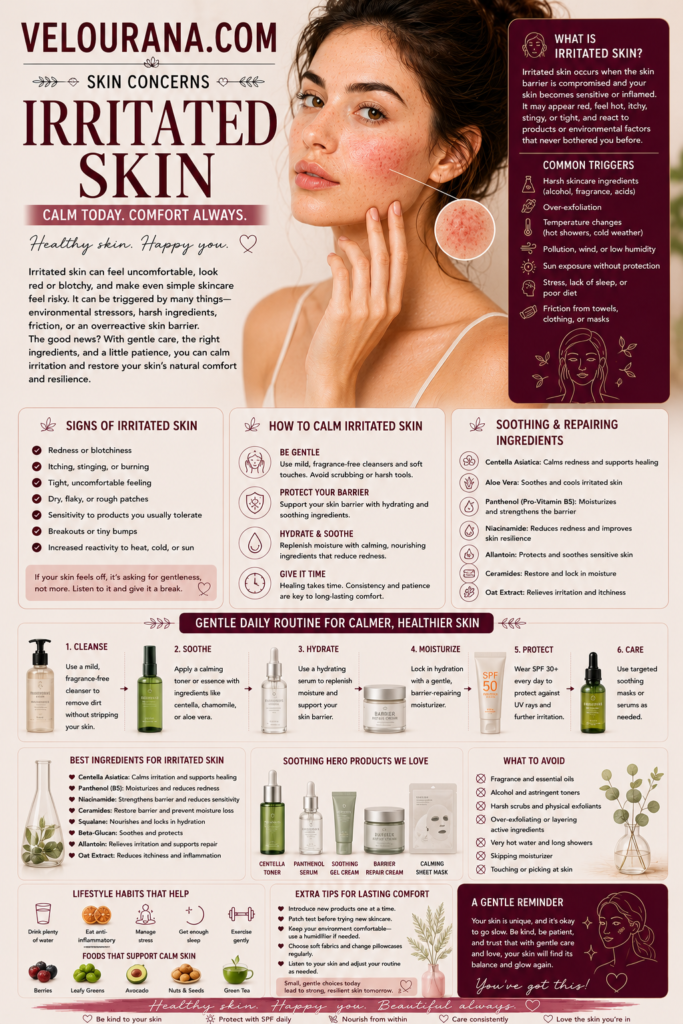
CATEGORY: Irritated Skin
The words sensitive skin and irritated skin are often used as though they describe the same thing. In ordinary conversation, the distinction can seem unimportant. A moisturizer stings, the cheeks become red, the skin feels tight, and the natural conclusion is simply that the complexion is sensitive.
Yet the difference matters.
Sensitive skin usually describes a tendency. Irritated skin describes a state.
Someone may have naturally reactive skin that frequently responds to fragrance, strong actives, temperature changes, or environmental stress. Another person may normally tolerate almost anything but become irritated after over-exfoliation, sun exposure, shaving, a new product, or an unusually aggressive routine.
The visible symptoms can overlap. Both may involve redness, burning, itching, tightness, roughness, or discomfort.
But they do not always require the same long-term strategy.
If skin is naturally sensitive, the goal is usually to build a routine around lower reactivity and consistent tolerance. If ordinarily resilient skin has become temporarily irritated, the more immediate objective may be identifying what changed, reducing unnecessary exposure, and allowing the barrier to recover before returning to a normal routine.
Confusing the two can lead to unnecessary restriction in one direction and excessive experimentation in the other.
Someone who has temporarily irritated skin may conclude that they must avoid active skincare forever. Someone with persistently reactive skin may continue treating each episode as an isolated accident rather than recognizing a pattern.
A more useful approach begins by asking a different question.
Is this how the skin generally behaves, or is this a departure from normal?
Sensitivity Is Often a Pattern
Sensitive skin does not have one universally accepted definition in everyday cosmetic language, largely because sensitivity can be experienced in different ways.
For one person, it means frequent burning after skincare application. For another, flushing in response to heat. Someone else may react to fragrance, cold weather, shaving, or products that others tolerate easily.
Some people experience symptoms with very little visible change. Their skin may look relatively normal while feeling tight, prickly, hot, or uncomfortable.
This is one reason sensitivity can be difficult to evaluate solely by appearance.
What makes the pattern important is recurrence.
A complexion that has repeatedly reacted to strongly fragranced products over several years is telling a different story from a complexion that suddenly burns after a week of daily exfoliation.
Likewise, a person who develops redness every winter may have environmental sensitivity that becomes prominent under particular conditions. Another may notice that the cheeks become reactive after long flights, heated offices, or periods of intense sun exposure.
Patterns create context.
They allow someone to stop thinking in terms of isolated bad products and start understanding the broader conditions under which the skin becomes uncomfortable.
This does not necessarily mean the person has a dermatological disorder. But persistent or pronounced sensitivity can sometimes overlap with conditions such as rosacea, eczema, or contact dermatitis, which is one reason recurring symptoms deserve attention rather than endless self-diagnosis.
The practical value lies in recognizing that sensitivity is rarely best understood through a single moment.
It is understood through history.
Irritation Usually Has a Story
Temporary irritation often has a more identifiable beginning.
Perhaps a new retinoid was introduced.
Perhaps exfoliation frequency increased.
Maybe several products were changed during the same week.
A clay mask was left on too long.
The skin was scrubbed after wearing heavy makeup.
A peel was followed by sun exposure.
Shaving was unusually aggressive.
A strongly fragranced product was applied immediately after exfoliation.
The face was washed repeatedly during a hot day.
Sometimes the trigger is obvious enough that the story almost writes itself.
At other times, irritation develops through accumulation. Nothing seems extreme when considered individually, but several modest stressors occur within a short period and the skin eventually reaches its limit.
This cumulative form of irritation is especially easy to misunderstand.
A person may have used an exfoliating acid for months without difficulty and reasonably conclude that it cannot be responsible. But frequency may have increased. Weather may have become drier. A retinoid may have been added. Cleansing may have become stronger.
Tolerance depends on context.
Skin care is not chemistry performed in an empty laboratory. It happens on living tissue whose condition changes from day to day.
The fact that something was tolerated last month does not guarantee identical tolerance today.
This is why investigating irritation requires looking backward rather than merely looking at the product currently in hand.
The Skin Barrier Sits at the Centre of Both Problems
Sensitive and irritated skin can feel different in origin, but both often involve the skin barrier in important ways.
The outer layers of the skin help control water loss while limiting penetration by substances from the environment. When barrier function is compromised, the skin may lose moisture more readily and become more vulnerable to external irritants.
This can increase sensations such as tightness, burning, itching, and discomfort.
For naturally sensitive skin, barrier vulnerability may be part of a recurring tendency.
For temporarily irritated skin, barrier disruption may be something that developed after excessive treatment or environmental exposure.
Either way, the practical implications overlap.
Aggressive cleansing becomes less appealing.
Repeated exfoliation becomes less sensible.
Friction matters more.
Moisturization becomes more important.
Introducing five new products simultaneously becomes a poor diagnostic strategy.
Barrier care has become a fashionable phrase, but its value lies in being relatively unglamorous.
The barrier does not need to be “hacked.”
It needs to function.
And much of what helps it function well is surprisingly ordinary: gentle cleansing, adequate moisturization, avoiding unnecessary irritation, protecting the skin from excessive sun exposure, and choosing treatments that match actual tolerance rather than theoretical ambition.
Why Product Labels Can Be Misleading
The phrase for sensitive skin appears everywhere.
It can be useful as a starting point, but it should not be treated as a guarantee.
There is no universal cosmetic formula that every sensitive complexion will tolerate. Two products both marketed for sensitive skin may contain very different ingredients, textures, preservatives, fragrances, botanical extracts, or active compounds.
Likewise, “natural” does not automatically mean gentle.
Botanical ingredients can still irritate or trigger allergic reactions in susceptible individuals. Essential oils are natural substances, yet their fragrant components may be problematic for certain reactive complexions.
Conversely, synthetic ingredients are not inherently harsh.
This is where marketing categories become less useful than actual skin behaviour.
A product designed for sensitive skin may work beautifully for one person and poorly for another.
The same applies to terms such as soothing, calming, hypoallergenic, dermatologically tested, clean, gentle, or barrier-supporting.
They may communicate something about the intended positioning of the product, but they do not replace individual observation.
The most reliable information comes from what happens after repeated real-world use.
Does the product produce burning?
Does redness increase?
Does the skin feel tighter afterward?
Does itching appear consistently?
Does the reaction occur only when the product is combined with another active?
These questions are more useful than the adjective printed on the front of the bottle.
The Difference Between Tingling and Trouble
One of the most confusing areas in sensitive skincare is sensation.
Some products naturally produce mild transient sensations because of their formulation or active ingredients. That does not automatically mean damage is occurring.
At the same time, the idea that pain proves effectiveness has been exaggerated far beyond usefulness.
A skincare routine does not become more advanced because it burns.
Persistent stinging, pronounced burning, swelling, intense itching, or worsening redness should not be dismissed as evidence that a product is “working.”
The difficulty lies in interpreting intensity, duration, and context.
A very brief mild tingle that disappears immediately and leaves the skin comfortable afterward is different from a burning sensation that continues for minutes and is followed by increasing redness and tightness.
Likewise, a product that feels fine on healthy skin but burns sharply after over-exfoliation may be revealing more about the skin's current condition than about the product alone.
Rather than asking whether tingling is always good or always bad, it is better to ask whether the sensation is expected, mild, short-lived, and compatible with comfortable skin afterward.
When discomfort repeatedly accompanies a product, there is little reason to keep forcing tolerance simply because the ingredient is considered beneficial.
Skincare is not an endurance test.
Why Sensitive Skin Often Needs Fewer Experiments
Beauty is built on novelty.
New textures, new active ingredients, new combinations, new delivery systems, and new claims make skincare interesting.
Sensitive skin often benefits from resisting that rhythm.
Every new product introduces uncertainty.
If a routine contains a cleanser, serum, moisturizer, and sunscreen that are consistently well tolerated, replacing all four because a new range appears attractive may create four new variables simultaneously.
When irritation follows, it becomes almost impossible to identify the cause.
This is especially relevant for people who already know they are reactive.
A better strategy is to treat compatibility as valuable information.
If a moisturizer consistently works, that predictability has real worth.
If a cleanser leaves the face comfortable rather than tight, it has already passed a test that marketing cannot replicate.
This does not mean someone with sensitive skin can never try new products.
It means novelty should be introduced deliberately.
One change at a time provides information.
Multiple changes create noise.
Patch Testing Is Useful but Not Perfect
Patch testing is frequently recommended for reactive skin.
The general idea is sensible: before applying an unfamiliar product broadly across the face, use it repeatedly on a small area and observe whether a reaction develops.
This can reduce the chance of immediately exposing the entire complexion to something problematic.
But patch testing has limitations.
Facial skin may respond differently from skin elsewhere on the body. A product might be tolerated on the jawline but sting around the nose or eyes. Reactions can also depend on frequency, combination, and total surface exposure.
Patch testing therefore provides useful information, not certainty.
The same principle applies to allergy patch testing performed medically, which is a different and more structured process used to investigate allergic contact dermatitis.
Consumers sometimes confuse the two.
Testing a cosmetic on a small area at home is essentially a cautious trial.
Medical patch testing is a diagnostic procedure supervised by healthcare professionals using standardized allergens and interpretation.
The distinction matters because recurring unexplained reactions should not be reduced to endless home experiments.
If reactions are persistent, severe, or difficult to explain, professional assessment becomes more valuable than repeatedly testing products on yourself.
Fragrance Deserves Particular Attention
Fragrance creates one of the most emotionally complicated decisions in sensitive skincare.
People often love fragranced beauty products because fragrance makes routines pleasurable.
A moisturizer that smells elegant can feel more luxurious than one with almost no scent. Cleansers, body lotions, oils, and masks often use fragrance to create identity and mood.
But fragrance can also be a source of irritation or allergic contact dermatitis in susceptible individuals.
For people with chronically reactive skin, fragrance-free formulations often provide a more conservative starting point.
This does not mean every fragranced product will irritate every person.
Nor does it mean fragrance is inherently dangerous.
The relevant point is probability and personal history.
If someone repeatedly experiences unexplained facial redness and uses several fragranced products, simplifying the routine with fragrance-free alternatives can reduce one category of potential variables.
Another useful distinction is between fragrance-free and unscented.
An unscented product may contain ingredients designed to mask other odors.
For someone specifically trying to avoid fragrance exposure, reading the ingredient information matters more than relying on the sensory impression that a product has no obvious smell.
Sensitive Skin and Active Ingredients Are Not Enemies
There is a tendency to treat sensitive skin as though it must remain permanently excluded from active skincare.
That is too simplistic.
Many people with reactive complexions successfully use retinoids, exfoliating acids, vitamin C, acne treatments, or other active ingredients.
The difference is usually in how they are introduced and used.
Concentration matters.
Frequency matters.
Vehicle matters.
Combination matters.
The condition of the skin at the time of application matters.
A person may tolerate a retinoid twice weekly but become irritated with nightly use. Someone may tolerate lactic acid but not a stronger glycolic formulation. Another may use vitamin C comfortably but react when it is layered with several exfoliating products.
Sensitivity therefore does not necessarily require abandoning effective ingredients.
It requires respecting the margin between benefit and irritation.
That margin may be narrower.
The goal should be the lowest level of complexity and intensity that produces the desired benefit without creating chronic discomfort.
More frequent treatment is not automatically more effective if it repeatedly forces recovery periods.
Over-Exfoliation Can Make Anyone Look Sensitive
One of the reasons sensitive and irritated skin are easily confused is that over-treatment can make normally resilient skin behave like sensitive skin.
A person may suddenly notice that sunscreen stings.
Moisturizer burns.
The cheeks are red after washing.
Foundation catches on flakes.
The face feels tight despite appearing shiny.
This can lead to the conclusion that the skin has fundamentally changed.
Sometimes it has.
But sometimes the complexion has simply been pushed too far.
Frequent acids, retinoids, scrubs, exfoliating cleansers, facial brushes, peels, and abrasive pads can collectively reduce tolerance.
The solution is not necessarily to replace every product with a sensitive-skin equivalent.
It may be to stop over-exfoliating.
This distinction can save enormous amounts of unnecessary purchasing.
A compromised routine cannot always be repaired by swapping brands while preserving the same level of intensity.
Sometimes the architecture of the routine is the problem.
Climate Can Change the Rules
Skin sensitivity is not necessarily constant throughout the year.
Humidity, temperature, wind, indoor heating, air conditioning, and sun exposure can all change how a routine feels.
A lightweight gel moisturizer that is perfect during a humid Mediterranean summer may feel inadequate during winter.
An exfoliant tolerated three times per week in one season may become uncomfortable in another.
Cold wind can make exposed cheeks feel raw.
Long periods in centrally heated rooms can increase dryness.
Air conditioning can create its own dry environment.
Summer introduces different challenges: sweat, heat, sun exposure, frequent cleansing, swimming, and increased sunscreen use.
The intelligent routine therefore changes with conditions.
Consistency does not mean rigidity.
It means preserving the same principles while adjusting the details.
Someone with reactive skin should not feel that changing moisturizer texture or reducing active frequency during winter represents failure.
It represents adaptation.
Cleansing Is Often the First Place to Look
When skin becomes irritated, cleansing deserves close examination because it happens so frequently.
A cleanser is used once or twice daily, sometimes more.
That repeated exposure can have a greater effect than a treatment used once per week.
Signs that cleansing may be too aggressive include persistent tightness after washing, increased flaking, burning when subsequent products are applied, or the feeling that the face is “squeaky clean.”
Clean skin does not need to feel stripped.
For reactive skin, technique matters as much as formula.
Water that is comfortably lukewarm is generally preferable to very hot water.
Fingertips are often gentler than brushes or textured cloths.
Cleansing should last long enough to remove what needs to be removed but should not become a vigorous massage session.
Drying should be gentle.
If makeup or water-resistant sunscreen requires double cleansing, both steps should still be designed around minimal friction.
The goal is effective removal without turning cleansing into daily exfoliation.
Moisturizer Becomes a Diagnostic Tool
Moisturizer does more than relieve dryness.
During a reactive period, it can also provide useful information.
A basic moisturizer that was previously comfortable suddenly stinging may suggest that the skin's tolerance has changed.
If the sting improves after several days of simplified care, that supports the idea that temporary barrier disturbance was involved.
If the same moisturizer consistently produces redness every time it is used, even when the skin is otherwise stable, the formula itself deserves scrutiny.
This is another reason not to switch products too quickly.
Predictable products create a baseline.
Without a baseline, every reaction becomes difficult to interpret.
Someone with reactive skin often benefits enormously from having a reliable cleanser, moisturizer, and sunscreen that can serve as anchors while other products are introduced or removed.
These anchor products do not need to be glamorous.
Their value lies in being boring enough to trust.
Makeup Can Complicate Irritation
When redness appears, makeup becomes both a solution and a potential source of additional stress.
Foundation and concealer can reduce the visible impact of irritation and make someone feel more comfortable socially.
There is nothing inherently wrong with that.
The difficulty arises if applying and removing makeup increases friction or if the products themselves worsen sensitivity.
Heavy coverage may require stronger removal.
Repeated blending over flaky areas can create mechanical irritation.
Powder may emphasize dryness and encourage additional preparation with primers, oils, or exfoliation.
A more useful approach during recovery is to minimize the total workload placed on the skin.
If makeup is needed, choose the least irritating combination that provides enough coverage.
Apply it gently.
Remove it thoroughly but without scrubbing.
Do not exfoliate simply to create a smoother canvas while the skin is actively irritated.
Temporary texture is usually preferable to prolonging inflammation for the sake of one flawless makeup application.
Sunscreen and Reactive Skin Require Patience
Sun protection remains important for virtually every complexion, and irritated skin is no exception.
Yet finding a sunscreen that feels comfortable on reactive skin can be surprisingly difficult.
Some formulas sting around the eyes.
Others feel drying.
Some produce warmth on recently exfoliated skin.
Mineral and organic filters can each be tolerated differently by different individuals.
There is no universal sunscreen category that guarantees zero irritation.
The practical goal is consistency.
A sunscreen must provide adequate protection and be comfortable enough to use properly.
If one repeatedly burns or causes obvious irritation, forcing continued use because it has excellent reviews makes little sense.
At the same time, introducing multiple sunscreens during an acute flare can make the situation even more confusing.
Once the skin has settled enough for meaningful testing, individual formulas can be evaluated slowly.
For highly reactive skin or people with diagnosed skin conditions, dermatologist guidance may be particularly useful.
Redness Is Not Always Sensitivity
Facial redness can arise from many causes.
Temporary flushing after exercise is not necessarily skin sensitivity.
Sunburn is not the same as contact dermatitis.
Rosacea is not simply “sensitive skin.”
Eczema is not merely dryness.
Acne-related inflammation may create redness without the person having a generally reactive complexion.
Seborrheic dermatitis can produce redness and scaling in characteristic areas.
Allergic reactions may present with itching, swelling, or rash.
This matters because treating all redness with the same calming serum can delay more appropriate care.
A useful rule is to pay attention to persistence, severity, recurrence, and pattern.
Does redness disappear quickly?
Is it always in the same location?
Does it include bumps or scaling?
Is there significant itching?
Does it involve the eyes?
Does it return repeatedly despite a simple routine?
The more persistent and distinctive the pattern, the more worthwhile professional evaluation becomes.
When a Dermatologist Can Save You Months of Guessing
There is a point at which continuing to buy products becomes less rational than getting a diagnosis.
Persistent redness, recurring burning, unexplained itching, swelling, cracking, open skin, frequent rashes, or symptoms that fail to improve after removing obvious irritants are all reasonable reasons to seek professional help.
A dermatologist may identify a condition that cosmetic trial and error would never clarify.
They may also help distinguish allergic contact dermatitis from irritant reactions or recommend patch testing where appropriate.
This can prevent a frustrating cycle in which every new flare is blamed on the latest product even though the underlying issue remains untreated.
Professional evaluation is not only for severe disease.
It can be useful when the pattern is simply confusing.
Clarity has value.
Building a Routine Around What Skin Can Actually Tolerate
The most sustainable skincare routine is not the one with the most products.
It is the one the skin can tolerate consistently.
That idea sounds simple, but it challenges much of modern beauty culture.
The industry naturally emphasizes possibility.
There are products for pores, pigmentation, dullness, wrinkles, dehydration, firmness, texture, acne, redness, and brightness.
A person could theoretically construct a routine addressing every concern simultaneously.
But skin does not experience each product in isolation.
It experiences the total routine.
Someone with reactive skin may therefore achieve better long-term results by choosing priorities.
Perhaps pigmentation is the primary concern this year.
Perhaps acne treatment matters more than aggressive anti-aging.
Perhaps simply maintaining comfortable, hydrated skin is the correct priority during winter.
Choosing fewer objectives is not giving up.
It is allocating the skin's tolerance intelligently.
The Difference Between Caution and Fear
Sensitive skincare advice can easily become overly restrictive.
Avoid this.
Never use that.
Do not exfoliate.
Do not use retinoids.
Do not try fragrance.
Do not change anything.
Such advice may prevent irritation, but it can also create unnecessary fear around skincare.
The better objective is informed caution.
Understand that some ingredients and techniques have higher irritation potential.
Introduce them gradually.
Do not combine everything at once.
Watch how your own skin responds.
Reduce frequency when necessary.
Stop when discomfort becomes persistent.
Seek medical advice when the pattern suggests something more than temporary cosmetic irritation.
This approach respects sensitivity without allowing it to dominate the entire relationship with skincare.
Sensitive skin is not defective skin.
It is simply skin with a particular tolerance profile.
When Irritation Becomes Useful Information
An episode of irritation is unpleasant, but it can reveal something important.
It may expose an exfoliation frequency that is too high.
It may show that one particular combination of actives is not well tolerated.
It may reveal that winter requires more moisturization.
It may identify fragrance as a recurring problem.
It may demonstrate that cleansing is too aggressive.
It may uncover a pattern suggesting rosacea, eczema, or contact dermatitis that deserves professional assessment.
The key is to learn from the episode rather than simply suppress it.
If every flare is treated as an isolated emergency, the same pattern can repeat indefinitely.
If the routine is examined and rebuilt around the information provided by the skin, future irritation may become less frequent.
Comfort Is a Meaningful Skincare Goal
Beauty discussions often focus on visible outcomes.
Smoother texture.
Brighter tone.
Fewer lines.
Less pigmentation.
Smaller-looking pores.
Clearer skin.
Comfort is rarely treated with the same importance.
Yet skin that feels comfortable is a substantial achievement, particularly for someone prone to sensitivity or irritation.
Comfort means cleanser does not sting.
Moisturizer does not burn.
The face does not feel tight by midday.
There is no constant urge to scratch.
Weather does not produce immediate distress.
A new product can be introduced without destabilizing the entire routine.
Comfort creates the foundation on which other cosmetic goals can be pursued.
Without it, every additional treatment becomes harder to sustain.
Knowing Which Skin You Have Today
Perhaps the most useful way to think about sensitive and irritated skin is not as permanent identities but as conditions that require observation.
Someone may have generally resilient skin that is irritated today.
Someone else may have naturally sensitive skin that is perfectly calm today.
The skincare routine should respond to the skin's present condition rather than blindly following a fixed schedule.
If the face is comfortable, treatment can proceed according to tolerance.
If it becomes tight, hot, flaky, or unusually reactive, intensity can be reduced.
If symptoms persist despite simplification, the possibility of an underlying condition deserves consideration.
This flexible approach is more realistic than demanding that skin behave identically every day of the year.
The Better Question
When the skin becomes red or uncomfortable, the instinctive question is usually, “What product will fix this?”
A more useful question is often, “What changed?”
Was something introduced?
Was something increased?
Has the weather changed?
Has the skin been exfoliated more often?
Has there been significant sun exposure?
Has cleansing become more aggressive?
Is the redness recurring in a recognizable pattern?
Does this happen repeatedly even when the routine is simple?
These questions distinguish temporary irritation from a broader tendency toward sensitivity.
And once that distinction becomes clearer, skincare becomes easier to manage.
Sensitive skin benefits from predictability, thoughtful formulation choices, gradual experimentation, and respect for individual tolerance.
Temporarily irritated skin benefits from identifying the trigger, reducing unnecessary exposure, restoring comfort, and resisting the urge to overcorrect.
Persistent unexplained redness deserves something different again: professional evaluation.
The skin does not need to fit neatly into one category forever.
It simply needs care that matches its present condition.
Understanding that difference turns sensitivity from a vague label into something much more useful—a guide to how much the skin can comfortably tolerate, when it needs less, and when its repeated signals deserve closer attention.
The End Velourana
 Discover More From Our Family of Websites
 ZodiacBearing (Astrology, Tarot, Numerology, Angel Numbers & Spiritual Guidance)
 Velourana (Beauty, Makeup, Hair Care, Skincare & Beauty Tips)
 HavenBearing (Home, Living, Organization, Décor & Everyday Inspiration)
 PawBearing (Pet Care, Dog Breeds, Animal Health, Training & Pet Products)
 PsyCatherine (Notes From the Journal of a Psychologist on Real Life)

