
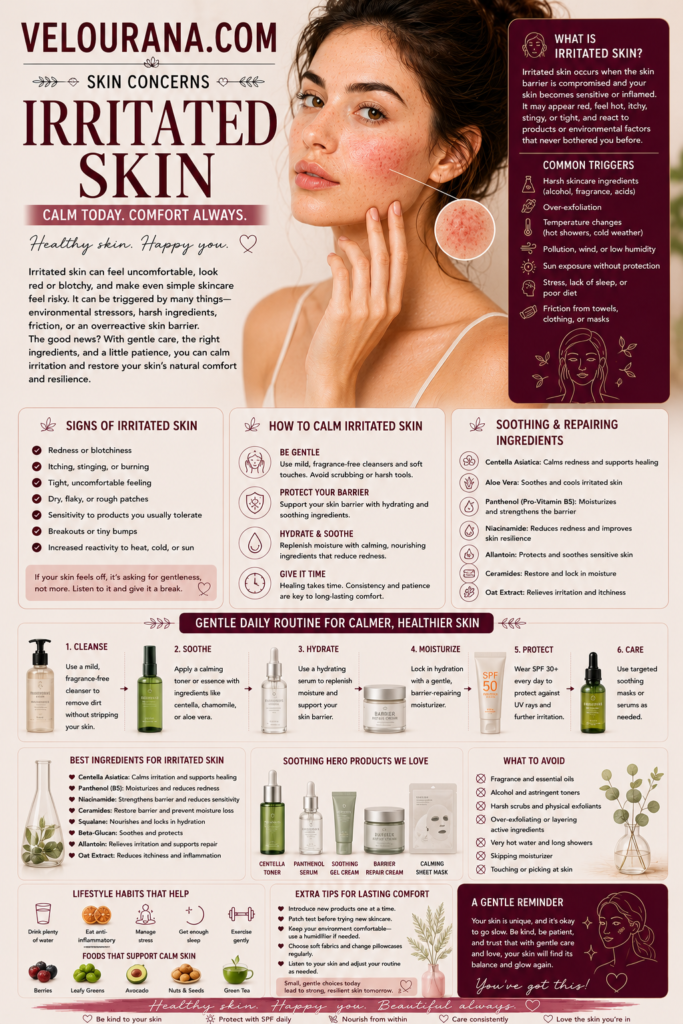
CATEGORY: Irritated Skin
There is a frustrating moment familiar to anyone who has experienced irritated skin: the obvious trigger has been removed, yet the skin still refuses to settle.
The exfoliating treatment has been stopped. The unfamiliar serum has been pushed to the back of the cabinet. The weather has changed, the sunburn has faded, or the overenthusiastic cleansing routine has been abandoned. Logically, the problem should be over. Instead, the cheeks remain flushed. Moisturizer still produces an uncomfortable flicker of heat. Areas around the nose or mouth feel tight. Products that were previously uneventful suddenly seem impossible to tolerate.
This persistence can make irritation seem mysterious. It can also provoke a particularly unhelpful response: more intervention.
If stopping the offending product did not immediately solve the problem, perhaps another soothing serum is needed. Perhaps a stronger barrier cream. Perhaps a hydrating mask every night. Perhaps the remaining roughness needs to be exfoliated away. Soon a complexion that initially reacted to too much stimulation is being exposed to an entirely new collection of products intended to rescue it.
The missing idea is that skin does not always return to equilibrium at the exact moment a trigger disappears.
Irritation can create conditions that temporarily make further irritation easier. Barrier disruption can increase dryness and vulnerability. Inflammation can heighten sensations of discomfort. Dryness may encourage rubbing or scratching. Redness can provoke attempts to cover, cleanse, exfoliate, cool, or treat the skin. Those interventions may introduce additional friction and ingredients. The original trigger disappears, but the environment that developed around it continues.
This is the redness feedback loop.
Breaking it requires understanding that recovery is not simply the absence of the original irritant. It is the gradual restoration of a skin environment in which ordinary contact, cleansing, moisturization, weather, and daily life are once again comfortably tolerated.
Irritation Rarely Exists as a Single Event
We tend to imagine irritation as a straightforward sequence.
Something irritating touches the skin. The skin becomes red. The irritating substance is removed. The redness disappears.
Sometimes that is approximately what happens. But skin reactions can be considerably more complicated because irritation influences the condition of the surface that encounters everything afterward.
Consider a person who begins using a strong exfoliating product too frequently. Initially, there may be only mild tightness. The person interprets this as dryness and adds another product. Then a retinoid is applied as usual. The next morning, cleanser stings. Foundation catches around the mouth. The face is washed again in the evening, perhaps a little more vigorously because the texture feels rough. Moisturizer now burns for several seconds.
Which product caused the irritation?
The exfoliant may have started the process, but by this stage the question is no longer simple. Several exposures are interacting with skin whose tolerance has changed.
This is one reason reactive periods can seem unpredictable. Products that were tolerated individually may become uncomfortable when used together or when applied to an already stressed surface. Physical actions that are normally harmless—drying the face with a towel, shaving, washing after exercise—may suddenly become noticeable.
The condition of the skin has become part of the equation.
This is also why merely identifying a culprit is not always enough. Removing the initial trigger is important, but the skin may still need time and a gentler environment before its previous tolerance returns.
The Barrier and the Threshold of Tolerance
Healthy skin is not impermeable, but its outermost structures perform an essential protective function. They help regulate water loss while creating a controlled boundary between the body and the external environment.
When that boundary is functioning well, everyday exposures are often uneventful.
When it becomes compromised, the same exposures can feel very different.
The concept of a tolerance threshold is useful here. Everyone's skin has limits, although those limits vary dramatically. One person can exfoliate several times per week without visible difficulty. Another develops redness after a single application. Someone may tolerate a particular active ingredient perfectly during humid summer weather but find the same routine uncomfortable during a cold, dry winter.
The threshold is not necessarily fixed.
A person might use an acid on Monday, a retinoid on Tuesday, shave on Wednesday, spend Thursday outdoors in strong wind, and notice irritation on Friday after applying a moisturizer they have owned for six months.
It is tempting to blame Friday's moisturizer because that is when the burning occurred.
But the moisturizer may simply have arrived after several days of accumulated stress.
This changes how irritation should be investigated. Instead of examining only the last product used, it is useful to reconstruct the days preceding the reaction. What was applied? How frequently? Was the skin exfoliated? Was there significant sun exposure? Shaving? Swimming? Cold weather? A new cleanser? A longer-than-usual hot shower?
Skin tolerance can be understood as a budget.
Every potentially stressful exposure spends a little of that budget. When the total remains comfortably within the skin's capacity, nothing dramatic happens. When cumulative exposure exceeds that capacity, irritation can emerge.
Recovery involves allowing the budget to rebuild.
Why Redness Can Become Self-Perpetuating
Redness is visible, and visible changes invite correction.
That is where the feedback loop can become behavioral as well as biological.
A red complexion may be covered with more makeup. More makeup may require more thorough removal. Thorough removal may involve longer cleansing, stronger cleansers, wipes, cloths, or repeated passes over the skin. The additional friction can leave already uncomfortable areas feeling worse.
Flaking creates another loop.
When tiny scales appear around the nose or mouth, they look like something sitting on the skin that should be removed. Exfoliation seems logical. Yet if the flaking reflects dryness and barrier disturbance, additional exfoliation can intensify the very conditions producing the roughness.
Itching creates an even more obvious cycle.
Skin feels itchy, so it is scratched. Scratching temporarily relieves the sensation but physically disturbs the surface. The area becomes more inflamed and may subsequently itch more.
Even constant inspection can contribute indirectly. A person who checks irritated skin repeatedly in a magnifying mirror begins noticing every tiny irregularity. Each irregularity suggests another corrective action. Skincare becomes increasingly reactive to the appearance of the skin rather than guided by a stable plan.
The solution is not to ignore genuine symptoms.
It is to distinguish observation from interference.
A complexion can be monitored without being manipulated every few hours.
Why Everything Suddenly Seems to Burn
One of the most alarming features of a reactive episode is the sensation that almost everything has become irritating.
Even water may feel uncomfortable. A basic moisturizer may sting. Sunscreen that was previously well tolerated suddenly feels hot around the nose. Sweat during exercise produces burning. The face becomes difficult to forget because ordinary sensations that once remained below conscious awareness are now noticeable.
This does not necessarily mean someone has suddenly become allergic to an entire bathroom cabinet.
Stinging can occur when a vulnerable surface encounters ingredients or environmental conditions it would ordinarily tolerate. Products containing potentially irritating actives may be particularly noticeable, but even otherwise mild formulas can become uncomfortable on severely dry or disrupted skin.
This is one reason product-hopping during irritation creates confusion.
Imagine replacing a stinging moisturizer with another one, then another. If all three sting, the conclusion may be that all three are unsuitable.
Perhaps they are.
But another possibility is that the skin itself is temporarily unable to tolerate much contact.
This distinction matters because endlessly searching for the one magical formula that produces absolutely no sensation can result in a procession of new ingredients being introduced to skin that would benefit from fewer variables.
When even very simple products repeatedly cause substantial discomfort, particularly when symptoms are persistent or worsening, professional evaluation becomes more appropriate than continued experimentation.
Heat Is More Important Than It Looks
Redness and heat often travel together.
Sometimes the skin literally feels warmer. In other situations, warmth from the environment makes redness or discomfort more noticeable. Hot showers, overheated rooms, direct sun, vigorous exercise, saunas, steam, and very warm weather can all alter how a reactive complexion feels.
For people with rosacea, heat and temperature extremes are well-recognized triggers of flushing. But even without rosacea, irritated skin can feel particularly uncomfortable when exposed to excessive heat.
This creates an interesting contradiction in skincare rituals.
Warmth is frequently associated with cleansing and relaxation. Steaming the face is sometimes presented as preparation for deeper cleansing. Hot water feels satisfying when removing heavy products. A steaming shower can seem therapeutic.
Yet when the skin is already flushed and reactive, increasing heat may be exactly the wrong sensory direction.
Comfortable lukewarm water is generally a more conservative choice.
At the opposite extreme, aggressive cooling is not necessarily wise either. Applying ice directly to irritated skin can create another form of stress. The objective is not to shock the skin into submission but to avoid unnecessary temperature extremes.
This principle extends beyond washing.
A person recovering from irritation might notice that the face becomes more uncomfortable after standing beside an oven, exercising intensely, drinking very hot beverages, or moving rapidly between cold outdoor air and overheated indoor spaces.
Not every exposure needs to be eliminated.
The useful information lies in patterns.
If heat consistently intensifies redness, respecting that pattern can reduce one component of the feedback loop.
Friction: The Irritant Nobody Keeps in a Bottle
Ingredient lists receive enormous attention because they are visible, searchable, and easy to discuss.
Friction has no ingredient list.
Yet repeated physical contact can be highly relevant to irritated skin.
Think about how many times the face is touched during an ordinary day. Cleansing. Drying. Applying toner with cotton pads. Massaging serum. Rubbing moisturizer into the skin. Applying makeup with brushes or sponges. Removing makeup. Wiping sweat. Adjusting glasses. Resting the face on a hand. Scratching an itch. Shaving. Pulling clothing over the head. Sleeping against a pillow.
Most of these actions are harmless when performed gently on comfortable skin.
But repetition matters when the surface is already vulnerable.
This is particularly important because friction can hide inside practices marketed as beneficial. Facial massage, cleansing brushes, textured pads, scrubs, washcloth exfoliation, reusable makeup-removing cloths, and vigorous double cleansing can all have legitimate places in personal routines. Their suitability changes when the skin becomes irritated.
Recovery may require temporarily making touch almost boring.
Cleanse with minimal pressure. Pat rather than rub. Apply moisturizer without prolonged massage. Avoid repeatedly feeling rough patches to determine whether they are still rough.
The goal is not to become afraid of touching the face.
It is to stop asking vulnerable skin to endure unnecessary mechanical work.
The Problem With Trying to Treat Every Symptom Separately
Irritated skin can present several symptoms simultaneously.
It may be red, dry, flaky, tight, rough, itchy, and dull.
Beauty logic encourages assigning a product to each problem.
Redness receives a calming serum. Dryness receives a hydrating essence. Flaking receives an exfoliant. Tightness receives facial oil. Roughness receives an acid. Dullness receives vitamin C. The result is a routine containing six interventions for what may actually be one interconnected problem.
This is where understanding mechanism becomes more useful than chasing symptoms.
If several visible changes emerged at approximately the same time after over-treatment, there is a reasonable possibility that they share a common origin. Addressing the underlying state may therefore improve several symptoms simultaneously.
The flakes do not necessarily need their own treatment.
Neither does the temporary dullness.
A simplified routine allows the skin's response to become easier to interpret. If redness, tightness, and roughness all improve when active treatments are paused and gentle care is maintained, that tells you something valuable.
Skincare becomes considerably more rational when symptoms are not automatically converted into shopping categories.
A Recovery Routine Should Be Deliberately Uneventful
There is no universal routine for every irritated complexion because irritation has different causes, and persistent inflammatory conditions may require diagnosis and treatment.
For uncomplicated cosmetic over-irritation, however, the philosophy of recovery can be remarkably straightforward.
Reduce the number of variables.
Cleansing should be gentle enough that the skin does not feel stripped afterward. Depending on individual circumstances, some people may find that a very gentle evening cleanse is sufficient while the morning routine can remain minimal. Someone wearing makeup or water-resistant sunscreen will still need effective removal, but effectiveness does not require aggressive rubbing.
Moisturization should focus on comfort and reducing dryness rather than delivering an impressive collection of active ingredients.
Fragrance-free formulations can be useful during reactive periods, particularly for people prone to sensitivity. Richer creams or ointments may suit very dry areas, while lighter formulations may be more comfortable for other complexions.
Daytime protection from excessive sun exposure remains important, but sunscreen itself must also be tolerable. People with highly reactive skin may need to experiment carefully with formulations once acute discomfort has settled, rather than forcing themselves to continue using something that consistently produces significant burning.
What is conspicuously absent from this approach is excitement.
No rotating masks.
No emergency peel to remove the flakes.
No three new barrier serums introduced simultaneously.
No attempt to recover from excessive skincare by purchasing more skincare than before.
The simplicity is intentional because every additional product creates another variable.
The Emotional Pressure to Fix Visible Redness
Skin irritation is physical, but its visibility can create a powerful psychological urgency.
A sore shoulder can be hidden beneath clothing. Facial redness sits in the center of social interaction.
That visibility can make a temporary problem feel intolerable. People may become reluctant to leave the house without makeup, repeatedly check mirrors, compare photographs from one day to the next, or spend hours researching possible causes.
The beauty industry naturally offers answers because answering visible concerns is what the industry does.
But irritated skin often improves on a timetable that cannot be compressed by enthusiasm.
This is difficult because modern beauty culture is built around immediate action. If there is a concern, there should be a product. If the product does not work quickly enough, there should be another product.
Recovery asks for a different kind of discipline.
It asks someone to tolerate temporary imperfection without constantly interfering with it.
A few days of rough texture may be less damaging than exfoliating the roughness aggressively. Temporary dullness may be preferable to introducing a brightening acid while the face still stings. Wearing less makeup for a short period may be easier on some irritated complexions than repeatedly applying and removing full coverage.
These are not universal rules.
They illustrate a broader principle: cosmetic urgency should not be allowed to override biological recovery.
How to Know When Skin Is Actually Improving
Improvement is not always dramatic enough to photograph.
Often the earliest signs are sensory.
Water no longer stings.
Moisturizer feels neutral rather than hot.
The face does not become progressively tighter after cleansing.
An itchy patch is noticed less frequently.
The urge to touch or scratch declines.
Then the visible changes follow. Redness becomes less intense or less persistent. Flaking diminishes. Texture becomes more even. Makeup applies more predictably. The complexion begins behaving like itself again.
These subtle changes are important because they provide guidance about when to restart a normal routine.
The mistake is treating the first good morning as proof that recovery is complete.
Skin can look substantially better before it has regained its usual tolerance. Immediately restarting several active ingredients may simply recreate the original conditions.
A period of stability is more informative than a single day of improvement.
Once the skin has remained comfortable, products can be reintroduced gradually. Starting with the essentials preserves clarity. Treatments can follow individually, allowing enough time to observe the response.
This method may feel slow, but it can ultimately save enormous amounts of time because it reveals which elements of a routine are genuinely compatible.
Rebuilding a Routine Around Tolerance Rather Than Ambition
After an episode of irritation, there is an opportunity to reconsider what a skincare routine is supposed to achieve.
Many routines are constructed around maximal possibility.
If retinoids can improve one concern, acids another, vitamin C another, niacinamide another, peptides another, and exfoliating masks another, it can seem logical to incorporate all of them.
But the theoretical benefits of a product are irrelevant if the combined routine cannot be comfortably sustained.
A better routine is not necessarily the routine containing the greatest number of evidence-supported ingredients.
It is the routine in which useful ingredients are used at frequencies and in combinations that the individual skin can tolerate consistently.
This may involve alternating treatments rather than layering them.
It may involve exfoliating less frequently than a product label permits.
It may mean choosing one active priority rather than pursuing every concern simultaneously.
It may mean accepting that an ingredient loved by millions simply does not suit one particular complexion.
There is no prize for tolerating the most elaborate routine.
Skin does not know how many products were purchased. It responds only to what reaches it.
Irritation Versus Allergy: Why the Difference Matters
Not every reaction is simple over-treatment.
Contact dermatitis can broadly involve irritant reactions or allergic reactions, and distinguishing them can be difficult without professional assessment.
Irritant contact dermatitis occurs when substances or exposures directly damage or irritate the skin. The likelihood and severity can depend on concentration, duration, frequency, and the vulnerability of the skin.
Allergic contact dermatitis involves an immune reaction after sensitization to a particular substance. A person can potentially develop an allergy to something that was previously tolerated, which is one reason the statement “I have used it for years” does not completely exclude a product from consideration.
Fragrance ingredients, preservatives, hair dyes, metals, adhesives, and numerous other substances can be involved in contact allergy.
This distinction matters because the long-term strategy differs.
If the problem is cumulative irritation from excessive exfoliation, adjusting frequency and rebuilding the routine may solve it.
If there is an allergy to a particular substance, avoiding that allergen becomes considerably more important.
Repeated unexplained reactions therefore should not automatically be managed by buying products labeled for sensitive skin. A dermatologist may recommend further evaluation, and patch testing can sometimes help identify allergic contact dermatitis.
When irritation keeps returning despite a carefully simplified routine, the persistence itself becomes useful information.
When Redness Should Not Be Managed at Home
Most people will experience minor temporary irritation at some point, but there are situations where professional care is appropriate.
Severe swelling, blistering, extensive rash, significant pain, open or weeping skin, signs of infection, rapidly worsening symptoms, eye involvement, or breathing difficulties require more urgent attention than ordinary cosmetic troubleshooting.
Persistent or frequently recurring facial redness also deserves evaluation.
Rosacea, eczema, seborrheic dermatitis, perioral dermatitis, allergic contact dermatitis, and other conditions can produce symptoms that consumers may casually describe as “sensitivity.” Their management is not interchangeable.
This is particularly important when someone has already tried simplifying skincare and symptoms continue.
There is a point at which further cosmetic experimentation produces less information rather than more.
A dermatologist can examine patterns that a mirror cannot interpret: exactly where the reaction occurs, what areas are spared, whether there are papules, scaling, swelling, visible vessels, or other clues, and whether medication or testing is appropriate.
The goal is not to medicalize every blush or momentary sting.
It is to recognize when persistent symptoms have moved beyond ordinary skincare territory.
The Most Effective Intervention May Be Removing One
Irritated skin teaches an unusual beauty lesson because improvement can come from subtraction.
Removing one exfoliating night.
Removing fragrance during a reactive period.
Removing the cleansing brush.
Removing very hot water.
Removing the urge to scrub away flakes.
Removing three products introduced during the same week.
Removing the expectation that skin should tolerate everything simply because each product is individually considered beneficial.
Subtraction creates space for observation.
Once the noise disappears, patterns become clearer.
Perhaps the complexion was never inherently sensitive; the routine was simply too intense. Perhaps winter requires a different approach from summer. Perhaps a specific ingredient is consistently associated with discomfort. Perhaps shaving days require less active skincare. Perhaps redness has characteristics suggesting that professional assessment would be useful.
These discoveries are difficult to make while the routine is constantly changing.
Calm skin is not produced by passivity. It is produced by appropriate intervention.
Sometimes appropriate intervention means adding something useful.
Sometimes it means stopping.
Breaking the Feedback Loop
The redness feedback loop survives because each symptom encourages another response.
Dryness invites exfoliation.
Redness invites treatment.
Stinging invites product replacement.
Roughness invites scrubbing.
Visible irritation invites concealment, followed by more intensive cleansing.
Anxiety invites experimentation.
Breaking the loop requires interrupting that automatic sequence.
When the skin becomes reactive, the first objective is not perfection. It is stability. Reduce avoidable irritation. Simplify the routine. Handle the face gently. Protect it from unnecessary environmental stress. Moisturize appropriately. Observe whether symptoms are actually improving before changing course again.
Then give recovery enough time to become convincing.
When comfort returns, rebuild slowly enough to learn from the process.
This transforms an irritating episode into useful information about the complexion's real tolerance. The person who understands that threshold can construct a routine that is not merely impressive on paper but sustainable in practice.
And sustainability is one of the least glamorous yet most important principles in skincare.
Healthy-looking skin rarely depends on how aggressively it can be treated.
It depends on maintaining the delicate balance in which cleansing, treatment, protection, environment, and recovery remain compatible with one another.
When that balance is lost, redness can become a loop.
When the loop is broken, the skin no longer has to keep asking for relief.
The End Velourana
 Discover More From Our Family of Websites
 ZodiacBearing (Astrology, Tarot, Numerology, Angel Numbers & Spiritual Guidance)
 Velourana (Beauty, Makeup, Hair Care, Skincare & Beauty Tips)
 HavenBearing (Home, Living, Organization, Décor & Everyday Inspiration)
 PawBearing (Pet Care, Dog Breeds, Animal Health, Training & Pet Products)
 PsyCatherine (Notes From the Journal of a Psychologist on Real Life)

