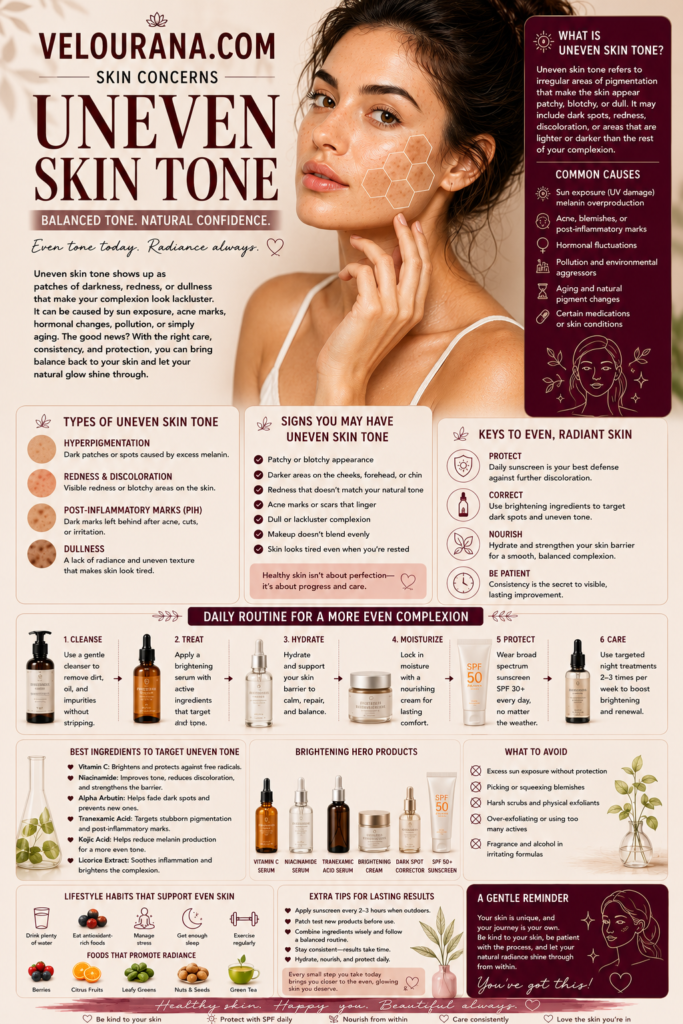
CATEGORY: Uneven Skin Tone
Uneven skin tone rarely arrives as a dramatic event. More often, it develops quietly. A faint mark remains after a blemish. The forehead becomes slightly deeper in colour after repeated sun exposure. The area around the mouth looks duller than the cheeks. Small patches that once disappeared quickly begin to linger. Eventually, the face no longer seems to possess the visual continuity it once had, even though it may be difficult to identify precisely when the change began.
This gradual quality is one of the most important characteristics of uneven tone. The complexion visible today is not simply a reflection of what happened to the skin yesterday. It contains a history.
Sun exposure accumulates. Inflammation leaves traces. Hormonal influences alter pigment behaviour. Skin renewal changes with age. Irritation can repeatedly stimulate the same areas. Dryness modifies surface reflection. Individual marks overlap with older ones until what began as a collection of separate events becomes an overall impression of irregular colour.
This helps explain why uneven tone can feel surprisingly resistant to quick solutions. A serum introduced this week is being asked to address changes that may have developed over months or years.
Understanding this accumulated history changes the question from “What product will make my skin even?” to something more useful: “What has been repeatedly creating this unevenness, and how can I interrupt that process while allowing existing changes to improve?”
That is where meaningful correction begins.
The Skin Remembers Exposure
The idea that skin has a memory is not literal, but it is an effective way to understand cumulative environmental damage.
Every period of ultraviolet exposure produces biological responses. Some are immediately visible, such as tanning or sunburn. Others are subtle and accumulate gradually. Over years, repeated exposure can contribute to changes in pigmentation, texture and the overall appearance of the complexion.
This is why pigmentation frequently becomes more noticeable with age even in someone who has never experienced a dramatic episode of sun damage. Ordinary exposure matters.
Childhood holidays, years of walking outdoors, driving, commuting, sitting in bright environments and spending weekends in the sun all contribute to lifetime exposure. The skin does not reset at the end of each summer.
Pigment-producing melanocytes respond to ultraviolet radiation by increasing melanin production. This is part of the body's defence against radiation, not a cosmetic malfunction. Problems of unevenness arise when that response becomes irregular or when repeated exposure makes certain areas visibly darker than their surroundings.
The face is particularly vulnerable because it is exposed throughout the year. Its geography also creates uneven exposure. The forehead, nose and cheekbones project outward and may receive considerable radiation. Hair, hats, facial structure and daily habits create further differences.
Someone who drives frequently may experience asymmetric exposure through a side window. Someone who habitually sits near a bright window may have another pattern. Outdoor hobbies create their own distribution.
The eventual result may appear spontaneous because the accumulated changes become visible only after crossing a certain threshold.
But the process may have been developing for years.
Pigment Production Is Protective Before It Is Cosmetic
Melanin is often discussed only when people want less of it.
Biologically, however, melanin serves an important protective role. Produced by melanocytes and transferred to surrounding keratinocytes, it helps absorb and disperse ultraviolet radiation.
Different people naturally produce and distribute melanin differently, creating the enormous diversity of human skin tones. None of these natural differences represents pigmentation damage.
Uneven pigmentation occurs when pigment activity becomes locally altered.
Ultraviolet radiation is one stimulus, but it is not the only one. Inflammation can influence melanocyte activity. Hormonal signals can alter pigmentation patterns. Certain injuries and skin conditions can leave darker areas behind. Some medications and medical conditions may also influence pigmentation, which is one reason unexplained changes deserve professional evaluation rather than automatic cosmetic treatment.
The distinction between normal pigment and excess local pigment is fundamental.
A skincare routine designed to improve unevenness should not be conceived as suppressing the skin's natural colour. Its purpose is to reduce inappropriate contrast created by areas where pigment production or distribution has become different from surrounding skin.
This is also why the language of “brightening” is generally more useful than the idea of bleaching.
Healthy skin is not colourless skin.
A successful routine respects the individual's natural complexion while gradually reducing irregularities that make the surface appear less balanced.
The Sun Does Not Need to Burn the Skin to Change It
One persistent misconception is that sun damage requires visible sunburn.
It does not.
Sunburn represents an acute inflammatory response to excessive ultraviolet exposure. Pigment-related changes can occur without that dramatic warning signal. Repeated lower-level exposure still influences melanocytes and contributes to cumulative photodamage.
This matters enormously for people treating uneven tone.
A person may carefully avoid beaches and intentional tanning yet spend significant amounts of time outdoors without adequate protection. Because the skin never becomes red or painful, the exposure feels harmless.
Meanwhile, pigmentation may continue to deepen.
The relationship becomes particularly frustrating when corrective products are being used simultaneously. An exfoliating or brightening routine may gradually improve existing discoloration while daily ultraviolet exposure stimulates additional pigment production.
Progress and regression occur together.
From the user's perspective, the product seems ineffective. In reality, the routine may be fighting an environmental stimulus that has never been adequately controlled.
Broad-spectrum sunscreen therefore occupies an unusual position in pigmentation care. It does not function like a conventional corrective serum, yet it may determine whether corrective treatments are able to produce visible progress.
Regular sunscreen use also needs to be realistic. Applying an insufficient amount in the morning and then spending an entire day in intense sunlight may not provide the protection someone imagines. Outdoor conditions, sweating, swimming and prolonged exposure can make reapplication necessary.
Shade, clothing, hats and behavioural choices remain valuable companions to sunscreen.
The objective is not fear of daylight. It is reduction of unnecessary exposure, particularly when the skin is already demonstrating a tendency toward irregular pigmentation.
Inflammation Leaves More Than Redness Behind
The connection between inflammation and uneven tone becomes obvious after acne.
A blemish appears, becomes inflamed and eventually resolves. Yet its departure is incomplete. A flat brown, greyish, reddish or purplish mark remains where the active lesion once existed.
This can create the strange experience of having fewer active breakouts while the complexion still looks heavily affected by acne.
Depending on the individual and the type of mark, the remaining colour may involve post-inflammatory hyperpigmentation, post-inflammatory erythema or a combination of processes. These are not identical phenomena, even though they may all be casually described as acne marks.
The broader lesson extends beyond acne.
Inflammation changes the skin environment. Eczema, irritation, scratching, burns, cosmetic reactions and other inflammatory events can leave visible changes after the original trigger has disappeared.
Skin tone plays an important role in how these consequences appear. People with more melanin-rich skin can be particularly susceptible to persistent post-inflammatory hyperpigmentation, although it can occur across skin tones.
This creates a crucial principle for treatment: preventing inflammation can be part of preventing pigmentation.
A person who continually squeezes blemishes may extend the inflammatory process. Someone who aggressively exfoliates an irritated area in an attempt to remove its darkness may provoke further inflammation. A harsh product used to fade pigmentation can therefore create conditions that encourage more pigmentation.
This apparent contradiction explains many disappointing skincare experiences.
The strongest treatment is not necessarily the treatment that produces the fastest net improvement.
Sometimes the most effective pigmentation routine is the one that creates the least additional inflammation while working steadily over time.
Hormones Can Change the Rules
Not all pigmentation behaves like an ordinary sun spot or post-blemish mark.
Melasma demonstrates this particularly well.
It commonly appears as patches of pigmentation, often with a relatively symmetrical distribution across areas such as the cheeks, forehead or upper lip. Its biology is complex and can involve hormonal influences as well as exposure to ultraviolet radiation and visible light.
Pregnancy and hormonal medications are among the contexts commonly associated with melasma, although the condition is not limited to them.
The practical importance is that melasma can be persistent and recurrent. Someone may achieve substantial improvement only to notice the pigmentation becoming more visible again after sun exposure or hormonal changes.
This does not mean treatment has failed.
It means the underlying tendency has not necessarily disappeared.
For some pigmentation disorders, maintenance is more realistic than the expectation of permanent elimination. Sun protection remains important even after visible improvement. Treatment may need to be adjusted over time, and professional dermatological guidance can be particularly valuable.
Melasma also illustrates why self-diagnosis based purely on colour can be unreliable.
Two brown patches can look superficially similar while having different causes and therefore different management requirements.
When pigmentation is extensive, persistent, recurrent or difficult to classify, identifying what it actually represents is more valuable than purchasing another generic brightening serum.
The Barrier Can Determine Whether Treatment Helps or Hurts
The skin barrier receives less attention than glamorous active ingredients because its contribution is less dramatic.
Yet barrier condition can determine whether a pigmentation routine succeeds.
The outermost layers of the skin help regulate water loss and protect against environmental irritants. When this barrier becomes disrupted, the skin may feel tight, sting easily, become flaky or react to products that were previously comfortable.
A damaged barrier can also make the complexion look less even.
Dry, rough areas reflect light differently. Redness becomes more visible. Texture appears exaggerated. Makeup sits irregularly. The skin may look simultaneously dull and shiny because surface dehydration and oil production are not mutually exclusive.
For pigmentation-prone skin, there is an additional concern: barrier disruption often accompanies inflammation.
This makes over-treatment particularly counterproductive.
A person sees dark marks and introduces an acid. Progress seems slow, so exfoliation frequency increases. A retinoid is added. Then a strong vitamin C formula. Eventually the face feels irritated, but because the products are associated with brightening, the discomfort is interpreted as evidence of effectiveness.
It is not.
Persistent burning, significant redness and continuing irritation are not necessary conditions for pigmentation improvement.
A functioning barrier creates a more stable foundation from which targeted ingredients can work. Moisturisation is therefore not separate from tone correction. It supports the environment in which correction takes place.
There are occasions when temporarily simplifying a routine can produce a better-looking complexion even before pigment has significantly changed. Once dryness and irritation improve, surface reflection becomes more uniform and inflammatory redness decreases.
The face appears calmer.
That calmness is not a cosmetic consolation prize. It is often an important step toward longer-term improvement.
Cellular Turnover Changes What We See
The upper layers of the epidermis are continually renewed. Cells formed deeper within the epidermis gradually move toward the surface before eventually being shed.
This process contributes to the gradual evolution of superficial pigmentation.
When excess pigment is located within epidermal cells, normal turnover helps move pigmented material toward the surface over time. Certain skincare ingredients can influence aspects of this process, which is one reason retinoids and exfoliating acids are often associated with improvements in tone and texture.
But the phrase “cell turnover” has sometimes been transformed into an excuse for excessive exfoliation.
The logic appears simple: if natural shedding helps remove pigmented cells, then aggressively accelerating shedding should remove pigmentation faster.
Skin biology is more complicated.
The epidermis is not dead material waiting to be scrubbed away. It is a highly organised protective tissue. Excessive disruption can impair barrier function and trigger irritation. The theoretical benefit of faster exfoliation can therefore be undermined by the biological consequences of overdoing it.
This is particularly relevant when pigmentation sits deeper within the skin. Surface exfoliation cannot simply polish away pigment located beneath the superficial layers.
The depth of pigmentation helps explain why some marks disappear relatively quickly while others remain stubborn.
It also explains why professional assessment may become useful when months of sensible topical care produce little improvement. The issue may not be insufficient exfoliation. It may be the nature or location of the pigment.
Age Changes the Appearance of Unevenness
Uneven tone often becomes more noticeable over time, but ageing does not create one simple pigmentation pattern.
Several processes converge.
Cumulative sun exposure becomes more visible. Cellular turnover changes. Previous inflammatory events have had more years to leave their traces. Hormonal transitions may influence pigmentation. Skin texture changes, altering the way light reflects from the face.
The result is often a combination of pigment and texture rather than one isolated issue.
This is why mature skin may appear more uneven even when individual dark spots are not especially dramatic. Small areas of pigmentation combine with dryness, fine lines and surface irregularities, creating greater visual contrast.
The skincare strategy therefore benefits from addressing the complexion as a whole.
A product that improves hydration may enhance luminosity. A retinoid, when appropriate and well tolerated, may support several concerns simultaneously. Consistent sunscreen helps prevent further photodamage while protecting progress made through other treatments.
Trying to erase each visible mark individually can miss the larger transformation taking place within the skin.
With age, the concept of even tone increasingly overlaps with the concept of skin quality.
Smoothness, hydration, resilience and luminosity all influence whether pigmentation attracts the eye.
Why Some Marks Fade and Others Stay
One of the most confusing features of uneven pigmentation is inconsistency.
A blemish on one part of the face may disappear without leaving any visible trace. Another, apparently similar blemish leaves a mark that remains for months.
Several variables can contribute.
The intensity and duration of inflammation matter. Deeper inflammatory lesions may produce more persistent aftermath than superficial ones. Picking or squeezing can increase tissue injury. Individual areas of the face may respond differently. Sun exposure can darken existing marks. The depth of deposited pigment can influence how quickly it resolves.
Skin tone and individual biological tendencies also matter.
This means it is unrealistic to assign every mark a universal fading schedule.
Cosmetic marketing sometimes encourages the expectation that a specific number of days will produce a predetermined degree of improvement. Clinical studies can provide useful information about ingredient performance, but an individual's pigmentation exists within a much more complicated environment.
A product is only one variable.
How consistently it is used, whether sunscreen is applied, whether new inflammation continues, whether the product itself causes irritation and what type of pigmentation is being treated all influence the outcome.
This is why comparison between people can be misleading.
One person's post-blemish mark disappearing rapidly does not establish the timeline for another person's skin.
Correcting Existing Pigment Requires Restraint
Once uneven pigmentation has developed, there are several cosmetic pathways through which its appearance may be addressed.
Some ingredients influence processes involved in melanin production or transfer. Others encourage epidermal renewal. Antioxidants may help address environmental oxidative stress while supporting a brighter appearance. Certain ingredients have anti-inflammatory properties that can be useful when unevenness coexists with acne or sensitivity.
Vitamin C, niacinamide, azelaic acid, alpha arbutin, tranexamic acid, retinoids and alpha hydroxy acids are among the ingredients commonly encountered in tone-focused skincare.
The temptation is to interpret this variety as a shopping list.
It should not be.
A person does not automatically need every ingredient with evidence or potential relevance to pigmentation. Combining too many active formulas can make a routine difficult to tolerate and nearly impossible to troubleshoot.
A better strategy is based on purpose.
If recurring acne is the major source of new marks, the routine needs to address breakouts as well as pigmentation. If sun exposure is the dominant issue, photoprotection becomes central. If the skin is dry and reactive, barrier stability may need to precede aggressive correction.
Targeted ingredients can then be selected around that context.
This is slower than assembling an elaborate routine in a single afternoon, but it has one enormous advantage: the skin is more likely to tolerate it long enough for meaningful improvement to occur.
The Most Powerful Routine May Be the One You Can Repeat
Consistency is an underestimated skincare technology.
A theoretically excellent routine that is used irregularly, abandoned because of irritation or constantly replaced by new products has limited opportunity to produce results.
A simpler routine performed consistently can accumulate benefits.
This is particularly relevant for pigmentation because improvement often requires sustained management. Sunscreen works best as a habit. Brightening treatments generally require repeated application over time. Retinoids require adaptation and continued use. Moisturisation protects the environment in which these interventions operate.
Routine design should therefore consider human behaviour as seriously as ingredient chemistry.
If a morning routine contains eight steps and takes twenty minutes, will it realistically be followed every day? If an active treatment leaves the skin visibly peeling before every social occasion, will the user continue it? If sunscreen feels unpleasant, will enough actually be applied?
Elegance in skincare often means reducing friction.
Products should fit the person's skin and life.
A morning routine might consist of a gentle cleanse when needed, one targeted treatment, moisturiser if required and broad-spectrum sunscreen. Evening care may involve cleansing, a carefully chosen active on appropriate nights and moisturisation.
There is no universal requirement for a particular number of steps.
What matters is that each step has a reason to exist.
Prevention Gradually Changes the Mathematics
Imagine pigmentation as a balance between marks appearing and marks fading.
If five old marks fade while five new ones develop, the complexion may look unchanged despite successful treatment.
If five fade and only one new mark develops, visible progress becomes much easier to achieve.
This is the mathematics of prevention.
It explains why controlling acne can transform a pigmentation routine even before a dedicated brightening treatment becomes more powerful. It explains why sunscreen can improve long-term outcomes despite not immediately removing existing spots. It explains why avoiding unnecessary irritation matters.
The rate at which new unevenness develops is as important as the rate at which existing unevenness improves.
This principle becomes increasingly valuable over time.
Initially, someone may be focused almost entirely on correction. Eventually, the routine should become good enough at prevention that fewer new problems require correction.
The complexion then stops behaving like a constantly replenished backlog.
This is the point at which maintenance becomes possible.
Knowing When Skincare Has Reached Its Limit
Cosmetic skincare can accomplish a great deal, but it cannot solve every cause of uneven colour.
A persistent pigmentation pattern may require diagnosis. A changing mole should not be treated with brightening serum. Rapidly developing or unexplained changes deserve medical attention. Conditions such as melasma may benefit from professional management.
Dermatologists can distinguish between pigmentary and vascular concerns, evaluate suspicious lesions and determine whether prescription treatments or procedures are appropriate.
Professional options can be more powerful than over-the-counter skincare, but greater power also requires greater precision.
Chemical peels, prescription depigmenting agents, lasers and other procedures are not automatically superior simply because they are stronger. The wrong intervention can aggravate pigmentation, particularly in skin susceptible to post-inflammatory hyperpigmentation.
Professional treatment is therefore not merely an escalation in intensity.
It is an escalation in diagnostic specificity.
Knowing when ordinary skincare has reached its reasonable limit prevents months of increasingly aggressive experimentation.
A Complexion Is the Result of What Happens Repeatedly
The deepest lesson behind uneven skin tone is that repetition matters more than isolated events.
One forgotten application of sunscreen does not define a complexion. Years of repeated exposure can.
One blemish may leave no lasting trace. Repeated inflammatory breakouts can create widespread post-blemish pigmentation.
One exfoliating treatment may make the skin feel smooth. Chronic over-exfoliation can leave it reactive and visibly uneven.
Likewise, one night of a brightening serum rarely transforms pigmentation. Months of consistent, well-tolerated care can.
Skin is shaped by patterns.
This makes uneven tone less mysterious than it first appears. The complexion is continually responding to light, inflammation, hormones, skincare, environment and time. What eventually becomes visible is the accumulated result of those interactions.
Correcting unevenness therefore means changing the pattern.
Protect the skin more consistently than it is exposed unnecessarily. Calm inflammation rather than repeatedly provoking it. Support the barrier instead of continually stripping it. Choose targeted ingredients carefully enough that they can remain part of the routine. Allow gradual biological processes the time required to produce visible change.
The objective is not to force every part of the face into identical colour.
It is to reduce the accumulated signals that cause certain areas to stand apart.
When those signals become quieter, the complexion often becomes quieter too. Old marks gradually lose prominence. New ones appear less frequently. Texture becomes more uniform. Light moves across the skin more smoothly.
The result is not artificial perfection.
It is a complexion whose history is no longer the first thing the eye notices.
The End
Velourana.
 Discover More From Our Family of Websites
 ZodiacBearing (Astrology, Tarot, Numerology, Angel Numbers & Spiritual Guidance)
 Velourana (Beauty, Makeup, Hair Care, Skincare & Beauty Tips)
 HavenBearing (Home, Living, Organization, Décor & Everyday Inspiration)
 PawBearing (Pet Care, Dog Breeds, Animal Health, Training & Pet Products)
 PsyCatherine (Notes From the Journal of a Psychologist on Real Life)