
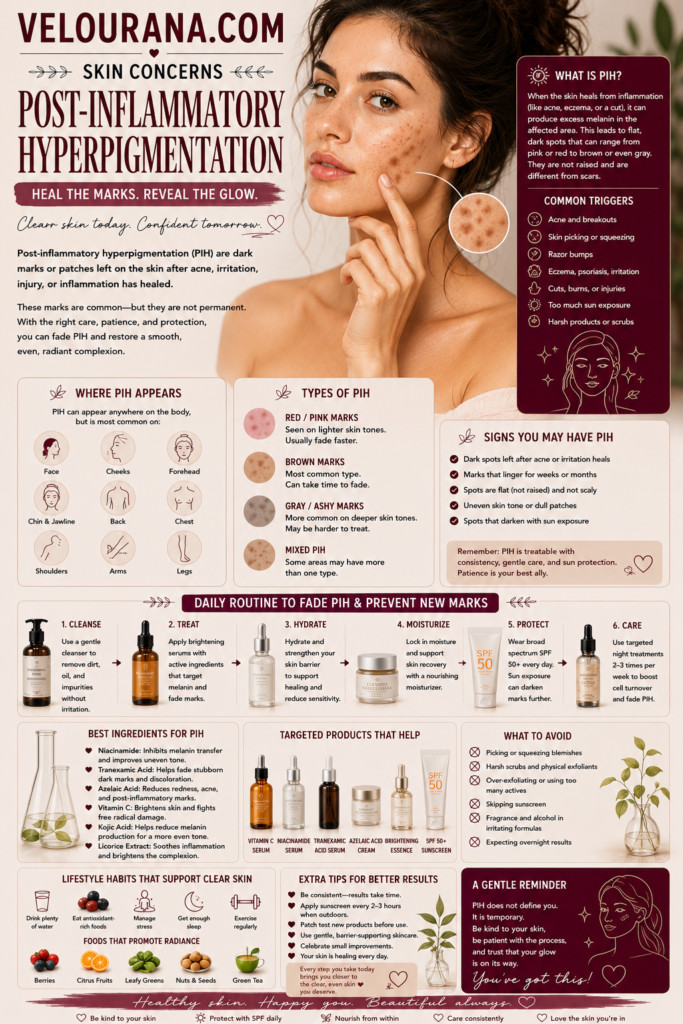
CATEGORY: Post-Inflammatory Hyperpigmentation
A blemish disappears. The swelling settles, the tenderness is gone, and the skin has technically healed. Yet something remains: a brown, grey-brown, or sometimes almost shadow-like mark exactly where the inflammation once lived. It can feel as though the skin has kept a record of an event that should already be over.
This is the peculiar nature of post-inflammatory hyperpigmentation, commonly shortened to PIH. Unlike an active breakout, rash, burn, or irritation, PIH is not usually evidence that the original problem is still occurring. It is the pigmentary aftermath of that problem—a change in colour produced when inflammation disrupts the normal regulation and distribution of melanin.
That distinction changes almost everything about how PIH should be approached. A dark mark left by acne cannot necessarily be managed in the same way as active acne. Pigmentation following eczema is not simply another form of sunspot. And aggressively exfoliating a stubborn mark may actually prolong the very process someone is trying to correct.
PIH therefore asks for a different kind of skincare intelligence. The goal is not merely to fade what can be seen. It is to understand why the mark appeared, prevent the skin from repeatedly creating new ones, protect existing pigmentation from becoming more persistent, and encourage gradual improvement without generating another cycle of irritation.
The most effective approach is often less about attacking pigment and more about interrupting the sequence that produces it.
The Mark Is the Aftermath, Not the Original Injury
Post-inflammatory hyperpigmentation develops following inflammation or injury to the skin. Acne is one of its most familiar triggers, but it is far from the only one. Eczema, dermatitis, insect bites, burns, scratching, friction, folliculitis, allergic reactions, infections and cosmetic procedures can all be followed by areas of increased pigmentation.
The word post-inflammatory is particularly useful because it describes the sequence.
First there is inflammation.
Then the inflammation subsides.
Pigmentation remains.
During an inflammatory response, the skin releases a complicated collection of chemical signals. Melanocytes—the specialised cells responsible for producing melanin—can respond to this inflammatory environment by increasing pigment production. Melanin may subsequently be transferred into surrounding epidermal cells in greater quantities or distributed irregularly. If inflammation is sufficiently intense or deep, pigment can also become located deeper within the skin.
The result is not one single uniform type of mark. PIH can range from relatively light tan discoloration to deep brown or greyish pigmentation, and its persistence can vary substantially.
This also explains an experience familiar to people with acne-prone skin: the pimple may last for a week, while its visual memory lasts for months.
The inflammatory episode and the pigmentation it leaves behind operate on different timescales.
It is tempting to interpret that persistence as evidence that the skin is failing to heal. In many cases, however, the opposite is true. The active injury has healed; what remains is the slower process of pigment normalisation.
Understanding this can prevent one of the most common mistakes in pigmentation care: repeatedly treating a healed area as though something still needs to be forcibly removed from it.
Why Some Skin Develops More Persistent PIH
Any skin tone can develop post-inflammatory hyperpigmentation. Nevertheless, PIH tends to be more noticeable, more frequent and potentially more persistent in skin with greater baseline pigmentation. Research has consistently identified PIH as a particularly important concern in darker skin phototypes.
This does not mean darker skin is somehow less capable of healing. Rather, the melanocyte system is highly responsive, and inflammation can stimulate a more visible pigmentary response.
The intensity of the original inflammation matters too.
A tiny superficial blemish that resolves quickly may leave little or no visible mark. A large inflammatory lesion, repeated scratching, prolonged dermatitis or an irritated acne lesion that has been squeezed and manipulated can create a much more substantial inflammatory event.
Depth matters as well.
When excess pigment is primarily located within the epidermis, the outer region of the skin, the resulting discoloration commonly appears tan to dark brown. When inflammation disrupts deeper structures and pigment reaches the dermis, the mark can develop a greyer or blue-grey quality and may be considerably slower to improve. Epidermal PIH generally has a more favourable natural course than deeper dermal pigmentation.
This is one reason apparently similar dark marks may behave very differently.
Two people can use identical routines on marks that look superficially alike and experience completely different timelines. Even on the same face, one blemish may leave pigmentation that fades relatively quickly while another produces a mark that remains visible far longer.
PIH is therefore better understood as a biological response than as a simple surface stain.
The colour is visible at the surface, but its behaviour is determined by what happened within the skin.
The Cycle That Keeps Creating New Marks
Treating pigmentation without controlling its trigger is like continually cleaning water from a floor while leaving the tap running.
For acne-related PIH, this principle is especially important.
Imagine someone who has twenty visible dark marks and continues to develop several inflammatory blemishes every month. A brightening routine might gradually improve some older pigmentation, but every new inflammatory lesion has the potential to create another mark. The complexion can appear permanently unchanged even while individual areas are fading because new pigmentation is continually replacing the old.
The same pattern occurs with eczema that repeatedly flares, ingrown hairs that remain inflamed, habitual scratching, irritating hair-removal practices or skincare routines that continually compromise the skin.
This is why management of the underlying inflammatory condition is considered fundamental to PIH treatment.
The practical implication is significant.
For someone with acne and PIH, reducing inflammatory breakouts may ultimately contribute more to an even-looking complexion than adding another brightening serum. For someone whose pigmentation follows irritation, identifying the irritating product or behaviour can matter more than intensifying exfoliation.
Pigmentation care therefore begins one step earlier than pigmentation itself.
Ask not only, “How do I fade this mark?”
Ask, “Why did my skin create this mark, and is that process still happening?”
That second question often reveals the more important part of the solution.
Why Picking and Squeezing Can Change the Pigment Story
A small blemish can become a much larger inflammatory event when it is repeatedly squeezed, scratched or picked.
Manipulation places additional mechanical stress on already inflamed tissue. The surrounding area can become redder, more swollen and more traumatised. Damage may extend beyond the original boundaries of the blemish, meaning the eventual mark can be larger than the spot that created it.
This explains the frustrating experience of extracting something almost microscopic and later being left with a conspicuous dark patch.
The problem is not moral and it is not about having perfect skincare discipline. Picking can be extraordinarily tempting, particularly when a lesion feels raised or visible. But from a pigmentation perspective, reducing unnecessary trauma is one of the simplest ways of limiting additional inflammatory signalling.
The same principle extends beyond acne.
Constantly scratching an itchy patch, repeatedly rubbing irritated skin, using harsh physical scrubs or attempting to peel away flaky areas can prolong inflammation. The skin is repeatedly asked to repair itself while simultaneously being disturbed.
A useful way to think about PIH is that inflammation determines the message and melanocytes help record it.
The quieter the inflammatory episode can be kept, the less dramatic that record may become.
Sunlight Does Not Have to Create the Mark to Make It Matter
PIH originates with inflammation, but exposure to ultraviolet radiation can contribute to its persistence and darkening. This makes photoprotection a foundational component of pigmentation management rather than an optional finishing step. Reviews of PIH treatment consistently include sunscreen and photoprotection as important parts of management, while a recent systematic review examining prevention in skin of colour found sunscreen to be the intervention that most consistently prevented PIH development among the approaches evaluated.
This creates an important shift in perspective.
Sunscreen is not merely there to prevent future sunspots.
When someone is trying to improve PIH, daily photoprotection helps create an environment in which existing pigmentation is not continually encouraged to become more pronounced.
This matters because skincare routines are sometimes built almost entirely around active ingredients. There may be an exfoliating acid at night, vitamin C in the morning, a retinoid on alternate evenings and a brightening treatment somewhere between them—yet sunscreen is inconsistent.
That is a backwards hierarchy.
A pigmentation routine should first reduce the forces that keep producing or intensifying pigmentation. Only then should increasingly sophisticated corrective steps be layered on top.
Protection also extends beyond sunscreen itself. Seeking shade during intense exposure, using hats where practical and avoiding deliberate tanning all reduce unnecessary stimulation.
This is not an argument for fearing daylight or living indoors. It is simply recognition that pigment biology does not operate independently of the environment.
When the objective is greater colour uniformity, protection and correction belong to the same strategy.
Brightening Ingredients Work Best When the Skin Can Tolerate Them
The modern skincare market offers an enormous vocabulary of pigmentation ingredients. Azelaic acid, retinoids, niacinamide, vitamin C derivatives, alpha hydroxy acids, kojic acid and other pigment-modulating ingredients frequently appear in products intended to improve uneven tone.
The temptation is obvious: if one brightening ingredient can help, perhaps five will help five times faster.
Skin rarely behaves according to that arithmetic.
PIH occupies an unusual position because the condition is created by inflammation while some treatments capable of improving pigmentation can themselves become irritating when used too aggressively. Excessive irritation can potentially worsen pigmentation, particularly in skin already prone to strong post-inflammatory responses. This need to balance effectiveness against irritation is repeatedly emphasised in dermatological discussions of PIH.
The best routine is therefore not necessarily the routine containing the greatest number of active ingredients.
It is the strongest routine the skin can comfortably sustain.
That difference is fundamental.
Azelaic acid is frequently used in pigmentation-focused care because it can address both inflammatory acne and uneven pigmentation, making it particularly relevant when breakouts and their aftermath coexist. Retinoids can help regulate epidermal turnover and are among the more extensively studied topical approaches for PIH. A 2024 systematic review focusing on skin of colour found topical retinoids to be the most frequently investigated intervention among the studies included, although outcomes across treatments remained variable rather than universally dramatic.
Niacinamide is another popular component of tone-supportive routines, while vitamin C and related antioxidants are commonly incorporated for their broader role in brightening and protection against oxidative stress.
But ingredients should not be treated like contestants in a race.
The question is not simply which ingredient is theoretically strongest. It is which intervention fits the person’s skin, the cause of their PIH, the depth and persistence of the pigmentation, the rest of their routine and their tolerance.
Consistency with a sensible treatment usually has more value than repeatedly abandoning products in search of something more aggressive.
The Barrier Is Part of Pigmentation Care
Moisturiser is rarely marketed with the drama of a pigmentation serum.
It does not promise to erase spots in days. It does not usually appear in dramatic before-and-after campaigns. Yet barrier support can be one of the most strategically important parts of a PIH routine.
A compromised skin barrier becomes more vulnerable to irritation. Increased irritation can encourage inflammation. Inflammation is precisely the process capable of generating or aggravating PIH.
Barrier care is therefore not separate from pigmentation care.
It supports it.
This becomes particularly important when exfoliating acids or retinoids are being used. These ingredients may be valuable, but increasing their frequency faster than the skin can tolerate can produce tightness, stinging, persistent redness, flaking or tenderness.
Those signals should not automatically be interpreted as evidence that a treatment is “working.”
A product can influence skin biology without making the skin visibly suffer.
Indeed, when PIH is the concern, chronic irritation is especially counterproductive. Someone may accelerate exfoliation while simultaneously creating low-level inflammation, effectively pressing the accelerator and brake at the same time.
A well-designed routine therefore leaves space for gentleness.
A mild cleanser, appropriate moisturiser and dependable sunscreen can provide the framework within which targeted actives operate. On some days, doing less may be exactly what allows the treatment plan to continue.
This is particularly relevant for people who have spent months rotating through strong acids, scrubs, masks and spot treatments. Sometimes the skin does not need another intervention. It needs a period in which the existing interventions can function without competition.
Why Exfoliation Is So Easily Overestimated
PIH looks as though it should be removable.
The mark appears on the surface, so exfoliation seems intuitive: remove old cells, reveal clearer ones underneath.
There is some logic here. Carefully selected exfoliating ingredients can be useful within a pigmentation routine. But the idea becomes misleading when it turns into the belief that a dark mark can simply be scrubbed or peeled away.
Melanin is not dirt.
And deeper PIH is not sitting on top of the skin waiting to be polished off.
Aggressive physical scrubbing, excessive acid use or frequent home peels can create exactly the kind of irritation that pigmentation-prone skin does not need. Instead of shortening the process, the attempt to force rapid results can generate additional inflammation and potentially additional discoloration.
This is also why visible peeling should not be treated as a measure of effectiveness.
A treatment does not become more sophisticated because the face is flaking.
Exfoliation should have a defined purpose within the routine rather than functioning as an expression of frustration.
If an exfoliating acid is being used, the rest of the routine should be designed around tolerability. Adding multiple acids, scrubs and retinoids without considering their combined irritation potential turns a targeted routine into an uncontrolled experiment.
PIH rewards patience partly because skin turnover and pigment clearance are biological processes with their own pace.
Skincare can influence those processes.
It cannot simply order them to happen overnight.
Time Is an Active Ingredient
Perhaps nothing about PIH is more psychologically difficult than its timeline.
An inflammatory event can happen quickly. Pigment can remain long after the event has been forgotten.
Epidermal PIH may gradually fade over months, while deeper pigmentation can persist considerably longer. Historical clinical reviews describe epidermal pigmentation as potentially taking months to years to resolve untreated, with dermal pigmentation often following an even more prolonged course.
This does not mean every mark will remain for years.
It means that expectations should be based on biology rather than advertising.
A product promising transformation in several days may improve hydration or temporary radiance, but established pigmentation generally demands a longer view.
This is where photography can be surprisingly useful. Daily mirror inspection is a poor way to evaluate gradual changes because the observer adapts to tiny differences. A photograph taken under similar lighting every few weeks can reveal progress that is almost invisible from one morning to the next.
It can also prevent unnecessary routine changes.
Without objective comparison, someone may conclude after three weeks that nothing is happening, introduce another active, become irritated, stop everything, buy a different product and begin again.
The pigmentation has barely had time to respond before the strategy has changed four times.
Consistency allows both the skin and the person treating it to generate useful information.
If a routine is tolerated and appropriate, giving it sufficient time makes it possible to determine whether it actually works.
When More Aggressive Treatment Becomes Less Intelligent
There is a point at which stronger does not mean better.
Chemical peels, prescription depigmenting treatments and laser or light-based procedures may have roles in selected cases of PIH, particularly when pigmentation is persistent or resistant to simpler approaches. But procedures introduce another paradox: they deliberately create controlled effects in the skin, and if those effects provoke excessive inflammation, they can themselves trigger or worsen PIH.
This risk is particularly important in more highly pigmented skin.
A 2024 systematic review found improvement with several PIH interventions but also highlighted the limitations of available evidence and variability of outcomes. Laser treatments produced improvement for some patients but were also associated with cases in which PIH worsened. A separate review of laser treatment in skin of colour similarly describes lasers as generally secondary to topical approaches because of variable response, expense and complication risk.
The conclusion is not that procedures should be feared.
It is that they should be respected.
A professional who understands pigmentation and has experience treating the relevant skin type can evaluate whether a procedure is appropriate, select parameters carefully and consider the risk of creating additional inflammation.
This is especially important when pigmentation is unusually deep, widespread, resistant to treatment or diagnostically uncertain.
Not every brown mark is PIH.
Melasma, solar lentigines and other pigmentary conditions can resemble one another, while some medical conditions or medications can also alter pigmentation. Treating the wrong diagnosis aggressively can waste time at best and aggravate the skin at worst.
When the pattern does not make sense, diagnosis should come before escalation.
Building a Routine Around the Cause Rather Than the Colour
A thoughtful PIH routine has a hierarchy.
At its foundation is control of the trigger.
If acne is producing the pigmentation, the routine needs an acne strategy. If dermatitis is responsible, controlling dermatitis takes priority. If shaving repeatedly causes follicular inflammation, the grooming process deserves attention. If an overly aggressive skincare routine created the marks, adding more aggressive skincare is unlikely to be the elegant solution.
Next comes protection.
Daily sunscreen reduces an important external factor capable of intensifying pigment. Gentle cleansing and adequate moisturisation help maintain a barrier capable of tolerating treatment.
Only then comes targeted correction.
One or perhaps a small number of carefully selected active ingredients can be introduced according to the skin’s needs. The objective is not to create the most impressive ingredient list. It is to create a routine that can be followed for long enough to produce meaningful change.
This hierarchy can make pigmentation care seem almost disappointingly simple.
But simple and easy are not the same thing.
A restrained routine requires resisting the constant invitation to purchase something stronger. It requires accepting that visible improvement may occur slowly. It requires understanding that a calm month without new inflammatory lesions can represent enormous progress even if old marks have not yet disappeared.
In PIH, prevention and correction are happening simultaneously.
Every blemish that heals without being picked, every eczema flare that is properly controlled, every day the skin is protected from excessive ultraviolet exposure and every potentially irritating treatment that is used responsibly reduces the chance of adding another mark to the collection.
The complexion becomes more even not only because old pigment is fading, but because new pigment is no longer arriving at the same rate.
Learning to Read What the Skin Is Actually Saying
Post-inflammatory hyperpigmentation is often described as a cosmetic problem, but that phrase can underestimate how visible pigmentation changes the way people experience their own skin.
Someone may no longer care about the original pimple but remain preoccupied with the mark it left behind. A person whose acne is medically well controlled may still feel as though they have active acne because dozens of dark marks preserve the visual pattern of previous breakouts.
This distinction deserves recognition.
Clearer skin is not always immediately even-toned skin.
The inflammatory phase and the pigmentary phase can overlap, but they are not identical. Treating them as separate stages makes progress easier to recognise.
The first victory may be fewer new lesions.
The second may be fewer new marks.
Only later does the accumulated pigmentation begin to visibly recede.
Seen this way, PIH becomes less mysterious. The skin is not randomly refusing to cooperate. It is moving through several biological processes at different speeds.
That understanding can also reduce the urge to constantly intervene.
Skin does not need to be punished into becoming clear.
It needs the conditions in which inflammation becomes less frequent, the barrier remains functional, pigment receives less stimulation and normal renewal can gradually change what is visible.
When Professional Guidance Matters
Many mild cases of PIH can gradually improve with time, careful skincare and protection. But there are circumstances in which professional assessment becomes particularly valuable.
Pigmentation that appears without a clear preceding inflammatory event deserves closer evaluation. So does discoloration that changes unexpectedly, spreads rapidly, has unusual borders or colours, or behaves differently from ordinary post-blemish marks.
Persistent acne, eczema, folliculitis or another inflammatory disorder may also require treatment in its own right. In these situations, addressing the underlying disease can prevent months or years of continually accumulating pigmentation.
A dermatologist can also distinguish superficial pigmentation from deeper or more complex pigmentary disorders and determine whether prescription therapy or a carefully selected procedure is appropriate.
This becomes increasingly important before pursuing powerful peels, lasers or other energy-based treatments.
The more aggressive the proposed intervention, the more important correct diagnosis and experienced treatment become.
PIH is frustrating precisely because it can make people impatient. Yet impatience is a poor basis for choosing a procedure capable of creating additional inflammation.
Escalation should be strategic, not emotional.
The Goal Is Not to Fight Pigment, but to Break the Inflammatory Memory
Post-inflammatory hyperpigmentation becomes easier to understand when it is viewed not as an isolated dark spot but as the final chapter of an inflammatory event.
The mark has a history.
Perhaps there was a pimple beneath it. Perhaps an itchy rash. Perhaps repeated friction, a burn, an ingrown hair or a skincare treatment that was simply too aggressive. The visible pigmentation is evidence of the skin’s response to what happened before.
That history determines the smartest way forward.
Prevent or control the inflammation that begins the process. Avoid adding unnecessary trauma. Protect the skin from environmental factors that can intensify pigmentation. Support the barrier so that corrective ingredients remain tolerable. Introduce targeted treatments thoughtfully rather than stacking every brightening ingredient available. Give the skin enough time to demonstrate whether the strategy is working.
And recognise when stubborn or unusual pigmentation deserves professional assessment rather than another round of experimentation.
There is no single universal timeline and no ingredient capable of guaranteeing instant disappearance. Current evidence supports multiple approaches to PIH, but treatment outcomes remain variable, particularly in more persistent cases.
That reality is not a reason for pessimism.
It is a reason for precision.
PIH is often the skin remembering inflammation long after inflammation itself has disappeared. Successful care is therefore not simply an attempt to erase the memory. It is an attempt to stop repeatedly creating the experience that the skin is being asked to remember.
Once that cycle is interrupted, fading is no longer fighting against a constant stream of new pigmentation.
The skin finally has the opportunity to move forward.
The End Velourana.
 Discover More From Our Family of Websites
 ZodiacBearing (Astrology, Tarot, Numerology, Angel Numbers & Spiritual Guidance)
 Velourana (Beauty, Makeup, Hair Care, Skincare & Beauty Tips)
 HavenBearing (Home, Living, Organization, Décor & Everyday Inspiration)
 PawBearing (Pet Care, Dog Breeds, Animal Health, Training & Pet Products)
 PsyCatherine (Notes From the Journal of a Psychologist on Real Life)

