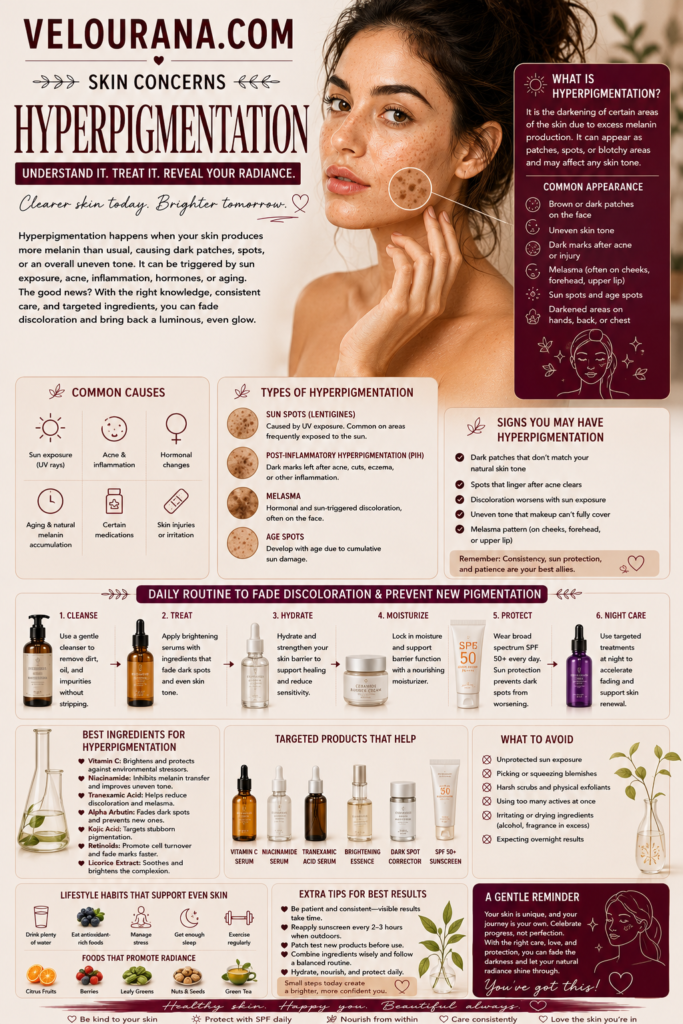
CATEGORY: Hyperpigmentation
Hyperpigmentation routines often become complicated for the same reason people become impatient with them: pigment fades slowly.
A mark remains visible for weeks, so another product is added. Then another. A brightening serum is joined by an exfoliating toner, a retinoid, a vitamin C treatment, an acid peel and perhaps a second product promising to target melanin through a different pathway.
The routine begins with a sensible objective and gradually becomes a collection of increasingly forceful interventions.
Yet hyperpigmentation is one of the skin concerns most likely to punish unnecessary aggression.
Many forms of pigmentation are influenced by inflammation. Irritation can therefore become part of the problem. If treatment repeatedly disrupts the barrier, produces prolonged redness or creates inflammatory reactions, the skin may respond in ways that make discoloration harder rather than easier to control.
This creates a central principle for pigmentation care: a good routine should correct excess pigment without continually provoking the biology that produces it.
That sounds simple, but it changes how products are selected, how quickly they are introduced and how progress is judged.
The objective is not to build the strongest routine possible.
It is to build the strongest routine the skin can tolerate consistently enough to allow gradual improvement.
Start With the Cause Before Choosing the Products
The first step in designing a pigmentation routine is not choosing an active ingredient.
It is understanding what is producing the pigmentation.
A mark left after acne requires a different strategic emphasis from melasma. Repeated irritation around the mouth needs a different approach from sun-induced spots. Pigmentation following eczema cannot be separated entirely from the inflammatory condition that produced it.
This distinction matters because pigment-targeting products do not automatically remove the underlying trigger.
Imagine someone with persistent inflammatory acne using an excellent brightening serum. Existing marks gradually fade, but new blemishes continue developing every week. Each new lesion creates another opportunity for post-inflammatory hyperpigmentation.
The serum may be working.
The overall strategy is incomplete.
Or consider someone with melasma who uses an effective prescription treatment but remains inconsistent with photoprotection. Pigment production is being suppressed at night while an important trigger remains active during the day.
Again, the treatment may be effective while the system around it undermines the result.
This is why the useful starting question is not, "Which ingredient is strongest?"
It is, "What keeps creating this pigmentation?"
Once that is understood, the routine can be organised around both correction and prevention.
Cleansing Should Leave the Skin Ready, Not Stripped
Cleansing rarely receives much attention in discussions of hyperpigmentation because cleansers are not usually expected to fade dark marks.
But they determine the condition in which the rest of the routine operates.
An overly harsh cleanser can leave the skin tight, dry and more vulnerable to irritation. This matters when the routine already contains active treatments such as retinoids, acids or pigment-targeting agents.
A gentle cleanser should remove sunscreen, makeup, sebum and environmental residue without turning cleansing itself into a repeated inflammatory event.
For some people, that means using a simple non-stripping cleanser morning and evening.
For others, particularly those with dry or sensitive skin, a morning water rinse or very mild cleanse may be sufficient.
The precise format matters less than the outcome.
The skin should not feel aggressively degreased.
Tightness immediately after washing is not evidence of cleanliness. It can indicate that the cleansing step is removing more than the skin comfortably tolerates.
This is especially relevant for pigment-prone skin because the entire routine should minimise unnecessary irritation.
The cleanser does not need to perform every job.
It simply needs to prepare the skin for the treatments that actually require contact time.
One Well-Chosen Active Can Be More Useful Than Five
The modern skincare market encourages layering.
If vitamin C can help brighten, why not add azelaic acid?
If azelaic acid helps, why not include an alpha-hydroxy acid?
If exfoliation helps turnover, why not add a retinoid?
Eventually the routine contains multiple ingredients with overlapping benefits and overlapping irritation potential.
This can make it difficult to understand what is helping and what is causing problems.
A better approach is to begin with one central corrective treatment selected according to the pigmentation pattern and skin tolerance.
Azelaic acid can be particularly useful when pigmentation coexists with acne or inflammatory tendencies.
Vitamin C can be incorporated into daytime routines for its antioxidant and brightening role.
Retinoids can influence epidermal turnover and may support treatment of both acne and pigmentation.
Niacinamide is often included in formulations designed to support barrier function and a more even-looking complexion.
Other pigment-targeting ingredients may also be appropriate depending on the formulation and the individual's needs.
The important principle is not that one ingredient is universally superior.
It is that each ingredient should have a reason for being in the routine.
A product should not be added merely because it appears on a popular list of "best ingredients for hyperpigmentation."
The routine should remain understandable.
If the skin becomes irritated, you should be able to identify the likely cause.
If pigmentation improves, you should have some idea which treatment deserves credit.
Complexity should be earned, not assumed.
Retinoids Require Respect, Not Fear
Retinoids are among the most widely discussed ingredients in corrective skincare because they influence several processes relevant to texture, acne and pigmentation.
They can support epidermal turnover and may help improve some forms of uneven pigmentation over time.
But their usefulness depends heavily on tolerance.
A retinoid introduced too aggressively can produce dryness, peeling, burning and inflammation.
For pigment-prone skin, that is not a trivial inconvenience.
The goal should therefore be gradual adaptation.
Someone new to retinoids may begin with a lower frequency rather than immediately using the product every night. Moisturiser can be used to support tolerance. Other potentially irritating actives may need to be reduced during the adjustment period.
This cautious approach is sometimes dismissed as slow.
In reality, it increases the likelihood that the treatment can continue.
A retinoid that produces severe irritation and is repeatedly stopped may deliver less cumulative benefit than a gentler schedule maintained consistently.
Retinoids also require additional caution in certain circumstances, including pregnancy, when topical retinoids are generally avoided.
The larger principle applies beyond this ingredient.
Active treatments should be introduced according to the skin's ability to tolerate them, not according to the maximum frequency printed in an advertisement.
Exfoliation Should Support the Routine, Not Dominate It
Exfoliation can be useful in hyperpigmentation care because epidermal turnover contributes to the gradual removal of pigmented surface cells.
Alpha-hydroxy acids such as glycolic acid are frequently included in brightening routines for this reason.
But exfoliation is easily overused.
The word itself suggests progress: something old is being removed.
This makes it psychologically satisfying.
A slight tingle can feel like activity.
Peeling can be mistaken for effectiveness.
Yet the amount of visible peeling does not directly measure the amount of pigmentation being corrected.
Excessive exfoliation can compromise the barrier and create inflammation.
If the skin becomes persistently sensitive, tight or red, the exfoliation step may be interfering with the larger strategy.
This becomes especially important when exfoliants are combined with retinoids and other strong treatments.
A routine can contain individually reasonable products while becoming collectively excessive.
One acid used periodically may be helpful.
Several acids layered across the week may be unnecessary.
A professional chemical peel may be appropriate in selected cases.
Repeated home resurfacing without adequate recovery may not be.
Pigmentation responds to controlled intervention better than constant assault.
Moisturiser Is Part of Pigmentation Treatment
Moisturiser is often treated as optional in routines focused on specific concerns.
People sometimes assume that if a product does not directly inhibit melanin or accelerate turnover, it is not contributing to pigmentation correction.
This underestimates the importance of tolerance.
A moisturiser supports the barrier.
A healthier barrier can reduce dryness and sensitivity.
Reduced sensitivity can make it easier to use targeted treatments consistently.
Consistency increases the chance of meaningful improvement.
The moisturiser therefore contributes indirectly to the success of the active treatment.
This is particularly important when someone uses retinoids, exfoliating acids or other ingredients capable of causing dryness.
Choosing a moisturiser does not require unnecessary complexity.
The skin needs enough support to remain comfortable and resilient.
Dry skin may prefer a richer formulation.
Oily or acne-prone skin may prefer something lighter.
Sensitive skin may benefit from simpler formulations with fewer potential irritants.
The correct texture is the one that encourages regular use without causing unwanted congestion or discomfort.
Moisturiser should not be seen as the opposite of active skincare.
It is often what makes active skincare sustainable.
Sunscreen Is the Morning Treatment
In a hyperpigmentation routine, sunscreen should not be considered merely the final cosmetic layer.
It is a central treatment step.
Ultraviolet exposure stimulates melanogenesis and can darken existing pigmentation.
If light exposure continues while corrective treatments are being used, the routine is attempting to move the pigmentary system in two opposing directions.
Nighttime treatment is telling the skin to reduce or process excess pigment.
Daytime exposure may be encouraging more pigmentation.
Consistent broad-spectrum sunscreen helps reduce this contradiction.
For persistent pigmentation and particularly melasma, visible light can also be relevant. Tinted sunscreens containing iron oxides are often useful because they provide additional protection in this part of the light spectrum.
This does not mean every person with a single post-acne mark requires an elaborate pigmentation sunscreen strategy.
But anyone investing substantial effort in correcting hyperpigmentation should take daily photoprotection seriously.
The most sophisticated pigment serum cannot fully compensate for repeated unprotected exposure.
A practical sunscreen is therefore better than a theoretically perfect one that is unpleasant enough to discourage regular use.
Texture matters.
Finish matters.
Compatibility with makeup matters.
Whether the formula stings the eyes matters.
The best sunscreen for pigmentation is the sunscreen that provides appropriate protection and can be worn consistently enough to make that protection meaningful.
Morning and Evening Should Have Different Priorities
A pigmentation routine becomes easier to manage when morning and evening are given different roles.
The morning routine is primarily protective.
Gentle cleansing may be followed by an antioxidant or brightening treatment where appropriate, moisturiser if needed and sunscreen.
The evening routine can focus more heavily on correction.
This is where retinoids, azelaic acid, selected exfoliating treatments or other targeted ingredients may be used, depending on tolerance and the treatment plan.
Separating priorities reduces the temptation to apply every active at once.
It also helps minimise interaction-related irritation.
Someone does not need to use exfoliating acid, retinoid and multiple pigment serums in the same evening merely because all of them could potentially address hyperpigmentation.
Alternating products across different nights may be more tolerable.
For some people, a simple schedule works best: retinoid on selected evenings, exfoliant on another evening, recovery-focused moisturising on others.
For someone with sensitive skin, even this may be too much.
For someone with very tolerant skin under professional guidance, a more intensive approach may be appropriate.
There is no virtue in making the routine complicated.
The structure exists to serve the skin.
Recovery Nights Are Productive Nights
One of the most useful concepts in active skincare is the recovery night.
Nothing dramatic happens.
No acid is applied.
No retinoid is used.
No strong brightening treatment is layered.
The skin is cleansed gently and moisturised.
To someone accustomed to equating intensity with progress, this can feel like wasted time.
It is not.
Recovery allows the barrier to stabilise and irritation to settle.
That can improve tolerance of subsequent active treatments.
It also provides an opportunity to observe the skin without additional variables.
If sensitivity improves rapidly on recovery nights, the routine may be too aggressive.
If the skin remains comfortable, current frequency may be appropriate.
This rhythm of treatment and recovery can be particularly valuable for people who repeatedly experience irritation during pigment correction.
A routine does not need to attack pigmentation every night.
It needs to create a long enough period of healthy, controlled skin in which gradual correction can occur.
Treat Acne and Pigmentation Together
For people with acne-related hyperpigmentation, treating marks while ignoring active acne is one of the most common strategic mistakes.
The two concerns are connected.
Every inflammatory lesion can potentially leave another pigmented mark.
This means acne control is part of pigmentation prevention.
Ingredients that address both concerns can therefore be particularly useful.
Azelaic acid is one example.
Retinoids are another.
Other acne treatments may also be necessary depending on severity.
The key is to prevent the routine from becoming two separate routines layered on top of each other.
One set of products for acne.
Another for pigmentation.
Another for exfoliation.
Another for barrier repair.
The cumulative irritation can become substantial.
A more intelligent strategy looks for overlap.
Can one treatment address acne while supporting pigmentation improvement?
Can the cleanser remain neutral instead of containing another strong active?
Can moisturiser improve tolerance enough to reduce interruptions?
Can sunscreen help prevent darkening of existing marks?
Thinking in systems keeps the routine manageable.
Do Not Pick at the Problem You Are Trying to Treat
Picking is often dismissed as a bad habit, but in pigmentation-prone skin it can meaningfully alter the outcome of a blemish.
A lesion already contains inflammation.
Squeezing, scratching or repeatedly touching it creates additional mechanical trauma.
This can prolong inflammation and increase the chance of residual discoloration.
The irony is that picking often begins as an attempt to make the blemish disappear faster.
The immediate surface may look flatter afterward.
But the inflammatory footprint can become larger and longer-lasting.
This can transform a temporary blemish into a mark that remains visible for months.
For someone whose acne consistently leaves PIH, reducing picking may be one of the simplest pigment-prevention strategies available.
It requires no additional product.
It does, however, require recognising that the appearance of today's blemish is less important than the appearance of the skin after that blemish heals.
Strong Treatments Should Not Be Layered Automatically
Several ingredients commonly used for hyperpigmentation can be irritating.
The problem is not necessarily using them.
It is combining them without understanding the total burden.
A retinoid and exfoliating acid used on separate nights may be perfectly manageable.
The same products used together every evening may be too much.
Vitamin C may be well tolerated in the morning, but an acidic formulation layered onto already sensitised skin can sting.
Azelaic acid may be comfortable for many users but can still cause irritation in some.
Hydroquinone may be useful under appropriate guidance but is not an ingredient to combine indiscriminately with every available active.
Skincare routines should therefore be evaluated as complete systems.
Ask how the skin feels after the entire week, not after a single product.
Does it remain comfortable?
Is there persistent redness?
Is peeling increasing?
Does water sting?
Has the skin become unexpectedly shiny and tight?
Are new dark marks appearing in areas that were previously clear?
These observations matter more than whether individual products are technically compatible on paper.
Hydroquinone Belongs to a Different Category
Hydroquinone deserves separate consideration because it has a long history in the treatment of hyperpigmentation and can be highly effective.
But it should not be treated like an ordinary cosmetic brightening serum.
Its use requires more structure.
Depending on jurisdiction, concentration and indication, hydroquinone may be prescription-only or otherwise regulated.
It is generally used for defined treatment periods rather than casually applied indefinitely.
Irritation can occur.
Long-term inappropriate use has also been associated with complications, including exogenous ochronosis.
For these reasons, medical guidance is particularly valuable.
This is especially true when pigmentation is extensive, persistent, recurrent or suspected to be melasma.
The lesson extends beyond hydroquinone.
Not every stronger treatment belongs in an unsupervised home routine.
There is a point at which professional diagnosis and monitoring become more useful than adding another product independently.
Professional Procedures Need the Same Logic as Home Care
Chemical peels, lasers, intense pulsed light and other professional treatments can produce impressive results in carefully selected cases.
But they do not escape the fundamental rule of pigment biology.
Inflammation can create pigmentation.
A procedure deliberately creates controlled injury or energy exposure.
The quality of the outcome depends partly on how the skin responds.
This is why procedure selection matters so much in pigment-prone skin.
Skin tone matters.
The type of pigmentation matters.
Pigment depth matters.
Previous PIH matters.
Device settings matter.
Practitioner experience matters.
Aftercare matters.
Sun protection matters.
A procedure should therefore not be selected simply because it promises faster results than topical treatment.
The correct question is whether it offers an acceptable benefit-to-risk balance for the specific pigmentation being treated.
This is particularly important for darker skin tones, where some energy-based treatments require considerable expertise to minimise unwanted pigment changes.
Professional treatment can be extremely valuable.
Professional does not mean risk-free.
Know When the Routine Is Too Strong
Skin usually provides warning signs before a routine becomes completely intolerable.
Persistent burning is one.
Continuous peeling is another.
Redness that does not settle may indicate excessive irritation.
Products that previously felt comfortable may suddenly sting.
The skin may feel tight even after moisturising.
These signs should not automatically be dismissed as "purging" or evidence that the treatment is working.
Purging refers to a specific phenomenon associated with treatments that accelerate cell turnover and can temporarily bring existing comedonal lesions to the surface.
It does not explain every reaction.
Burning, severe redness, swelling and widespread irritation deserve attention.
A routine that causes ongoing inflammation may undermine pigmentation treatment.
Reducing frequency, temporarily stopping irritating actives and restoring a simpler barrier-supportive routine may be more productive than forcing the skin through escalating discomfort.
If a reaction is significant, professional medical advice may be appropriate.
Discipline in skincare includes knowing when not to apply something.
The Routine Should Become Simpler as You Learn More
At the beginning of pigmentation treatment, experimentation is understandable.
You are discovering what the skin tolerates and what appears effective.
Over time, however, the routine should become clearer.
Perhaps vitamin C makes little noticeable difference while azelaic acid is consistently helpful.
Perhaps the retinoid works well but only when used three nights per week.
Perhaps exfoliation adds irritation without enough visible benefit.
Perhaps the tinted sunscreen dramatically improves the stability of melasma.
The routine should evolve according to this information.
Products that do not justify their place can be removed.
This is the opposite of the usual consumer pattern, in which routines become larger as more products are discovered.
Good skincare often becomes smaller.
Each remaining product has a defined purpose.
There is less overlap.
Fewer variables make the skin easier to understand.
The routine becomes something that can be maintained even during travel, busy periods and changing seasons.
That sustainability is particularly valuable for hyperpigmentation because long-term control matters more than short bursts of perfection.
Give the Routine Enough Time to Tell You the Truth
One of the hardest parts of pigmentation treatment is waiting long enough to judge it.
The skin does not provide immediate feedback about every biological process.
A moisturiser can make the skin feel softer within minutes.
A cleanser can remove makeup immediately.
Pigmentation treatments work on a different timeline.
A product influencing melanin production does not erase existing pigment overnight.
Cellular turnover takes time.
Deeper pigmentation may require much longer.
Melasma can fluctuate.
Post-inflammatory marks may fade slowly even when no new pigmentation is being created.
This means a routine that is tolerated well should usually be evaluated over meaningful periods rather than several days.
Photographs taken under similar lighting can help.
The mirror is surprisingly unreliable because gradual changes are difficult to recognise when the face is seen every day.
A monthly photograph may reveal that a mark is considerably lighter even when daily observation suggests nothing has changed.
The key is to avoid confusing patience with passivity.
If pigmentation is worsening rapidly, behaving unusually or showing no improvement despite an appropriate strategy over a substantial period, reassessment is sensible.
But constantly changing a tolerable routine prevents the skin from ever revealing whether it could have worked.
A Sustainable Routine Is a Better Routine
Hyperpigmentation encourages dramatic solutions because the problem itself is visually obvious.
But the biology behind it is gradual.
This makes sustainability one of the most underrated criteria in treatment selection.
Can the routine be followed for months?
Can it survive a busy week?
Can it be maintained without causing repeated barrier damage?
Can sunscreen realistically be worn every day?
Can the active treatment be used often enough to matter without producing chronic irritation?
Can the routine be simplified during sensitive periods instead of abandoned entirely?
If the answer is yes, the strategy has a chance to produce cumulative results.
A perfect routine followed for ten days is rarely as useful as an appropriate routine maintained for six months.
Hyperpigmentation Responds Better to Cooperation Than Force
Skin does not need to be punished into becoming even.
It needs the right signals repeated over time.
Reduce unnecessary inflammation.
Treat the condition creating new marks.
Support the barrier.
Use appropriate pigment-targeting ingredients.
Protect the skin from light that encourages renewed pigmentation.
Allow recovery when needed.
Escalate only when there is a reason.
Seek professional help when the pigmentation itself or the treatment required exceeds what routine skincare should reasonably manage.
This approach may feel less dramatic than aggressive resurfacing.
But pigmentation is not usually defeated in a single dramatic moment.
It changes through accumulation.
A little less inflammation.
A little less ultraviolet exposure.
A little less new pigment.
A little more controlled turnover.
A little more time.
Eventually those small changes become visible.
The most successful hyperpigmentation routine is therefore not the one that makes the skin work hardest.
It is the one that stops making the skin defend itself against the treatment.
The End Velourana
 Discover More From Our Family of Websites
 ZodiacBearing (Astrology, Tarot, Numerology, Angel Numbers & Spiritual Guidance)
 Velourana (Beauty, Makeup, Hair Care, Skincare & Beauty Tips)
 HavenBearing (Home, Living, Organization, Décor & Everyday Inspiration)
 PawBearing (Pet Care, Dog Breeds, Animal Health, Training & Pet Products)
 PsyCatherine (Notes From the Journal of a Psychologist on Real Life)