
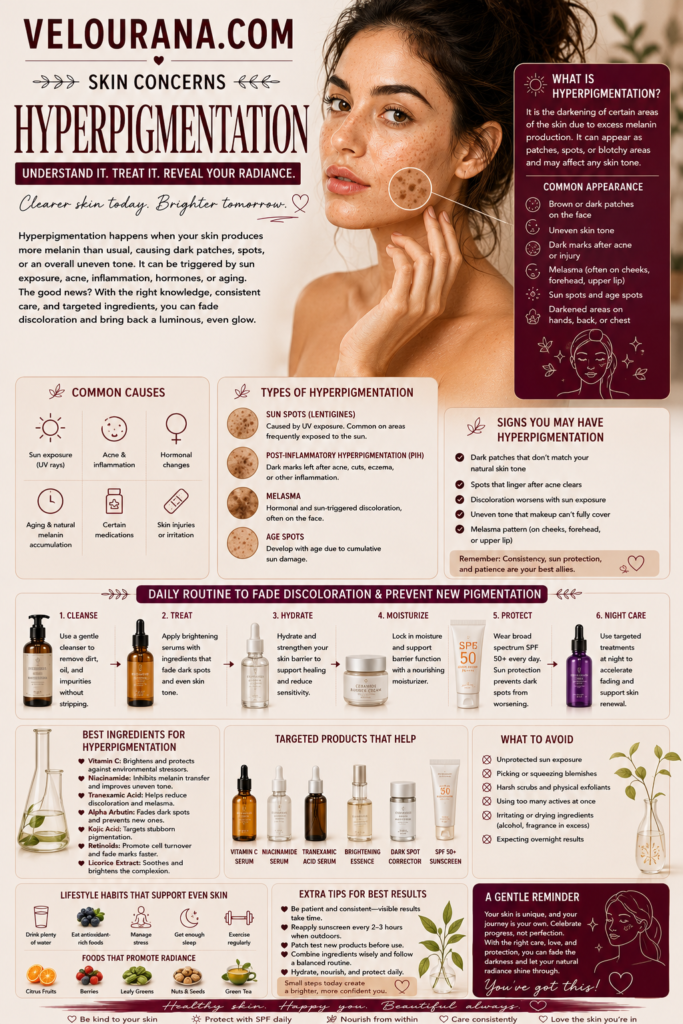
CATEGORY: Hyperpigmentation
One of the most discouraging experiences in pigmentation care happens after the treatment appears to have worked.
A dark area gradually becomes lighter. The complexion looks more even. Months of sunscreen, targeted skincare and patience finally seem worthwhile. Then, sometimes slowly and sometimes surprisingly quickly, the colour begins to return.
It is tempting to interpret recurrence as failure. Perhaps the serum was not strong enough. Perhaps a more powerful acid is needed. Perhaps professional treatment should have been more aggressive.
But recurrent hyperpigmentation often reveals something more important: fading existing pigment and controlling the biological conditions that produce pigment are not the same task.
A treatment can successfully reduce visible melanin without permanently removing the skin's tendency to produce it again. If ultraviolet radiation, visible light, inflammation, hormonal influences, friction or another trigger remains active, the pigmentary system can simply restart.
This is particularly obvious with melasma, but the principle extends to many forms of hyperpigmentation. A person with recurring acne may repeatedly develop post-inflammatory marks. Someone whose skin is chronically irritated may continue creating new areas of discoloration even while treating older ones. Years of sun exposure can leave a complexion in which pigmentation gradually reappears or new spots emerge.
The more useful question, therefore, is not simply whether a treatment can fade pigmentation.
It is whether the entire strategy can keep the conditions that created that pigmentation under control.
Fading and Prevention Are Two Different Biological Jobs
When a dark mark is already visible, the eye naturally focuses on removing it.
Skincare follows the same instinct. Brightening ingredients are selected. Exfoliation is introduced. Perhaps retinoids are added. The routine becomes organised around making existing colour disappear.
Yet pigmentation is dynamic.
Melanocytes continually respond to biological and environmental signals. They produce melanin, which is transferred to surrounding skin cells. The amount, distribution and persistence of that pigment contribute to what eventually becomes visible at the surface.
A fading treatment works somewhere within this process. It may interfere with melanin production, influence pigment transfer, accelerate epidermal turnover or support the gradual removal of pigmented cells.
But suppose the melanocyte continues receiving signals encouraging pigmentation.
New pigment can still be produced.
This explains why apparently successful treatment can be followed by recurrence. The visible evidence was reduced, but the underlying stimulus remained.
The distinction becomes especially important in conditions such as melasma, which is widely recognised as chronic and prone to recurrence. Even when treatment achieves substantial improvement, continued maintenance and photoprotection may be necessary.
Post-inflammatory hyperpigmentation provides another example. A topical treatment may gradually fade old acne marks, but if inflammatory acne remains active, every new lesion represents another opportunity for pigmentation.
The routine may therefore be working perfectly well on yesterday's marks while tomorrow's marks are already being created.
Long-term pigmentation management becomes much more effective when these two jobs are separated conceptually.
First, what can help existing pigmentation fade?
Second, what must change so that the skin produces less unwanted pigmentation in the future?
Sometimes the second question matters more.
The Skin Remembers Inflammation
Inflammation is one of the most important recurring themes in hyperpigmentation.
A blemish, rash, burn, scratch or other inflammatory event can stimulate pigment production. Once the original problem resolves, the pigmentation can remain as a visual after-effect.
This is why post-inflammatory hyperpigmentation is better understood as evidence of a previous biological event rather than an isolated cosmetic defect.
The skin has healed, but it has not returned immediately to its previous colour.
For someone prone to PIH, preventing unnecessary inflammation can therefore be as important as using brightening ingredients.
Consider acne.
There are two possible ways to approach the resulting pigmentation. One is to wait until blemishes disappear and then treat the marks. The other is to reduce inflammatory acne while simultaneously supporting the gradual fading of existing discoloration.
The second strategy addresses both production and correction.
This sounds obvious when stated clearly, yet many routines do the opposite. Considerable money is spent on dark-spot serums while the inflammatory condition responsible for those spots receives relatively little attention.
The same pattern can occur with irritation.
A person notices pigmentation and responds by introducing multiple exfoliating acids. The skin becomes sensitive, dry and inflamed. More pigmentation develops. Stronger treatments are then added because the original treatments appear ineffective.
Eventually the routine becomes part of the pigmentation cycle.
Breaking that cycle sometimes requires doing less.
A calmer skin barrier may create a less inflammatory environment. A gentler cleanser may matter. Reducing unnecessary exfoliation may matter. Treating dermatitis appropriately may matter. Avoiding constant picking and squeezing may matter.
None of these interventions sounds as sophisticated as a new pigment-correcting molecule.
Yet if inflammation is the signal instructing the skin to produce more pigment, reducing that signal is fundamental.
Why Melasma So Often Comes Back
Melasma is perhaps the clearest demonstration that pigmentation cannot always be permanently "removed."
It commonly appears as patches of brown or grey-brown pigmentation, often with a symmetrical distribution across areas such as the cheeks, forehead and upper lip.
Its biology is multifactorial. Genetic susceptibility, hormonal influences and exposure to radiation all appear to participate. Pregnancy and certain hormonal medications may influence melasma in susceptible individuals, while sunlight is a major aggravating factor.
This combination helps explain why recurrence is so common.
A topical treatment may reduce melanin production. A carefully chosen procedure may improve visible pigmentation. The skin may become dramatically clearer.
But the individual's underlying susceptibility has not necessarily disappeared.
Return to substantial sun exposure, inadequate protection or other relevant triggers and pigmentation can become more active again.
This is why the idea of "finishing" melasma treatment can be misleading.
A better model is active treatment followed by maintenance.
During the active phase, stronger or more targeted therapies may be used under appropriate guidance. Once satisfactory improvement is achieved, the objective changes. Instead of continuing maximum-intensity correction indefinitely, the routine may transition toward maintaining the improvement while minimising triggers.
This resembles the management of many chronic skin tendencies.
Control is not inferior to cure simply because the condition can return. Long periods of excellent control can represent a highly successful outcome.
The psychological adjustment matters.
If someone expects melasma to disappear permanently after a short course of treatment, recurrence feels catastrophic.
If the same person understands from the beginning that melasma often requires long-term management, recurrence becomes information. Something in the balance has changed, and the strategy can be reassessed.
Light Exposure Is More Complicated Than Sunburn
Many people unconsciously measure sun exposure by whether their skin burns.
For pigmentation, that is an inadequate measure.
The biological effects of radiation can occur without visible sunburn. Someone may spend an ordinary day outdoors, experience no redness and still expose pigment-prone skin to signals capable of influencing melanogenesis.
This is why pigmentation-focused photoprotection needs to become habitual rather than reactive.
Sunscreen should not appear only during holidays, heatwaves or beach days.
The face is exposed during walking, commuting, sitting outside a café, driving and countless ordinary activities. Cumulative exposure matters.
Broad-spectrum sunscreen is therefore one of the foundations of hyperpigmentation management.
But melasma and some other pigmentary concerns have also expanded the discussion beyond ultraviolet radiation. Visible light can contribute to pigmentation, particularly in darker skin tones, which is one reason tinted sunscreens containing iron oxides have become important in pigmentation-focused dermatology.
This does not mean everyone needs to become anxious about every ray of daylight.
It means photoprotection should be designed around the actual goal.
Someone using sunscreen primarily to avoid burning may behave differently from someone trying to stabilise recurrent melasma.
The second person has a reason to think about daily consistency, adequate quantity, reapplication during sustained exposure and additional protection such as hats and shade.
The difference is strategic.
A brightening routine attempts to reduce pigmentation after it appears.
Photoprotection helps reduce one of the signals encouraging that pigmentation to return.
Used together, these approaches make biological sense.
Why Summer Can Undo Months of Progress
Pigmentation often exposes the weakness of routines that work only under ideal conditions.
During cooler months, someone may carefully follow a brightening routine and achieve noticeable improvement. Then summer arrives.
There are longer days, stronger sunlight, holidays, outdoor meals, swimming, perspiration and irregular routines. Sunscreen may be applied in the morning but not reapplied. Hats are forgotten. Skincare is skipped during travel.
Within weeks, pigmentation looks darker again.
It may appear as though months of treatment have been erased.
In reality, the skin has been placed in a different environmental context.
This is why a long-term pigmentation strategy should not remain identical throughout the year.
The underlying principles remain consistent, but emphasis can change.
During periods of intense exposure, protection may deserve greater attention than aggressive correction. Trying to perform strong peels or repeatedly irritating the skin while simultaneously exposing it to significant sunlight may create unnecessary risk.
During lower-exposure periods, certain corrective treatments may be easier to manage.
This seasonal awareness is particularly important for people living in sunny climates.
The goal is not to hide indoors.
It is to understand that pigmentation responds to cumulative behaviour.
A day at the beach with careful sunscreen use does not automatically destroy months of progress. Nor does a single forgotten application guarantee recurrence.
Patterns matter.
Repeated exposure without adequate protection creates the conditions in which pigmentation is more likely to remain active.
The Problem With Chasing Faster Results
Hyperpigmentation creates impatience because it changes slowly while remaining highly visible.
Every morning the mark is still there.
After two weeks, perhaps it looks almost identical.
A stronger product becomes tempting.
Then another.
Eventually the routine contains an exfoliating toner, vitamin C, a retinoid, an alpha-hydroxy acid, a separate pigment serum and perhaps occasional home peels.
Each ingredient may have a legitimate purpose individually. The problem is the cumulative burden.
Skin does not evaluate ingredients according to their reputation.
It experiences the total routine.
If that routine repeatedly causes irritation, barrier disruption and inflammation, pigment-prone skin may respond badly even though every individual product was purchased specifically to improve pigmentation.
This creates an important rule for long-term management: the strongest routine is not the routine containing the strongest products.
It is the strongest routine the skin can tolerate consistently.
Tolerance is not a compromise.
It determines whether treatment can continue long enough to produce meaningful improvement.
Suppose a powerful treatment creates severe irritation after five days and must be stopped for three weeks. Compare it with a moderate treatment that can be used consistently for six months.
The second strategy may ultimately deliver more cumulative benefit.
This is particularly important because pigmentation correction is measured in months rather than days.
A routine designed for dramatic short-term sensation may be poorly suited to a problem requiring long-term stability.
Maintenance Is an Active Phase, Not an Absence of Treatment
People often think of maintenance as what happens after the "real" treatment is finished.
In pigmentation care, maintenance is often part of the real treatment.
Once visible discoloration improves, the skin may still retain the same predisposition that allowed it to develop.
Photoprotection therefore continues.
Trigger management continues.
Depending on the condition and professional recommendations, selected topical treatments may continue in a less intensive form.
The objective changes from aggressive correction to preserving stability.
This transition is important because some treatments are not intended for unrestricted continuous use.
Hydroquinone is a good example. It can be highly effective in appropriately selected cases, but it is generally used in defined treatment courses rather than treated as an ordinary moisturiser to be applied indefinitely without supervision.
A maintenance strategy may therefore rely on other ingredients and consistent photoprotection after an intensive treatment phase.
The precise approach depends on the diagnosis.
Post-inflammatory pigmentation associated with acne may be maintained partly by controlling acne.
Melasma may require a more deliberate long-term pigment-management strategy.
Sun-related pigmentation may place even greater emphasis on preventing additional cumulative photodamage.
The common principle is that improvement should trigger a change in strategy, not abandonment of strategy.
Stopping everything the moment the skin looks clearer can recreate the conditions that allowed pigmentation to develop initially.
Why Your Routine Should Change When Your Skin Changes
A skincare routine should not become an inflexible contract.
Skin changes.
Weather changes.
Hormonal circumstances change.
Medications change.
Acne activity changes.
Tolerance changes.
Sun exposure changes.
The appropriate pigmentation routine in January may not be identical to the appropriate routine during a Mediterranean August.
Similarly, a routine suitable during active acne may need adjustment once acne is controlled.
Someone using prescription treatment may need a different supporting routine from someone using only cosmetic products.
This is where observation becomes more valuable than constant experimentation.
Rather than asking whether a product is universally "good for hyperpigmentation," ask what the skin currently needs.
Is pigmentation actively worsening?
Are new marks appearing?
Is inflammation present?
Is the skin becoming irritated?
Has sun exposure increased?
Has a new medication or hormonal change coincided with pigmentation?
Is the existing treatment being tolerated?
These questions help distinguish a genuine treatment failure from a change in circumstances.
Sometimes the correct response is to intensify treatment.
Sometimes it is to reduce irritation.
Sometimes it is to improve photoprotection.
Sometimes it is to address the underlying inflammatory condition.
And sometimes persistent or unusual pigmentation deserves professional reassessment rather than another adjustment to a home routine.
Pigmentation and the Skin Barrier Are Not Separate Subjects
The skin barrier is often discussed in relation to dryness and sensitivity, while pigmentation is treated as a completely different category.
In practice, they can be closely connected.
A compromised barrier can increase sensitivity and make active treatments more irritating. Irritation can produce inflammation. In pigment-prone skin, inflammation can contribute to post-inflammatory hyperpigmentation.
This means moisturising and barrier support can have an indirect but important role in a pigmentation routine.
A moisturiser does not need to inhibit melanin production to be useful.
If it allows someone to tolerate an effective retinoid or pigment-targeting treatment more consistently, it is supporting the strategy.
If reducing harsh cleansing decreases chronic irritation, that change may also help create a more stable environment.
This is why routines should be evaluated as systems rather than collections of independent products.
The cleanser affects how the skin tolerates the treatment.
The moisturiser affects comfort and barrier function.
The targeted active addresses pigmentation.
The sunscreen reduces exposure to important pigment triggers.
Each component influences the others.
Removing all "boring" products and concentrating only on active ingredients may therefore weaken rather than strengthen the routine.
When Pigmentation Is Telling You Something Else
Not every recurrence should be handled by increasing skincare intensity.
Sometimes pigmentation is a clue.
If dark patches repeatedly appear in a characteristic pattern, a dermatologist may identify melasma or another pigmentary condition.
If pigmentation follows repeated rashes, the inflammatory disorder deserves attention.
If discoloration develops after starting a medication, that history may be relevant.
If a pigmented lesion changes in size, colour, shape or appearance, treating it cosmetically without diagnosis is inappropriate.
This distinction matters because consumers have unprecedented access to strong skincare products.
It is possible to spend months treating something called a "dark spot" without knowing exactly what that spot represents.
The internet encourages visual self-diagnosis because conditions are presented through photographs. But several pigmentary disorders can overlap visually, and photographs cannot reproduce the value of clinical history and examination.
Professional evaluation becomes especially sensible when pigmentation appears unusual, changes, is widespread without an obvious explanation, fails to respond to reasonable treatment or is associated with other symptoms.
There is no prize for treating every skin concern independently.
Knowing when skincare has reached the limit of what it should reasonably be expected to solve is part of good skincare.
The Emotional Trap of Perfectly Even Skin
There is another reason hyperpigmentation can become difficult to manage: the goal quietly changes.
At first, someone wants to improve several obvious dark marks.
The marks become lighter.
Then smaller differences in colour become noticeable.
Those improve.
Now tiny variations that would once have been invisible begin to feel unacceptable.
The objective has shifted from improving hyperpigmentation to achieving perfectly uniform skin.
Human skin is not perfectly uniform.
Natural variations in colour exist. Blood vessels, follicles, shadows, previous inflammation and ordinary anatomical differences create variation across the face and body.
When perfection becomes the standard, treatment has no natural endpoint.
There is always another faint mark to correct.
This can encourage unnecessary escalation and chronic irritation.
A healthier objective is meaningful improvement.
Are the most prominent areas becoming less noticeable?
Is the overall complexion more even?
Are fewer new marks developing?
Is the skin comfortable?
Can the routine be maintained without dominating daily life?
These are better measures of success than examining the face centimetres from a magnifying mirror.
Building a Routine Around Control Rather Than Attack
The most sustainable hyperpigmentation routine is usually built around a few stable principles rather than constant escalation.
The skin is cleansed gently.
The barrier is supported.
One or more appropriate pigment-targeting treatments are used according to tolerance and need.
Inflammatory conditions that create pigmentation are addressed rather than ignored.
Daily photoprotection reduces one of the most important environmental triggers.
Progress is evaluated over realistic periods.
If improvement plateaus, the strategy is reassessed rather than automatically intensified.
This structure may appear almost too simple.
But pigmentation care becomes complicated precisely because the problem persists long enough to invite endless intervention.
Every new product creates another variable.
Every irritation episode makes progress harder to interpret.
Every dramatic change prevents the routine from being evaluated properly.
Consistency removes some of that noise.
It allows the skin's response to become visible.
Hyperpigmentation Is Often Managed Before It Is Erased
The language of beauty encourages finality.
Erase.
Eliminate.
Correct.
Clear.
These words imply a destination at which pigmentation has disappeared and no further attention is required.
Sometimes individual marks do fade completely.
But recurrent pigmentation often does not fit that narrative.
Melasma may need ongoing control.
Acne-related PIH may continue until inflammatory acne is controlled.
Sun-induced pigmentation may be influenced by decades of cumulative exposure.
Skin that readily develops pigmentation after irritation may always benefit from avoiding unnecessary inflammation.
None of this means treatment is futile.
It means success should be defined intelligently.
A condition can be highly manageable without being permanently erased.
The complexion can become dramatically clearer.
Pigmentation can become faint enough that it no longer dominates appearance.
New marks can become less frequent.
Recurrences can become smaller and easier to control.
A routine can become simpler rather than stronger.
These are meaningful outcomes.
The Real Victory Is Breaking the Cycle
Persistent hyperpigmentation is rarely solved by thinking only about pigment.
The visible colour is the final stage of a longer story.
Something stimulated the skin.
Melanocytes responded.
Pigment was produced or redistributed.
The mark became visible.
Treatment then attempted to remove it.
If the same stimulus remains, the story can begin again.
This is why long-term pigmentation care becomes more effective when attention moves backward through that sequence.
Instead of concentrating exclusively on the final mark, identify what repeatedly starts the cycle.
For one person, it may be inflammatory acne.
For another, melasma combined with inconsistent sun protection.
For another, chronic irritation from an excessively aggressive routine.
For another, repeated physical friction.
The correct response will therefore differ.
What remains constant is the principle: fading pigment is only half of pigmentation care when the skin continues receiving instructions to make more.
The most successful routine is not necessarily the one that produces the fastest initial transformation.
It is the one that makes recurrence progressively less likely while allowing existing pigmentation to fade.
That requires patience, but not passive patience.
It requires observation, protection, targeted treatment and restraint.
Eventually, the focus changes.
You stop asking how quickly you can force the colour away.
You begin asking how quietly you can persuade the skin to stop recreating it.
That is where temporary fading begins to become long-term control.
The End Velourana
 Discover More From Our Family of Websites
 ZodiacBearing (Astrology, Tarot, Numerology, Angel Numbers & Spiritual Guidance)
 Velourana (Beauty, Makeup, Hair Care, Skincare & Beauty Tips)
 HavenBearing (Home, Living, Organization, Décor & Everyday Inspiration)
 PawBearing (Pet Care, Dog Breeds, Animal Health, Training & Pet Products)
 PsyCatherine (Notes From the Journal of a Psychologist on Real Life)

