
CATEGORY: Hyperpigmentation
Hyperpigmentation is often described in deceptively simple language. A patch of skin looks darker than the surrounding area, so the obvious goal appears to be equally simple: lighten it. This way of thinking has shaped an enormous part of the modern skincare market, filling routines with brightening serums, exfoliating acids, pigment-correcting treatments and increasingly complicated combinations of active ingredients.
Yet hyperpigmentation is not really one condition, and darkness itself is not the whole problem.
A brown mark left after a blemish, symmetrical patches associated with melasma, pigmentation produced by repeated irritation and a sun-induced spot may resemble one another in the mirror while arising through different biological histories. Even pigmentation that appears similar at the surface can behave differently depending on where excess pigment is situated within the skin.
This explains one of the most frustrating experiences in pigmentation care: two people can use the same highly regarded treatment and have completely different results. One sees gradual fading; the other sees almost nothing. A third person initially improves and then discovers that the pigmentation returns.
The important question, therefore, is not simply What fades pigment?
It is Why is this skin producing, retaining or repeatedly recreating excess pigment in the first place?
Understanding that distinction changes almost everything about how hyperpigmentation should be approached.
Pigment Is Part of the Skin's Protective Biology
Melanin is frequently discussed as though it were an unwanted substance that appears only when something has gone wrong. In reality, it is fundamental to normal skin biology.
Specialised cells known as melanocytes produce melanin and distribute pigment to surrounding keratinocytes. This pigment contributes to skin colour and participates in the skin's response to environmental exposure, particularly ultraviolet radiation.
Hyperpigmentation occurs when this pigment system becomes more active in particular areas, when pigment accumulates abnormally, or when melanin is deposited in locations where it becomes slower and more difficult to clear.
That distinction matters because the melanocyte is not simply malfunctioning whenever a dark mark develops. In many situations it is responding to a signal.
Ultraviolet radiation can be one signal. Inflammation can be another. Hormonal influences may contribute to melasma. Physical injury, irritation and certain medications can also be associated with pigmentation changes.
This creates a more useful way of imagining pigmentation.
The visible colour is the outcome. Behind it is a biological instruction.
If the instruction continues, concentrating exclusively on removing existing pigment becomes an incomplete strategy. It resembles continually wiping water from a floor without finding the source of the leak.
For this reason, effective pigmentation care frequently involves two parallel objectives: reducing the appearance of pigment that already exists while reducing the stimuli encouraging new pigmentation.
The second objective is sometimes less glamorous, but it can be the more important one.
The Different Faces of Hyperpigmentation
The word hyperpigmentation describes an appearance rather than a single diagnosis.
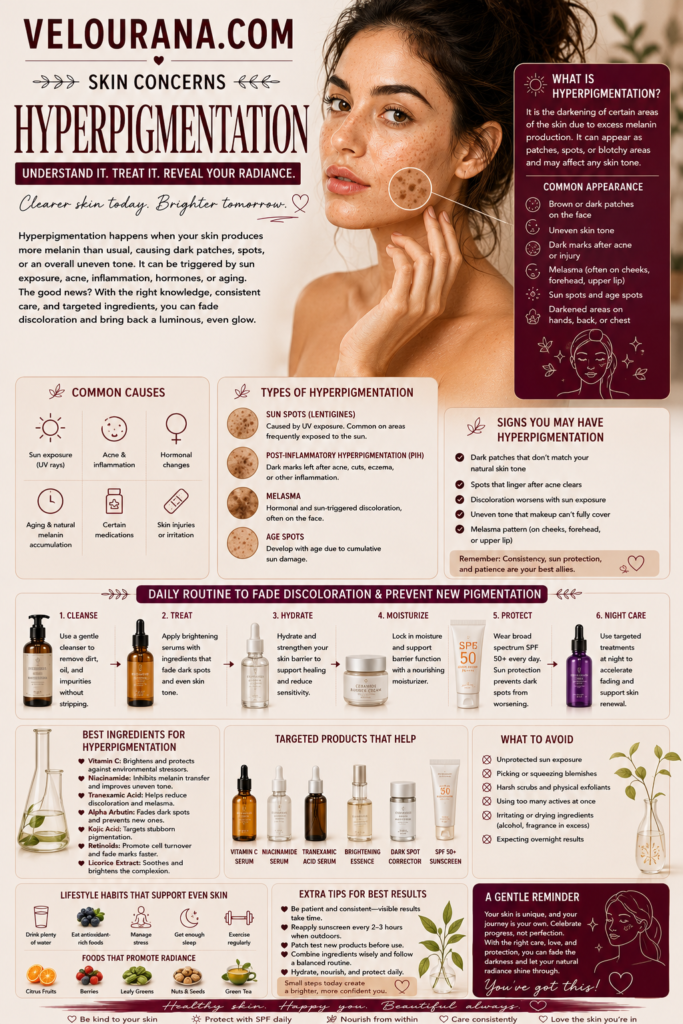
One particularly common form is post-inflammatory hyperpigmentation, or PIH. This develops after inflammation or injury. Acne lesions are familiar triggers, but dermatitis, burns, infections, scratching and other inflammatory or traumatic events can also leave residual pigmentation.
During inflammation, melanocytes may increase melanin production. When inflammation affects deeper structures, pigment can also enter the dermis, where it may become incorporated within cells called macrophages.
This helps explain why the aftermath of a blemish can sometimes last considerably longer than the blemish itself.
The inflammatory episode may disappear within days, yet its pigmentary footprint remains for months.
Melasma behaves differently. It commonly appears as irregular but often symmetrical areas of pigmentation, particularly on the face. Its biology is complex, and recognised influences include genetic predisposition, ultraviolet and visible light exposure and hormonal factors. Pregnancy and hormonal medications can be associated with its development in some people.
Then there are lentigines and other forms of pigmentation associated with cumulative sun exposure, as well as medication-related pigmentation and less common pigmentary disorders.
This diversity has an important practical consequence.
Not every dark area should automatically be treated as a cosmetic dark spot.
Pigmented lesions include benign conditions, but the differential diagnosis of a dark lesion can also include melanoma and pigmented basal cell carcinoma. A new, changing, unusual or otherwise concerning pigmented lesion deserves medical assessment rather than experimentation with increasingly aggressive brightening products.
The smartest pigmentation routine begins with classification, not exfoliation.
Why Inflammation Can Leave Colour Behind
Post-inflammatory hyperpigmentation reveals something important about the relationship between pigmentation and skin health: inflammation and colour are closely connected.
Imagine an acne lesion developing on the cheek.
The visible blemish is inflammatory. Eventually the swelling subsides, tenderness disappears and the surface heals. Yet inflammatory signalling may have stimulated melanocytes to produce additional melanin. The skin therefore resolves the original lesion while retaining evidence that the inflammation occurred.
This phenomenon can happen in all skin tones, although PIH is often more pronounced and persistent in darker skin.
The implication is significant.
Someone trying to treat post-acne pigmentation cannot think only about the old marks. If new inflammatory lesions continue appearing, the skin may continue producing new marks.
The pigmentation routine and the acne strategy therefore cannot be completely separated.
The same principle applies beyond acne.
Repeated irritation from harsh skincare, aggressive exfoliation or constant friction may create exactly the kind of inflammatory environment that pigment-prone skin does not need. The irony is that a person can become so determined to remove pigmentation that the treatment itself becomes another source of irritation.
This is one of the great paradoxes of brightening skincare.
More intensity does not necessarily mean faster correction.
Sometimes it means more inflammation, followed by more pigmentation.
A useful pigmentation routine must therefore respect the skin barrier. A product that repeatedly burns, stings or causes substantial irritation should not automatically be interpreted as "working." The American Academy of Dermatology specifically advises gentle skincare in melasma because irritation can make dark spots darker.
Comfort is not merely a cosmetic luxury in this context. It can be part of pigment management.
Depth Changes the Entire Timeline
One of the least appreciated aspects of hyperpigmentation is that what appears on the surface may not actually be confined to the surface.
Pigment can be predominantly epidermal, meaning that it is concentrated in the upper layers of the skin. It can also extend into the dermis.
This difference affects appearance, treatment response and time.
Epidermal pigment generally has a greater opportunity to fade as epidermal cells progress through normal turnover. Dermal pigmentation can be considerably more persistent because pigment located deeper within the skin does not simply disappear with ordinary surface exfoliation.
DermNet notes that PIH can involve epidermal melanosis, dermal melanosis or both. The American Academy of Dermatology similarly explains that superficial dark spots may fade over months, whereas deeper discoloration can take years.
This is why judging a pigmentation treatment after a few days makes little biological sense.
Skin is not paint.
A brightening ingredient does not simply dissolve visible brown colour from the face. Changes depend on processes such as melanin synthesis, pigment transfer, cellular turnover, inflammation control and protection from stimuli that encourage renewed pigmentation.
Patience is therefore not empty skincare advice. It reflects the biology of what is being treated.
It also explains why excessively accelerating a routine can become counterproductive. Someone who sees little change after two weeks may add another acid, increase retinoid frequency, introduce a peel and begin scrubbing more aggressively.
The skin then becomes irritated.
Pigment-producing cells receive another inflammatory signal.
The attempt to accelerate fading may have created conditions for additional pigmentation.
A slower routine that the skin tolerates consistently can ultimately outperform an impressive collection of products that repeatedly destabilises it.
Sunlight Is Not Merely a Summer Problem
A pigmentation routine without serious photoprotection is working against a powerful biological stimulus.
Ultraviolet radiation encourages melanogenesis, and existing post-inflammatory pigmentation can darken with UV exposure.
This means sunscreen has a different significance in pigmentation care than it does in a routine concerned only with preventing sunburn.
It is not simply protection added after treatment.
It is part of treatment strategy.
If a person spends months trying to reduce excess pigment while repeatedly exposing that pigment system to radiation that stimulates melanogenesis, progress becomes more difficult to achieve and maintain.
The problem is particularly relevant to melasma, where sun exposure is a recognised trigger and long-term photoprotection forms a central part of management.
And ultraviolet radiation is not the complete story.
Visible light can contribute to hyperpigmentation, particularly in darker skin tones, and this has increased interest in tinted sunscreens containing iron oxides. The American Academy of Dermatology recommends tinted SPF 30+ formulations containing iron oxide for people dealing with melasma and discusses their usefulness in protecting against visible light.
For someone with persistent pigmentation, therefore, the sunscreen conversation may need to go beyond the number printed beside "SPF."
Broad-spectrum protection matters. Adequate application matters. Reapplication during sustained outdoor exposure matters. Shade, hats and other forms of physical protection matter.
Consistency matters most of all.
A sophisticated serum used at night cannot compensate perfectly for inconsistent protection during the day.
This can feel disappointing because sunscreen does not produce the dramatic sensation associated with a peel or powerful active ingredient. It does not necessarily make pigmentation look different tomorrow morning.
Its value is quieter.
It helps prevent the biological process you are trying to control from being repeatedly stimulated.
That is foundational rather than glamorous.
The Brightening Ingredient Question
Once triggers and photoprotection are considered, topical ingredients can play an important role in managing many forms of epidermal hyperpigmentation.
Different ingredients intervene at different stages of pigment formation, transfer or epidermal turnover.
Among commonly used options are azelaic acid, vitamin C, retinoids, hydroquinone, glycolic acid, kojic acid, niacinamide, arbutin and other pigment-targeting agents.
But reading a list of ingredients can create the wrong impression.
It may suggest that the ideal pigmentation routine is simply the routine containing the greatest number of brightening agents.
It is not.
Ingredient selection needs to account for the type of pigmentation, skin sensitivity, other treatments being used and the person's ability to maintain the routine without chronic irritation.
Azelaic acid, for example, is frequently used in pigmentation care and can be particularly relevant when discoloration exists alongside acne-prone skin. Retinoids can support epidermal turnover and are incorporated into some dermatological pigmentation strategies. Vitamin C is widely used as an antioxidant and brightening ingredient. Niacinamide is often incorporated into everyday formulations designed to support a more even-looking complexion.
Hydroquinone occupies a more medicalised position in pigmentation treatment. It can be highly effective in appropriate cases, but it should not be treated as an indefinite casual cosmetic. DermNet advises stopping hydroquinone when there has been no benefit after three months and highlights the need to discontinue treatment if significant irritation develops. Regulations and availability also differ between countries.
Melasma may require still more specialised management. Dermatological treatment can involve combinations of prescription ingredients, and professional assessment is particularly valuable when pigmentation is persistent, recurrent or resistant to ordinary skincare.
The point is not to identify a universal "best" ingredient.
It is to choose an appropriate mechanism without overwhelming the skin.
Why More Exfoliation Is Not Always Better
Hyperpigmentation has become strongly associated with exfoliation because removing superficial epidermal cells can improve the appearance of some forms of surface pigmentation.
From that fact, however, an unfortunate conclusion sometimes follows: if some exfoliation is useful, more must be better.
Pigment biology does not cooperate with that logic.
Chemical exfoliants such as alpha-hydroxy acids can form part of pigmentation management. Professional chemical peels can also be used in selected circumstances.
But procedures that intentionally injure or resurface the epidermis have an inherent contradiction when used on pigment-prone skin: the procedure intended to reduce pigmentation can itself produce inflammation capable of triggering pigmentation.
DermNet specifically notes that chemical peels, laser treatments and intense pulsed light can help some epidermal pigmentation while also potentially aggravating PIH through epidermal injury.
This is especially important for anyone tempted by the promise of immediate transformation.
Pigmentation usually rewards control more than aggression.
An acid does not become better simply because it produces more peeling. A treatment is not automatically more effective because the face feels tight afterward. Redness is not proof that pigment is disappearing.
For some people, carefully controlled exfoliation can be valuable. For others, reducing exfoliation may actually improve the overall pigmentation strategy because it allows inflammation to settle.
The question should always be whether a treatment is moving the skin toward greater stability.
If every attempt to brighten the complexion leaves it irritated for several days, the routine deserves reconsideration.
Melasma Changes the Rules
Melasma deserves particular attention because it demonstrates why pigmentation should not be approached as a simple stain-removal problem.
Melasma can be persistent and recurrent. Genetic predisposition, hormonal influences, ultraviolet exposure and visible light may all participate in its behaviour.
This means successful improvement does not necessarily mean permanent disappearance.
Someone may achieve substantial fading and then experience recurrence after renewed sun exposure, hormonal changes or other triggers. The goal therefore becomes not only correction but long-term control.
That requires a different psychological relationship with skincare.
Instead of pursuing a single intensive treatment followed by abandonment of the routine, melasma management often requires ongoing photoprotection and carefully selected maintenance measures.
Procedures deserve caution as well. Lasers, IPL, microneedling and chemical peels can have roles in professional management, but some can worsen pigmentation or be followed by relapse. DermNet emphasises that several procedural approaches require expert use because of these risks.
This does not mean procedures should be feared.
It means they should be matched to diagnosis, skin type and pigment depth rather than selected because a device is marketed as technologically advanced.
The most expensive treatment is not necessarily the most appropriate treatment.
Sometimes disciplined everyday management is doing more important work than the dramatic intervention.
A Better Routine Begins With Restraint
An intelligent hyperpigmentation routine does not need to contain ten active ingredients.
In many cases, simplicity creates the conditions in which targeted treatment can actually function.
The foundation is gentle cleansing that removes sunscreen, makeup and environmental residue without leaving the skin chronically tight or irritated.
Moisturising supports the barrier and can improve tolerance of active treatments. This becomes particularly important when retinoids, acids or other potentially irritating ingredients are introduced.
Then comes the targeted pigment treatment.
Instead of simultaneously beginning several strong products, introducing treatments deliberately makes it easier to understand what the skin tolerates and what causes irritation.
Daytime photoprotection completes the structure.
This may sound less impressive than a shelf full of corrective serums, but pigmentation is a long-term biological process. The routine needs to be repeatable.
A person who follows a moderate routine consistently for six months may accomplish far more than someone who cycles between aggressive treatment and recovery every few weeks.
This is also why product hopping can become problematic.
Pigmentation changes slowly. If a product is abandoned every two weeks because it has not produced a dramatic transformation, it becomes almost impossible to judge whether the routine had meaningful potential.
There are exceptions, of course. Significant irritation is a reason to reassess promptly, and concerning pigmentation should be medically evaluated rather than observed indefinitely.
But when the skin is tolerating an appropriate routine, time is part of the treatment.
The Hidden Importance of Preventing New Marks
It is easy to measure pigmentation care by staring at the oldest, darkest spot.
A more meaningful measure may be whether fewer new marks are appearing.
Consider someone with acne-associated PIH.
If twelve existing marks are slowly fading but four new inflammatory lesions appear every week, the complexion may never seem to improve. The person concludes that the brightening treatment has failed.
Yet the greater problem is not necessarily failure to fade old pigment.
It is continuous production of new pigment.
Controlling the underlying acne can therefore become one of the most effective pigmentation interventions even though an acne treatment is not marketed as a dark-spot corrector.
The same reasoning applies to irritation.
If shaving repeatedly produces inflammation, technique and irritation control matter.
If eczema repeatedly flares and leaves darker patches, controlling the inflammatory condition matters.
If picking at blemishes turns minor lesions into prolonged inflammatory injuries, changing that behaviour matters.
Hyperpigmentation management becomes much more logical once prevention and correction are viewed as a single system.
Instead of asking only, "How do I remove this mark?" ask, "What produced it, and is that still happening?"
That question often reveals the missing part of the routine.
When Professional Treatment Becomes Worthwhile
Not all pigmentation requires a dermatologist, but there are situations where professional evaluation becomes especially valuable.
A pigmented lesion that is new, changing or clinically unusual should not simply be assumed to be hyperpigmentation. Pigmented skin cancers can enter the differential diagnosis of dark lesions, which is one reason diagnosis matters before cosmetic treatment.
Persistent facial pigmentation may also require differentiation between melasma, PIH, lentigines, drug-induced pigmentation and other pigmentary disorders.
Professional assessment can sometimes determine whether pigmentation is predominantly epidermal or has a deeper component, which may help explain why previous treatments have failed.
A dermatologist can also supervise stronger therapies and determine whether procedures are appropriate.
This becomes particularly important when someone has already spent months escalating home treatments without success.
At that point, buying another serum may provide less value than establishing what is actually being treated.
Professional procedures can include chemical peels, certain laser technologies, IPL and other interventions, depending on the diagnosis. But procedures are not inherently superior to topical treatment, and some carry a meaningful risk of worsening pigmentation.
The objective should never be maximum intervention.
It should be appropriate intervention.
Progress Is Better Measured in Months Than Days
Hyperpigmentation can create a distorted sense of time.
Because the mark is visible every morning, it feels as though nothing is changing. Daily observation magnifies frustration while hiding gradual improvement.
Photographs taken under consistent lighting every four to six weeks can sometimes reveal progress that is difficult to recognise in the mirror.
Expectations also need to account for pigment depth and cause.
The American Academy of Dermatology notes that a spot only a few shades darker than the surrounding natural skin colour may take approximately six to twelve months to fade naturally once its cause is removed, while deeper pigmentation can take considerably longer.
That does not mean every mark follows the same schedule. Treatment can accelerate improvement, while ongoing triggers can prolong it.
It means pigmentation should not be evaluated according to the instant-results culture surrounding much of modern beauty.
A complexion may become progressively more even without becoming perfectly uniform.
Old marks may lighten while stubborn areas remain.
Melasma may improve substantially while still requiring maintenance.
Success is therefore better understood as movement toward stability: fewer new areas of pigmentation, gradual fading of existing marks, healthier tolerance of the routine and better control of recognised triggers.
The Goal Is Not to Silence Melanin
There is a deeper conceptual mistake hidden within much of the language surrounding hyperpigmentation.
Melanin itself is not the enemy.
Healthy skin is not skin without pigment. The purpose of pigmentation treatment is not to suppress the skin's natural colour or pursue an artificially lighter complexion.
The objective is to address unwanted areas of excess or uneven pigmentation while respecting the biological system responsible for normal skin colour.
That distinction is especially important in darker skin tones, where pigmentary responses can be more visible and where overly aggressive treatment carries its own risks.
The best approach is therefore not a war against pigment.
It is management of the circumstances that have caused pigment production to become uneven.
Protect the skin from unnecessary radiation.
Reduce avoidable inflammation.
Treat underlying conditions that repeatedly create marks.
Choose targeted ingredients intelligently.
Give them enough time to work.
Avoid turning irritation into a daily ritual.
Seek professional assessment when pigmentation behaves unusually, persists despite appropriate care or could represent something other than ordinary cosmetic hyperpigmentation.
Once hyperpigmentation is understood this way, skincare becomes less frantic.
The question stops being which miracle product can erase a dark spot fastest.
Instead, the focus shifts toward understanding the skin's behaviour and gradually changing the conditions that maintain the discoloration.
That is a slower promise than instant correction.
It is also a far more realistic one.
Hyperpigmentation is rarely just colour sitting passively on the surface. It is often the visible memory of sunlight, inflammation, hormones, injury or another biological event.
Successful care begins when we stop treating that memory as a stain and start understanding the process that created it.
The End Velourana
 Discover More From Our Family of Websites
 ZodiacBearing (Astrology, Tarot, Numerology, Angel Numbers & Spiritual Guidance)
 Velourana (Beauty, Makeup, Hair Care, Skincare & Beauty Tips)
 HavenBearing (Home, Living, Organization, Décor & Everyday Inspiration)
 PawBearing (Pet Care, Dog Breeds, Animal Health, Training & Pet Products)
 PsyCatherine (Notes From the Journal of a Psychologist on Real Life)

