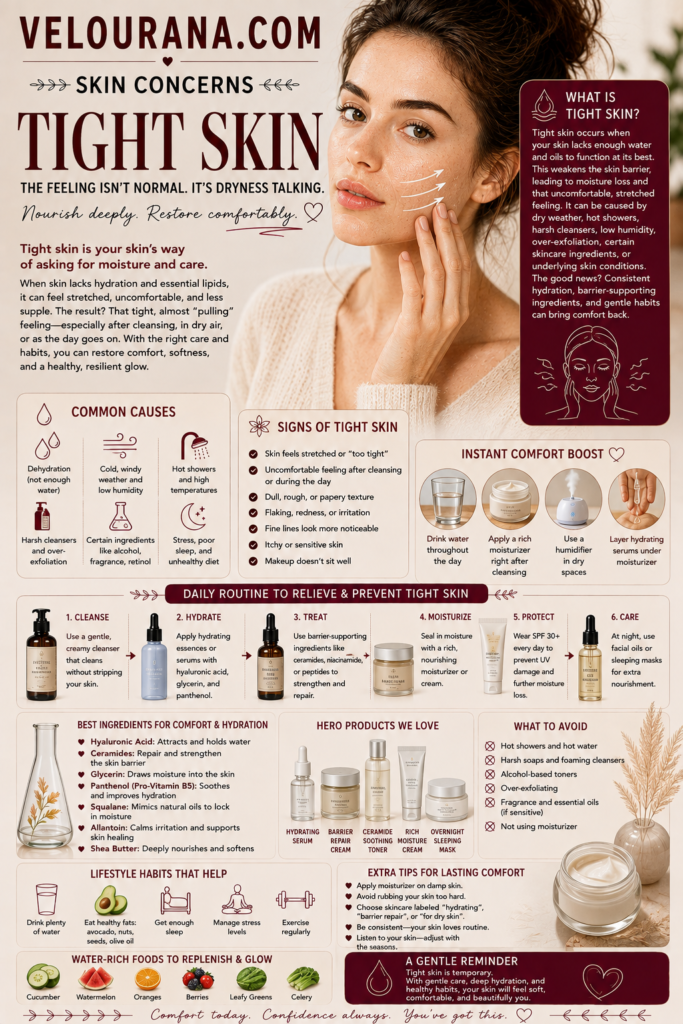
CATEGORY: Tight Skin
Moisturizer is supposed to make dry skin feel comfortable. The logic seems straightforward: the face feels tight, cream is applied, and the uncomfortable sensation should disappear. Sometimes it does. At other times, however, the relief lasts only a few minutes. The skin softens immediately after application, then gradually begins to feel stretched again. Some people respond by adding another layer, switching to a richer cream, applying facial oil on top, or collecting increasingly elaborate hydrating products—yet the underlying tightness remains.
This can make the problem seem mysterious. If tightness is related to dryness, and moisturizer addresses dryness, why does moisturizing sometimes fail to solve it?
The answer is that moisturizing is not a single event and tightness is not caused by one isolated deficiency. Comfortable skin depends on an entire system: how effectively the outermost layer retains water, how much it is being disturbed by cleansing and environmental exposure, whether the moisturizer being used is appropriate for the level of dryness, and whether other products in the routine are repeatedly creating irritation.
A cream cannot always compensate for everything that happens before and after it.
Persistent tightness therefore offers an opportunity to look at skincare more intelligently. Instead of asking only whether the moisturizer is “good,” it is worth examining the conditions in which that moisturizer is being asked to work.
Moisturizer Cannot Undo an Entire Routine by Itself
Imagine washing the face with a strong cleanser under very hot water, rubbing it dry with a towel, applying several potentially irritating active products and then finishing with moisturizer.
The moisturizer may be excellent.
The routine may still leave the skin uncomfortable.
This illustrates one of the most important principles in caring for dry or tight skin: the performance of one product cannot be separated from the environment created by everything else.
Dry skin occurs when the outer layers lose too much water. Harsh soaps and detergents, excessive washing, hot water and low-humidity environments are among the factors known to contribute to dryness. Dermatology guidance therefore focuses not merely on applying moisturizer but on modifying bathing and cleansing practices as well.
When tightness persists, moisturizer often receives all the attention because it is the product most obviously associated with hydration. Yet sometimes the more important question concerns what happened ten minutes earlier.
How was the skin cleansed?
How hot was the water?
How long was the face washed?
Was an exfoliating acid applied afterward?
Was a retinoid used the previous evening?
Has the weather suddenly become colder?
Is the indoor environment exceptionally dry?
When several drying influences are operating simultaneously, moisturizer is being asked not merely to maintain comfortable skin but to compensate continuously for repeated disruption.
The distinction is important because it changes the strategy. Instead of endlessly searching for a stronger moisturizer, it may be more effective to reduce the processes that are creating the need for such aggressive compensation.
Temporary Softness Is Not the Same as Lasting Hydration
One reason persistent tightness can be confusing is that many products create an immediate improvement in texture.
The skin feels smoother as soon as a cream is applied. Roughness becomes less noticeable. Makeup glides more easily across the surface. There may even be a temporary cooling or soothing sensation.
Those changes are valuable, but immediate sensory improvement does not necessarily mean that the underlying moisture imbalance has been fully corrected.
Moisturizers generally work through combinations of ingredients with different functions. Humectant ingredients help attract and hold water. Emollient ingredients help soften and smooth the spaces between surface skin cells. More occlusive ingredients help reduce the evaporation of water from the skin.
An effective moisturizer may combine these approaches rather than relying exclusively on one.
This becomes particularly relevant when someone repeatedly applies very lightweight hydrating products but still experiences tightness.
A watery serum containing humectants can feel wonderfully refreshing. If the skin is significantly dry, however, hydration without sufficient support against water loss may not provide lasting comfort. The serum has not necessarily failed; it may simply be performing only part of the job required by that particular complexion.
At the opposite extreme, applying a very occlusive product to skin that has received little water or hydration may make the surface feel coated without necessarily producing the desired sense of suppleness.
This is why formulation matters more than fashionable ingredient names.
A moisturizer is a system rather than a hero ingredient.
The Barrier Determines What Happens to Water
The phrase “skin barrier” has become so common in beauty marketing that it can sound like a vague advertising concept. In reality, the protective function of the outermost skin layer is fundamental to maintaining hydration.
The stratum corneum, the outermost portion of the epidermis, is composed of flattened cells surrounded by a lipid-rich matrix. A frequently used analogy compares the arrangement to bricks and mortar: the cells act somewhat like bricks while lipids help fill the spaces between them.
The analogy is imperfect, as biological skin is far more dynamic than a wall, but it captures an important principle. The organization of this outer layer helps restrict excessive water loss while limiting the penetration of unwanted substances from the environment.
When this system is disrupted, water can escape more readily.
The technical term often used is transepidermal water loss, or TEWL—the passive movement of water through the epidermis and ultimately into the surrounding environment.
Some water loss is normal. Human skin is not supposed to be completely impermeable.
The problem arises when conditions increase water loss beyond what the surface can comfortably accommodate.
This is one reason tight skin may persist even when moisturizer is being used. The issue is not simply whether water or cream has been placed onto the face. The question is how effectively the skin can maintain a comfortable level of hydration between applications.
If the outer layer is repeatedly being disturbed, the cycle becomes predictable: moisturize, feel better, gradually become tight again, moisturize again.
Breaking the cycle often requires supporting the conditions that allow moisture to remain rather than merely replacing it repeatedly.
Cleansing Can Determine Whether Moisturizer Succeeds
Cleansing and moisturizing are often treated as separate stages, but for dry skin they are intimately connected.
A cleanser determines what is removed from the surface. Moisturizer then attempts to restore comfort afterward.
When cleansing is appropriately gentle, that transition can be easy. When cleansing is excessively aggressive, moisturizer begins from a disadvantage.
Traditional soaps and some strongly cleansing formulations can remove lipids and alter the surface environment in ways that increase dryness. Dermatologists commonly recommend mild, fragrance-free cleansers for dry or sensitive skin and advise avoiding products that leave the skin excessively stripped.
The sensation immediately after cleansing can therefore be remarkably informative.
If the face feels comfortable while damp but becomes intensely tight within minutes of drying, the cleansing stage deserves attention. If moisturizer then removes the tightness temporarily but the same pattern repeats twice every day, repeatedly upgrading the moisturizer without reconsidering the cleanser may miss the more important variable.
There is also the question of quantity.
Using more cleanser does not necessarily clean the face better. Nor does extending the cleansing process indefinitely. Most daily cleansing does not require an aggressive performance.
The objective is to remove sunscreen, makeup, excess oil and accumulated material without leaving the surface feeling punished for having been cleaned.
The Double-Cleansing Question
Double cleansing has become a standard feature of many skincare routines.
The concept is sensible in the right circumstances. An oil-based or balm cleanser can help dissolve makeup and water-resistant sunscreen, followed by a water-based cleanser to remove remaining residue.
For someone wearing substantial makeup or persistent sunscreen, this can be useful.
But a useful technique can become an automatic ritual.
Someone with dry, tight skin who wears little or no makeup may not necessarily require two thorough cleansing stages every evening. Likewise, a person may use an effective first cleanser, remove everything successfully, and then follow it with an unnecessarily strong foaming cleanser simply because double cleansing has become associated with proper skincare.
The skin does not award points for the number of steps completed.
What matters is whether cleansing accomplishes its purpose without creating avoidable discomfort.
If tightness is persistent, reviewing the necessity and intensity of every cleansing stage can be more productive than assuming that more cleansing is inherently more sophisticated.
Moisturizing at the Wrong Moment
Timing is one of the simplest variables in skincare, yet it is easily overlooked.
Dermatologists commonly recommend applying moisturizer shortly after washing, when the skin is still slightly damp. The reason is practical: moisturizer can help trap some of the water remaining at the surface rather than waiting until the skin has completely dried and begun to feel uncomfortable.
This does not require dripping-wet skin.
The objective is simply not to allow the face to sit bare for an extended period after washing when dryness is already a problem.
For people with elaborate routines, however, a surprising amount of time can pass between cleansing and moisturizing.
Toner is applied. Then essence. Then a serum. Another serum follows. Perhaps an active treatment is added. Each layer is given time to “absorb.” By the time moisturizer arrives, the skin may already feel tight.
A multi-step routine is not automatically harmful, but complexity should serve a purpose.
If the complexion is uncomfortable, shortening the distance between cleansing and effective moisturization can sometimes make more difference than adding another hydrating step.
When a Lightweight Lotion Is Simply Not Enough
Texture preferences influence skincare choices enormously.
Many people dislike rich creams. They want products that disappear immediately, leave no shine and cannot be felt on the face. Modern cosmetic chemistry has made it possible to create impressively elegant lightweight moisturizers.
But sensory elegance and adequate moisturization are not always identical goals.
Someone with mildly dehydrated but otherwise balanced skin may find a gel moisturizer perfectly sufficient. Someone with persistently dry, tight skin in winter may require something more substantial.
Creams and ointment-like formulations generally provide stronger protection against moisture loss than very light lotions, although individual formulations vary considerably. Dermatologists often recommend creams or ointments rather than lotions for very dry skin because of their greater moisturizing capacity.
This does not mean everyone with tight skin needs to coat the face in a heavy ointment.
It means texture should be chosen according to need rather than ideology.
If a moisturizer feels beautiful for twenty minutes but the skin becomes tight again an hour later, it may simply not provide enough support under the current conditions.
That same product might be excellent in summer.
Skincare products do not have to be permanently good or bad. Their suitability can change with the skin and environment.
Ceramides and the Architecture of Comfortable Skin
Ceramides have become prominent in products marketed for barrier support, and their popularity has a genuine physiological basis.
They are naturally occurring lipids found in significant amounts within the stratum corneum. Alongside cholesterol and fatty acids, they contribute to the lipid organization that supports the skin's protective function.
When dry skin is discussed purely in terms of adding water, this lipid component is easily overlooked.
Hydration is not only about supplying water. It is also about maintaining an environment capable of retaining it.
This is why moisturizers formulated with physiologically relevant lipids can be useful for dry complexions. The point is not that every person must purchase a product prominently advertising ceramides on the label. Nor does the presence of ceramides automatically make one moisturizer superior to every alternative.
Formulation remains crucial.
But understanding their role changes the way we think about persistent tightness. The skin may not simply be asking for more watery hydration. It may benefit from a moisturizer designed to support the lipid-rich structure of its outer layer.
The difference is subtle but important.
Hydrating the skin and supporting its ability to remain hydrated are related goals, not identical ones.
Hyaluronic Acid Is Useful, but It Is Not Magic
Few skincare ingredients have become as closely associated with hydration as hyaluronic acid.
Its ability to bind water has made it a natural choice for hydrating serums and moisturizers, and well-formulated products containing it can contribute to a more hydrated, comfortable surface.
The difficulty begins when one ingredient becomes synonymous with an entire biological function.
Consumers may assume that if their skin feels tight, they simply need hyaluronic acid. They buy a serum, apply it faithfully and are surprised when the complexion still feels dry.
The problem is not necessarily the ingredient.
The expectation is too large.
Hyaluronic acid is a humectant. It can contribute to hydration, but the overall condition of dry skin still depends on cleansing, the surrounding humidity, the moisturizer applied with or after it, the condition of the outer skin layer and other components of the routine.
A hydrating serum can be excellent while still being insufficient as a complete strategy for persistent dryness.
This illustrates a broader principle in skincare: ingredients are most useful when understood according to their function rather than treated as celebrities.
No single humectant can replace an intelligently constructed routine.
Facial Oils Cannot Replace Everything Either
At the opposite end of the hydration conversation are facial oils.
When skin feels tight, applying oil can feel intuitive. Oils create slip, soften roughness and can reduce the sensation of dryness. Some people find them extremely comfortable, particularly when incorporated into or layered with moisturizer.
Yet oil and water are not interchangeable.
An oil may provide emollience and help reduce moisture loss depending on its composition, but it does not directly supply water to dehydrated skin in the way people sometimes imagine.
This is why applying oil alone to very dry skin can produce an unusual experience: the face feels smoother and more lubricated but still somehow tight underneath.
Again, the product is not necessarily failing.
It is performing the function its composition allows.
For some complexions, a facial oil works beautifully as part of a broader moisturizing strategy. For others, a well-formulated cream already provides everything necessary, making an additional oil redundant.
The important point is that “more nourishing” is not automatically the same as “more hydrating.”
Exfoliation Can Quietly Keep Skin in a State of Discomfort
Exfoliation promises smoothness, clarity and brightness, all qualities that dry skin may appear to lack.
This creates a trap.
When dryness produces rough texture or flaking, exfoliating the visible flakes seems logical. The surface immediately becomes smoother, reinforcing the idea that exfoliation has solved the problem.
But if the underlying reason for the flaking is persistent dryness or irritation, repeated exfoliation can maintain the very condition that created the flakes.
Chemical exfoliants such as alpha hydroxy acids and beta hydroxy acids have legitimate cosmetic uses. Physical exfoliation can also be tolerated by some skin types. The issue is frequency, concentration and individual tolerance.
Dry, tight skin does not always need to be polished.
Sometimes it needs to be left alone long enough to recover.
This becomes especially important when multiple exfoliating products are hidden within a routine. A toner contains an acid. A serum contains another exfoliating ingredient. A mask is used weekly. A scrub appears occasionally. The individual products may seem mild, yet cumulative exposure can become significant.
Persistent tightness is one reason to audit the entire routine rather than examining products individually.
Retinoids Can Change the Moisture Equation
Retinoids occupy an important place in dermatology and cosmetic skincare, but they can also cause dryness and irritation, particularly when introduced too quickly or used more frequently than the skin tolerates.
A person may begin using a retinoid for acne, pigmentation or signs of aging and interpret subsequent tightness as evidence that they simply need a stronger moisturizer.
Sometimes additional moisturization helps.
But the frequency or strength of the active treatment may also need consideration.
This is a useful example of why skincare cannot always be divided into “treatment products” and “comfort products,” with moisturizer expected to repair whatever the treatments create.
An effective routine balances ambition with tolerance.
If an active ingredient produces constant discomfort, escalating other products to compensate may not be the most elegant solution. Adjusting frequency, application technique or formulation—with professional guidance when appropriate—may create a more sustainable relationship between treatment and skin comfort.
The Weather May Be Stronger Than Your Moisturizer
Persistent tightness is often seasonal.
A moisturizer performs perfectly in September and suddenly seems useless in January. The formulation has not changed. The environment has.
Cold outdoor temperatures combined with heated indoor air can create a challenging cycle for dry skin. Humidity falls, exposure to wind increases, and people often take hotter showers because the weather is colder.
Each factor pushes in the same direction.
The moisturizer that was adequate under moderate conditions may no longer be sufficient.
This is one reason skincare should not be treated as a fixed prescription for life.
Seasonal adaptation can be simple. A richer moisturizer may replace a lighter one. Cleansing may become gentler. Exfoliation may be reduced. A humidifier can help increase moisture in particularly dry indoor air. Dermatology guidance recognizes humidification as one strategy for reducing dry-skin symptoms in low-humidity environments.
The objective is not to redesign the entire routine every three months.
It is to acknowledge that skin exists within a climate.
Air Conditioning Creates Its Own Version of Winter
Dryness is not exclusively a cold-weather problem.
Summer can produce its own form of environmental tightness, particularly for people who spend long periods in heavily air-conditioned buildings.
A person may walk through warm, humid outdoor air and then spend eight hours in a cool, dry office. The skin experiences repeated environmental transitions even though the season itself appears favorable for hydration.
Air travel intensifies this effect. Aircraft cabins have very low humidity compared with many everyday environments, which is why the skin can feel unusually dry and tight after a long flight.
These circumstances help explain why occasional episodes of tightness do not necessarily mean the entire skincare routine has become unsuitable.
Context matters.
A temporary increase in moisturization around travel or periods of intensive climate control may be enough. Persistent problems under ordinary conditions require a broader investigation.
Sunscreen and Tight Skin
Daily sun protection remains important even when skin is dry.
The difficulty is that sunscreen formulations vary enormously in texture and sensory effect. Some feel rich and moisturizing; others dry down very matte. Certain formulations may feel comfortable on oily skin but uncomfortably drying on someone already experiencing tightness.
This can create a frustrating conflict.
A person finds a moisturizer that finally leaves the face comfortable, applies sunscreen, and within half an hour the familiar pulling sensation returns.
The solution is not to abandon sun protection.
It is to recognize sunscreen as part of the complete skincare system.
A formulation appropriate for one skin type may not suit another. People with dry complexions may prefer sunscreens with more moisturizing vehicles, while those prone to oiliness may prefer lighter textures.
The best sunscreen is not merely one with an appropriate protection rating. It is one that can be used consistently and comfortably in the context of the person's actual skin.
Makeup May Be Absorbing More Than You Realize
Persistent tightness that becomes noticeably worse during the day can sometimes be connected to makeup.
Long-wearing and matte complexion products are designed to resist movement and control shine. These characteristics can be extremely useful for oily skin or situations requiring extended wear.
On a dry complexion, however, the same qualities can accentuate discomfort.
Foundation may initially look beautiful, then become increasingly rigid as the hours pass. Powder can absorb surface oils and intensify the dry sensation. Repeated touch-ups add additional layers.
The result can feel like skincare failure even though the moisturizer performed adequately before makeup was applied.
This does not mean dry skin cannot wear matte makeup.
It means cosmetic finish should be considered part of the moisture equation.
Using less powder on naturally dry areas, choosing more flexible complexion formulas and preparing the skin appropriately can reduce the tension between longevity and comfort.
Why Constantly Switching Products Can Make the Problem Harder to Solve
When tightness persists, frustration encourages experimentation.
A new moisturizer is purchased. Three days later it is replaced. A hydrating serum is added. Then a facial oil. Then a barrier balm. Then a different cleanser.
Eventually the routine contains so many variables that identifying the source of improvement or irritation becomes almost impossible.
Skin also requires time.
While immediate reactions can certainly occur, many changes in comfort and tolerance are easier to evaluate over a consistent period than after one or two applications.
This is where patience becomes a practical skincare tool.
A simplified routine creates information.
If the skin improves, products can later be reintroduced thoughtfully. If it does not, the persistent symptoms become clearer and professional advice may be appropriate.
Constant product rotation creates noise.
For someone genuinely trying to understand why the face feels tight despite moisturizing, less experimentation can produce more knowledge.
The Psychological Appeal of Doing More
There is a reason complicated skincare is so seductive.
Action feels productive.
When the skin is uncomfortable, applying another serum creates the sensation of responding. Purchasing a richer cream feels like progress. Adding a mask provides an immediate ritual of care.
Doing less can feel strangely passive.
Yet biological systems do not necessarily improve according to the amount of attention they receive.
Skin needs cleansing, protection and appropriate moisturization. Certain concerns benefit from targeted treatments. But beyond that point, every additional intervention introduces another variable.
Persistent tightness can therefore become a useful discipline.
Instead of asking, “What else can I add?” ask, “What can I stop doing that may be contributing to this?”
That question is less glamorous.
It is often more revealing.
When Moisturizer Stings
Moisturizer should generally make dry skin feel better.
When a familiar cream suddenly stings, burns or produces persistent redness, the change deserves attention.
Sometimes severely dry or irritated skin becomes more sensitive to products that previously caused no discomfort. Ingredients reaching a compromised surface can produce sensations that were absent when the skin was in a more resilient condition.
But persistent burning should not simply be accepted as proof that a product is “working.”
A moisturizer is not an exfoliating treatment. Its primary purpose is support and comfort.
If several normally gentle products suddenly sting, simplifying the routine and reducing potentially irritating actives may be sensible. If the reaction is significant, worsening or associated with swelling, rash, severe itching or other concerning symptoms, professional evaluation becomes more appropriate.
The skin does not need to suffer for skincare to be effective.
Persistent Tightness May Not Be Ordinary Dryness
Most episodes of tight skin are manageable with ordinary changes in skincare and environment.
Not every case belongs exclusively to cosmetics, however.
Conditions including eczema, psoriasis and other forms of dermatitis can involve dryness, scaling, inflammation and discomfort. Allergic or irritant contact dermatitis can also develop in response to substances contacting the skin.
Persistent symptoms therefore deserve a threshold beyond which experimentation stops.
If tightness is accompanied by substantial redness, persistent itching, painful cracking, bleeding, widespread scaling, sores or symptoms that do not improve despite gentle skincare, a dermatologist or other qualified healthcare professional can assess whether an underlying condition is present.
Professional assessment is not a failure of skincare.
It is recognition that skincare and dermatology occupy overlapping but different territories.
Building a Routine That Does Not Need Constant Rescue
The most satisfying routine for tight skin is not necessarily the one containing the largest number of hydrating products.
It is the one that stops creating a daily emergency.
That often begins with cleansing. The face should be cleaned effectively but gently, using comfortably warm rather than very hot water. Afterward, moisturizer can be applied without unnecessarily delaying until the surface is completely dry.
The moisturizer itself should match the degree of dryness. If a gel disappears instantly but leaves the face uncomfortable soon afterward, a creamier formulation may be more appropriate. Ingredients such as glycerin, ceramides, hyaluronic acid, petrolatum, dimethicone and other established moisturizing components can play useful roles depending on the formulation and the person's needs.
Active ingredients can then be considered within the context of tolerance rather than ambition.
Exfoliation does not need to be maximized. Retinoids do not need to be used at the highest frequency a person can endure. Cleansing does not need to produce squeaky skin. Powder does not need to cover every centimetre of the face.
The goal is not maximum intervention.
It is sustainable function.
Moisturizer Works Best When the Rest of the Routine Allows It To
Persistent tightness after moisturizing does not automatically mean that the moisturizer is ineffective.
Sometimes it is too light. Sometimes it is applied too late. Sometimes the environment is unusually dry. Sometimes cleansing is removing too much from the surface. Sometimes exfoliation or active treatments are repeatedly creating irritation. Sometimes the complexion needs a more supportive combination of water-binding, emollient and occlusive ingredients.
And sometimes the persistence of symptoms indicates that the problem belongs partly or entirely outside the realm of ordinary cosmetic dryness.
The solution begins by resisting the urge to judge one product in isolation.
Skin experiences the routine as a whole.
It experiences the cleanser and the water temperature. It experiences the towel, toner, serum and active treatment. It experiences sunscreen, makeup, wind, heating and air conditioning. It experiences how frequently everything is repeated.
Moisturizer arrives within that environment.
When the surrounding conditions are reasonable, an appropriate moisturizer can do its job remarkably well. The skin becomes softer, more flexible and less conspicuous to the person wearing it. The face can move without producing that distracting sensation of being stretched across the cheeks.
That is ultimately the more meaningful measure of hydration.
Not how many products were applied.
Not whether the latest celebrated ingredient appears on the label.
Not whether the skin looks artificially glossy.
But whether, hours after the routine is finished, the complexion remains quietly comfortable enough to be forgotten.
The End Velourana
 Discover More From Our Family of Websites
 ZodiacBearing (Astrology, Tarot, Numerology, Angel Numbers & Spiritual Guidance)
 Velourana (Beauty, Makeup, Hair Care, Skincare & Beauty Tips)
 HavenBearing (Home, Living, Organization, Décor & Everyday Inspiration)
 PawBearing (Pet Care, Dog Breeds, Animal Health, Training & Pet Products)
 PsyCatherine (Notes From the Journal of a Psychologist on Real Life)