
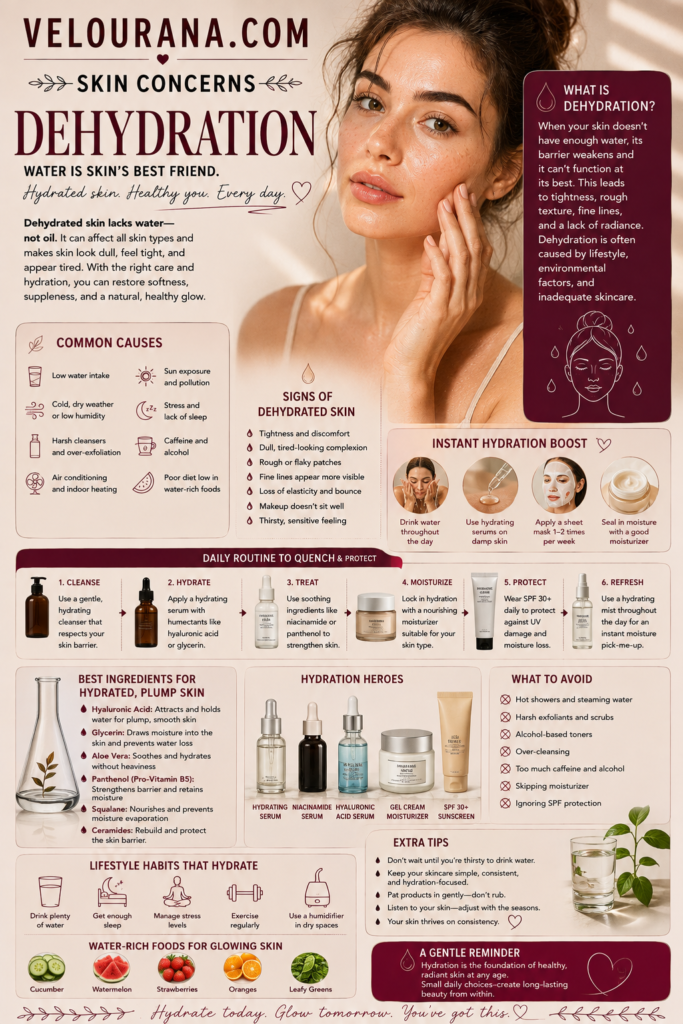
CATEGORY: Dehydration
Skin dehydration is one of the most misunderstood conditions in everyday skincare. It is often treated as though it were simply another name for dry skin, yet the two ideas are not identical. Dryness is generally associated with insufficient oil and with a skin type that naturally produces less sebum. Dehydration, by contrast, describes a state in which the skin is struggling to maintain sufficient water. This distinction matters because a complexion can be oily and dehydrated at the same time, just as naturally dry skin can become considerably more dehydrated when its environment or routine works against it.
The confusion is understandable. Dehydrated skin can feel tight, appear dull, make fine lines more noticeable and develop an uncomfortable surface texture. These are qualities people readily associate with dryness. Yet simply applying the richest cream available does not always solve the problem. The more useful question is not whether the skin needs "more moisture" in a vague sense, but why it is losing water, how effectively its outer layers are retaining that water, and whether the skincare routine is helping or interfering with that process.
Healthy-looking hydration therefore depends on more than adding a fashionable hydrating serum. It is the result of a relationship between water, the skin barrier, environmental conditions, cleansing habits, moisturising ingredients and the frequency with which the skin is exposed to substances or behaviours that encourage water loss. Understanding that relationship changes dehydration from a frustrating cosmetic mystery into something far more manageable.
Dehydration Is a Condition, Not a Permanent Skin Identity
The language of skincare frequently places people into fixed categories: oily, dry, combination, normal or sensitive. These categories can be useful, but dehydration behaves differently because it can occur across them.
Someone with naturally oily skin may notice considerable shine across the forehead and nose while simultaneously experiencing tightness after cleansing. Makeup may separate strangely, the surface may look less smooth than expected, and fine dehydration lines may become visible around the eyes or across the forehead. The instinctive response can be to conclude that the skin is producing too much oil and therefore needs stronger cleansing. That response can sometimes make the uncomfortable feeling worse.
A person with naturally dry skin faces a different version of the same problem. Because the skin already produces relatively little sebum, environmental water loss may be more noticeable, particularly during cold weather, after long hot showers or when indoor heating and air conditioning reduce surrounding humidity. The underlying dry skin type remains, but a temporary dehydrated state can sit on top of it.
This is why dehydration is better understood as a changing condition rather than a permanent identity. Skin can move into and out of a dehydrated state according to its environment, routine and barrier condition.
The distinction also explains why two people complaining that their skin feels "dry" may need quite different adjustments. One may genuinely need a richer, more occlusive moisturiser because their naturally dry skin lacks sufficient lipid support. Another may have an oily complexion that has been repeatedly cleansed, exfoliated and treated with aggressive products until it feels tight and uncomfortable. Giving both people exactly the same routine overlooks the mechanisms behind what they are experiencing.
Understanding the condition begins with understanding water itself.
The Quiet Movement of Water Through the Skin
The outermost layer of the epidermis, the stratum corneum, is often described as a barrier, but that word can make it sound completely impermeable. It is not. Water is continually moving toward the skin's surface and escaping into the surrounding environment. This process is commonly referred to as transepidermal water loss.
Some water loss is normal. The objective of skincare is not to seal the body inside an absolutely waterproof coating. The problem arises when the skin's ability to retain water becomes less effective or when environmental conditions encourage water to disappear from the surface faster than the skin can comfortably accommodate.
The structure of the stratum corneum helps explain why.
Its cells are surrounded by an organised lipid environment that contributes to barrier function. When this outer structure is functioning well, it helps slow excessive water loss while protecting the underlying skin from external irritants. When it becomes disrupted, water can escape more readily and the skin may become rougher, tighter or more reactive.
This is why hydration cannot sensibly be separated from barrier care. Putting water-attracting ingredients onto the surface can be useful, but keeping that water from disappearing again is equally important.
A useful analogy is a reservoir. Filling a reservoir matters, but filling it repeatedly while leaving an unnecessary leak unresolved is inefficient. Dehydrated skincare should therefore consider both sides of the equation: increasing useful hydration and reducing avoidable water loss.
This also helps explain why a serum can initially make skin feel beautifully plump but fail to provide lasting comfort when used without an appropriate moisturiser. The serum may contribute humectant ingredients and water, but the overall routine still needs to support retention.
Why Dehydrated Skin Can Look Older Than It Is
One reason dehydration attracts so much attention is the speed with which it can influence appearance.
When the outer skin is adequately hydrated, its surface tends to appear smoother and more supple. When water content decreases, fine surface irregularities become easier to see. Lines that seemed insignificant may suddenly look sharper. Makeup may settle differently. Light no longer reflects from the complexion in quite the same way, and what previously looked luminous can appear tired or dull.
These changes can easily be interpreted as accelerated ageing.
The distinction between dehydration lines and structural wrinkles is important. A wrinkle associated with longer-term ageing involves much more than temporary surface water content. Age-related changes can involve collagen, elastin, facial movement, cumulative ultraviolet exposure, changes in facial volume and numerous biological processes occurring deeper than the outermost skin.
Dehydration cannot reasonably be blamed for all of these changes, nor can hydration erase established wrinkles.
What improved hydration can do is make the surface look smoother and more comfortable, reducing the exaggerated appearance that dehydration can give to fine lines. This can sometimes produce a surprisingly noticeable cosmetic improvement, particularly around areas where the skin is thin.
It is consequently possible to look in the mirror after several days of a gentler, more supportive routine and feel that the complexion suddenly looks "younger." The improvement may be genuine, but its mechanism is not necessarily reversal of ageing. The skin may simply be displaying its existing structure through a better-hydrated surface.
That is still valuable. Skincare does not need to perform biological miracles to produce meaningful visible improvements.
When Cleansing Becomes Part of the Problem
Cleansing is essential, but the cultural idea that properly cleansed skin should feel extremely tight has caused considerable confusion.
That squeaky, almost stretched sensation after washing is sometimes interpreted as evidence that oil, sunscreen, pollution and makeup have finally been removed. Yet persistent tightness after cleansing can indicate that the routine is unnecessarily harsh for the skin.
The American Academy of Dermatology recommends gentle cleansing practices for dry skin, including warm rather than hot water and avoiding unnecessarily harsh cleansers. Dermatologists also recommend applying moisturiser while the skin is still damp because this helps retain water in the skin.
For dehydration-prone facial skin, cleansing should therefore accomplish a fairly modest objective: remove what needs to be removed without turning the process into an assault on the barrier.
This does not mean everyone must abandon effective cleansing or that sunscreen and makeup should be left incompletely removed. It means cleansing intensity should correspond to what is actually present on the skin.
A person wearing long-wearing makeup and water-resistant sunscreen may reasonably require a more thorough evening cleanse than someone who has spent the day indoors wearing little beyond moisturiser. The mistake is assuming that maximum cleansing power is automatically preferable every morning and evening regardless of circumstances.
Water temperature matters as well. Very hot water may feel luxurious, particularly in winter, but prolonged hot washing can worsen dryness. Shorter exposure to comfortably warm water is generally kinder to skin that already feels depleted. The same principle applies beyond the face: long, steaming showers followed by vigorous towel drying can leave body skin feeling significantly tighter.
The objective is not to treat the skin as fragile porcelain. It is simply to stop creating a hydration problem and then trying to repair it with increasingly elaborate products.
Humectants Are Valuable, but They Are Only One Part of Hydration
Few skincare terms have become as closely associated with hydration as hyaluronic acid. Its popularity has encouraged many people to think of hydration as something delivered primarily through a single ingredient.
Hyaluronic acid is indeed a humectant, and humectants are extremely useful. They attract and bind water, helping increase moisture within the outer skin. Glycerin and urea are other important examples. Cleveland Clinic describes humectants as ingredients that attract and bind water to the skin, while occlusive ingredients help reduce moisture loss.
This distinction reveals why effective moisturisers are often more sophisticated than a bottle containing one celebrated ingredient.
Imagine applying a lightweight humectant serum to dehydrated skin. The immediate sensory experience may be excellent: coolness, slip, softness and a temporarily plumper appearance. But hydration management does not end at application. The skin still needs an environment that helps retain that moisture.
A moisturiser can bring several functional categories together.
Humectants contribute water-binding properties. Emollients improve softness and smoothness by filling spaces between surface cells and improving texture. Occlusive substances create a more water-resistant layer that slows evaporation. Many well-formulated moisturisers combine these approaches rather than forcing the consumer to build them separately through numerous products.
This is why a straightforward moisturiser containing ingredients such as glycerin, ceramides, dimethicone, petrolatum, mineral oil or hyaluronic acid may sometimes outperform a complicated collection of fashionable hydrating essences when the actual problem is insufficient water retention.
The American Academy of Dermatology includes glycerin, hyaluronic acid, dimethicone, mineral oil, petrolatum, shea butter and other moisturising ingredients among options commonly found in creams and ointments used for dry skin.
The broader lesson is that ingredient categories matter more than ingredient celebrity.
Hydration is a system.
The Barrier Changes What "Hydrating" Really Means
The skincare industry often separates "hydrating" products from "barrier" products as though they address unrelated concerns. In practice, the distinction is much less clean.
A functioning barrier is fundamental to maintaining hydration.
If the outer layers are compromised, repeatedly adding humectants may provide temporary relief without addressing the reason the complexion repeatedly returns to tightness. This is particularly relevant when dehydration follows aggressive exfoliation, excessive cleansing or the simultaneous introduction of multiple active products.
Modern skincare routines can become surprisingly demanding. A person may use an exfoliating acid, retinoid, vitamin C product, acne treatment, cleansing brush and clay mask within the same general routine because each product individually has a legitimate purpose. The difficulty lies not necessarily with any single ingredient but with the cumulative burden.
Skin does not evaluate products according to marketing categories. It experiences the combined routine.
When the complexion becomes tight, stings when products are applied, develops unusual sensitivity or suddenly begins flaking, the most productive response is often simplification rather than adding another active ingredient.
A reduced routine can provide useful information. A gentle cleanser, suitable moisturiser and daytime sunscreen create a baseline from which the skin's behaviour can be observed. Once comfort has returned, other products can be reconsidered individually.
This is not an argument against active skincare. Retinoids, exfoliating acids and acne treatments can have valuable roles. It is an argument against assuming that more intervention automatically produces faster improvement.
Dehydrated skin often benefits from fewer competing demands.
The Environment Is Part of Your Skincare Routine
A skincare routine does not begin when the bathroom cabinet opens. The environment surrounding the skin influences its water balance throughout the day.
Humidity is particularly important.
Cold winter air often contains relatively little moisture, while indoor heating can make the environment even drier. Air conditioning can create similarly challenging conditions during hot weather. The American Academy of Dermatology notes that low humidity and indoor heating can contribute to dry skin and recommends measures including moisturising and, where appropriate, using a humidifier.
This helps explain why a routine that performs beautifully in spring can suddenly feel inadequate in January without any product having changed.
Seasonal skincare adjustments therefore make physiological sense.
A lightweight gel moisturiser may provide sufficient comfort during humid summer weather. During a cold, dry winter, the same complexion may benefit from a cream with stronger emollient and occlusive properties. This does not mean the person's fundamental skin type has transformed. The surrounding conditions have changed the amount of support required.
Travel makes this especially obvious.
Someone leaving a humid coastal climate for a cold continental city may notice tightness within days. Long periods in air-conditioned environments can produce similar changes. Aircraft cabins are famously dry environments, and while a single flight does not permanently damage otherwise healthy skin, it can leave the complexion temporarily feeling less comfortable.
The useful response is adaptation rather than panic.
Skincare should be responsive. The perfect routine is not necessarily the one that remains identical twelve months of the year; it is the one that can be adjusted intelligently as circumstances change.
Oily Skin Is Not Protected From Dehydration
Perhaps the most persistent misconception about dehydration is that oily skin must already possess too much moisture.
Oil and water are not interchangeable.
Sebum contributes lipids to the surface of the skin. A complexion can therefore produce substantial oil while still experiencing insufficient water in its outer layers. Cleveland Clinic distinguishes dry skin partly by lower sebum production, illustrating why oil production and hydration should not be treated as the same variable.
This distinction becomes particularly important in acne-prone skincare.
Someone experiencing breakouts may understandably become suspicious of moisturisers. If the face feels shiny by midday, adding a cream can seem counterintuitive. The routine gradually becomes centred on oil removal: foaming cleansers, acids, clay masks, mattifying products and spot treatments.
When the skin begins feeling tight, the response may be even more cleansing because the increased surface oil is interpreted as evidence that the original strategy has not gone far enough.
A more balanced approach is possible.
Hydrating oily skin does not require coating it in the heaviest ointment available. Texture can be selected according to preference and skin behaviour. Lightweight lotions, gels or gel-creams can deliver humectants and emollients without the sensory heaviness that some oily complexions dislike.
The principle is to provide enough support to maintain comfort rather than forcing the skin into an artificial state of complete matte dryness.
There is also no reliable reason to assume that deliberately dehydrating oily skin will permanently "train" it to produce less oil. Sebum production is influenced by factors including genetics and hormones. Stripping the surface is not a dependable method of reprogramming sebaceous glands.
The goal is balance, not punishment.
Layering Works Best When Every Layer Has a Purpose
The rise of multi-step skincare has transformed hydration into a ritual. Toners, essences, mists, ampoules, serums, emulsions, creams, sleeping masks and facial oils can all occupy a single routine.
There is nothing inherently wrong with layering. Done thoughtfully, it can create an exceptionally comfortable experience. The danger lies in assuming that hydration quality can be measured by the number of layers applied.
A simpler way to think about layering is through function.
After gentle cleansing, a water-based hydrating product can introduce humectants if desired. A moisturiser can then provide a combination of water-binding, smoothing and water-retaining ingredients. Particularly dry areas may benefit from a richer layer. During the daytime, sunscreen completes the routine from a protective perspective.
The American Academy of Dermatology recommends broad-spectrum, water-resistant sunscreen with SPF 30 or higher as part of protecting skin from ultraviolet exposure.
The order matters less than understanding what each layer contributes.
Applying several nearly identical humectant serums may provide diminishing returns. By contrast, pairing a hydrating layer with an appropriate moisturiser addresses both water attraction and retention.
Application timing can also make a difference. Moisturising shortly after washing, while the skin remains slightly damp, helps trap some of that water rather than allowing it all to evaporate. This principle is recommended by dermatologists for dry skin care and can be incorporated easily without buying another product.
A useful hydration routine is therefore not necessarily expensive, elaborate or visually impressive.
It is coherent.
Exfoliation Cannot Scrub Dehydration Away
Dehydrated skin often develops a rough, uneven surface, which naturally creates the temptation to exfoliate.
Sometimes exfoliation has a place. Accumulated dead surface cells can contribute to texture, and well-tolerated chemical exfoliation can improve the appearance of certain skin concerns. The difficulty comes when dehydration itself is responsible for the roughness.
In that situation, repeated exfoliation can become a cycle.
The skin looks flaky, so it is exfoliated. It temporarily feels smoother, but the routine further challenges an already uncomfortable barrier. More flaking appears. The person concludes that the exfoliation was insufficient and increases frequency or strength.
Eventually, the skincare routine becomes an attempt to polish away a problem that actually requires recovery.
The American Academy of Dermatology specifically cautions against exfoliating dry, peeling skin in situations where stripping the skin further can worsen the problem.
A useful clue is how the skin feels rather than simply how it looks.
If roughness is accompanied by tightness, unusual sensitivity, stinging when ordinarily gentle products are applied, or sudden intolerance to familiar products, hydration and barrier support deserve priority before aggressive resurfacing.
Once the skin feels consistently comfortable again, exfoliation can be reconsidered gradually if there is another reason to use it.
The ability to stop treatment temporarily is an underrated skincare skill.
Drinking Water and the Myth of Hydration From the Inside Alone
The word dehydration inevitably raises another question: should someone with dehydrated skin simply drink more water?
Adequate systemic hydration is important for general health, and genuine bodily dehydration should obviously be addressed. But skincare dehydration cannot be reduced to the number of glasses of water consumed each day.
The skin's surface hydration depends on barrier function, environmental exposure, water loss and topical care as well as overall physiology. A person who already drinks an adequate amount of fluid is unlikely to correct an impaired skincare routine merely by forcing themselves to consume dramatically more water.
This matters because "drink more water" can become an easy answer that ignores what is actually happening at the surface.
Consider someone who takes two long hot showers every day, cleanses aggressively, exfoliates frequently, works for hours in strongly air-conditioned rooms and uses no moisturiser. Their skin may feel dehydrated even if their fluid intake is entirely reasonable.
Changing the relevant external behaviours is likely to be more useful than turning hydration into a drinking competition.
Conversely, skincare products cannot compensate for genuine medical dehydration. Skin is part of the body, and overall health remains important.
The sensible position sits between two extremes: internal hydration matters, but topical dehydration is not simply proof that someone has failed to drink enough water.
Why Nighttime Can Be an Opportunity for Recovery
Night routines have acquired an aura of complexity, yet dehydrated skin often benefits from making the evening routine calmer rather than more ambitious.
The skin does not require a different active ingredient for every night of the week. Evening simply provides an opportunity to cleanse away sunscreen, makeup and daily residue and then leave the complexion in a comfortable, protected state for several uninterrupted hours.
For someone experiencing dehydration, this may mean temporarily reducing strong actives and concentrating on moisturisation.
A richer moisturiser at night can be particularly useful for people who dislike heavier textures during the day. Some may choose a cream containing humectants, emollients and occlusive ingredients. Very dry areas can sometimes tolerate a small amount of a more occlusive product on top, although acne-prone individuals may prefer lighter formulations.
The correct texture is personal.
What matters is the morning result. Skin that wakes feeling comfortable, flexible and calm is providing useful feedback. Skin that wakes tight despite multiple hydrating layers suggests that the routine, environment or underlying condition may need reconsideration.
Night skincare should not be judged by how impressive the product lineup looks beside the sink.
It should be judged by how the skin behaves.
When Dehydration Is Telling You Something More
Most episodes of mild dehydration or dryness can improve with sensible changes to cleansing, moisturising and environmental exposure. There is nevertheless a point at which persistent symptoms should not simply be treated as a cosmetic inconvenience.
Skin that repeatedly cracks, bleeds, becomes intensely itchy, develops a persistent rash or remains uncomfortable despite appropriate moisturising deserves professional evaluation.
The American Academy of Dermatology notes that persistent or excessive dryness can sometimes be associated with conditions such as atopic dermatitis, psoriasis or other medical issues, and recommends seeing a dermatologist when dryness does not improve with appropriate self-care.
Burning and stinging also deserve attention, particularly when products that previously felt comfortable suddenly become painful.
This is one reason self-diagnosis has limits. The internet can describe common patterns, but several different dermatological conditions can produce redness, flaking, tightness or itching. Treating every uncomfortable complexion as ordinary dehydration risks delaying appropriate treatment.
Professional advice is particularly important when symptoms are severe, persistent, spreading or accompanied by significant inflammation.
Good skincare includes knowing when skincare alone is not the answer.
Hydration Is Ultimately About Restraint and Retention
The most effective approach to dehydrated skin is surprisingly unglamorous.
Cleanse without unnecessarily stripping. Introduce water-binding ingredients where useful. Apply moisturiser while the skin retains some surface moisture. Choose enough emollient and occlusive support to reduce excessive water loss. Adjust textures according to season and skin type. Protect the complexion from ultraviolet exposure. Reduce aggressive treatments when the skin is clearly struggling.
Then give the routine enough consistency to reveal whether it is working.
This approach lacks the excitement of constantly introducing new products, but it respects the biology of the skin. The outer barrier is not something that needs to be conquered. It is something skincare should help maintain.
Dehydration also teaches an important lesson about the appearance of healthy skin. A luminous complexion is not created solely by exfoliating until every irregularity disappears. Much of what people perceive as smoothness, softness and glow depends on an outer surface containing and retaining an appropriate amount of water.
When that balance is disturbed, the complexion can look tired remarkably quickly. When it is restored, improvement can sometimes be equally noticeable.
The answer is rarely to flood the skin indiscriminately with every product labelled "hydrating." Water needs somewhere to remain. Humectants need a supportive formulation. The barrier needs respect. Environmental conditions need consideration. Active ingredients need proportion.
Once these elements work together, hydration becomes less about chasing a temporary plumping effect and more about creating a complexion that remains consistently comfortable.
That is the deeper meaning of hydrated skin: not skin that has been temporarily drenched, but skin that is able to hold on to what it needs.
The End Velourana
 Discover More From Our Family of Websites
 ZodiacBearing (Astrology, Tarot, Numerology, Angel Numbers & Spiritual Guidance)
 Velourana (Beauty, Makeup, Hair Care, Skincare & Beauty Tips)
 HavenBearing (Home, Living, Organization, Décor & Everyday Inspiration)
 PawBearing (Pet Care, Dog Breeds, Animal Health, Training & Pet Products)
 PsyCatherine (Notes From the Journal of a Psychologist on Real Life)

