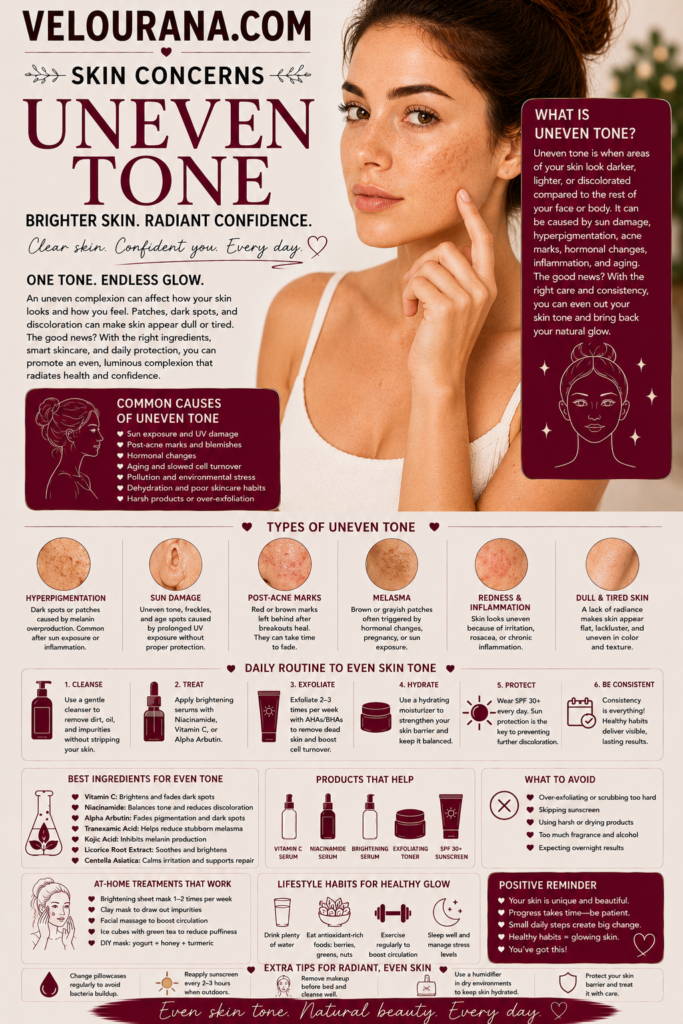
CATEGORY: Uneven Tone
There is a curious contradiction in the way pigmentation changes with age. The skin does not simply become darker, nor does every part of the complexion change in the same direction. Instead, contrast begins to increase. A small brown mark on the cheek becomes more distinct. The forehead carries traces of years spent in the sun. A blemish that once disappeared without consequence now seems to leave a shadow behind. Areas around the mouth or temples appear subtly different from neighboring skin, and the complexion that once seemed visually continuous begins to resemble a landscape with a longer and more complicated history.
This is one reason dark spots can have such a strong influence on perceived skin aging. A face may have relatively few deep wrinkles and still appear more mature when pigmentation becomes irregular. Conversely, a complexion with visible lines can retain an impression of vitality when its color remains relatively clear and harmonious. The eye responds not only to wrinkles but to contrast, light reflection, texture, and the distribution of color across the face.
Dark spots are therefore more than isolated marks. They are often evidence of processes that have been occurring for years: ultraviolet exposure, inflammatory episodes, hormonal influences, changes in cellular turnover, and repeated environmental stress. Some pigmentation becomes visible soon after its trigger. Other discoloration represents accumulated damage that remained relatively inconspicuous until later life.
Understanding why these marks become increasingly noticeable is essential because it changes the objective of skincare. The task is not simply to attack every brown area with the strongest available brightening product. It is to identify what continues to stimulate pigment, reduce unnecessary triggers, protect the surrounding complexion, and gradually influence the processes that determine how pigment is produced and distributed.
Dark spots tell a story. Effective skincare begins by learning how to read it.
Pigmentation Is Part of the Skin's Protective Biology
Melanin is frequently discussed only in cosmetic terms, yet its fundamental role is protective.
Produced by melanocytes and distributed to surrounding keratinocytes, melanin contributes to natural skin color and helps protect cellular structures from ultraviolet radiation. When skin encounters ultraviolet light, pigment production can increase as part of its response to that exposure.
This mechanism explains tanning, but tanning is only the most immediately visible expression of a much longer biological relationship between light and pigmentation.
Over many years, repeated ultraviolet exposure can disrupt the orderly distribution of pigment. Instead of the complexion simply becoming uniformly darker during exposure and returning toward baseline afterward, certain areas begin retaining more pigment than others. Solar lentigines—the flat brown marks commonly called sun spots, liver spots, or age spots—are strongly associated with cumulative sun exposure and are particularly common on areas such as the face and hands.
Their popular name can be misleading. They are associated with age largely because age provides more time for ultraviolet exposure to accumulate. The calendar itself is not painting brown marks onto the skin.
This distinction matters enormously.
If dark spots were simply an unavoidable consequence of getting older, prevention would have limited value. But when a significant part of the process is driven by accumulated environmental exposure, daily behavior becomes relevant.
The appearance of pigmentation at fifty may partly reflect what happened at twenty-five, thirty-five, and forty-five.
This delayed visibility is one reason sun protection can feel unrewarding when people are young. Sunscreen prevents changes that may not otherwise become obvious for years. There is no dramatic moment when someone can see the exact pigmentation they did not develop.
Yet prevention is occurring nonetheless.
The absence of future damage is one of skincare's least visible achievements.
Why Yesterday's Sun Can Become Today's Dark Spot
Sun exposure has a cumulative character.
A holiday tan fades. A mild sunburn resolves. Summer ends, and the skin appears to return to normal. It is therefore tempting to imagine that the event has disappeared entirely.
Biologically, the situation is more complicated.
Ultraviolet radiation can create cellular changes that accumulate over time. Repeated exposure affects not only pigmentation but collagen, elastin, vascular structures, and other components of the skin. The visible signs grouped under the term photoaging emerge gradually from this accumulated history.
Pigment irregularity is one of those signs.
Certain regions of the face receive considerably more exposure than people realize. The forehead, nose, upper cheeks, temples, and sides of the face can accumulate light during ordinary activities that do not feel like sunbathing at all. Walking, driving, sitting near windows, eating outdoors, gardening, commuting, and repeatedly stepping outside for short periods all contribute to lifetime exposure.
The resulting pigmentation may therefore appear surprisingly specific.
One cheek can sometimes show more discoloration than another. The forehead may develop a pattern unlike the lower face. The hands and décolletage may reveal photodamage more clearly than protected areas of the body.
This geographical quality of pigmentation is useful because it demonstrates that uneven tone is rarely random.
The skin has been interacting with its environment for decades, and different areas have experienced different conditions.
Once this is understood, sunscreen stops being merely a product associated with beaches and summer holidays. It becomes part of long-term pigmentation management.
For someone actively treating dark spots, this is particularly important. Corrective skincare attempts to reduce existing pigment while ultraviolet exposure can encourage additional pigment formation. Without protection, the routine may be simultaneously pressing the accelerator and the brake.
Aging Makes Contrast More Complicated
A dark spot does not exist visually in isolation. It is perceived in relation to the skin around it.
As skin ages, several characteristics of that surrounding background change. Surface texture can become less smooth. Hydration may decline. Fine lines create tiny shadows. Vascular changes may contribute redness. Areas of dullness alter light reflection. Some regions may become lighter while others accumulate pigment.
The result is increased visual complexity.
Imagine placing the same small brown mark on two surfaces. One is smooth, luminous, and relatively uniform. The other contains subtle redness, dryness, textural variation, and neighboring areas of different pigmentation. The mark itself may be identical, yet its visual effect can be very different.
This helps explain why treating dark spots alone does not always create the improvement people expect.
A person may successfully fade several areas of pigmentation but still perceive the complexion as uneven because dehydration, redness, texture, and dullness remain. Conversely, improving hydration and surface smoothness can sometimes make pigmentation appear less dominant even before the amount of melanin has changed substantially.
This is an important anti-aging principle: perceived tone is partly optical.
Light striking a smooth, hydrated surface reflects differently from light striking dry, irregular skin. Better moisturization cannot remove a solar lentigo, but it can improve the overall visual environment in which that mark is seen.
The best routines therefore treat the complexion rather than merely treating spots.
Inflammation Can Produce Pigment Long After the Problem Is Gone
Sunlight is only one route to discoloration.
Inflammation provides another.
When skin experiences acne, eczema, irritation, burns, scratches, or other injuries, the inflammatory response can stimulate pigment production. After the original problem resolves, an area of discoloration may remain. This is known as post-inflammatory hyperpigmentation.
The frustrating feature of this process is its timing.
The blemish may last a week. The pigmentation it leaves can remain for months.
This creates the impression that mature skin has suddenly become unable to "heal" from blemishes in the way it once did. While many factors can influence recovery, what people are often noticing is not an active blemish but the pigmentary memory of inflammation.
Picking makes this especially problematic.
A small blemish that might have resolved relatively quietly is squeezed, scratched, repeatedly inspected, and manipulated. The resulting inflammation is greater than the original lesion required, increasing the possibility of a persistent mark.
Aggressive skincare can create a similar cycle.
Someone sees pigmentation and begins using strong exfoliating acids. The skin becomes irritated. More products are added because the complexion now looks worse. The barrier becomes increasingly compromised, inflammation persists, and susceptible skin produces additional discoloration.
At that point the routine designed to correct uneven tone has become one of its causes.
The lesson is counterintuitive but important: pigmentation treatment often requires less aggression, not more.
Calming the event that produces pigment can be as important as treating the pigment already present.
Hormones Can Change the Rules of Pigmentation
Some forms of uneven pigmentation cannot be explained adequately by sun exposure alone.
Melasma is an important example.
It typically appears as patches of pigmentation, frequently on the face, and its development can involve a combination of genetic susceptibility, hormonal influences, and light exposure. Pregnancy, hormonal medications, and other hormonal circumstances may play a role in susceptible individuals.
Melasma also demonstrates why pigment disorders should not be approached as though they were all identical dark spots.
A solitary solar lentigo and diffuse melasma may both look brown, but they do not necessarily behave in the same way. Melasma can be persistent and recurrent. Light exposure can reactivate it, which makes ongoing photoprotection particularly important even after improvement.
Visible light can matter as well as ultraviolet radiation in melasma. This is why dermatologists may recommend tinted sunscreens containing iron oxides for people dealing with this condition.
The broader lesson extends beyond melasma itself.
Color is an appearance. Cause is biology.
Skincare decisions should be based as much as possible on the second rather than the first.
Treating every patch with the same product because everything looks "dark" ignores the processes beneath the surface.
The Depth of Pigment Changes How It Behaves
Another reason dark spots respond differently is that pigment does not always sit at the same depth.
When excess melanin is concentrated primarily within the epidermis, topical treatments may have relatively direct access to the processes involved as skin renews itself. Pigment located deeper within the dermis can be more persistent and difficult to influence.
This helps explain why two apparently similar marks can behave very differently.
One gradually fades over several months with sunscreen and a well-designed topical routine. Another barely changes despite using the same products.
It is tempting to interpret the second situation as evidence that the products are useless. Sometimes the explanation is instead that the pigmentation is biologically different.
Color can provide clues but not certainty. Superficial pigmentation often appears brown, while deeper pigment may take on grayish or bluish qualities depending on skin tone and depth. Professional examination can provide a much more meaningful assessment than simply comparing marks in a bathroom mirror.
This is particularly important before pursuing aggressive procedures.
The deeper the pigmentation problem, the more tempting it becomes to use stronger treatment. Yet stronger treatment can also produce more inflammation, and inflammation can generate additional pigmentation.
Effective treatment therefore depends on precision rather than brute force.
Why Spot Treating Alone Has Limits
A tiny dark mark naturally invites a tiny treatment.
This is why spot-correcting products are appealing. Apply the active ingredient directly to the discoloration, avoid unnecessary treatment elsewhere, and wait for the mark to fade.
For certain localized concerns, this can be reasonable.
But age-related uneven tone is frequently broader than the visible spots themselves.
The surrounding skin may contain subtle pigment irregularity that has not yet developed into clearly defined marks. Sun exposure affects fields of skin, not merely individual brown dots. Inflammation and hormonal pigmentation can also create diffuse patterns.
A routine based exclusively on chasing visible spots may therefore miss the larger environment producing them.
This does not mean strong treatments should automatically be spread across the entire face. It means that the foundation of pigmentation management should generally be complexion-wide: photoprotection, barrier support, gentle cleansing, control of inflammation, and appropriately selected ingredients.
Targeted treatment can then be layered onto that foundation when appropriate.
This approach also helps prevent the strange situation in which individual marks improve while the surrounding complexion continues accumulating new irregularities.
Correction without prevention becomes an endless game of pursuit.
Retinoids Address More Than One Dimension of Aging Skin
Retinoids have an unusual place in mature skincare because they can influence several visible concerns simultaneously.
Depending on the formulation and strength, retinoids can support skin renewal, improve aspects of texture, address fine lines, and contribute to the management of certain pigmentation irregularities.
This makes them attractive for someone whose uneven tone exists alongside other signs of photoaging.
Their usefulness, however, depends heavily on tolerability.
Retinoids can cause dryness, peeling, redness, and irritation, particularly when introduced too quickly or combined indiscriminately with other active products. For pigmentation-prone skin, excessive irritation is especially undesirable because inflammation itself can contribute to discoloration.
Gradual introduction is therefore not an unnecessarily cautious ritual. It is part of the treatment strategy.
A person might begin with a lower-strength cosmetic retinol used infrequently, allowing the skin to adapt before increasing frequency. Moisturizer can support comfort. Other potentially irritating products may need to be reduced rather than stacked into the same routine.
Prescription retinoids require professional guidance.
The principle remains the same regardless of strength: the best dose is not the most powerful dose a person can purchase. It is the treatment level that produces useful biological effects while remaining sustainable for the skin.
Vitamin C Belongs to a Broader Daytime Strategy
Vitamin C has become almost synonymous with brightening, yet its role is most useful when understood in context.
As an antioxidant, topical vitamin C can complement a morning routine designed around environmental protection. It can also influence processes associated with pigmentation and contribute to a brighter-looking complexion over time.
It does not replace sunscreen.
This distinction is important because skincare marketing sometimes allows antioxidant serums to acquire an almost protective mythology of their own. A vitamin C product may support the skin's defenses, but it does not provide the dependable ultraviolet protection supplied by an appropriately formulated sunscreen.
The two functions are complementary rather than interchangeable.
A sensible morning routine might therefore contain gentle cleansing, an antioxidant treatment where tolerated, moisturizer according to skin needs, and broad-spectrum sunscreen.
That sequence is not dramatic.
It does not create the sensation of attacking pigmentation.
Yet it addresses one of the central realities of dark-spot management: the skin must be protected while it is being corrected.
Azelaic Acid Offers a Different Kind of Versatility
Azelaic acid is particularly interesting when uneven tone exists alongside inflammation or blemish-prone skin.
Its usefulness illustrates an important principle in skincare formulation: sometimes the most valuable ingredient is not the one with the most aggressive reputation but the one that addresses several relevant pathways while remaining reasonably compatible with long-term use.
Azelaic acid is used in dermatology for conditions including acne and rosacea and can also help with certain forms of hyperpigmentation. This makes it particularly relevant when post-inflammatory marks are part of the complexion's unevenness.
Rather than simply asking, "What fades dark spots?" it is more useful to ask, "What is causing these dark spots, and what else is happening in the skin?"
If blemishes continue to generate new marks, controlling the blemishes becomes part of pigmentation treatment.
If persistent inflammation is creating discoloration, calming that inflammatory process matters.
If the skin cannot tolerate an elaborate routine, a versatile ingredient may be more valuable than four specialized serums.
This is where intelligent routine design begins to resemble editing.
The objective is not to include everything good.
It is to remove what is unnecessary until what remains has a clear purpose.
Exfoliating Acids Need Restraint
Chemical exfoliation can make skin feel immediately smoother, which gives it a psychological advantage over many pigmentation treatments.
You can often feel exfoliation working.
That sensation can become misleading.
Alpha hydroxy acids such as glycolic acid encourage exfoliation of the outer epidermal layers and may support improvement in superficial pigmentation and texture. Used appropriately, they can contribute to a more refined complexion.
Used excessively, they can compromise the barrier and create irritation.
This matters because pigmentation treatment is a long-term project. A routine that repeatedly produces burning, prolonged redness, or significant peeling is not automatically more effective because it feels active.
There is also a tendency to combine exfoliation with every other corrective ingredient: glycolic acid, retinoid, vitamin C, another brightening serum, perhaps a peel on weekends.
Each addition sounds logical when considered separately.
Together, they may exceed what the skin can tolerate.
The mature complexion often benefits from strategic spacing. Exfoliation can occupy particular evenings while a retinoid is used on others. Recovery nights can contain little more than gentle cleansing and moisturizer.
Nothing is being "wasted" on those quieter evenings.
Recovery is part of the routine.
Sunscreen Is the Treatment That Protects Every Other Treatment
If there is one concept that deserves repetition in discussions of pigmentation, it is that sunscreen is not merely preventative.
It protects the progress created by everything else.
Imagine spending months gradually reducing a dark mark while repeatedly exposing the same melanocytes to the stimulus that contributed to its formation. Improvement becomes harder to achieve and harder to maintain.
Broad-spectrum SPF 30 or higher is a common dermatological recommendation, with higher protection often chosen by people specifically managing pigmentation and photoaging. Application needs to be generous enough to achieve meaningful protection, and reapplication becomes important during prolonged outdoor exposure.
Physical measures strengthen the strategy.
A wide-brimmed hat protects areas that sunscreen application may miss or cover unevenly. Shade reduces total exposure. Sunglasses protect the eye area and may reduce habitual squinting at the same time. Planning outdoor activities away from intense midday sun can lower exposure without requiring someone to avoid daylight entirely.
This is mature sun care: not fear of the sun, but management of exposure.
Consistency matters more than perfection.
One forgotten application does not erase years of good habits, just as one excellent application does not compensate for chronic unprotected exposure.
Darker Skin Tones Require Particular Respect for Inflammation
Uneven pigmentation affects all skin tones, but its behavior and consequences are not identical across them.
Skin containing more melanin can be particularly susceptible to post-inflammatory hyperpigmentation. A seemingly minor inflammatory event may leave a visible mark that persists long after the original problem has resolved.
This has important implications for treatment.
Aggressive peels, poorly selected laser procedures, excessive exfoliation, and chronic irritation may carry a greater pigmentary consequence in susceptible individuals. Professional treatments should therefore be selected by practitioners who understand how different skin tones respond to inflammation and energy-based devices.
The objective should never be to make naturally deeper skin lighter.
The goal is to reduce abnormal or unwanted differences between affected areas and the person's natural baseline complexion.
That distinction is both biologically and aesthetically important.
Healthy skin tone is not defined by lightness.
It is defined by the quality and stability of the individual's own complexion.
When a Dark Spot Should Not Be Treated as a Cosmetic Problem
Most discussions of dark spots naturally focus on benign pigmentation, but there is an important boundary that should never be ignored.
Not every pigmented lesion is an age spot.
A mark that is new, changing, unusually shaped, multicolored, symptomatic, bleeding, crusting, growing, or otherwise different from a person's ordinary pattern deserves medical attention. Dermatologists evaluate pigmented lesions partly because some skin cancers can initially be mistaken for harmless discoloration.
This becomes increasingly important with age because the number of accumulated skin changes tends to increase, making it easy to dismiss something unfamiliar as simply another sign of getting older.
Cosmetic products should not be used to delay evaluation of a suspicious lesion.
Similarly, pigmentation that appears suddenly, extensively, or without an obvious explanation may warrant professional assessment.
The purpose of skincare education is not to turn every consumer into a dermatologist.
It is partly to teach the limits of self-treatment.
Knowing when not to apply another serum is sometimes the most intelligent skincare decision available.
A Sustainable Routine Can Be Surprisingly Simple
A pigmentation routine does not need to resemble a chemistry laboratory.
For many people, the foundation can remain remarkably concise.
Morning care focuses on protection: gentle cleansing where needed, perhaps an antioxidant or well-tolerated brightening ingredient, moisturizer, and broad-spectrum sunscreen.
Evening care focuses on correction and recovery: cleansing, one principal treatment selected according to the skin's needs, and moisturizer.
Additional exfoliation may be introduced periodically rather than automatically every day.
That simplicity creates several advantages.
It becomes easier to identify which product is causing irritation. The skin receives fewer simultaneous challenges. The routine costs less. Compliance improves because the process does not require twenty minutes twice a day. Most importantly, the skin has an opportunity to remain stable enough for active ingredients to work over the months they actually require.
There is no prize for having the longest skincare routine.
Complexion improvement occurs inside the skin, not in the number of bottles arranged beside the sink.
The First Sign of Success May Be Fewer New Spots
When evaluating a pigmentation routine, people naturally watch their darkest existing mark.
That mark may also be the slowest thing to change.
A more revealing early sign of progress can be what stops happening.
Perhaps blemishes no longer leave such persistent shadows. Maybe summer passes without the sudden appearance of several new spots. The complexion looks more stable after time outdoors. Irritation decreases because the routine has become gentler. Existing marks are still visible, but fewer new ones are joining them.
This is meaningful progress.
Prevention changes the trajectory of the complexion before it creates a dramatic before-and-after photograph.
Once new pigmentary disturbances slow down, corrective treatments have a much better opportunity to catch up with the existing discoloration.
Over subsequent months, contrast may gradually decrease. Dark areas soften around their edges. The complexion begins to look more coherent. Makeup requires less correction. Light reflects more evenly because hydration and texture have improved alongside pigmentation.
These changes are subtle individually.
Together, they can alter the entire impression of the face.
Aging Skin Does Not Need to Become Perfectly Uniform
There is something unrealistic about the idea of completely uniform adult skin.
A face that has lived for decades will show evidence of genetics, expression, environment, hormones, health, and time. Freckles may remain. A few sun spots may persist. Different areas of the face naturally have slightly different undertones and vascularity.
The purpose of treating uneven tone is not to erase this history until the complexion resembles a digitally corrected surface.
The more meaningful goal is balance.
Dark spots should not be allowed to multiply unnecessarily because preventable ultraviolet exposure continues unchecked. Inflammation should not repeatedly leave marks because the skin is being overtreated. Persistent or unusual pigmentation should not be ignored when professional assessment is warranted. Corrective ingredients should be given enough time to work without creating a second problem through irritation.
This philosophy produces a different relationship with aging skin.
Instead of examining the face for evidence of failure, the routine becomes an exercise in preserving clarity.
Some marks will fade. Others will soften. A few may remain.
What changes most significantly is the environment around them.
When the barrier is comfortable, inflammation is controlled, texture is smoother, the complexion is protected from excessive light exposure, and pigment production is no longer being repeatedly provoked, individual spots become less dominant.
The face begins to read as a whole again.
And that may be the most realistic definition of successful tone correction in mature skin: not the elimination of every mark accumulated through life, but the restoration of enough visual harmony that those marks no longer define the complexion.
The End Velourana
 Discover More From Our Family of Websites
 ZodiacBearing (Astrology, Tarot, Numerology, Angel Numbers & Spiritual Guidance)
 Velourana (Beauty, Makeup, Hair Care, Skincare & Beauty Tips)
 HavenBearing (Home, Living, Organization, Décor & Everyday Inspiration)
 PawBearing (Pet Care, Dog Breeds, Animal Health, Training & Pet Products)
 PsyCatherine (Notes From the Journal of a Psychologist on Real Life)