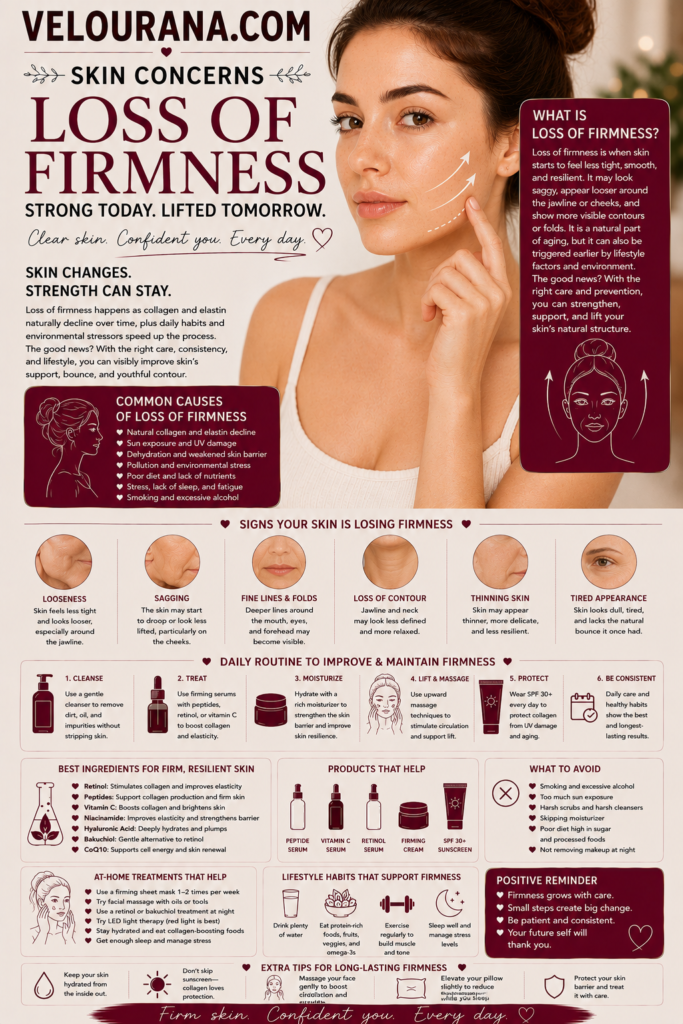
CATEGORY: Loss of Firmness
Loss of firmness rarely appears everywhere at once.
One person notices it first beneath the eyes, where the skin seems thinner and less supported. Another sees it around the mouth. Someone else becomes aware of a softer jawline, while the forehead and upper cheeks still appear comparatively firm. The neck may begin to look different even though the centre of the face remains relatively unchanged.
This unevenness can be confusing because it seems to contradict the idea that skin aging is a single, uniform process.
It is not.
Every region of the face has its own anatomy, thickness, movement patterns, exposure history and relationship with the tissues underneath. Some areas contain more sebaceous glands. Some are thinner. Some are folded repeatedly through expression. Some are more exposed to sunlight. Others sit over structures that change significantly with age.
Firmness therefore changes according to geography.
The skin around the eyes cannot be expected to age exactly like the skin of the cheeks. The neck cannot be treated as though it were simply an extension of the forehead. The jawline is influenced by deeper anatomical changes that differ from those affecting the temples.
This regional perspective matters because it explains why a single firming product may seem effective in one area and disappointing in another.
The problem is often not the product alone.
It is the assumption that every visible change has the same cause.
The Face Is Made of Different Skin Environments
Although the face is spoken about as one cosmetic unit, its skin varies considerably from region to region.
The forehead and central face may be more sebaceous.
The eye area is relatively thin.
The lips have a distinct anatomical structure.
The neck is often more delicate and can be less tolerant of aggressive treatment.
The cheeks sit over important fat compartments that strongly influence contour.
The jawline occupies the boundary between facial skin and the structures of the lower face and neck.
These differences affect appearance.
Thicker skin can conceal certain structural changes longer than thinner skin. Areas with greater oil production may appear less dry. Highly mobile areas develop different patterns of creasing from relatively static regions.
This is why comparing one part of the face with another can be misleading.
The lower eyelid may show fine creasing while the cheek remains smooth.
The neck may look lax while the forehead still appears tight.
The mouth may develop vertical lines even though the upper face looks relatively youthful.
These differences do not mean one region has "aged badly."
They reflect different biology.
The Eye Area Often Reveals Structural Change Early
The skin around the eyes is particularly revealing because it is thin and continuously mobile.
Blinking occurs thousands of times each day.
Smiling repeatedly folds the outer eye area.
The underlying tissues are delicate and the transition between the lower eyelid and cheek can change as facial volume shifts.
As collagen and elastic support decline, fine lines may become increasingly visible.
At first they appear primarily during expression.
Later, some remain visible at rest.
The lower eyelid may also appear less taut, particularly as surrounding volume and deeper support change.
This creates an important distinction.
Fine lines around the eyes may respond somewhat to hydration, retinoids, sun protection and other treatments directed at photoaging.
More pronounced under-eye bags or structural hollows involve deeper anatomy.
A cream can improve the quality of the skin covering those structures.
It cannot necessarily remove the structure creating the shadow.
This is one reason under-eye products generate such extreme expectations.
The area combines pigmentation, vascular visibility, thin skin, volume changes, puffiness, fine lines and structural contour.
A single cosmetic is often expected to solve all of them.
No product category could realistically satisfy such a broad demand.
The Cheeks Depend Heavily on Underlying Volume
Cheeks are visually powerful because they shape the central face.
In youth, the cheek often creates a smooth transition between the eye, nose, mouth and jaw.
Its appearance depends not only on skin quality but also on the distribution of facial fat and the projection of the underlying skeleton.
As these deeper structures change, the skin covering them may appear less supported.
This can create a sense of deflation.
The cheek may look flatter above and heavier below.
The fold between the nose and mouth can become more pronounced.
Light that once reflected from a rounded cheek may create different shadows.
A person may interpret this entire process as sagging skin.
But skin laxity is only one component.
This matters when evaluating firming treatments.
A retinoid may improve dermal quality.
A moisturizer may improve hydration.
Sun protection may reduce further photodamage.
But if the dominant change is volume loss, topical treatment will have limited influence on the contour itself.
This is not failure.
It is simply the boundary between skincare and anatomy.
The Mouth Is Shaped by Movement and Support
The region around the mouth is one of the most mechanically active parts of the face.
Speaking, eating, smiling, pursing the lips and countless small expressions repeatedly move the tissues.
Over time, these movements interact with declining collagen support and changes in surrounding structures.
Fine vertical lines can become visible around the lips.
The corners of the mouth may appear less supported.
The transition from the cheek into the lower face may change.
The lips themselves can lose volume and definition with age.
These changes often become grouped together under the general concept of loss of firmness.
Again, the causes are layered.
Surface lines may be influenced by photoaging and repetitive movement.
Changes in lip volume are deeper.
The corners of the mouth are influenced by surrounding tissue relationships.
The lower face is affected by fat distribution, ligaments, muscles and skeletal support.
A firming cream around the mouth may improve hydration and texture.
It cannot restore the full architecture of a younger perioral region.
Understanding that distinction helps prevent endless product escalation.
The Jawline Is a Boundary, Not Just a Skin Area
The jawline is uniquely sensitive to aging because it represents a visible boundary.
When that boundary becomes less sharp, the entire lower face can appear different.
The skin may contribute through reduced elasticity and collagen support.
But deeper changes are particularly important.
Fat compartments can shift in relative prominence.
Supportive structures change.
The underlying mandible remodels over time.
The relationship between the lower cheek and upper neck evolves.
The result can be a softer contour or early jowling.
Because the change looks like descent, consumers naturally search for lifting products.
This is where marketing language becomes especially persuasive.
A serum is applied upward.
A cream is massaged toward the ears.
A roller is moved along the mandibular edge.
These rituals may be pleasant.
Hydration can improve the surface.
Massage may temporarily alter fluid distribution.
But permanent structural lifting requires a mechanism capable of influencing deeper anatomy.
The direction in which a cream is rubbed does not override that anatomy.
The skin does not remain lifted because a moisturizer was applied upward instead of downward.
Application technique may affect comfort and friction.
It does not mechanically reposition the lower face.
The Neck Has Its Own Aging Pattern
The neck is often one of the earliest places where people become concerned about firmness.
Its skin is relatively thin and repeatedly folded by movement.
It is also frequently neglected in sun protection.
For years, sunscreen may stop at the jaw while the neck receives cumulative ultraviolet exposure.
Eventually the difference becomes visible.
The neck can develop fine creasing, uneven tone, roughness and reduced resilience.
Horizontal lines may deepen.
The skin may appear less closely supported by underlying structures.
But not every neck line is a sign of advanced aging.
Horizontal neck creases can appear even in young adults because the area naturally folds during movement.
The important question is not whether lines exist, but how the overall skin quality is changing.
The neck also deserves greater caution with active ingredients.
A retinoid tolerated comfortably on the forehead may cause significant irritation when applied at the same strength and frequency to the neck.
This is why copying the entire facial routine downward can create problems.
The neck often benefits from slower introduction of actives, consistent moisturization and careful sun protection.
Firmness treatment should adapt to the region rather than assuming all skin responds identically.
The Temples Can Reveal Volume Change More Than Laxity
The temples are often overlooked until they change.
Because the region contributes to the smooth contour between forehead and cheek, hollowing can subtly alter the shape of the upper face.
This may make the brow and cheekbone appear more prominent.
The face can look narrower.
The overall impression may be interpreted as loss of firmness even though the dominant process is volume change.
Again, the surface is revealing deeper anatomy.
No topical cream can restore substantial lost temple volume.
Skincare can improve the quality of the overlying skin.
It cannot rebuild the underlying tissue volume responsible for projection.
This distinction becomes increasingly important as people begin using skincare terminology to describe structural concerns.
"Firming" may actually mean fuller.
"Lifting" may actually mean restoring volume.
"Tightening" may actually mean sharpening a contour.
These words describe visual goals, not necessarily biological mechanisms.
A good routine begins by identifying what the visual concern actually represents.
The Forehead Often Ages Through Lines Before Laxity
The forehead behaves differently from the lower face.
Its most visible early aging changes often involve expression lines.
The frontalis muscle repeatedly raises the eyebrows, creating horizontal folds.
Over time, these dynamic lines can become more persistent.
Sun exposure and collagen changes contribute to the transition.
Yet the forehead may still feel relatively firm.
This is a useful example of why wrinkles and firmness should not be treated as interchangeable.
A person can have prominent forehead lines while maintaining considerable tissue support.
Another person can have very few forehead lines yet show significant lower-face laxity.
The pattern depends upon expression habits, anatomy, genetics, skin characteristics and environmental history.
This regional diversity explains why judging "how old skin looks" according to one feature is unreliable.
Skin aging is multidimensional.
The Upper Face and Lower Face Do Not Age Symmetrically
One of the most common patterns of facial aging is increasing contrast between the upper and lower face.
The forehead may remain relatively smooth.
The upper cheeks may still have good skin quality.
Meanwhile, the lower cheeks and jawline begin to soften.
This can feel sudden because the face's outline changes more dramatically than its texture.
The explanation again lies in anatomy.
The lower face is strongly influenced by changing volume, support structures and the boundary with the neck.
The upper face has different relationships with bone, muscle and fat.
Even when chronological aging affects the entire skin surface, the visual consequences are not evenly distributed.
This is why using one anti-aging metric for the whole face creates confusion.
A treatment can genuinely improve fine lines in the upper face without changing the jaw.
That does not mean it failed.
It means the jaw problem was driven by different structures.
Uneven Sun Exposure Creates Uneven Firmness
Environmental history is not distributed perfectly across the face either.
One side may receive more sunlight during driving.
The forehead, nose and cheeks may receive greater direct exposure than areas beneath the jaw.
The neck and upper chest may be repeatedly exposed while receiving less sunscreen.
Hairstyles, hats, occupations and outdoor habits can all influence which regions accumulate more ultraviolet damage.
Over decades, these differences can become visible.
One side of the face may develop deeper wrinkles or more pigmentation.
Certain regions may feel rougher or less resilient.
This regional pattern reinforces the importance of treating sunscreen application as a complete-area practice.
Protection should include the entire exposed face, ears, neck and other uncovered skin as appropriate.
The areas that are repeatedly forgotten are often the areas that later seem to have "aged faster."
Why Side-Sleeping Can Make One Side Look Different
Mechanical compression during sleep has also attracted considerable attention.
A person who consistently sleeps on one side may notice temporary morning creases more frequently on that side.
With age, declining elasticity can make these creases take longer to disappear.
This has led to increasingly elaborate anti-aging sleep recommendations.
But the significance should be kept in perspective.
Sleep position is only one of many influences on facial appearance.
Genetics, ultraviolet exposure, smoking, hormonal changes, facial anatomy and chronological aging are much more important to the overall process.
A person should not sacrifice sleep quality simply to maintain a theoretically ideal facial position.
Good sleep has value far beyond cosmetic concerns.
Sleep lines are an interesting example of mechanical deformation.
They should not become a reason for anxiety.
Different Areas Require Different Tolerance Strategies
Regional skin differences also matter when designing a routine.
The forehead may tolerate a retinoid well.
The corners of the nose may become irritated.
The neck may react strongly.
The eye area may require more cautious application.
This is normal.
Uniform application does not guarantee uniform response.
A sophisticated skincare routine can therefore vary according to region.
The same active may be used less frequently on delicate areas.
Moisturizer can be applied more generously where dryness occurs.
Exfoliation can be limited where the barrier is easily disrupted.
This approach is often more effective than forcing every part of the face through the same routine.
The objective is not procedural symmetry.
It is biological compatibility.
The Eye Cream Question
Because the eye area behaves differently, many people assume a dedicated eye cream is mandatory.
It is not always necessary.
A well-formulated facial moisturizer may be perfectly suitable around the eyes if it is non-irritating and tolerated.
However, dedicated eye products can be useful when they offer a texture, concentration or ingredient profile better suited to that region.
The important point is that the label "eye cream" does not automatically make a product capable of lifting eyelids or eliminating structural bags.
The same standards should apply as elsewhere.
What is the mechanism?
Is the concern hydration, fine lines, pigmentation or puffiness?
Does the product plausibly address that concern?
The more precisely the problem is defined, the less likely unrealistic expectations become.
Why One Firming Serum Cannot Solve Every Region
A firming serum may contain a retinoid, peptides, antioxidants or hydrating ingredients.
Each may have useful effects.
But the face presents several different problems simultaneously.
Around the eyes, the concern may be fine creasing.
On the cheek, it may be volume-related flattening.
At the jawline, it may be structural descent.
On the neck, it may be photodamage and reduced elasticity.
No single topical mechanism can fully address all four.
This is not necessarily a criticism of the serum.
It is a criticism of the expectation placed upon it.
A product can be good without being universal.
Skincare becomes more logical when products are matched to concerns instead of asking one bottle to restore every dimension of facial aging.
Localized Firmness Does Not Mean Localized Biology
People often apply anti-aging products only where the visible problem has appeared.
A serum goes only on the jaw.
Retinol is used only around the eyes.
Sunscreen is applied carefully to the cheeks but forgotten on the neck.
This can be counterproductive.
The biological processes driving aging affect broader areas than the currently visible concern.
Photoprotection should therefore be comprehensive.
Retinoids, when appropriate and tolerated, are generally used across relevant facial regions rather than exclusively painting individual wrinkles.
Moisturization supports the overall barrier.
Localized concerns may require additional attention, but good foundational care remains broader.
Waiting until a region visibly loses firmness before protecting it misses the preventive opportunity.
Why Lower-Face Changes Often Feel More Emotional
There is a psychological reason jawline and lower-face changes attract so much attention.
They alter silhouette.
Fine lines change surface detail.
A softer jaw changes perceived shape.
Humans recognize shape rapidly, so even subtle changes in facial outline can feel disproportionately significant.
This can create the impression that aging suddenly accelerated.
In reality, the underlying changes were often gradual.
The face simply crossed a visual threshold at which the contour difference became noticeable.
Understanding this can help reduce reactive decision-making.
The moment a change becomes visible is not necessarily the moment aggressive treatment is required.
It may simply be the first moment the eye recognized a process that has been developing for years.
Men and Women May Show Different Regional Patterns
Sex-related biological differences can also influence skin aging patterns.
Skin thickness, hormone environments, facial hair, fat distribution and skeletal anatomy all contribute.
Men often have thicker facial skin in certain regions, while androgen-related characteristics affect sebaceous activity and hair growth.
Women experience major hormonal changes around menopause that can influence collagen and skin thickness.
These differences can shape where and how firmness changes become visible.
But individual variation remains enormous.
No universal pattern applies to every man or woman.
Genetics and environmental history frequently matter as much as broad biological categories.
The useful lesson is not to compare one person's aging pattern rigidly with another's.
Professional Assessment Becomes More Useful When the Problem Is Regional
When someone is considering a procedure, identifying the exact region and mechanism becomes especially important.
Under-eye hollowing requires a different discussion from neck laxity.
Jawline softening is different from fine cheek creasing.
Surface photodamage differs from significant volume loss.
The procedure should be selected according to the tissue involved.
This is why a qualified clinician begins with assessment rather than simply offering the same treatment to every aging concern.
Lasers, microneedling, energy-based devices, injectables and surgery operate differently.
Their benefits and risks differ.
Their ability to influence particular tissue layers differs.
A treatment appropriate for surface texture may do little for major structural descent.
A volume treatment may be inappropriate when the primary concern is skin quality.
The more accurately the problem is identified, the more rational the intervention becomes.
Building a Regional Firmness Routine Without Overcomplicating It
Acknowledging regional differences does not mean creating a twelve-step routine for each part of the face.
The foundation can remain simple.
Gentle cleansing supports the entire facial barrier.
Broad-spectrum sunscreen protects exposed skin.
Moisturizer maintains hydration.
An evidence-supported active such as a retinoid can be used where appropriate and tolerated.
Regional adaptation happens mainly through intensity.
The eye area may need less product.
The neck may need lower frequency.
Dry areas may need richer moisturization.
Areas prone to congestion may prefer lighter textures.
This keeps the routine coherent without pretending every region is identical.
Why Progress Should Be Evaluated Area by Area
If different areas age differently, progress should also be evaluated differently.
The forehead may show improvement in fine lines.
The cheeks may appear smoother.
The neck may become better hydrated.
The jawline may remain structurally similar.
A person who evaluates the whole face according to the one area that changed least may incorrectly conclude that nothing worked.
It is more useful to ask what each intervention was capable of changing.
Did hydration improve?
Did texture become smoother?
Did fine lines soften?
Did pigmentation become more even?
Is the skin tolerating treatment?
Has sun protection become consistent?
These are meaningful outcomes even when deeper anatomical contours remain unchanged.
Skincare should be judged according to achievable targets.
The Face Does Not Age According to a Single Clock
Perhaps the most useful way to understand uneven firmness is to imagine that different parts of the face are following different clocks.
The eye area has one combination of thinness, movement and support.
The cheeks have another.
The jawline has another.
The neck has another.
Each accumulates age according to its own anatomy and environmental history.
This is why trying to force the entire face back toward one uniform youthful condition is unrealistic.
Even youth itself is not uniform.
The eyelids are thinner than the cheeks at twenty-five.
The mouth is more mobile than the temples.
The neck folds when the head moves.
Variation is built into the structure from the beginning.
Firmness Is Better Managed Through Understanding Than Uniformity
Loss of firmness becomes much less confusing once regional variation is accepted.
The face is not one sheet of identical skin.
It is a collection of biologically distinct areas covering a complex anatomical structure.
The eye area reveals thinness and movement.
The cheek reveals the importance of volume.
The jawline reveals the interaction between skin and deeper support.
The neck reveals the consequences of movement, thinness and often-neglected sun exposure.
The mouth reveals repetitive expression and structural transition.
Each region tells a different part of the aging story.
This understanding changes the objective of skincare.
Instead of trying to make every area behave the same way, the goal becomes preserving the quality of each area according to its needs.
Protect the entire exposed surface from ultraviolet damage.
Maintain hydration and barrier health.
Use evidence-supported treatments consistently rather than aggressively.
Adapt intensity where skin is more delicate.
Recognize when the visible concern is being created by deeper anatomy rather than surface quality.
And avoid interpreting uneven aging as evidence that something has gone wrong.
Skin ages unevenly because the face itself is uneven.
Its thickness varies.
Its movement varies.
Its underlying support varies.
Its exposure varies.
Firmness therefore changes in patterns rather than according to a single uniform decline.
Once that pattern is understood, skincare becomes more precise and far less frustrating.
The objective is not to force every region into identical tightness.
It is to preserve resilience where possible, improve skin quality where treatment can help, and respect the anatomical differences that make every face age in its own particular way.
The End Velourana
 Discover More From Our Family of Websites
 ZodiacBearing (Astrology, Tarot, Numerology, Angel Numbers & Spiritual Guidance)
 Velourana (Beauty, Makeup, Hair Care, Skincare & Beauty Tips)
 HavenBearing (Home, Living, Organization, Décor & Everyday Inspiration)
 PawBearing (Pet Care, Dog Breeds, Animal Health, Training & Pet Products)
 PsyCatherine (Notes From the Journal of a Psychologist on Real Life)