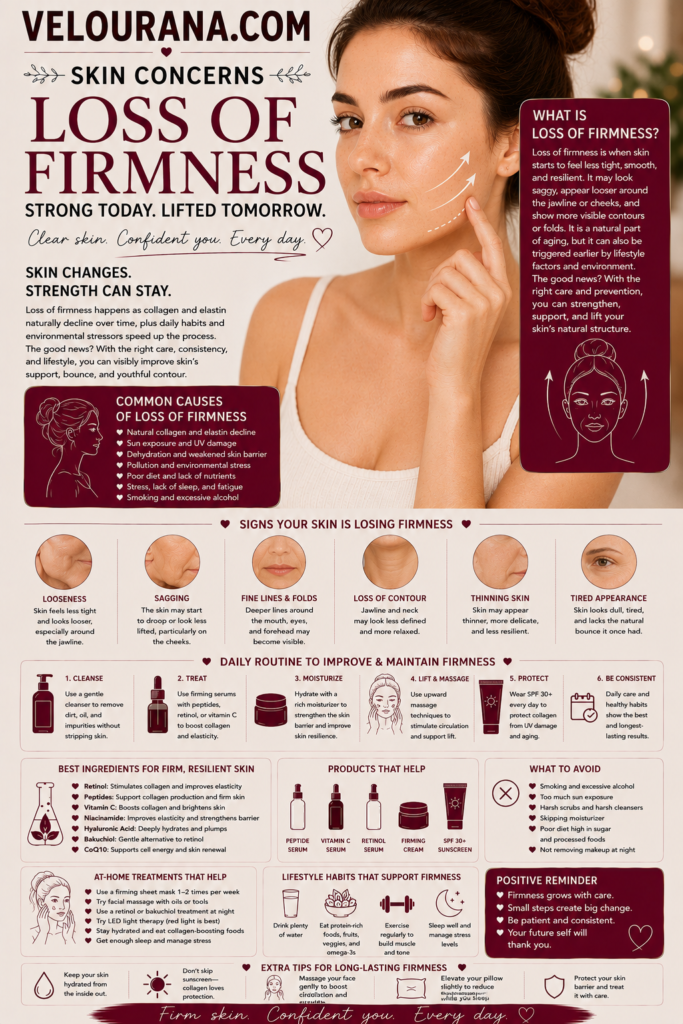
CATEGORY: Loss of Firmness
Loss of firmness is one of the more difficult signs of skin aging to describe because it rarely arrives as a single, unmistakable change. A fine line can be pointed to. A dark spot can be photographed. Dryness can be felt almost immediately. Firmness is different. It is perceived through relationships: the cheek seems to sit differently, the jawline appears less defined, the skin beneath the eyes no longer looks quite as taut, or the surface seems to move more readily when facial expressions change.
For that reason, loss of firmness is often reduced to the convenient language of "sagging." Yet sagging is only the visible conclusion of a much more complicated process. Firm-looking skin depends upon an entire structural environment beneath the surface: collagen that provides tensile strength, elastic fibres that allow tissue to stretch and return, extracellular matrix components that help organize and hydrate the dermis, fibroblasts that maintain this environment, underlying fat compartments that contribute volume and contour, and deeper anatomical structures that influence the shape of the face.
As these systems change with age, the face does not simply become "looser." Its architecture gradually changes.
This distinction matters because skincare is frequently marketed as though firmness were something that could simply be poured back into the skin. A cream promises lifting. A serum claims to tighten. An ingredient is described as rebuilding the youthful structure of the face. Some topical treatments genuinely can improve aspects of aging skin, but understanding firmness requires separating what skincare can realistically influence from what belongs to deeper anatomy.
The most useful approach, therefore, is not to search for a miraculous tightening product. It is to understand what firmness actually represents, protect the structures that remain, support the biological processes that can still respond to treatment, and recognize when a concern has moved beyond what topical skincare can reasonably accomplish.
Firmness Is an Architectural Quality, Not a Single Substance
Young skin does not look firm because it contains one particular "firmness molecule." Its appearance emerges from the organization of many different components working together.
The dermis provides much of this structural foundation. Collagen fibres contribute strength and resistance to deformation, while the elastic fibre network contributes resilience—the ability of skin to stretch and return toward its previous position. Other components of the extracellular matrix help maintain the environment in which these fibres function.
This arrangement is remarkably sophisticated. Skin cannot simply be rigid. It must bend when we smile, compress when we sleep, stretch as the body moves, and accommodate thousands of small mechanical changes throughout the day. Firmness therefore does not mean hardness. Healthy youthful skin combines strength with flexibility.
Elastin is particularly important to this distinction. Elastic fibres help skin recoil after deformation, and research into cutaneous aging shows that their organization and function change significantly with both chronological aging and environmental exposure.
Collagen, meanwhile, provides a structural framework against which those elastic properties operate. Aging affects not merely how much collagen is present but also the quality, organization and fragmentation of the collagen-rich extracellular matrix. Studies of naturally aged and photoaged skin describe progressive deterioration of this dermal environment, with consequences for mechanical strength, resilience and visible appearance.
This helps explain why a face can look less firm even when its skin surface remains relatively smooth. Texture and firmness overlap, but they are not identical.
Someone may have few prominent wrinkles yet notice that the lower face has become softer in outline. Another person may have many expression lines but retain considerable structural definition. Aging does not unfold according to a single universal sequence because genetics, facial anatomy, sun exposure, lifestyle, hormonal influences and environmental history all participate in the final appearance.
The concept of firmness therefore becomes much clearer when it is understood as an architectural property rather than a cosmetic surface condition.
What Changes Inside Aging Skin
One of the central events in dermal aging is deterioration of the extracellular matrix.
Collagen is not an inert scaffold that remains unchanged throughout life. It exists within a living environment that is continually maintained and remodeled. Fibroblasts, the principal cells responsible for producing many dermal matrix components, interact with their surrounding collagen network. With aging, this relationship becomes progressively less efficient.
Collagen fibres become fragmented, the organization of the matrix changes, and collagen production declines. Research examining human skin aging describes this fragmentation as part of a self-perpetuating deterioration: when the surrounding collagen network loses structural integrity, fibroblasts themselves experience a less supportive mechanical environment, which can further impair their ability to maintain the matrix.
The elastic system changes as well.
Elastin is unusual because it turns over extremely slowly. Much of the body's functional elastic architecture is created early in life, making preservation particularly important. Over decades, environmental damage and intrinsic aging alter elastic fibres, while the capacity to assemble new functional elastic structures becomes increasingly limited.
Other extracellular components change too. Proteoglycans, glycosaminoglycans and matrix-associated proteins contribute to hydration, organization and mechanical behaviour. Aging therefore affects a network rather than simply reducing two famous proteins called collagen and elastin.
The visible consequence is gradual.
Skin may initially seem slightly less springy. Later, contours can appear softer. Creases may remain visible longer after expression. Areas that once seemed naturally supported can begin to look less compact.
This is why firmness rarely disappears overnight. The architecture has usually been changing long before the difference becomes obvious in the mirror.
Chronological Aging and Photoaging Are Not the Same Process
Time changes skin even when it is carefully protected. This is intrinsic, or chronological, aging.
Sun exposure adds another process on top of it.
Photoaging is not merely chronological aging happening faster. Although the two processes share certain features, chronically sun-exposed skin develops distinctive structural abnormalities. Research has repeatedly shown significant changes in collagen and elastic fibre architecture in photoaged skin, including collagen deterioration and the accumulation of abnormal elastin-containing material known as solar elastosis.
That distinction is important because the word "elastin" can otherwise become misleading.
If elastin contributes elasticity, it might seem logical that more elastin must always mean firmer skin. But photoaged skin can contain accumulations of abnormal elastotic material while simultaneously demonstrating poorer elasticity. The issue is therefore not simply quantity. Organization and functionality matter enormously.
Healthy elastic fibres form an intricate network. In chronically photodamaged skin, parts of that architecture become degraded or disorganized. Fine elastic structures near the upper dermis can diminish while abnormal material accumulates elsewhere.
Ultraviolet radiation also contributes to oxidative stress and biological signalling that promotes degradation of dermal matrix components. Repeated exposure across many years therefore has consequences that may not be visible immediately after any individual sunny day.
This is one of the most important ideas in firmness-focused skincare: prevention is not merely an introductory stage before "real" anti-aging treatment begins.
Preventing additional photodamage is itself treatment.
A sophisticated serum used every evening cannot fully compensate for repeated unprotected ultraviolet exposure during the day. Protecting collagen and elastic architecture from avoidable damage may be less glamorous than promising to rebuild everything later, but biologically it is considerably more sensible.
Why Loss of Firmness Is Often Most Visible Around Facial Contours
If firmness were exclusively a skin problem, facial aging would be much easier to treat.
It is not.
The face is a layered anatomical structure. Skin rests above subcutaneous tissue, muscles, connective structures and bone. These deeper tissues also change with age. Fat compartments can alter in volume and position, while skeletal remodeling changes the framework supporting the overlying soft tissues.
Consequently, what a person interprets as "loose skin" may represent several changes occurring simultaneously.
The cheeks illustrate this particularly well. A youthful cheek contour is not created by taut epidermis alone. It reflects the relationship between skin quality, dermal thickness, soft-tissue volume and the deeper facial framework. When those relationships change, the cheek can appear flatter or lower even if the skin itself is in relatively good condition.
The jawline presents a similar problem. Changes in skin elasticity contribute to reduced definition, but so can shifts in facial fat and deeper support. A topical cream applied to the jawline acts primarily within the skin. It cannot reposition bone, ligaments or substantial volumes of displaced tissue.
This does not make skincare pointless. It makes expectations more intelligent.
Improving hydration, surface quality and dermal function can make aging skin look healthier, smoother and somewhat more resilient. Over time, evidence-supported ingredients may improve aspects of photoaging. But a cosmetic formula should not be expected to perform the mechanical work of a procedure designed to affect deeper tissues.
Recognizing this boundary protects consumers from a particularly common category of anti-aging disappointment: expecting a topical product to solve an anatomical problem.
The Difference Between Hydrated Skin and Structurally Firmer Skin
One reason firming products can seem remarkably effective after a single application is hydration.
Well-hydrated skin often looks plumper, smoother and more reflective. Fine dehydration lines become less obvious. The surface can feel softer and more supple. These changes may make the face appear fresher and, visually, somewhat firmer.
This is useful. It simply should not be confused with structural remodeling.
Humectants help attract or retain water within the outer skin environment. Emollients smooth spaces between surface cells. Occlusive ingredients reduce water loss. Together, a well-designed moisturizer can significantly improve the appearance and comfort of dry or dehydrated aging skin.
But increasing water content in the stratum corneum is not equivalent to rebuilding a fragmented collagen matrix deep within the dermis.
The distinction is similar to restoring the finish of an old piece of furniture versus rebuilding its internal frame. Both improvements matter, but they operate at different levels.
This is not an argument against moisturizers. Quite the opposite. A resilient skin barrier makes almost every long-term skincare strategy easier to tolerate. Aging skin can become drier, and aggressive attempts to "stimulate" it through excessive exfoliation or irritating active ingredients may compromise the barrier further.
A good moisturizer therefore belongs in a firmness-conscious routine even if it does not literally lift the face.
The problem arises only when temporary plumping is marketed as permanent structural transformation.
A useful way to evaluate a product is to ask what kind of result it is promising. Immediate smoothness is plausible. Improved hydration is plausible. A temporarily plumper appearance is plausible. Gradual improvement in certain signs of photoaging from particular evidence-supported actives can also be plausible.
An instant restructuring of the deeper facial architecture is something very different.
Retinoids and the Meaning of Evidence in Firming Skincare
Among topical approaches to photoaged skin, retinoids occupy an unusually important position because their history is supported by considerably more research than many fashionable anti-aging ingredients.
Retinoids are derivatives of vitamin A. Different forms vary in potency, conversion requirements, stability and tolerability. Prescription tretinoin has particularly extensive evidence, while cosmetic products commonly contain retinol or retinaldehyde.
Their importance to firmness lies largely in their effects on epidermal turnover and dermal collagen biology. Dermatological guidance recognizes retinoids for improving several signs of aging, including fine lines and aspects of texture and pigmentation, and research reviews continue to identify retinoids among the better-supported topical interventions for photoaged skin.
That does not mean every retinol serum will dramatically tighten skin.
Formulation matters. Concentration matters. Stability matters. Consistent use matters. Individual tolerance matters. And even an effective retinoid operates within biological limits.
A recent review of skin-aging interventions emphasizes an important problem within the wider anti-aging market: promising mechanisms and commercial claims frequently exceed the quality of clinical evidence available. Retinoids remain comparatively well supported, but many other interventions are backed by smaller, shorter or less rigorous studies.
This is precisely why ingredient discussions should avoid treating every active as though it possesses equal evidence.
A person beginning a retinoid also gains nothing from trying to reach the highest possible strength immediately. Irritation does not prove that collagen is being produced. Persistent redness, burning, peeling and barrier disruption can make a routine unsustainable.
A lower-strength product used consistently may ultimately be more useful than an aggressive product repeatedly started and abandoned.
Firmness changes slowly. The routine designed to support it should therefore be built for months and years rather than for an impressive first week.
Sunscreen Is Part of a Firming Routine Even Though It Does Not Feel Like One
The cosmetic industry tends to make restoration more exciting than preservation.
A bottle promising collagen renewal sounds active. Sunscreen sounds defensive.
Biologically, that distinction is misleading.
If ultraviolet exposure contributes substantially to deterioration of collagen and elastic architecture, reducing that exposure helps protect the very structures a firming routine is attempting to preserve. Studies comparing sun-protected and chronically exposed skin demonstrate profound differences in dermal collagen and elastic fibre organization.
Daily photoprotection therefore belongs at the centre of any serious strategy addressing premature loss of firmness.
This does not mean living in fear of daylight. It means treating ultraviolet exposure as cumulative rather than episodic.
Many people associate sun protection almost exclusively with beaches, summer holidays and visibly intense sunlight. Photoaging, however, reflects accumulated exposure over long periods. The ordinary days matter too.
Broad-spectrum sunscreen, appropriate clothing, shade and sensible sun behaviour work together. The objective is not perfection but reduction of unnecessary cumulative damage.
This also changes how we should think about anti-aging progress.
If skin looks approximately the same after a year of consistent sun protection, that may seem unimpressive compared with a dramatic before-and-after advertisement. Yet aging has continued during that year. Preventing some additional deterioration is itself a meaningful outcome, even though prevention is difficult to photograph because the comparison face—the version that received more ultraviolet damage—does not exist.
Much of good aging skincare operates in precisely this quiet territory.
Peptides, Antioxidants and the Temptation of the Collagen Claim
Once collagen became a familiar word in beauty marketing, almost every category of product found a way to claim a relationship with it.
Peptides are frequently presented as collagen messengers. Vitamin C is associated with collagen synthesis as well as antioxidant activity. Niacinamide appears in broad anti-aging formulations because of its multiple effects on skin function. Various botanical extracts are marketed for antioxidant protection. Hyaluronic acid is often described using language that blurs hydration with structural rejuvenation.
Some of these ingredients can be valuable. The problem is not necessarily the ingredient. It is the distance between a plausible biological mechanism and a guaranteed visible outcome.
Laboratory evidence that a molecule participates in a biological pathway does not automatically establish that a cosmetic formulation containing that molecule will penetrate appropriately, remain stable, reach a useful concentration, produce a clinically meaningful change and do so consistently across different people.
Modern reviews of skin-aging interventions repeatedly emphasize this evidence gap. Formulation stability, bioavailability, study design, treatment duration and objective measurement all influence whether an attractive mechanism becomes a meaningful treatment.
This is especially relevant to "collagen-boosting" claims.
The phrase sounds precise while often being remarkably vague. How much collagen? Which type? Measured where? After how long? Was the change demonstrated in human skin or inferred from cells in a laboratory? Did participants actually look firmer? Was the difference large enough to matter visually?
Consumers rarely receive those details.
A more sensible approach is to treat supportive ingredients as part of a complete routine rather than expecting every serum to independently transform facial structure.
An antioxidant formulation may complement sunscreen. A peptide moisturizer may provide hydration while incorporating ingredients with potentially useful signalling properties. Niacinamide may support barrier function and improve other visible concerns. None of these products needs to perform a cosmetic facelift to justify its existence.
Skincare becomes easier to evaluate once products are allowed to accomplish realistic things.
Why More Exfoliation Does Not Mean More Firmness
When skin begins to look dull, rough or aged, exfoliation produces one of the fastest visible changes available from skincare. Removing excess surface cells can make texture appear smoother and light reflect more evenly.
Because the result is immediate, it is tempting to keep increasing exfoliation.
Firmness does not work this way.
Alpha hydroxy acids and other exfoliating ingredients can have legitimate roles in anti-aging skincare, depending on their type, concentration and formulation. But repeatedly stripping the surface in pursuit of tighter-looking skin can create irritation rather than rejuvenation.
This becomes especially problematic when exfoliating acids are layered with retinoids, strong vitamin C formulations, scrubs and multiple other actives.
A routine may contain many excellent ingredients and still be poorly designed.
Barrier disruption can leave skin dry, inflamed, tight in the uncomfortable sense rather than firm in the structural sense, and more reactive to products that would otherwise be tolerable. The resulting cycle is familiar: aggressive treatment causes irritation, the routine is stopped, the skin recovers, and another aggressive treatment begins.
Firmness-focused skincare benefits from patience because the biological processes of interest are slow.
There is no prize for making skin peel.
A calmer routine that can be maintained consistently is usually more rational than a constantly changing collection of maximum-strength products.
Lifestyle, Biology and the Limits of Cosmetic Control
Skin does not exist independently from the person carrying it.
Smoking, ultraviolet exposure, nutrition, sleep patterns and other environmental or behavioural factors can influence visible aging, although their effects are not equal and should not be converted into simplistic beauty rules.
Smoking, for example, has long been associated with accelerated visible skin aging. Chronic ultraviolet exposure has an especially well-established relationship with photoaging.
Nutrition provides the substrates required for normal tissue maintenance, but the relationship between diet and facial firmness is frequently exaggerated commercially. No single fashionable food can rebuild facial architecture. A generally adequate diet is more biologically sensible than pursuing isolated "anti-aging" foods as though they were medicines.
The same caution applies to supplements.
Collagen supplements have become extremely popular, and research continues to investigate their possible effects. Yet contemporary reviews note limitations in the evidence base and do not place oral collagen in the same evidentiary category as established topical retinoids.
There is another important factor that skincare discussions sometimes avoid because it is less marketable: genetics.
People inherit different facial structures, skin characteristics and aging patterns. Two individuals of the same age who have followed similar routines can look very different. Some naturally retain fuller cheeks. Some develop pronounced lower-face laxity. Others show pigmentation or fine lines long before contour changes become prominent.
Good skincare cannot erase biological individuality, nor should that be its purpose.
Its more reasonable goal is to help skin function and look as healthy as possible within the person's own biology.
When Topical Skincare Reaches Its Natural Limit
There comes a point at which increasing the number of creams produces diminishing returns.
This is particularly relevant when the primary concern is substantial laxity rather than early changes in skin quality.
Professional aesthetic treatments operate through different mechanisms and at different depths. Depending upon the procedure, they may create controlled tissue injury intended to stimulate remodeling, deliver energy into specific tissue layers, replace lost volume or surgically reposition tissue.
These categories should not be treated as interchangeable.
Microneedling, certain laser procedures, radiofrequency-based treatments, ultrasound-based technologies, injectable treatments and surgery all differ in mechanism, evidence, risk, recovery, cost and the kind of problem they are designed to address.
The existence of these procedures does not mean everyone experiencing loss of firmness needs one.
It means that anatomical problems deserve anatomically appropriate expectations.
Someone primarily concerned about mild photodamage, fine texture changes and early reduction in elasticity may gain meaningful benefit from consistent photoprotection and a well-designed topical routine. Someone whose concern is pronounced jowling or substantial tissue descent is asking skincare to solve a deeper structural issue.
A qualified dermatologist or appropriately trained medical professional can help distinguish these situations and discuss realistic options. This becomes especially important before energy-based or invasive treatments, where individual anatomy, skin type, medical history and treatment parameters matter.
The objective should not be to escalate treatment automatically.
It should be to match the intervention to the problem.
Building a Routine Around Preservation Rather Than Panic
The appearance of early laxity often provokes exactly the wrong response: suddenly changing everything.
A new retinol appears. Then a peptide serum. Then an exfoliating toner, vitamin C, facial device, collagen mask and overnight treatment. Within weeks, it becomes impossible to know which products are helping, which are irritating and which are doing nothing.
A firmness-conscious routine does not need to be complicated.
Its foundation is protection from avoidable ultraviolet damage. Around that foundation, gentle cleansing protects the barrier, an appropriate moisturizer maintains hydration and comfort, and evidence-supported treatment ingredients can be introduced according to tolerance and individual needs.
Retinoids may be particularly useful for suitable individuals. Other ingredients can support complementary goals such as antioxidant protection, pigmentation management, hydration or barrier function.
What matters is the hierarchy.
Sunscreen should not be neglected because the budget was spent on a luxury "lifting" serum. Moisturizer should not be abandoned because dry skin is mistakenly interpreted as evidence that an active ingredient is working. Five experimental products should not replace one treatment that has been used consistently enough to have a chance of producing results.
Aging skincare rewards repetition.
Morning after morning of photoprotection is more meaningful than occasional bursts of perfect behaviour. A tolerated retinoid used consistently has greater potential than an excessively strong formula used intermittently. Maintaining the barrier allows active treatment to continue.
The routine becomes almost deliberately uneventful.
That is often a sign that it has been designed well.
Firmness Should Be Judged Over Time, Not From Tomorrow Morning's Mirror
One of the psychological difficulties of treating loss of firmness is that people naturally inspect their faces too frequently.
Lighting changes. Hydration changes. Sleep changes. Facial expression changes. Camera lenses distort proportions. A salty meal, dehydration or a poor night's sleep can temporarily change the appearance of the face enough to make daily comparisons almost meaningless.
Structural improvement should therefore be assessed over longer intervals.
Photographs taken under reasonably consistent lighting and angles can be more useful than memory. Even then, changes may be subtle.
This is especially important because topical anti-aging treatment operates gradually. Collagen remodeling is not an overnight process, and expecting visible lifting after several applications creates an opening for misleading products promising immediate transformation.
Some immediate cosmetic effects are perfectly legitimate. Hydration can make skin appear smoother quickly. Film-forming ingredients may temporarily create a tighter sensation. Optical ingredients can alter the way texture appears.
But these effects should be understood for what they are.
Temporary cosmetic enhancement and long-term biological change can coexist in the same routine. Neither needs to masquerade as the other.
A Different Way to Think About Aging Skin
The language surrounding firmness often treats aging as a battle against gravity in which the skin must somehow be forced upward.
That metaphor misses something important.
Skin is living tissue undergoing continuous change. Its collagen matrix is remodeled. Its elastic structures accumulate decades of mechanical and environmental history. Its barrier responds to climate, cleansing and treatment. The tissues beneath it change as well.
The objective cannot realistically be to freeze that system at one particular age.
A more useful objective is preservation of function and quality.
Protect collagen and elastic structures from unnecessary photodamage. Maintain a healthy barrier. Use well-supported treatments when appropriate. Avoid chronic irritation masquerading as effectiveness. Be skeptical of claims that a cosmetic can reconstruct deeper anatomy. Seek professional advice when the concern exceeds the realistic reach of topical skincare.
Most importantly, distinguish improvement from reversal.
Aging skin can often become smoother, better hydrated, more even in tone and healthier in appearance. Certain treatments can improve aspects of photoaging and support collagen remodeling.
But the biological history of skin cannot simply be erased.
That is not a failure of skincare. It is a reason to define skincare more intelligently.
Loss of firmness is ultimately the visible expression of changing architecture. Collagen, elastic fibres, extracellular matrix, hydration, facial volume and deeper support all contribute to what the eye interprets as youthful resilience. Once this is understood, the confusing marketplace of "lifting," "tightening" and "firming" products becomes easier to navigate.
The best strategy is not the product making the most dramatic promise.
It is the strategy that respects the biology: protect what remains, support what can respond, improve what can realistically be improved, and understand the boundary between skin quality and facial structure.
Firmness, after all, is not simply about making skin tighter.
It is about preserving the remarkable architecture that allows skin to remain strong, flexible and resilient throughout a lifetime.
The End Velourana
 Discover More From Our Family of Websites
 ZodiacBearing (Astrology, Tarot, Numerology, Angel Numbers & Spiritual Guidance)
 Velourana (Beauty, Makeup, Hair Care, Skincare & Beauty Tips)
 HavenBearing (Home, Living, Organization, Décor & Everyday Inspiration)
 PawBearing (Pet Care, Dog Breeds, Animal Health, Training & Pet Products)
 PsyCatherine (Notes From the Journal of a Psychologist on Real Life)