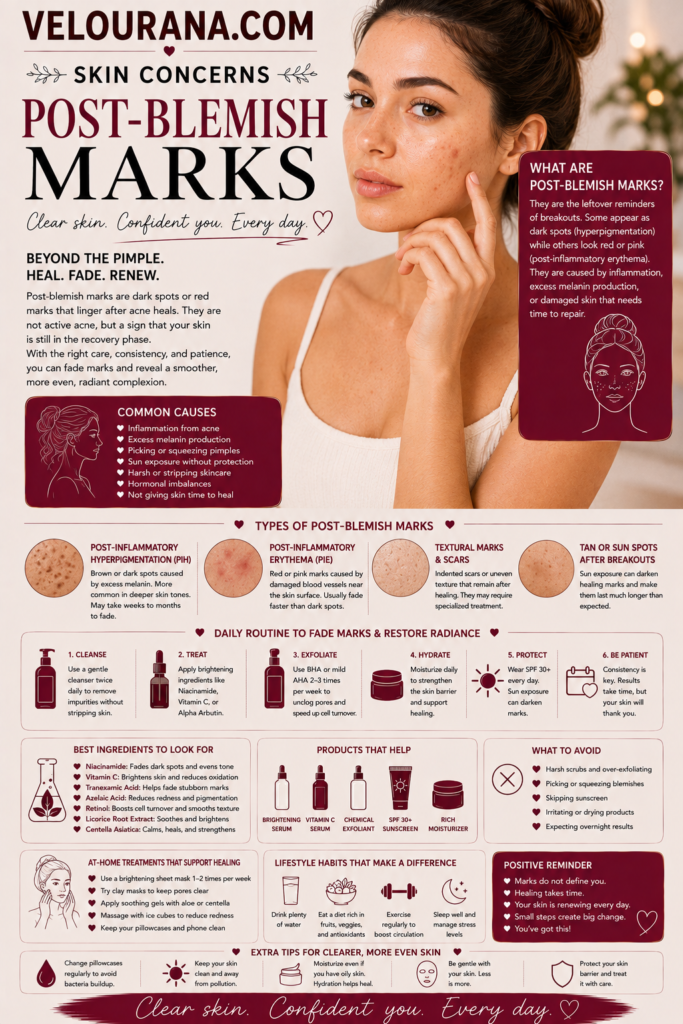
CATEGORY: Post-Blemish Marks
Post-blemish marks can create the impression that acne never truly leaves. One spot begins to fade, another appears beside it, and before the first has disappeared completely a third joins the pattern. The face can look continuously marked even during periods when the number of active blemishes has noticeably decreased.
This is one of the most important reasons post-acne discoloration can feel resistant to treatment. The problem is not always that individual marks refuse to fade. Often, the skin is successfully clearing old traces while simultaneously creating new ones.
The distinction matters.
If a complexion develops five new post-blemish marks during the same period in which five older marks become significantly lighter, the total visual burden may barely change. A person looking in the mirror sees roughly the same number of coloured spots and concludes that their fading routine has failed.
Biologically, however, progress may be taking place underneath that apparent standstill.
The strategic challenge is therefore larger than fading existing discoloration. The skin must also be protected from the inflammatory events that create the next generation of marks.
Once that idea becomes central, post-blemish care changes from a spot-by-spot battle into a broader system of prevention, recovery, and controlled treatment.
The Real Problem Is Often Accumulation
A single post-blemish mark is usually manageable.
Even a relatively dark area becomes less intimidating when it exists in isolation and there are no new blemishes forming around it. Time works in its favour. Pigmentation gradually softens, vascular redness settles, and the complexion slowly returns toward baseline.
Accumulation is what changes the experience.
Imagine a person who develops only two inflammatory blemishes each week. That does not sound like severe acne. Yet over three months, those two weekly blemishes can create more than twenty visible post-inflammatory marks if each lesion leaves a trace.
If those marks require several months to fade, the complexion can appear covered in discoloration even though active acne at any given moment is relatively modest.
This illustrates why acne severity and post-acne visual severity do not always match.
Someone may have only three active lesions but forty lingering marks.
Another person may experience ten active blemishes but almost no lasting discoloration.
The visible aftermath depends not only on how often acne occurs but also on how the skin responds after each inflammatory event.
For pigment-prone skin, accumulation becomes the central problem.
Every new blemish enters a queue of unresolved colour.
Prevention Changes the Mathematics of Fading
The simplest way to understand post-blemish recovery is to imagine two competing processes.
One process produces new marks.
The other fades existing ones.
As long as the rate of new mark formation equals or exceeds the rate of fading, the complexion may appear unchanged.
Once new mark formation slows substantially, everything changes.
The existing marks finally have time to disappear without being replaced at the same pace.
This is why better acne control can sometimes create a more dramatic improvement in pigmentation than adding another brightening serum.
It changes the mathematics.
A person who moves from ten inflammatory blemishes per month to two may not immediately see clearer skin because old marks are still present. But three or four months later, the difference can become striking because the pigment backlog has begun to shrink.
This delayed reward is one of the reasons acne treatment requires persistence.
The reduction in new lesions often happens before the reduction in visible discoloration.
The skin first stops accumulating damage.
Then it begins revealing the benefit.
Every Blemish Is a Potential Mark in the Making
A useful post-blemish mindset begins the moment a blemish appears.
Instead of treating the active spot as an isolated inconvenience, it helps to recognise that the way the lesion is handled may influence what remains afterward.
Inflammation is already present.
The objective is to prevent unnecessary escalation.
This means avoiding repeated squeezing, picking, scratching, abrasive cleansing, and constant application of multiple drying treatments.
Many people respond to a developing pimple with urgency. They apply salicylic acid, then benzoyl peroxide, then a drying lotion, then a clay mask, then another spot treatment before bed.
By morning the lesion may be smaller, but the surrounding skin is sometimes red, dehydrated, and irritated.
The question then becomes whether the blemish was treated or merely attacked.
Effective acne care does not require indifference. It requires proportion.
A targeted treatment used correctly may help.
Five overlapping interventions can produce inflammation beyond what the original lesion created.
When the skin is prone to post-inflammatory pigmentation, that difference matters.
Picking Is Not a Small Habit
Few behaviours contribute more directly to the post-blemish cycle than picking.
The urge is understandable.
A raised lesion feels unfinished. A visible whitehead appears removable. A clogged pore seems like a problem that can be physically extracted.
But squeezing changes the mechanical environment of the follicle.
Pressure can rupture its walls beneath the surface and force inflammatory contents into surrounding tissue. Fingernails can damage the epidermis. Repeated attempts may create bleeding, crusting, and a larger wound.
What began as one inflammatory process becomes several.
The skin then has to resolve acne inflammation, mechanical trauma, surface injury, and sometimes secondary irritation from the products applied afterward.
This often extends the recovery period.
The original blemish may have remained visible for four days.
The mark produced after aggressive manipulation can remain for four months.
That is a poor exchange.
For people who pick automatically, physical strategies can sometimes be more useful than relying on willpower alone. Hydrocolloid patches can act as a barrier between fingers and skin. Keeping nails short reduces the damage caused by unconscious touching. Removing magnifying mirrors can reduce the temptation to search for imperfections invisible at normal distance.
The objective is not perfection.
It is reducing unnecessary injury.
The Mirror Can Become Part of the Cycle
Post-blemish marks often encourage close inspection.
The person wants to know whether the mark is lighter, whether another blemish is forming, whether a pore looks clogged, whether a small bump needs attention.
The closer they look, the more abnormalities they find.
Magnifying mirrors are particularly deceptive because they present the skin at a scale nobody else sees during ordinary interaction.
Normal pores become craters.
Tiny sebaceous filaments look like blackheads.
Barely visible colour differences become major discoloration.
This magnification can trigger more intervention.
A person starts squeezing pores that were functioning normally, exfoliating areas that were not actually congested, and applying spot treatments to harmless texture.
The result can be additional irritation and therefore additional marks.
Post-blemish prevention sometimes requires changing not only the skincare routine but also the way the skin is observed.
A face is meant to be seen at conversational distance.
It does not need to survive forensic examination under ten-times magnification.
Acne Control Should Be the Foundation, Not an Afterthought
It is tempting to build a routine around the marks because they often cover more surface area than the active acne.
But treating discoloration while neglecting ongoing breakouts creates a permanently unfinished project.
The first priority should be reducing the frequency and intensity of new inflammatory lesions.
This does not mean everyone needs the same acne treatment.
Comedonal acne dominated by clogged pores may respond to a different strategy from inflammatory papules, pustules, hormonal breakouts, nodules, or cystic acne.
Salicylic acid can be useful for congestion because of its ability to penetrate oily follicular environments.
Retinoids can help normalise follicular cell turnover and reduce comedone formation.
Benzoyl peroxide can be useful for inflammatory acne.
Azelaic acid can support acne control while also addressing inflammation and post-inflammatory pigmentation.
Prescription treatments may be appropriate when acne is persistent, extensive, painful, or scarring.
The ideal regimen depends on the individual.
What remains universal is the principle that stopping new acne is part of treating old acne marks.
The Best Brightening Routine Cannot Outperform Continuous Inflammation
A person may invest heavily in pigmentation treatments and still see limited progress if acne remains active.
This can be difficult to accept because brightening products often receive more immediate cosmetic attention than acne prevention.
A serum promising luminous skin feels directly connected to discoloration.
A retinoid preventing next month's clogged pores feels less relevant to today's dark marks.
Yet the preventive treatment may have the greater long-term impact.
Suppose a brightening serum reduces the intensity of existing pigmentation by twenty percent over several months.
That improvement can be visually overwhelmed if twenty new marks form during the same period.
Now imagine the same serum used while acne frequency drops by eighty percent.
The complexion suddenly has room to improve.
This is why an intelligent post-blemish routine looks forward as much as backward.
It fades the past while reducing the production of future marks.
Inflammation Is the Common Thread
Whether a mark becomes red, brown, purple, or greyish, inflammation often sits near the beginning of the story.
The original blemish triggers inflammatory signalling.
Picking adds inflammation.
Harsh skincare adds inflammation.
Over-exfoliation adds inflammation.
Sunburn adds inflammation.
Even inappropriate cosmetic procedures can add inflammation.
For pigment-prone skin, repeated inflammation can continually stimulate melanocytes.
For redness-prone skin, repeated irritation can prolong vascular visibility.
This makes inflammation control a unifying principle across post-blemish care.
It does not mean inflammation can be eliminated completely. Acne itself is inflammatory.
The goal is to stop adding avoidable inflammatory stress.
A calm routine is not passive.
It is strategic.
The Barrier Determines Whether Prevention Is Sustainable
A routine designed to prevent future marks must be sustainable enough to continue for months.
That makes barrier health essential.
The skin barrier helps regulate water loss and protects the living layers beneath from external irritants.
When it is damaged, the skin may become tight, flaky, reactive, or unusually sensitive. Products that previously felt comfortable may begin to sting.
At that point, effective acne treatment becomes harder to maintain.
People often respond by stopping all treatment for a week, waiting for the skin to recover, then restarting everything at full intensity.
The result can be a repeating cycle of over-treatment and retreat.
A better approach is to build a regimen that stays below the threshold of chronic irritation.
That may involve using a retinoid fewer nights per week.
It may mean alternating exfoliating treatments instead of layering them.
It may require a more supportive moisturizer.
It may mean replacing a harsh foaming cleanser with something gentler.
The exact adjustments vary, but the objective is the same: treatment should be tolerable enough to remain consistent.
Moisturizer Can Prevent More Than Dryness
In acne-prone routines, moisturizer is sometimes treated as optional because the skin may already feel oily.
Oil production and hydration, however, are not the same thing.
A person can have oily skin and still experience barrier disruption or dehydration.
When active treatments increase dryness, the resulting discomfort can provoke several unhelpful responses. Some people stop effective medications prematurely. Others compensate with heavy occlusive products unsuitable for their skin. Still others continue pushing through irritation until inflammation becomes obvious.
A suitable moisturizer helps stabilise the routine.
It does not need to be heavy.
Gel creams, emulsions, light lotions, and more traditional creams all have different roles depending on the complexion and environment.
The important point is that moisture support allows treatment to continue without unnecessary barrier damage.
A stable barrier makes preventive acne care easier.
And easier preventive care means fewer future marks.
Sunscreen Prevents the Past From Becoming More Visible
Once a mark forms, sun exposure can increase the contrast between the affected area and the surrounding skin.
Ultraviolet radiation stimulates pigment production as part of the skin's natural protective response.
If a post-inflammatory mark already contains excess melanin, additional UV stimulation can prolong or deepen its visibility.
This is why sunscreen belongs in a preventive strategy even though it does not prevent acne directly.
It prevents existing marks from receiving another pigmentation stimulus.
It also protects newly healing skin.
The most effective sunscreen is one that fits comfortably into daily life.
Acne-prone skin may prefer lighter formulas.
Deep skin tones may prioritise products without visible white cast.
People who wear makeup may need a texture that layers well underneath it.
The perfect sunscreen on paper is useless if it remains in the bottle.
Consistency matters more than theoretical perfection.
The Morning Routine Should Protect More Than It Treats
Post-blemish routines are often overloaded in the morning.
Vitamin C, exfoliating toner, brightening serum, acne treatment, another serum, moisturizer, sunscreen, and makeup may all be layered before breakfast.
For some skin, that complexity is unnecessary.
Morning care often works best when it prepares the skin for environmental exposure.
A gentle cleanse or simple rinse may be enough depending on skin type.
A compatible antioxidant or pigmentation-supporting ingredient can be included if tolerated.
Moisturizer supports comfort and barrier function.
Sunscreen provides essential photoprotection.
The routine does not need to perform every possible treatment function before leaving the house.
A calmer morning can reduce pilling, irritation, and product interactions.
The skin then begins the day protected rather than overwhelmed.
Evening Is Where Long-Term Prevention Often Happens
Nighttime routines provide an opportunity to use active treatments without the complication of makeup or direct daytime exposure.
This is where ingredients such as retinoids, azelaic acid, salicylic acid, or other targeted treatments may fit depending on the skin's needs.
The mistake is assuming that all of them must be used together.
A retinoid may already be doing substantial work in preventing clogged pores and supporting turnover.
Adding strong exfoliation every night may contribute relatively little while greatly increasing irritation.
A carefully chosen active used consistently can outperform an elaborate rotation of products that the skin barely tolerates.
The objective is to create a routine that remains almost boringly dependable.
Boring skincare is often excellent skincare.
New Marks Can Sometimes Be Prevented by Treating Blemishes Early
There is value in addressing inflammatory acne before lesions become large and prolonged.
Early treatment can reduce the duration of inflammation in some cases.
A developing inflammatory lesion may respond to a correctly used acne treatment before it evolves into a more substantial blemish.
This does not justify constant touching or aggressive spot treatment.
It means recognising early acne and using established treatments consistently rather than waiting until every lesion becomes severe.
Preventive medications are even more valuable because they reduce the formation of lesions before they become visibly inflamed.
This is the difference between treating acne as an emergency and managing it as a pattern.
Emergency treatment focuses on individual pimples.
Pattern management reduces how often those pimples appear in the first place.
The second approach is far more powerful for post-blemish prevention.
Hormonal Patterns Require a Different Kind of Prevention
Some acne follows a predictable hormonal rhythm.
Lesions may appear around the jawline, chin, lower cheeks, or other areas in recurring cycles.
When this happens month after month, fading products are forced to fight against a continuous source of new inflammation.
Recognising the pattern matters because topical spot treatment may never fully control the underlying tendency.
Professional evaluation can be appropriate when hormonal acne is persistent, painful, cystic, or clearly cyclical.
Depending on the individual, medical treatment may include topical prescriptions, hormonal therapies, or systemic medications.
Reducing the driver of recurrent acne can dramatically change the post-blemish landscape.
The face stops receiving a predictable monthly wave of new marks.
Once again, prevention becomes the most efficient form of fading.
Diet, Stress, and Lifestyle Should Be Considered Without Blame
Acne is influenced by multiple biological factors.
Lifestyle can play a role for some individuals, but the relationship is complex and highly variable.
Stress may worsen acne in some people through hormonal and inflammatory pathways.
Sleep disruption can influence stress regulation and skin behaviour.
Certain dietary patterns may affect acne susceptibility in some individuals.
None of this means every breakout can be blamed on poor choices.
Post-blemish care becomes unhelpful when it turns into a search for personal failure.
The useful approach is observational.
If a person consistently notices that a particular pattern of eating, stress, or disrupted sleep coincides with worsening acne, it may be worth addressing.
The goal is not restriction for its own sake.
It is reducing identifiable triggers when they genuinely appear to matter.
Haircare Can Quietly Contribute to Facial Breakouts
Not every source of acne sits inside the skincare routine.
Hair oils, styling products, conditioners, pomades, and leave-in treatments can transfer onto the forehead, temples, cheeks, and jawline.
For people prone to congestion in these areas, this contact may contribute to breakouts.
The resulting post-blemish marks can then appear mysterious because the face products themselves seem well chosen.
Paying attention to where acne develops can reveal clues.
Breakouts concentrated along the hairline may suggest a different pattern from lesions occurring mainly around the chin.
Changing how hair products are applied, keeping residue away from facial skin, and washing pillowcases regularly can sometimes reduce this source of irritation or congestion.
Preventive skincare extends beyond the bottles labelled for the face.
Makeup Does Not Automatically Cause Acne
People with post-blemish marks are sometimes advised to abandon makeup entirely.
That advice is unnecessarily absolute.
Many people use complexion products without worsening acne, particularly when formulations are compatible with their skin and makeup is removed properly.
The more important issues are product selection, hygiene, and removal.
Heavy or highly occlusive formulations may not suit every acne-prone complexion.
Dirty brushes and sponges can accumulate oil, product residue, and microorganisms.
Sleeping in makeup can increase congestion and irritation.
Repeatedly scrubbing the face to remove long-wear makeup can also create unnecessary inflammation.
The solution is not necessarily giving up makeup.
It is using it in a way that does not interfere with acne management.
For someone uncomfortable with post-blemish marks, makeup can actually reduce the urge to over-treat the skin because it provides immediate cosmetic control while biological fading continues.
Pillowcases, Phones, and Small Habits Matter Less Than the Big Picture
Acne advice often becomes obsessed with minor contamination theories.
People are told to disinfect everything they touch, replace pillowcases constantly, avoid resting a hand on the face, and clean mobile phones repeatedly.
Basic hygiene is sensible.
But post-blemish prevention should not become an anxiety-driven sanitation project.
The largest influences usually remain acne biology, inflammation, appropriate treatment, picking behaviour, and product compatibility.
A dirty makeup brush used repeatedly on inflamed skin is worth correcting.
A pillowcase does not need to become the centre of an elaborate acne ritual.
Good routines prioritise the factors most likely to matter.
They do not turn everyday life into a list of possible threats.
Friction Can Create a Hidden Inflammatory Burden
Repeated friction can aggravate acne and irritate healing skin.
Masks, helmet straps, tight headwear, collars, sports equipment, and repeated rubbing can all contribute in susceptible areas.
The combination of heat, sweat, pressure, and friction can increase follicular irritation.
This becomes relevant to post-blemish marks when the same area is repeatedly inflamed.
A lesion begins to heal, then experiences mechanical irritation again.
The mark persists.
Another lesion forms nearby.
The cycle continues.
Reducing unnecessary friction does not cure all acne, but it removes another preventable source of inflammation.
Once again, the strategy is cumulative.
No single preventive adjustment needs to be dramatic if several together reduce the overall inflammatory burden.
The Fading Routine Should Not Compete With the Acne Routine
A common mistake is building two separate routines.
One treats acne.
The other treats marks.
The combined result can become excessive.
For example, someone may use salicylic acid and benzoyl peroxide for acne, then add glycolic acid, vitamin C, retinol, and a strong brightening serum for pigmentation.
Each product may have a reasonable justification in isolation.
Together, they may create irritation.
A better strategy is to look for overlap.
Azelaic acid can address both acne and pigmentation.
Retinoids can help prevent comedones while supporting turnover.
Niacinamide may support barrier function while contributing modestly to pigmentation management.
Sunscreen protects against pigment persistence while also supporting overall skin health.
One product can sometimes perform more than one role.
Efficiency is not only convenient.
It reduces the risk of inflammatory overload.
Give Every Product a Job
A coherent routine should allow each product to answer a simple question.
Why is this here?
The cleanser removes oil, sunscreen, makeup, and debris without excessive stripping.
The moisturizer supports the barrier.
The sunscreen protects against UV exposure.
The acne active reduces the formation or severity of new lesions.
The pigmentation active supports gradual fading.
If another product is added, it should contribute something not already being achieved sufficiently.
This approach prevents the collection of redundant serums.
It also makes troubleshooting easier.
When irritation develops, the routine can be analysed logically rather than treated as an inseparable pile of products.
Skincare becomes a system instead of a shelf.
One New Product at a Time Protects the Routine From Confusion
Introducing multiple treatments simultaneously makes it difficult to identify both success and failure.
If the skin breaks out after beginning three new products, the cause is unclear.
If pigmentation improves, it is equally unclear which product deserves credit.
Gradual introduction creates information.
It allows the skin's tolerance to be observed.
It reveals whether dryness is temporary or progressive.
It shows whether breakouts coincide with a specific formulation.
It makes the routine adjustable rather than mysterious.
This slow approach may feel inefficient at first.
In reality, it can save months of confusion.
Professional Treatment Can Break Cycles Home Care Cannot
Some acne patterns are too persistent or severe for cosmetic skincare alone.
Deep nodules, cystic lesions, extensive inflammatory acne, rapid scarring, and acne that fails to respond to appropriate over-the-counter treatment deserve dermatological assessment.
This is especially important when every lesion leaves substantial pigmentation.
Continuing to experiment indefinitely while the skin accumulates scars and marks can be more costly than seeking professional treatment earlier.
Prescription therapies can target acne through mechanisms unavailable in ordinary cosmetic products.
The specific option depends on the type of acne, medical history, age, sex, pregnancy considerations, previous treatment, and other individual factors.
Professional treatment is not an admission that skincare failed.
It is recognition that acne is a medical condition and sometimes requires medical management.
Once New Acne Slows, the Complexion Can Change Surprisingly Fast
There is often a turning point in successful post-blemish care.
It does not happen when the darkest mark disappears.
It happens when new marks stop arriving continuously.
At first, the face may still look heavily discoloured.
Then the oldest spots begin fading.
No equally dark replacements appear.
The next layer of marks lightens.
The overall complexion becomes quieter.
The change can feel sudden even though it has been building for months.
This is the reward of prevention.
Fading finally becomes visible because it is no longer being cancelled by constant new inflammation.
The Goal Is Not a Perfectly Controlled Face
Post-blemish prevention should not become another form of perfectionism.
Even an excellent acne routine may not eliminate every blemish.
Hormones change.
Stress occurs.
Weather shifts.
Products behave differently across seasons.
An occasional breakout does not mean the strategy has failed.
Success is often a reduction in frequency, severity, and aftermath.
Perhaps a person once developed fifteen inflammatory lesions per month and now develops three.
Perhaps every blemish once left a dark mark and now only the more inflammatory lesions do.
Perhaps marks once remained vivid for six months and now fade noticeably sooner.
These are substantial improvements even if the skin is not perfectly clear.
Dermatological progress rarely needs to be absolute to be transformative.
Old Marks Fade Best When the Skin Stops Producing New Ones
The most effective post-blemish strategy is not built around a single brightening ingredient.
It is built around reducing repetition.
Fewer inflammatory lesions.
Less picking.
Less unnecessary irritation.
Better barrier stability.
Consistent photoprotection.
Thoughtful use of active ingredients.
Earlier professional treatment when acne is persistent or scarring.
These changes alter the environment in which discoloration develops.
Existing marks are then allowed to do what many of them are biologically capable of doing: fade.
The process may still be slow.
Some marks remain longer than others.
Some skin types pigment more readily.
Some acne patterns require medical treatment before meaningful prevention becomes possible.
But once the rate of new mark formation falls below the rate of fading, the complexion moves in a different direction.
The backlog begins to clear.
That is the central idea worth remembering.
Post-blemish marks are not only something to treat after acne.
They are something to prevent during acne.
The most effective fading routine therefore begins before the mark has fully formed.
It begins with protecting the blemish from unnecessary trauma, controlling the inflammation that created it, and reducing the chance that another lesion will appear beside it next week.
Old marks need time.
The greatest gift a skincare routine can give them is fewer new ones to compete with.
The End Velourana
 Discover More From Our Family of Websites
 ZodiacBearing (Astrology, Tarot, Numerology, Angel Numbers & Spiritual Guidance)
 Velourana (Beauty, Makeup, Hair Care, Skincare & Beauty Tips)
 HavenBearing (Home, Living, Organization, Décor & Everyday Inspiration)
 PawBearing (Pet Care, Dog Breeds, Animal Health, Training & Pet Products)
 PsyCatherine (Notes From the Journal of a Psychologist on Real Life)