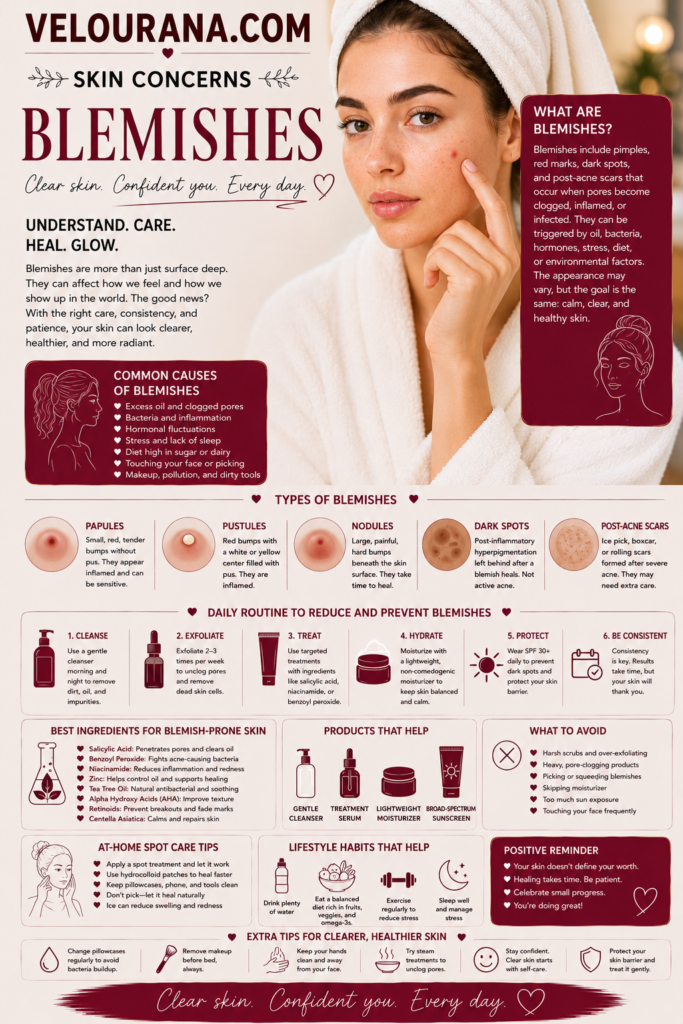
CATEGORY: Blemishes
A blemish does not always end when the pimple disappears.
For many people, the most frustrating stage begins afterward.
The swelling settles. The tenderness fades. The surface becomes flat again. Yet the skin still carries evidence of what happened. A red mark remains where inflammation once existed. A brown or greyish patch develops as the area heals. Sometimes the colour fades within weeks. Sometimes it lingers for months. In other cases, the skin changes not only in colour but also in texture, leaving a depression or raised area that behaves very differently from ordinary post-inflammatory marks.
This is where the word blemish becomes especially misleading.
A person may look at the face and see ten visible imperfections, but only two may represent active acne. The rest may be traces left behind by previous breakouts. If all ten are treated as though they are still pimples, the routine becomes confused immediately.
The skin is no longer dealing with one problem.
It is dealing with a history.
Understanding what happens after a blemish heals is therefore essential to building a sensible skincare strategy. The goal is not merely to make active acne disappear. It is to reduce the damage and inflammation surrounding each lesion, support recovery afterward and distinguish temporary colour changes from genuine structural scarring.
Once these stages are separated, post-blemish care becomes far more precise.
The End of the Pimple Is Not the End of the Process
An inflammatory blemish is an event.
It begins within the follicle, progresses through congestion and inflammation, then eventually resolves.
But the tissue surrounding that follicle has participated in the event.
Blood vessels have responded.
Inflammatory mediators have been active.
Pigment-producing cells may have been stimulated.
The skin barrier may have been disrupted through the lesion itself or through squeezing, picking or aggressive treatment.
When the visible bump disappears, these secondary effects do not necessarily vanish at the same speed.
This is why someone can have relatively little active acne yet still feel as though their complexion remains heavily blemished.
The face is displaying several generations of previous breakouts at once.
A recent lesion leaves fresh redness.
An older one has become brown.
Another is fading slowly.
One may have been repeatedly squeezed and left a deeper mark.
Together, they create the visual impression of continuous acne even when the number of new lesions is falling.
This distinction can be unexpectedly encouraging.
The skin may already be improving more than it appears to be.
Red Marks and Dark Marks Represent Different Aftermaths
One of the most useful distinctions in post-blemish care is the difference between persistent redness and persistent pigmentation.
A flat red or pink mark after acne is often associated with vascular and inflammatory changes left behind after the lesion resolves.
A brown, grey or darker mark may reflect post-inflammatory hyperpigmentation, in which inflammation stimulates excess pigment production.
The two can look similar from a distance, especially under makeup or artificial lighting, but they are not identical processes.
This matters because they do not necessarily respond to exactly the same interventions.
A treatment aimed at reducing excess pigment will not always address persistent redness effectively.
Similarly, a product marketed broadly as an "acne scar treatment" may be attempting to address colour, texture or both without making the distinction clear.
Precise language helps prevent unrealistic expectations.
The skin is easier to treat when the problem has first been named correctly.
Why Some Skin Develops Dark Marks More Easily Than Others
Post-inflammatory hyperpigmentation does not affect every person equally.
Skin tone and individual pigment response play a major role.
People with medium to deeper skin tones may be particularly prone to visible post-inflammatory pigmentation after acne or other forms of skin inflammation.
This does not mean lighter skin cannot develop pigmentary marks.
It means the pattern and persistence can differ substantially between individuals.
The severity of inflammation matters as well.
A small, relatively calm blemish may leave little evidence behind.
A deeply inflamed lesion may provoke a much stronger pigment response.
Mechanical trauma can intensify that response further.
Squeezing, scratching and repeatedly disturbing the same area can extend inflammation and create additional injury.
This is why one pimple may leave almost no mark while another remains visible long after it has healed.
The difference may not simply be the pimple itself.
It may also reflect what happened to the skin around it.
Picking Often Extends the Life of a Blemish
A blemish can exist for a few days.
The mark caused by picking it may last far longer.
This is one of the least satisfying truths in acne care because squeezing often creates immediate visual improvement.
The lesion becomes flatter.
The pressure is relieved.
The surface looks different within minutes.
The future cost is invisible at that moment.
Mechanical pressure can increase inflammation and tissue injury.
Broken skin may develop a scab.
The healing process becomes larger than the original lesion.
Pigment production may be stimulated more strongly.
What would have been a small temporary pimple can become a persistent dark mark.
The short-term success therefore conceals the long-term trade.
This is why avoiding picking is not merely advice about scarring.
It is also part of pigmentation prevention.
Post-Inflammatory Hyperpigmentation Is Not the Same as a Scar
The phrase "acne scar" is used very loosely.
Someone with flat brown marks may say they are covered in scars.
Someone else may have true depressions in the skin after deeper acne.
These are not the same thing.
Post-inflammatory hyperpigmentation is a change in colour.
The skin surface itself may remain smooth.
A true acne scar involves structural change.
Depressed scars reflect loss or alteration of tissue.
Raised scars involve a different healing response.
This distinction matters because topical skincare has very different limitations depending on the problem.
Pigmentation can often improve gradually with appropriate topical care and sun protection.
Deep textural scars usually require professional procedures for meaningful improvement.
No serum should be expected to rebuild a deep depression simply because it contains a brightening ingredient.
Understanding this prevents months of frustration.
Redness Can Persist Even When Pigment Is Not the Main Problem
Some people experience post-blemish marks that remain red or pink rather than brown.
This is particularly noticeable in lighter skin tones, although vascular changes can affect many complexions.
The redness may make the area look as though the acne is still active.
But if the lesion is flat, non-tender and no longer inflamed in the usual sense, the active pimple may already be gone.
This distinction changes treatment.
Repeatedly applying harsh spot treatments to a flat red mark can irritate the area without making it heal faster.
In some cases, irritation prolongs the visible redness.
The skin needs time.
A calmer routine may support recovery better than constant intervention.
Why Sun Exposure Can Make Marks More Persistent
Post-blemish pigmentation is influenced by light exposure.
Ultraviolet radiation can stimulate pigment production and make dark marks more noticeable or persistent.
This gives sunscreen a particularly important role in post-acne care.
A routine may contain several brightening ingredients and still struggle to produce even-toned skin if daily sun protection is inconsistent.
This is one reason sunscreen should not be viewed as unrelated to blemishes simply because it does not flatten pimples.
It protects the skin during the stage in which old blemishes are fading.
For people with post-inflammatory hyperpigmentation, this can be one of the most important supporting steps in the entire routine.
The texture of the sunscreen matters because consistent use depends on comfort.
Oily or acne-prone skin may prefer lighter formulations.
Drier skin may benefit from more moisturizing textures.
The best sunscreen is the one that provides effective protection and is used reliably.
Brightening Ingredients Should Be Chosen for the Mark, Not the Marketing
Once active acne is under better control, many people begin searching for products to fade residual marks.
This is where ingredient marketing becomes intense.
Vitamin C, niacinamide, azelaic acid, alpha hydroxy acids, retinoids, tranexamic acid and other ingredients may all appear in products targeting uneven tone.
Some can be useful.
The challenge is not finding an ingredient with evidence behind it.
The challenge is choosing a routine the skin can tolerate.
Several brightening products layered together may create irritation.
Irritation can itself worsen pigmentation in susceptible skin.
The routine then begins working against its own goal.
This is why gradual improvement often requires fewer products rather than more.
A well-chosen treatment used consistently may outperform a complicated collection that repeatedly disrupts the skin barrier.
Azelaic Acid Occupies an Interesting Middle Ground
Azelaic acid is particularly relevant to blemish-prone skin because it has roles in both acne and pigmentation management.
It can help address inflammatory and comedonal acne while also contributing to improvement in post-inflammatory hyperpigmentation.
This makes it useful for people dealing with both active breakouts and the marks they leave behind.
But even a versatile ingredient should not be treated as a miracle.
Formulation, concentration, frequency and individual tolerance matter.
Some people experience tingling or irritation initially.
The supporting routine still needs to be gentle enough for consistent use.
The value of azelaic acid lies partly in its ability to address more than one stage of the blemish cycle without requiring a completely separate product strategy for each concern.
Retinoids Can Support Both Prevention and Recovery
Retinoids are often discussed primarily as acne treatments.
Their value extends beyond preventing new comedones.
By influencing cell turnover and broader skin renewal, retinoids can also contribute to improvement in uneven tone over time.
This makes them particularly useful in routines addressing both ongoing acne and residual marks.
The important phrase is over time.
Retinoids do not erase pigmentation overnight.
They also require careful introduction because irritation can undermine progress.
If the skin becomes chronically inflamed from excessive retinoid use, the routine may create exactly the kind of irritation that post-blemish skin does not need.
Pregnancy and plans for pregnancy require particular caution because certain retinoids should not be used.
Professional guidance is valuable when stronger treatment is being considered.
Exfoliation Can Help, but More Is Not Always Better
Alpha hydroxy acids such as glycolic acid are commonly used to improve surface texture and uneven tone.
They can support gradual fading of post-inflammatory pigmentation.
But the same rule that applies to active blemish treatment applies here as well: exfoliation has a ceiling.
More frequent use does not guarantee faster improvement.
The skin can become irritated.
Pigmentation may appear more noticeable if inflammation increases.
This is especially relevant for people who are already using salicylic acid, retinoids or other active treatments.
The total routine matters more than the reputation of any individual ingredient.
A product that is excellent in isolation can become excessive when layered into an already aggressive routine.
Vitamin C Can Support Tone Without Being an Acne Treatment
Vitamin C is frequently included in routines for uneven pigmentation because of its antioxidant properties and role in supporting brighter, more even-looking skin.
For someone with post-blemish marks, it may be useful as part of a broader routine.
But it should not be confused with direct acne therapy.
If new inflammatory lesions continue appearing regularly, focusing entirely on vitamin C while neglecting acne control addresses the aftermath without addressing the source.
This is a recurring problem in blemish care.
People become so frustrated by marks that they devote the entire routine to fading them while fresh acne continues producing new marks.
The better strategy treats both timelines.
Prevent tomorrow's blemish.
Fade yesterday's mark.
Niacinamide Is Valuable Because It Supports More Than One Function
Niacinamide is widely used in blemish-focused skincare because it can support barrier function, help regulate the appearance of oiliness and contribute to improvement in uneven tone.
Its versatility makes it attractive for routines that need to remain relatively simple.
But versatility should not be confused with necessity.
Someone already using an effective, comfortable routine does not automatically need niacinamide simply because the ingredient is popular.
The same principle applies to every active.
A useful ingredient should solve a real problem.
A routine should not become a collection of famous names.
Hydration Affects How Marks Look Even When It Does Not Remove Them
Dehydrated or irritated skin can make post-blemish marks look more obvious.
Roughness changes the way light reflects from the surface.
Flaking can create contrast around pigmented areas.
Redness becomes more noticeable when the barrier is compromised.
This means hydration and moisturization can improve the overall appearance of post-blemish skin even when they are not directly fading pigment.
A smoother, calmer surface makes colour variation appear less dramatic.
This is another example of why supporting products deserve more credit.
Not every product needs to attack the blemish.
Some products make the skin healthier while the blemish fades.
Why Concealer Can Be Part of Recovery Rather Than Something to Avoid
People with post-acne marks often feel pressure to stop wearing makeup because the skin is "healing."
That is not always necessary.
Appropriate makeup can coexist with a sensible blemish routine.
Concealer can reduce the psychological burden of waiting for marks to fade.
The key is choosing formulations that suit the skin and removing them adequately at the end of the day.
Makeup does not stop pigmentation from fading simply because it covers it.
The recovery process continues beneath it.
For many people, the ability to conceal a mark makes it easier to resist squeezing, picking or over-treating the skin.
In that sense, makeup can support restraint.
The Timeframe for Fading Is Longer Than Most People Expect
One of the hardest parts of post-blemish care is accepting the timeline.
A pimple may resolve within days.
Pigmentation may take months.
This imbalance creates frustration.
Someone may use a brightening product for two weeks and conclude that nothing is happening.
But pigment metabolism is slow.
The skin needs time to redistribute and remove excess melanin.
This is why photography can sometimes be more useful than daily mirror inspection.
A picture taken once every few weeks under similar lighting can reveal gradual improvement that is almost impossible to notice day by day.
The eye adapts to the face it sees every morning.
Slow changes become invisible until they are compared over longer intervals.
New Blemishes Can Hide the Progress of Old Marks
Imagine a mark that takes three months to fade.
If a new pimple appears in the same region every two weeks, the area may never look completely clear even though each individual mark is improving.
This creates the illusion that pigmentation treatment is failing.
In reality, the routine may be fading old marks while new ones are continually being added.
This is why acne control remains the foundation of post-blemish recovery.
There is little efficiency in fading one mark while creating three more.
Prevention changes the arithmetic.
Fewer new lesions mean fewer new pigment events.
Over several months, the difference becomes visible.
Deep Acne Changes the Risk of Scarring
Not all blemishes heal in the same way.
Superficial inflammatory acne may resolve without permanent structural change.
Deeper lesions such as nodules can damage more tissue and increase the risk of scarring.
This is one reason painful, deep acne should not be managed indefinitely with cosmetic products alone.
The risk is not merely temporary redness.
It is permanent texture change.
Dermatological treatment can reduce that risk by controlling the inflammation earlier and more effectively.
Waiting until scars have already formed makes treatment more complicated.
Atrophic Scars Represent Loss of Support
Depressed acne scars develop when the healing process leaves insufficient collagen or structural support in the area.
They may appear as narrow deep pits, broader depressions or rolling irregularities.
Topical skincare can improve the overall quality of the skin but has limited ability to reverse significant structural depressions.
Professional procedures may include microneedling, laser treatments, subcision, chemical reconstruction techniques or other approaches depending on scar type.
The correct treatment depends on the architecture of the scar.
This is why professional assessment is important.
A treatment that works well for one scar pattern may be much less effective for another.
Raised Scars Require a Different Strategy
Some acne scars become raised rather than depressed.
These hypertrophic or keloid-type scars represent excess tissue formation during healing.
They require a completely different approach from atrophic scars.
Attempting to treat them with the same products used for pigmentation is unlikely to produce meaningful change.
Again, the word blemish hides more than it reveals.
Colour, texture and elevation need to be considered separately.
Professional Procedures Become More Relevant When Texture Has Changed
Once a blemish has altered the physical structure of the skin, topical products reach their limits.
This is where procedures can become more effective.
Microneedling may stimulate collagen remodeling.
Laser treatments can target texture and pigmentation.
Chemical peels can address certain forms of uneven tone and superficial scarring.
Subcision can release tethered scars.
Injectable treatments may be used in selected cases.
The correct approach depends on the scar type, skin tone, history of pigmentation and overall condition of the skin.
Professional expertise matters because aggressive procedures can themselves create pigmentation or complications when poorly chosen or improperly performed.
The goal is improvement, not simply intensity.
Why Treating Pigmentation Too Aggressively Can Backfire
Post-inflammatory hyperpigmentation is caused by inflammation.
This creates a paradox.
A person tries to fade the mark using strong active ingredients.
The treatment irritates the skin.
The irritation creates more inflammation.
The pigmentation becomes more persistent.
The routine has reproduced the mechanism it was trying to reverse.
This is why gentle consistency is so important in pigment-prone skin.
The skin does not need to be peeled aggressively to reveal a new layer.
It needs enough stimulation to support renewal without creating another inflammatory event.
The Emotional Weight of Marks Is Often Greater Than the Acne Itself
Residual blemish marks can affect confidence long after active acne has improved.
This is partly because they create a continuous visual reminder of previous breakouts.
Someone may know intellectually that the acne is better while still feeling as though the face looks unchanged.
Makeup can help.
Photography can help reveal progress.
But the emotional burden should not be dismissed.
If acne or its aftermath is causing significant distress, professional care is legitimate even when the condition would not be classified as severe.
Skin concerns do not need to reach a dramatic threshold before they deserve attention.
A More Intelligent Sequence for Post-Blemish Care
The order of priorities matters.
First, reduce new active acne.
Second, avoid unnecessary trauma.
Third, protect the skin from light exposure.
Fourth, introduce treatments that address residual colour.
Fifth, evaluate whether texture has changed and whether professional procedures are needed.
This sequence prevents the common mistake of trying to fade marks while new acne continues creating them.
It also reduces the temptation to attack every stage simultaneously with a large number of active products.
The skin does not need a different serum for every memory it carries.
It needs a coherent strategy.
The Mark Is Evidence of Healing, Not Permanent Failure
A residual blemish mark can feel like proof that the skin has been permanently damaged.
Often, it is temporary.
Post-inflammatory redness and pigmentation can fade gradually.
The timeframe varies between individuals and depends on the depth of inflammation, skin tone, sun exposure, picking and other factors.
Recognizing that the mark represents a healing process can change the emotional relationship with it.
It is not a pimple that refuses to disappear.
It is the aftermath of one.
When to Seek Professional Help
Professional assessment becomes valuable when pigmentation is persistent, scarring is developing, acne remains active despite appropriate treatment or the diagnosis is uncertain.
Deep or painful acne deserves earlier attention because preventing scars is easier than treating them later.
Sudden changes in pigmentation should also be evaluated rather than automatically attributed to acne.
Not every dark mark is post-inflammatory hyperpigmentation.
When something behaves differently from the usual pattern, professional diagnosis is more important than cosmetic experimentation.
Recovery Is a Separate Phase of Blemish Care
Blemish management is often treated as though it ends the moment active acne disappears.
But recovery deserves its own strategy.
The skin may need months to regain even tone.
The barrier may need repair after intensive treatment.
Pigmentation may fade gradually.
Redness may settle.
Scars may require procedures.
This is not failure.
It is the second half of the process.
Understanding that prevents people from over-treating skin that is already healing.
Clearer Skin Is Built by Preventing New Memories
Every inflammatory blemish has the potential to leave a memory.
Sometimes that memory is red.
Sometimes it is brown.
Sometimes it is textural.
The most efficient post-blemish strategy therefore begins before the mark exists.
Reduce the frequency of new acne.
Control inflammation.
Avoid picking.
Protect the skin from sun exposure.
Support the barrier.
Use targeted brightening treatments patiently.
Seek professional care when structural scarring becomes part of the picture.
The goal is not to erase every trace of the past overnight.
It is to stop continually creating new evidence of it.
Over time, that difference becomes visible.
Old marks fade without being replaced.
The complexion becomes more even.
The skin feels calmer.
The routine becomes less reactive.
A face that once seemed permanently covered in blemishes begins to reveal what was happening all along: much of the visible burden was not active acne but accumulated history.
Once new inflammation is controlled, that history finally has time to disappear.
And that is why post-blemish care requires a different kind of patience.
The pimple may be gone.
The skin is still finishing the story.
The End Velourana
 Discover More From Our Family of Websites
 ZodiacBearing (Astrology, Tarot, Numerology, Angel Numbers & Spiritual Guidance)
 Velourana (Beauty, Makeup, Hair Care, Skincare & Beauty Tips)
 HavenBearing (Home, Living, Organization, Décor & Everyday Inspiration)
 PawBearing (Pet Care, Dog Breeds, Animal Health, Training & Pet Products)
 PsyCatherine (Notes From the Journal of a Psychologist on Real Life)