
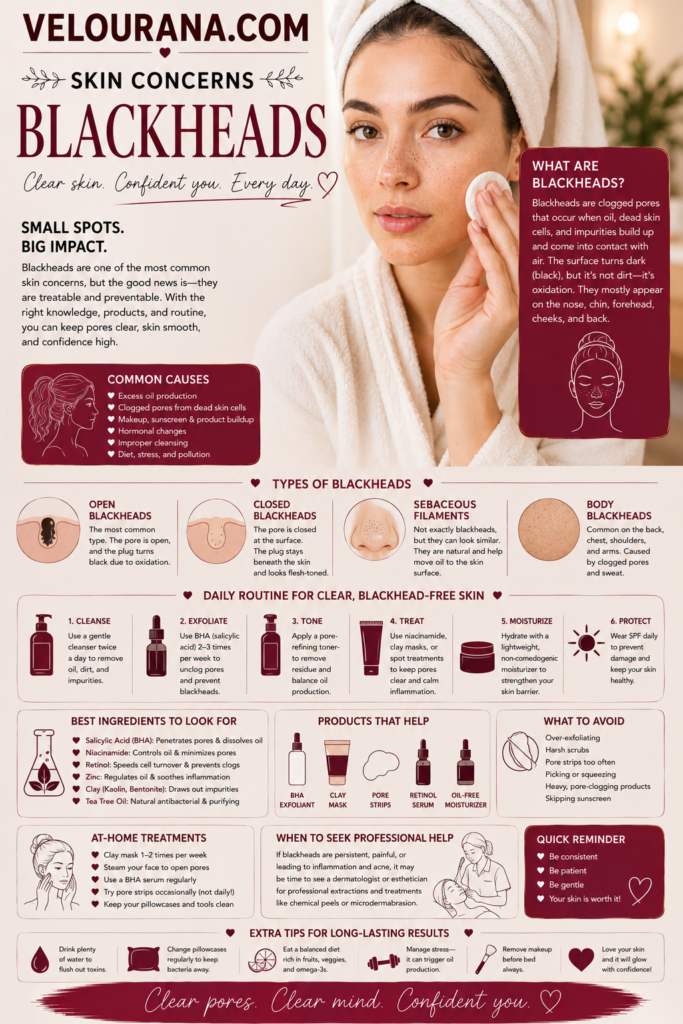
CATEGORY: Blackheads
Blackheads occupy an unusual place in skincare because they are visible enough to invite action but often mild enough to make professional treatment feel unnecessary. A dark plug appears on the nose, chin or forehead, and the instinct is immediate: remove it.
For many people, that removal becomes part of a familiar routine. A warm shower softens the skin. Fingers press around the pore. A metal extractor may be used. Pore strips, suction devices or masks are added. Sometimes the result is satisfying. The material emerges, the follicular opening appears clearer and the skin looks smoother.
The problem is that physical removal creates one of the strongest illusions in skincare: because something visible has been extracted, the underlying condition feels solved.
In reality, extraction is one of the most literal forms of symptom management. It removes an existing comedo. It does not necessarily change the tendency that allowed that comedo to form.
This does not make extraction useless. Nor does it mean every blackhead requires a dermatologist. The more important question is where extraction belongs within an intelligent skincare strategy and where it stops being helpful.
That distinction becomes especially important when home care begins to escalate. A person may start by squeezing a few blackheads occasionally, then begin inspecting the skin more closely. Tiny sebaceous filaments become targets. Closed bumps are pressed despite having no obvious opening. The same area is manipulated repeatedly because the pore does not look completely empty. Redness and marks begin lasting longer than the blackheads themselves.
At that point, the original concern has changed.
The problem is no longer simply congestion.
It is congestion combined with trauma.
Understanding the boundary between home skincare and professional care is therefore an essential part of blackhead management. Good skincare is not defined by doing everything personally. Sometimes the most sophisticated decision is knowing when the skin needs less intervention at home and more accurate assessment from someone trained to distinguish what should be treated, what should be left alone and what may not be a blackhead at all.
Why Extraction Feels More Effective Than Almost Anything Else
Skincare treatments usually require patience.
A cleanser performs its job without producing dramatic evidence. Salicylic acid may gradually reduce congestion over several weeks. A retinoid can require sustained use before the pattern of comedone formation noticeably changes.
Extraction is different.
Its effect can be immediate and visible.
Pressure is applied, material appears, and the pore looks clearer within seconds. This creates a powerful psychological reward because the treatment seems measurable in a way that gradual skincare rarely does.
The eye sees proof.
This immediacy can make extraction feel superior even when its long-term effect is limited.
Imagine someone using a comedonal treatment for six weeks. The number of new blackheads may already be decreasing, but the improvement is gradual enough that the person barely notices it from one day to the next.
Then they squeeze three visible blackheads from the nose.
The second event feels more successful because it provides instant confirmation, even though the first may be doing more to change the future pattern of congestion.
This is why blackhead care can become disproportionately focused on what can be removed today.
The underlying process is less visible.
Sebum continues to move through follicles. Keratinous material continues to be shed. Microcomedonal changes can develop before anything obvious appears at the surface. A preventive treatment works within that ongoing cycle.
Extraction operates after the cycle has already produced something visible.
Both approaches can have a place, but they are not equivalent.
One manages the existing lesion.
The other aims to reduce the conditions under which future lesions develop.
Once this difference becomes clear, extraction can be placed in a more appropriate role: occasional management rather than the central philosophy of skincare.
What Actually Happens When a Blackhead Is Squeezed
A blackhead is an open comedo containing accumulated sebum and keratinous material within a follicle.
When pressure is applied around the opening, that material may be forced outward.
If the comedo is superficial and pressure is controlled, the contents may release relatively easily. The opening can look cleaner and less dark immediately afterward.
But the surrounding skin is also being compressed.
This matters because living tissue is not a neutral surface.
Repeated or excessive pressure can irritate the follicle and the surrounding skin. Fingernails can create small abrasions. Aggressive manipulation can cause swelling, redness and inflammation. When a lesion does not release easily, people often increase force rather than accepting that it should be left alone.
That is where damage becomes more likely.
The desire to "get everything out" can be particularly harmful.
A pore does not need to look completely empty after extraction. Attempting to remove every trace of visible material encourages repeated squeezing of the same area. The skin becomes increasingly red while the improvement becomes increasingly marginal.
There is also a practical limit to what can be judged by sight.
A dark point may look as though it contains material that should be extracted, but it may actually be a normal sebaceous structure or a lesion that is not appropriate for home manipulation.
This uncertainty is one of the strongest arguments for restraint.
The human eye is excellent at seeing something it wants to remove.
It is less reliable at determining what that something actually is.
The Difference Between a Blackhead That Releases Easily and a Lesion That Should Be Left Alone
One of the dangers of home extraction is the assumption that every bump can be treated in the same way.
They cannot.
An obvious open comedo with a visible central plug is different from a small closed bump beneath intact skin. It is different from an inflamed papule. It is different from a painful deeper lesion. It is different from a sebaceous filament.
Trying to convert every one of these into something extractable can create more damage than improvement.
Closed comedones are particularly tempting because they can feel like small seeds beneath the skin. Without a natural opening, however, squeezing may simply compress and inflame the surrounding tissue.
Inflamed acne lesions deserve even greater caution.
When redness, tenderness or swelling is already present, mechanical pressure adds trauma to an area in which inflammation is already active.
The visual simplicity of the blackhead can therefore be misleading.
People often move from extracting genuine open comedones to manipulating every imperfection that appears nearby.
At that point, extraction is no longer targeted.
It becomes a general method of dealing with texture.
That is where the boundary between skincare and skin picking can begin to blur.
The safest response to resistance is often to stop.
If material does not release with minimal pressure, applying progressively greater force rarely represents precision. It represents escalation.
Sebaceous Filaments Are One of the Main Reasons Noses Become Over-Extracted
The nose deserves special attention because it is the area most frequently subjected to repeated extraction.
It also contains structures that are commonly mistaken for blackheads.
Sebaceous filaments are normal components of follicular anatomy that help guide sebum toward the skin surface. They are often especially visible across the nose and central face.
Because they can appear as tiny grey, yellowish or dark dots, they are easily interpreted as hundreds of small blackheads.
The confusion becomes stronger when squeezing produces visible material.
If something comes out, it feels logical to conclude that the pore was clogged.
But sebaceous filaments naturally contain sebum. Removing some of that material does not mean a pathological blockage has been cured.
The follicle continues functioning.
Within days, the filament may become visible again.
This creates a repetitive cycle in which the nose is extracted over and over because it never remains permanently empty.
The skin is behaving normally, while the person interprets normal function as repeated failure.
This misunderstanding can lead to one of the most aggressive patterns in blackhead care.
The nose is steamed. Pore strips are used. Fingers squeeze. Extraction tools follow. A suction device may be added. Exfoliating acids are applied afterward. By the end of the process, the nose is dramatically smoother—but also dramatically irritated.
Several days later, the dots return.
The entire procedure begins again.
Once sebaceous filaments are recognized as part of normal skin anatomy, this cycle becomes easier to interrupt.
True blackheads can still be treated.
But the objective no longer becomes an anatomically impossible poreless nose.
Why Metal Extraction Tools Are Not Automatically Safer
Comedone extractors can create an impression of professionalism.
They are made of metal, shaped specifically for pores and resemble instruments used in clinical or aesthetic settings. This can make them feel inherently safer than fingers.
The tool itself, however, does not provide the training required to use it appropriately.
Pressure can still be excessive.
The wrong lesion can still be targeted.
The instrument can still be dragged across the skin.
Repeated attempts can still damage the surrounding area.
Poor hygiene can add another problem if tools are not cleaned adequately.
The most important difference between a professional extraction and a home extraction is therefore not simply the object being used.
It is judgment.
A trained professional evaluates the lesion before attempting removal. They can distinguish open comedones from other structures, assess whether extraction is appropriate, use controlled technique and stop when further pressure would be counterproductive.
At home, the process is often guided by persistence.
If the plug does not emerge, pressure increases.
That difference matters.
An instrument can make excessive force easier to apply because the pressure is concentrated into a small area.
The existence of an extraction tool should therefore never be interpreted as permission to extract more aggressively.
Pore Strips Offer a Different Type of Extraction
Pore strips occupy a middle ground between skincare and mechanical removal.
They are applied to damp skin, allowed to adhere and then peeled away. The removed strip often displays small pieces of material, creating a dramatic visual confirmation that something has been extracted.
For temporary cosmetic refinement, this can be satisfying.
The nose may feel smoother. Surface oil and material associated with follicular openings may be removed. Some superficial blackheads may appear reduced.
The limitation is longevity.
A pore strip does not permanently alter sebaceous production or follicular keratinization.
It removes what it can physically adhere to at that moment.
The skin then continues functioning.
This is why frequent pore-strip use can become part of the same cycle as squeezing. The immediate result creates the expectation that maintaining clear pores requires repeated physical removal.
If used aggressively or on sensitive skin, adhesive removal may also provoke irritation.
The intelligent way to think about pore strips is therefore not as a cure but as an optional cosmetic treatment with temporary effects.
That description may sound less exciting than "deep pore cleansing," but it is more useful because it prevents the product from being assigned a job it cannot realistically perform.
Suction Devices Create Powerful Visual Drama but Require Caution
Pore-vacuum devices appeal to the same instinct as extraction tools: if something is inside the pore, perhaps it can simply be pulled out.
The suction can indeed lift surface oil and material from follicular openings, and the collecting chamber may make the process feel highly effective.
But suction is still mechanical force.
Too much pressure or prolonged use can irritate the skin, create bruising or damage superficial blood vessels in susceptible individuals.
The device also cannot distinguish a true blackhead from a sebaceous filament.
It acts wherever it is placed.
This is another example of how a technically impressive treatment can become less intelligent than a simple skincare routine.
The more powerful the device, the more important restraint becomes.
Skin should not have to display evidence of trauma in order for a pore treatment to feel worthwhile.
Why Redness After Extraction Is Not a Sign of Successful Deep Cleaning
The language surrounding blackhead removal sometimes frames temporary redness as evidence that the skin has been deeply cleansed.
This interpretation can normalize unnecessary injury.
Redness after squeezing is usually a sign that blood flow and inflammation have increased because the area has been mechanically stressed.
Mild temporary pinkness may occur after controlled manipulation, but pronounced redness, swelling, broken skin or prolonged tenderness are not desirable treatment endpoints.
The problem becomes more significant when strong active ingredients are immediately applied afterward.
Freshly manipulated skin may be more sensitive, yet people often follow extraction with acids, retinoids, alcohol-heavy toners or highly fragranced masks because they want to "close the pores" or prevent them from filling again.
The result can be a combination of mechanical and chemical irritation.
A calmer approach is more logical.
If the skin has been manipulated, the priority should be avoiding further unnecessary stress.
The desire to complete the treatment with something powerful often comes from the same misconception that created the problem in the first place: the idea that successful pore care must feel intensive.
Healthy skin rarely rewards intensity for its own sake.
Post-Extraction Marks Can Last Longer Than the Blackhead
One of the most frustrating consequences of aggressive extraction is that a temporary comedo can be replaced by a longer-lasting mark.
When the skin becomes inflamed or injured, post-inflammatory pigmentation can develop, particularly in skin tones that pigment easily.
Instead of a tiny blackhead that might have been managed gradually, the person is left with a brown or red mark that remains visible for weeks or months.
Small scabs can also form if the surface has been broken.
Repeated trauma to the same area may produce persistent redness or textural irregularity.
This changes the risk-benefit calculation.
An individual blackhead is usually small.
If removing it creates a mark several times larger and far more noticeable, the treatment has produced a poorer cosmetic outcome than the original lesion.
The urge to extract often operates too quickly for this calculation to happen.
The eye sees the blackhead now.
The possible mark exists in the future.
Immediate relief tends to win.
Remembering the potential aftermath can restore some balance.
Professional Extraction Is Different Because Assessment Comes First
Professional comedone extraction is a legitimate procedure when performed appropriately.
Its value lies not only in the technique but in selecting the right lesions.
A dermatologist or appropriately trained skincare professional can identify open comedones that are suitable for extraction and distinguish them from structures that should not be manipulated.
The skin may be prepared first, and sterile or properly sanitized instruments can be used in a controlled manner.
The practitioner also has something home extraction often lacks: a stopping point.
If a lesion does not release appropriately, there is no need to keep escalating force simply because it is visible.
Professional extraction can therefore be useful for stubborn blackheads that remain despite a sensible routine.
But even professional extraction should not be confused with long-term prevention.
Once the existing comedones are removed, the skin still needs maintenance.
Without an appropriate ongoing strategy, congestion can return.
The best professional approach therefore often combines immediate treatment with a plan for prevention.
When a Dermatologist Becomes More Valuable Than Another Product
Blackheads are often mild enough to manage with over-the-counter skincare, but there is a point at which continuing to buy products becomes less efficient than seeking medical guidance.
Persistent congestion is one reason.
If a well-designed routine has been used consistently for an appropriate period and significant blackheads remain, professional assessment can clarify whether the treatment needs strengthening, changing or simplifying.
Uncertainty about the diagnosis is another.
Not every dark point is a blackhead. Not every bump is acne. Conditions can mimic comedonal lesions, and treating everything as a clogged pore can delay appropriate care.
Inflammatory acne is a stronger reason.
When blackheads occur alongside painful papules, pustules, nodules or cyst-like lesions, the problem extends beyond simple comedonal congestion.
Scarring or persistent pigmentation also raises the stakes.
At that point, preventing further damage becomes more important than continuing cosmetic experimentation.
A dermatologist can evaluate the complete pattern rather than focusing only on the most visible lesion.
This is one of the major advantages of medical assessment.
A skincare routine sees products.
A dermatologist sees a condition.
Retinoids Can Shift the Strategy Away From Repeated Extraction
For someone who repeatedly extracts the same blackheads, preventive treatment becomes particularly important.
Topical retinoids are commonly used in acne management because they help normalize processes involved in comedone formation.
Conceptually, they change the relationship with blackheads.
Instead of waiting for a pore to become visibly clogged and then emptying it, treatment aims to reduce the likelihood of significant obstruction developing in the first place.
This does not produce the same instant satisfaction as extraction.
There is no dramatic plug to display.
No suddenly empty pore.
The reward comes later, when fewer lesions require attention.
This is often the more meaningful transformation.
The most successful blackhead routine may ultimately be the one in which extraction becomes boring because there is less to extract.
Retinoids can also cause irritation, especially when introduced too rapidly, so they need to be used with appropriate guidance and barrier support.
Pregnancy and plans for pregnancy require particular caution because some retinoids are not appropriate.
This is another situation in which professional advice can be valuable.
Prevention should be effective, but it should also be safe and sustainable.
Salicylic Acid Can Reduce the Urge to Extract by Addressing Congestion Gradually
Salicylic acid occupies a similar preventive role in many blackhead routines.
Its usefulness in comedonal skincare comes from its exfoliating activity and its ability to help address clogged pores.
The effect is gradual rather than dramatic.
A blackhead may become less obvious. Follicular congestion may reduce over time. Texture may improve.
For someone accustomed to extraction, this can initially feel unsatisfying.
Nothing "comes out."
But that absence of spectacle is precisely the point.
The skin is being managed without requiring physical trauma.
Used at an appropriate frequency, salicylic acid can become part of a routine that reduces dependence on squeezing and pore strips.
The key is not to turn chemical exfoliation into another form of aggression.
If several acids are layered repeatedly until the skin burns, the method has changed but the philosophy has not.
The goal remains controlled management, not maximum force.
When Blackhead Care Becomes Skin Picking
There is another reason extraction deserves careful attention: for some people, the behaviour itself becomes difficult to stop.
A person may begin by removing obvious blackheads but gradually spend longer periods examining the skin.
Magnifying mirrors make tiny irregularities visible.
Fingers search the face for bumps.
A pore that feels slightly raised becomes impossible to ignore.
The person may know that squeezing is causing redness but feel compelled to continue until the texture feels smooth.
This can become psychologically distressing.
The issue is no longer simply whether extraction is dermatologically advisable.
The behaviour itself may require attention.
Reducing access to magnifying mirrors, avoiding repeated close inspection and simplifying the routine can sometimes help break the pattern.
If picking feels compulsive or causes significant distress or skin damage, professional support may be appropriate.
This is not because the concern is trivial.
Quite the opposite.
A behaviour that repeatedly injures the skin deserves to be taken seriously.
Beauty culture can make this difficult because pore extraction is often presented as satisfying entertainment. Videos show endless close-ups of plugs being removed, reinforcing the idea that every visible follicle is an opportunity for action.
For someone prone to picking, that visual culture can intensify the problem.
Sometimes the healthiest blackhead treatment is to stop looking so closely.
Magnifying Mirrors Can Change the Definition of Normal Skin
At ordinary social distance, skin can look smooth and clear.
Under ten-times magnification, the same skin becomes a landscape of follicles, fine hairs, tiny pigment variations, sebaceous filaments and microscopic irregularities.
This is normal.
The danger is allowing the magnified image to become the standard against which the face is judged.
A blackhead routine should be designed for the face people actually see, not for the face visible under laboratory-style inspection.
This does not mean ignoring genuine concerns.
It means maintaining proportion.
If a pore is visible only under intense magnification, treating it aggressively may create a mark that becomes visible at normal distance.
The treatment has then made the skin look worse in the context that matters most.
Professional dermatology is built around diagnosis.
Home skincare should borrow some of that discipline.
Not everything visible requires intervention.
A Post-Extraction Routine Should Be Calmer Than the Extraction Itself
When extraction has already occurred, the temptation is to perform several additional steps.
The skin has been opened, so perhaps it should be disinfected.
The pores have been emptied, so perhaps they should be tightened.
The area is red, so perhaps a strong mask will calm it.
The result can be an overloaded post-extraction routine.
A more sensible principle is simplicity.
Freshly manipulated skin benefits from avoiding unnecessary irritation.
Harsh scrubs, strong acids, high-strength retinoids or fragranced treatments may not be the best immediate follow-up if the skin is already red and sensitive.
Gentle cleansing, suitable moisturizer and daytime sun protection may be more appropriate depending on the circumstances.
If the area is significantly swollen, painful, broken or showing signs of infection, home experimentation should stop.
The skin is not improved by proving how much treatment it can tolerate.
When Blackheads Are Accompanied by Inflammatory Acne
Comedones can exist alone, but they often appear as part of a broader acne pattern.
A person may have blackheads across the nose and forehead while also experiencing red papules, pustules or deeper lesions on the cheeks and jawline.
In this situation, treating only the blackheads can lead to an incomplete strategy.
Inflammatory acne involves additional processes and may require medications beyond those used for mild comedonal congestion.
Repeated extraction can also worsen the appearance of inflamed skin.
This is where professional assessment becomes particularly valuable.
A dermatologist can design a treatment plan that addresses the complete acne pattern rather than focusing only on the lesion that is easiest to see and remove.
The presence of scarring makes timely treatment even more important.
A blackhead may be cosmetically annoying.
A scar can be permanent.
Priorities should reflect that difference.
Acne That Changes Suddenly Deserves More Attention
Blackheads that have been present for years in a familiar distribution are different from a sudden eruption of comedonal-looking lesions.
Changes in medication, hormones, cosmetics, occupational exposures or health conditions can alter the skin.
If acne develops abruptly, becomes unusually widespread or appears in a pattern that does not resemble the person's previous skin behaviour, professional evaluation can be useful.
This is especially true when ordinary skincare produces little improvement.
The temptation is often to assume that the skin has suddenly become "clogged" and respond with increasingly strong exfoliation.
But unexplained change deserves curiosity before aggression.
The most important question may not be how to remove the lesions.
It may be why they appeared.
Professional Care Is Not a Failure of Skincare
There is sometimes a peculiar expectation that a good skincare routine should make dermatological care unnecessary.
This confuses cosmetics with medicine.
Over-the-counter skincare is excellent for maintenance and can significantly improve many mild skin concerns.
But acne is a medical condition as well as a cosmetic concern.
Some people need prescription treatment.
Others benefit from professional extraction.
Some require combination therapy or assessment for hormonal influences.
Using those resources is not evidence that the skincare routine failed.
It is evidence that treatment has been matched to the severity of the problem.
The most efficient routine is not always the one performed entirely at home.
Sometimes professional care saves time, money and skin irritation by ending months of trial and error.
The Goal Is to Need Extraction Less Often
The ideal outcome of blackhead treatment is not becoming exceptionally skilled at extraction.
It is reaching a point where extraction becomes less necessary.
This may happen gradually.
A consistent salicylic-acid treatment reduces visible congestion.
A retinoid helps prevent new comedones.
A cleanser stops leaving the face stripped and reactive.
A lighter sunscreen replaces a formulation that felt too heavy.
Hair products are kept away from the forehead.
The skin is no longer squeezed every evening.
Over several months, blackheads become fewer.
Some still appear.
But the overall pattern changes.
This is a far more meaningful improvement than clearing the nose perfectly once a week.
The routine has moved from repeated correction to ongoing prevention.
Knowing When to Stop Is Part of Good Skincare
Blackhead treatment is often described through action.
Cleanse.
Exfoliate.
Extract.
Treat.
Mask.
Repeat.
Yet some of the most important decisions involve stopping.
Stop squeezing when a lesion resists.
Stop treating every sebaceous filament as a blackhead.
Stop adding acids when the skin is already irritated.
Stop assuming that redness proves effectiveness.
Stop inspecting the nose at extreme magnification.
Stop purchasing another product when the routine already contains several performing the same function.
And when the problem remains persistent despite a sensible approach, stop expecting cosmetics alone to solve something that may require dermatological care.
Restraint is not neglect.
It is part of treatment.
Clear Skin Does Not Require Empty Pores
The fantasy underlying much blackhead care is the idea of the empty pore.
Nothing inside it.
Nothing visible at the opening.
No sebum.
No filament.
No shadow.
No texture.
But a living follicle is not supposed to remain empty.
Sebaceous glands continue producing material. Cells continue renewing. The pore remains part of functioning skin.
The objective is therefore not emptiness.
It is healthy function with less pathological obstruction.
That distinction changes everything.
A blackhead can be removed without declaring war on every follicle nearby.
Sebaceous filaments can be allowed to exist.
The nose can retain visible pores.
The skin can produce some oil.
A routine can still be successful.
This is a more realistic version of clear skin because it leaves room for normal anatomy.
The Point Where Home Care and Professional Care Meet
Home skincare and professional treatment should not be viewed as competing philosophies.
They work best as different levels of the same strategy.
Home care provides consistency.
It cleanses the skin, supports the barrier, delivers appropriate active ingredients, protects against ultraviolet exposure and reduces the conditions that favour congestion.
Professional care provides assessment.
It helps determine whether a lesion is truly a blackhead, whether extraction is appropriate, whether prescription treatment is needed and whether another condition is masquerading as acne.
The two meet at the point where ordinary maintenance is no longer enough.
That point will be different for everyone.
For one person, a few occasional blackheads may never require professional care.
For another, extensive comedonal acne may justify dermatological treatment early.
The important thing is not to delay appropriate care simply because the lesions seem cosmetically small.
Skin does not need to become severe before expert advice becomes legitimate.
The More Mature Philosophy of Blackhead Care
Blackheads tempt us toward control.
They are visible, accessible and apparently removable.
The more closely we inspect them, the more it feels as though perfect skin is only one extraction away.
But the biology of the follicle tells a different story.
Sebum will continue to be produced.
Cells will continue to renew.
Sebaceous filaments will continue to exist.
Pores will remain visible.
Some people will remain naturally more susceptible to congestion than others.
The intelligent objective is therefore not complete control.
It is thoughtful management.
That may include extraction occasionally, but extraction should serve the broader strategy rather than dominate it.
It may include salicylic acid, retinoids or other treatments, but active ingredients should be used to prevent congestion rather than punish the skin.
It may include professional care, not because home skincare has failed, but because medical expertise can clarify what cosmetics cannot.
Most importantly, it includes knowing when not to interfere.
A pore that is functioning normally does not need to be emptied.
A lesion that resists pressure does not need greater force.
A face that remains textured does not need endless correction.
The most successful blackhead routine may ultimately be the one in which the skin attracts less attention.
There is less checking.
Less squeezing.
Less experimentation.
Less urgency.
The pores have not disappeared.
They have simply stopped dominating the relationship with the face.
That is an important form of progress.
Because clear skin is not created by removing everything that can be seen.
It is created by understanding what belongs there, what can reasonably be improved and when intervention becomes more damaging than the imperfection it was meant to solve.
The End Velourana
 Discover More From Our Family of Websites
 ZodiacBearing (Astrology, Tarot, Numerology, Angel Numbers & Spiritual Guidance)
 Velourana (Beauty, Makeup, Hair Care, Skincare & Beauty Tips)
 HavenBearing (Home, Living, Organization, Décor & Everyday Inspiration)
 PawBearing (Pet Care, Dog Breeds, Animal Health, Training & Pet Products)
 PsyCatherine (Notes From the Journal of a Psychologist on Real Life)

