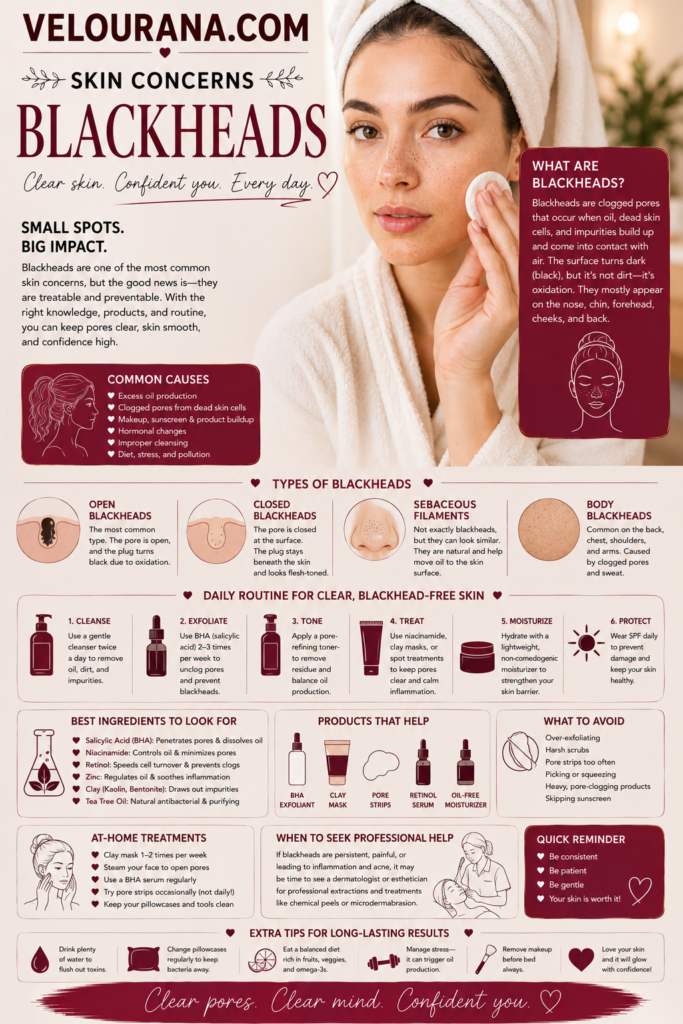
CATEGORY: Blackheads
Blackhead routines often become complicated for the same reason blackheads themselves are frustrating: the problem appears small enough that there should be a quick solution.
A few dark points across the nose seem as though they should disappear after the right cleanser. When they remain, an exfoliant is added. If that does not work quickly enough, a clay mask follows. Then a pore strip. Then another acid. Then a serum marketed for enlarged pores. Perhaps a retinoid is introduced later, followed by a richer moisturizer to compensate for the dryness created by everything that came before.
What began as a simple attempt to clear a few clogged follicles can gradually become a skincare routine in which almost every product is trying to correct the same problem from a slightly different angle.
This is one of the central paradoxes of blackhead care. The condition is associated with obstruction, yet treatment can become obstructed by its own complexity.
The skin does not evaluate products according to how persuasive their packaging is or how many different mechanisms have been promised. It experiences the cumulative effect of everything applied to it: cleansing agents, acids, retinoids, moisturizers, sunscreens, cosmetics, masks and mechanical manipulation. A routine that contains several individually reasonable products can therefore become collectively unreasonable.
Successful blackhead management depends less on assembling the largest possible collection of pore-clearing ingredients and more on giving each product a defined role.
The fundamental tasks are relatively straightforward. The skin needs to be cleansed without being repeatedly stripped. Follicular congestion needs to be addressed through an appropriate treatment. The barrier needs enough support for that treatment to remain tolerable. Daytime protection needs to be maintained. Everything else should earn its place.
This approach may appear less exciting than a shelf filled with treatments, but blackheads are rarely defeated by excitement.
They respond better to structure.
The Routine Should Begin With the Problem, Not the Product
The beauty market encourages routines to begin with products.
A new ingredient trends online, so it enters the bathroom. A cleanser promises deep pore purification, so the previous cleanser is replaced. A serum promises smoother texture, so it is layered beneath another serum already performing a similar function.
Over time, the person using the routine may know exactly what each product claims to do while becoming less certain what the skin actually needs.
A better blackhead routine begins by defining the concern accurately.
Are there genuine open comedones concentrated around the nose and chin? Is the forehead covered with many small closed bumps as well? Is the problem primarily visible sebaceous filaments? Is inflammatory acne also present? Is the skin oily and resilient, or easily irritated? Does congestion appear after particular cosmetics or hair products? Has the problem changed suddenly?
These distinctions matter because "blackheads" can become a catch-all description for several different visual experiences.
Someone whose primary issue is normal sebaceous filaments may not benefit from escalating acne treatment. Someone with substantial comedonal acne may need more than an occasional clay mask. Someone with inflamed lesions and scarring requires a different level of attention from someone with a few isolated open comedones.
The routine should therefore reflect the actual pattern of the skin rather than the general promise printed on a product.
This is one reason copying another person's routine rarely provides a perfect template.
Two people may both say they have blackheads, yet one has mild congestion around the nose while the other has widespread comedonal acne across the forehead, cheeks and chin. Their treatment needs are not equivalent.
Understanding the problem first also makes shopping simpler.
If a routine already contains an effective comedonal treatment, the next purchase does not necessarily need to be another pore-clearing serum. If the skin is becoming irritated, the more useful addition may be a gentler moisturizer. If sunscreen feels heavy and uncomfortable, changing its texture may improve the routine more than introducing another active ingredient.
Blackhead care becomes more efficient when every product answers a specific question.
Cleansing Has an Important but Limited Role
Cleansing is where most skincare routines begin, and blackhead-prone skin can make this step feel unusually significant.
Because blackheads appear dark and seem embedded in pores, it is easy to believe that more thorough cleansing must produce clearer skin. This can lead to repeated washing, strong foaming cleansers, cleansing brushes, scrubs and a preference for the tight sensation that follows aggressive oil removal.
Yet the role of cleansing should be understood precisely.
A cleanser removes material from the skin surface. It helps clear away sweat, environmental residue, cosmetics, sunscreen and excess surface oil. These are valuable functions. Proper cleansing can also make the rest of a skincare routine more comfortable and predictable.
What cleansing cannot do is permanently prevent all follicular obstruction.
Blackheads develop through processes occurring within follicles. Sebum production continues beneath the surface, and keratinous material can accumulate in ways that ordinary cleansing cannot simply wash away.
This is why the sensation of absolute degreasing is not a useful measure of whether a cleanser is working.
A face that feels tight after washing may feel exceptionally clean, but that sensation does not indicate that deeper comedones have been removed. It may simply indicate that the cleansing system is harsher than the skin needs.
The ideal cleanser for blackhead-prone skin is therefore not necessarily the strongest.
It should remove what needs to be removed while leaving the skin comfortable enough to tolerate subsequent treatment.
For someone wearing makeup or water-resistant sunscreen, thorough evening cleansing may require more attention than a quick rinse. Some people prefer a two-stage approach, beginning with an oil-based or balm cleanser followed by a water-based cleanser. Others find a single well-formulated cleanser sufficient.
The method matters less than the result: sunscreen and cosmetics should be removed without turning cleansing into an aggressive treatment in its own right.
Morning cleansing can also be adjusted according to the individual.
Someone with very oily skin may prefer using a mild cleanser in the morning. Someone whose skin becomes dry or sensitive may find that rinsing with water or using an especially gentle cleanser is adequate.
Uniform rules are less useful than observation.
If cleansing consistently leaves the face tight, stinging or flaky, the routine may already be working against itself before any active treatment is applied.
Salicylic Acid Makes Sense Because of Where the Problem Forms
Among the ingredients associated with blackhead care, salicylic acid has earned its prominence for a reason.
Blackheads involve follicular obstruction, and salicylic acid is particularly useful in acne-focused skincare because it helps exfoliate within the context of oily, congested skin. It is commonly used to address both blackheads and whiteheads.
The practical challenge is not recognizing that salicylic acid can be useful.
It is using it sensibly.
Because salicylic acid appears in cleansers, toners, leave-on liquids, serums, pads, masks and spot treatments, a person can unintentionally create a routine in which the same general exfoliating mechanism is repeated several times a day.
A salicylic-acid cleanser is followed by a salicylic toner, then a serum containing another exfoliating acid, perhaps followed twice weekly by a stronger peeling treatment.
The routine looks targeted because every product mentions pores.
The skin experiences cumulative exfoliation.
This distinction becomes especially important when irritation appears. The natural reaction may be to blame the strongest product, but irritation often reflects the total routine rather than a single ingredient.
A leave-on salicylic-acid product used consistently may be sufficient for someone with mild to moderate blackhead concerns. Another person may prefer a cleanser containing salicylic acid because leave-on formulations are difficult to tolerate. Someone using a retinoid may need to use exfoliating acids less frequently.
There is no universal schedule that suits every face.
Frequency should be guided partly by the skin's response.
If the face becomes chronically tight, red or flaky, increasing application frequency simply because blackheads remain visible is unlikely to be a sophisticated strategy.
The objective is to use the ingredient often enough to be useful but not so aggressively that irritation becomes the dominant skin concern.
This balance can feel unsatisfying because it lacks a dramatic formula.
Yet blackhead treatment is full of such trade-offs. The strongest possible treatment is rarely the same as the strongest sustainable treatment.
Retinoids Shift the Focus From Cleaning to Prevention
Blackheads are easy to approach as objects.
There is something visible inside a pore, so the instinct is to remove it.
Retinoids encourage a different way of thinking because their value in acne management is tied to the processes involved in comedone formation rather than to the immediate physical removal of an individual plug.
This makes them important for people dealing with recurring congestion.
A routine focused exclusively on extraction is reactive. It waits for a blackhead to become visible and then attempts to remove it.
A retinoid-based acne strategy is more preventive in principle. It aims to influence the follicular environment in a way that reduces the tendency toward comedone formation over time.
That difference also changes expectations.
There may be no dramatic moment when the pores suddenly look empty. Improvement develops gradually. Existing comedones take time to resolve, while fewer new ones ideally form.
Retinoids can also be irritating, particularly when introduced too aggressively.
This is why the surrounding routine becomes important. A gentle cleanser, appropriate moisturizer and measured introduction can determine whether a useful treatment becomes sustainable or is abandoned after a week of discomfort.
More frequent application is not automatically better if the result is persistent burning or peeling.
Some people begin by applying a retinoid less frequently and gradually increase use according to tolerance and professional guidance. Others need specific medical advice because of acne severity, sensitivity or other circumstances.
Pregnancy and plans for pregnancy require particular caution because some retinoids are not appropriate. In those circumstances, medical guidance should replace experimentation.
The larger lesson is that retinoids represent a shift in philosophy.
Blackheads do not need to be treated only as things to remove.
They can also be treated as things to prevent.
Exfoliation Works Best When It Is Not Competing With Itself
Chemical exfoliation has become so central to modern skincare that many routines contain several forms without the user fully realizing it.
Salicylic acid may be present in one product. Glycolic or lactic acid appears in another. A retinoid is used at night. An exfoliating mask is applied on weekends. A scrub is occasionally added because the skin feels rough.
Each product may have a logical purpose in isolation.
Together, they can create an unnecessarily intense environment.
The problem is not that ingredients must never be combined. Dermatological treatment can involve combinations, and experienced users may tolerate more active routines than beginners.
The problem is assuming that more exfoliation inevitably produces clearer pores.
Blackheads are not layers of dead skin sitting conveniently on top of the face waiting to be polished away.
Their formation involves the follicular canal. Surface exfoliation may improve texture and can support a broader acne strategy, but repeated aggressive exfoliation does not guarantee deeper or faster control.
There is also a practical issue: irritated skin becomes more difficult to treat.
When the barrier is compromised, products that were previously comfortable may begin to sting. Moisturizer may burn. Sunscreen application becomes unpleasant. Flaking interferes with makeup. The person then starts changing products, further complicating the routine.
A treatment plan that requires continual recovery from the treatment itself has lost some of its efficiency.
This is why alternating active products can sometimes make more sense than stacking them.
Someone using a retinoid may use an exfoliating acid on different nights rather than layering both immediately. Someone with sensitive skin may need fewer applications altogether.
The precise structure depends on individual tolerance, but the principle remains constant: active ingredients should complement one another rather than compete for dominance.
Moisturizer Is Not the Enemy of Congested Skin
The relationship between moisturizer and blackheads is frequently complicated by fear.
If a blackhead contains sebum, and the skin already feels oily, applying moisturizer can seem unnecessary or even counterproductive. A person may worry that adding anything creamy to the face will immediately block pores.
This can lead to a routine that contains several drying treatments and no meaningful barrier support.
The result is often uncomfortable skin that remains congested.
Moisturizer and sebum are not interchangeable.
Sebum is produced by sebaceous glands. A moisturizer is a topical formulation designed to support hydration, reduce water loss and improve the feel and function of the skin barrier. Different moisturizers accomplish this through very different textures and ingredient combinations.
The relevant issue for blackhead-prone skin is therefore formulation.
A heavy occlusive balm may feel excessive for someone with very oily skin in a humid climate. A lightweight lotion or gel-cream may feel far more appropriate. Someone using a drying acne treatment may require more emollience than their natural skin type would otherwise suggest.
The ideal moisturizer is the one that allows the skin to remain comfortable without creating an unwanted sense of heaviness or contributing to obvious congestion.
This becomes particularly important when using retinoids or exfoliating acids.
An active ingredient that is theoretically appropriate but intolerable without moisturizer may be less useful than the same ingredient used alongside adequate barrier support.
Moisturizer can therefore be part of blackhead treatment indirectly because it helps the person continue using the treatment that addresses the congestion.
This is a recurring theme in effective skincare.
Supporting products often determine whether active products succeed.
Sunscreen Belongs in a Blackhead Routine Even Though It Does Not Unclog Pores
Sunscreen is sometimes treated as unrelated to blackheads because it does not directly remove comedones.
Yet a skincare routine should not be designed around one concern so narrowly that it neglects the broader health and appearance of the skin.
Ultraviolet exposure affects pigmentation, skin texture and long-term structural integrity. Some acne treatments can also make sun protection particularly important.
There is another practical reason sunscreen deserves attention: the wrong sunscreen texture can make a blackhead-prone routine unpleasant.
Someone with oily skin may avoid sunscreen because previous formulas felt heavy, shiny or occlusive. The result is not evidence that sunscreen itself is incompatible with acne-prone skin. It may simply mean that the particular formulation did not suit that person's preferences.
Modern sunscreens vary substantially.
Some are rich and moisturizing. Others are fluid, gel-like or designed for oily skin. The best sunscreen is ultimately one that provides appropriate protection and is comfortable enough to be used consistently.
For blackhead-prone skin, this may require experimentation with texture rather than abandonment of sun protection.
The same applies to layering.
A rich moisturizer combined with a rich sunscreen and heavy foundation may feel unnecessarily occlusive on oily skin. Adjusting the weight of one layer can sometimes improve the entire routine without sacrificing any essential function.
This illustrates why skincare should be evaluated as a system.
Each product affects the experience of the products around it.
Masks and Pore Strips Should Be Understood for What They Can Actually Do
Few blackhead treatments are as emotionally satisfying as those that provide visible evidence.
A pore strip is removed and displays tiny plugs. A clay mask dries and leaves the nose matte. A peel-off mask reveals a smoother surface.
The appeal is immediate because the treatment creates something that can be seen.
This does not make such products inherently useless.
The problem begins when a temporary cosmetic effect is interpreted as long-term biological control.
A clay mask can absorb surface oil and make the skin feel cleaner and less shiny for a period of time. A pore strip may remove material from superficial follicular openings. These effects may be enjoyable.
They do not permanently change sebaceous activity or the ongoing process of comedone formation.
This is why the same areas may appear congested again later.
The product did not necessarily fail. The expectation was larger than its mechanism.
Masks and strips therefore make more sense as optional cosmetic additions than as the foundation of blackhead management.
A routine built primarily around occasional intensive treatments leaves long intervals in which the underlying tendency toward congestion continues unchanged.
By contrast, a well-tolerated daily or regularly scheduled routine can influence the skin more consistently.
Instant treatments can still have a place.
They simply need an honest job description.
Mechanical Exfoliation Requires More Restraint Than Enthusiasm
Scrubs occupy an unusual place in blackhead care.
They provide immediate tactile feedback. The skin feels smoother after use, and the mechanical action creates a convincing impression that dead cells and impurities are being physically removed.
That sensation can make scrubbing particularly tempting around the nose and chin.
Yet blackheads are not surface debris.
Mechanical exfoliation may smooth superficial roughness, but aggressive rubbing cannot safely grind away the biological process occurring within follicles.
When scrubs are used too vigorously or too frequently, they can irritate the skin and increase redness without providing a corresponding improvement in comedonal acne.
This is particularly problematic when a scrub is layered into a routine already containing acids or retinoids.
The skin does not distinguish between "chemical" and "physical" exfoliation in the way marketing categories do. It experiences the combined stress.
For someone who enjoys a gentle scrub and tolerates it well, occasional use may not be problematic.
But it should not be treated as essential blackhead therapy.
The same applies to cleansing brushes and textured devices. They may enhance the experience of cleansing for some people, yet stronger mechanical action should not be confused with deeper follicular treatment.
When the aim is to influence comedone formation, targeted active ingredients generally make more biological sense than repeated friction.
The Order of Products Matters Less Than Their Roles
Skincare routines often become intimidating because of concerns about exact layering order.
Should the acid go before the serum? Should moisturizer follow immediately? How long should the skin wait between steps? Can two actives be used on the same evening?
Some sequencing principles are useful, particularly when medications or specific formulations have application instructions.
But blackhead routines rarely succeed because someone discovered a magical sequence of eight products.
They succeed because the essential products are appropriate and used consistently.
A simple evening routine might involve cleansing, applying the chosen blackhead treatment according to its instructions, and moisturizing as needed.
A morning routine might involve cleansing or rinsing according to skin needs, moisturizer if required, and sunscreen.
This architecture can be modified, but the logic remains clear.
Problems arise when sequencing becomes a way to justify unnecessary complexity.
If five serums are layered between cleansing and moisturizer, the question is no longer merely which one should go first. It is whether all five are contributing something necessary.
A routine can be technically well ordered and strategically poor.
The strongest skincare routines are often those in which removing one product would clearly leave a missing function.
If nothing would be lost, the product may not have been essential.
Introducing Treatments Slowly Creates Better Information
One of the most useful principles in skincare is also one of the least exciting: change one thing at a time when possible.
This matters enormously in blackhead routines because active products can both help and irritate.
If a cleanser, acid serum, retinoid and moisturizer are all introduced during the same week, an improvement in congestion provides little information about which product deserves credit.
More importantly, if the face becomes red and flaky, identifying the cause becomes difficult.
The user may stop everything.
Several weeks later, another set of products is purchased, and the cycle begins again.
A slower introduction provides cleaner information.
The skin's response to each product becomes easier to observe. Tolerance can be assessed before another active ingredient is added. Unnecessary duplication becomes less likely.
This also encourages more realistic expectations.
If a treatment is given sufficient time to work, its effectiveness can be judged more fairly. Product hopping frequently prevents this.
Blackheads develop gradually, and their prevention is gradual as well.
The routine should reflect the timescale of the condition.
What to Do When the Routine Starts Burning
One of the most important skills in blackhead care is knowing when to reduce treatment.
Burning, persistent stinging, significant redness and marked flaking are not achievements.
They indicate that the skin is struggling with the current routine.
Mild temporary dryness can occur with certain acne treatments, especially during introduction, but there is a difference between adaptation and a chronically irritated barrier.
When irritation becomes substantial, adding another exfoliating product because blackheads remain visible usually compounds the problem.
The more rational response is to review the routine.
How many active products are being used? How frequently? Has a new cleanser been introduced? Are exfoliating acids and retinoids being layered together? Is mechanical exfoliation occurring as well? Is moisturizer adequate?
Sometimes simplification is itself a treatment decision.
Reducing the number or frequency of irritating products can restore tolerance and make it possible to reintroduce a targeted treatment more thoughtfully.
Persistent or severe irritation should not be managed through guesswork indefinitely. A dermatologist can help distinguish ordinary treatment-related dryness from dermatitis or other skin conditions.
Skincare should not require the person using it to become accustomed to constant discomfort.
When a Routine Is Simple Enough to Work
The beauty industry often associates sophistication with complexity.
A ten-step routine looks more deliberate than a four-step routine. Multiple serums create the feeling that several problems are being addressed simultaneously.
But biological effectiveness is not measured by shelf space.
For blackhead-prone skin, sophistication often means restraint.
A routine may be entirely adequate if it contains a cleanser, one appropriate active treatment, moisturizer according to need and sunscreen during the day.
Additional products can be added when they perform a distinct function.
An antioxidant serum may be used for broader skincare goals. A hydrating serum may improve comfort. A treatment for pigmentation may address post-acne marks.
There is nothing inherently wrong with having a longer routine.
The issue is whether complexity has accumulated because the skin needs it or because every unresolved pore triggered another purchase.
A routine is simple enough when the essential mechanisms are covered and the skin can tolerate them consistently.
It is complex enough when additional products have clear purposes.
Beyond that point, more may simply be more.
The Importance of Treating the Whole Pattern, Not Individual Blackheads
Spot treatment seems intuitive when a blackhead is visible.
A product is placed directly on the pore, and attention remains focused on that lesion until it disappears.
But comedonal acne often develops across areas rather than as completely isolated events.
If blackheads repeatedly appear across the nose or chin, treating only the individual visible plugs can miss the larger tendency.
Preventive treatment is often more logical when applied across the blackhead-prone area according to product instructions or professional guidance.
The reason is simple.
Microscopic comedonal changes can begin before they become visible.
Waiting until every lesion can be seen means treatment remains reactive.
This does not mean applying strong active ingredients indiscriminately across sensitive areas. It means recognizing that the problem can be regional rather than singular.
The difference is similar to maintaining a garden rather than pulling one weed at a time after it reaches full size.
The comparison is imperfect, but the principle is useful: prevention operates before the visible problem reaches its most obvious stage.
When Professional Treatment Becomes the More Efficient Choice
There is a point at which continuing to experiment with over-the-counter products becomes less efficient than seeking dermatological guidance.
Persistent comedonal acne may require prescription treatment. Blackheads occurring alongside inflammatory acne, painful lesions or scarring deserve particular attention.
Professional evaluation can also help determine whether the visible lesions are genuinely blackheads.
Conditions that resemble acne can be mistreated for months when every bump is assumed to be a clogged pore.
Dermatologists can prescribe medications that are not available in ordinary skincare, adjust treatment according to severity and tolerance, and perform controlled comedone extraction when appropriate.
Professional treatment can also reduce the psychological burden of experimentation.
Instead of buying a new product every few weeks, the person receives a coherent strategy based on the actual condition of the skin.
This is especially important when a routine has already become complicated.
Sometimes the most valuable professional advice is not another treatment.
It is identifying what can be stopped.
The Best Blackhead Routine Is the One That Can Continue
Blackheads rarely require a dramatic skincare philosophy.
They require a sustainable one.
The skin needs cleansing, but not punishment. Follicular congestion may benefit from targeted treatment, but not necessarily from five treatments performing overlapping functions. Moisturizer can support the barrier without being considered an enemy of oily skin. Sunscreen protects the broader health and appearance of the face even though it does not unclog a single pore.
Optional products can remain optional.
Masks can be enjoyed without being mistaken for permanent treatment. Pore strips can be understood as temporary extraction rather than long-term prevention. Scrubs can be used cautiously rather than treated as essential tools.
Most importantly, active ingredients need enough time to work.
The constant search for immediate improvement encourages routines to become stronger precisely when they should become steadier.
A successful blackhead routine may feel almost uneventful.
The cleanser works and is rarely thought about. The treatment is applied according to a consistent schedule. Moisturizer is adjusted according to comfort. Sunscreen is worn because it belongs in healthy daytime skincare. The person no longer spends every evening inspecting individual pores.
Weeks pass.
The nose may still have visible follicles because noses have follicles. The skin may still become oily because sebaceous glands remain active.
But blackheads become less prominent. Congestion develops more slowly. The texture looks more even. The routine causes fewer episodes of irritation. Extraction becomes less frequent because there is less that feels urgent to remove.
That is progress.
It does not arrive through a single dramatic product or a perfectly clean pore.
It comes from matching the routine to the biology of the problem and repeating that routine consistently enough for the skin to respond.
Blackhead care becomes far more effective once the question changes from "What else can I add?" to "What does my skin actually need?"
In many cases, the answer is surprisingly modest: appropriate cleansing, one well-chosen treatment, enough barrier support, daily protection and patience.
The challenge is not discovering twenty ways to fight blackheads.
It is resisting the temptation to use all twenty at once.
The End Velourana
 Discover More From Our Family of Websites
 ZodiacBearing (Astrology, Tarot, Numerology, Angel Numbers & Spiritual Guidance)
 Velourana (Beauty, Makeup, Hair Care, Skincare & Beauty Tips)
 HavenBearing (Home, Living, Organization, Décor & Everyday Inspiration)
 PawBearing (Pet Care, Dog Breeds, Animal Health, Training & Pet Products)
 PsyCatherine (Notes From the Journal of a Psychologist on Real Life)