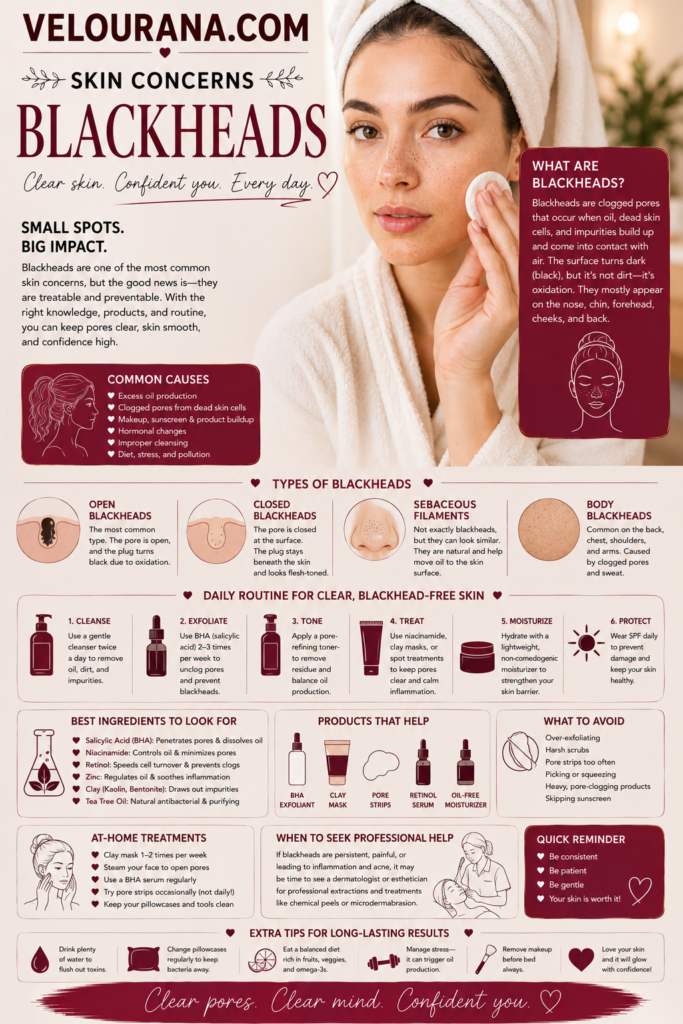
CATEGORY: Blackheads
Two people can use remarkably similar skincare routines and still have completely different relationships with blackheads. One may occasionally notice a few dark points around the nose. The other can cleanse carefully, choose products thoughtfully and maintain a consistent routine, yet still develop visible congestion across the nose, chin and forehead.
It is easy to interpret that difference as evidence that one person has discovered the correct products while the other has not. Skincare culture encourages this conclusion because products are tangible and controllable. A cleanser can be replaced. An exfoliant can be strengthened. A serum can be added. When blackheads remain, the routine becomes the obvious suspect.
But the tendency to develop blackheads begins deeper than the bathroom shelf.
Every person's skin has its own structural and biological characteristics. Follicles differ in visibility and behaviour. Sebaceous glands vary in activity. Hormones influence oil production. The way cells are shed within the follicular canal can contribute to congestion. Genetics affects acne susceptibility. Age, climate, cosmetics and other external influences then interact with those underlying characteristics.
Blackheads emerge from this combination rather than from a single mistake.
Understanding the architecture and behaviour of the pore therefore changes the question. Instead of asking why a particular product has failed to make pores disappear, it becomes more useful to ask why certain follicles are naturally more susceptible to visible congestion and how skincare can influence that tendency without attempting to erase normal skin anatomy.
That distinction is liberating because it replaces an impossible objective—permanently eliminating pores—with a practical one: helping susceptible follicles remain clearer, calmer and less conspicuous over time.
A Pore Is an Opening, Not an Imperfection
The word "pore" is used constantly in beauty, yet it often carries a negative implication. Pores are described as enlarged, clogged, dirty, open, stretched or stubborn, as though perfectly healthy skin should ideally contain none that can be seen.
Biologically, that expectation makes little sense.
The openings commonly referred to as facial pores are associated with structures within the skin, particularly hair follicles and sebaceous glands. Sebum produced by sebaceous glands travels through the follicular environment toward the surface. These structures are part of normal skin physiology.
Their visibility varies considerably.
On some areas of the face, follicular openings may be barely noticeable. On others—particularly the nose and central face—they can be much more apparent. Oiliness, congestion, skin texture, age and lighting can all affect how prominent they appear.
A visible pore is therefore not automatically a clogged pore.
This distinction becomes essential when dealing with blackheads because visual inspection alone can encourage overtreatment. Someone who believes every visible opening represents trapped material may begin exfoliating, squeezing or masking areas that are simply displaying normal follicular anatomy.
The problem is intensified by modern ways of looking at skin.
High-resolution cameras reveal detail that would never be visible during an ordinary conversation. Magnifying mirrors transform tiny follicular openings into large circular structures. Bright overhead bathroom lighting casts shadows into pores, making them appear deeper and darker.
Under these conditions, almost any human face can begin to look "congested."
The cosmetic ideal of completely poreless skin often comes from images that have been filtered, retouched, softly lit or viewed at a scale very different from real life. Comparing living skin with that visual standard can make normal anatomy seem pathological.
Blackheads are real lesions and can be treated. But treating blackheads intelligently begins by separating them from the existence of pores themselves.
A follicular opening does not need to disappear in order to be healthy.
Inside the Follicle, Congestion Begins Before It Can Be Seen
A blackhead is the visible stage of a process that begins within the follicle.
Sebaceous glands produce sebum, while cells associated with the follicular lining undergo normal turnover. Under favourable conditions, this material moves outward. In comedonal acne, however, the normal shedding and movement of cells within the follicle becomes altered. Keratinous material and sebum accumulate, creating a plug.
When the follicular opening remains exposed, the lesion is classified as an open comedo—a blackhead.
The dark surface is one of the most misleading aspects of the entire process because it resembles dirt. Yet its colour does not mean that environmental grime has simply fallen into an empty pore. The exposed material at the follicular opening develops its characteristic dark appearance through chemical and pigment-related processes at the surface.
This is why cleansing alone cannot prevent every blackhead.
Cleansing works primarily at the skin surface. It removes makeup, sunscreen, sweat, environmental residue and excess oil. Those functions are important, particularly for someone wearing cosmetics or water-resistant sun protection.
But a blackhead begins through processes occurring within a follicular structure.
No reasonable cleanser can permanently wash away sebaceous glands, stop cellular turnover or guarantee that keratinous material will never accumulate. Nor should it.
Once this is understood, the limitations of aggressive cleansing become obvious. Washing harder addresses the wrong level of the problem.
The same principle explains why blackheads can develop even in someone who is meticulous about hygiene. They are not proof of an unclean face.
The relevant issue is how material behaves within susceptible follicles.
That susceptibility varies from person to person, which is why one individual's skin can tolerate rich cosmetics and minimal exfoliation without obvious congestion while another develops comedones relatively easily.
Skincare can influence the process, but it begins with biology.
Sebaceous Glands Help Determine the Landscape
The distribution of blackheads across the face is rarely random.
The central face often behaves differently from the outer cheeks because sebaceous activity is not uniform across every centimetre of skin. The familiar T-zone—the forehead, nose and chin—is commonly oilier and frequently becomes the territory in which blackheads and visible sebaceous structures are most obvious.
This creates a characteristic skincare dilemma.
The cheeks may feel completely comfortable or even slightly dry while the nose becomes shiny within hours. Treating the entire face as though it were identical can therefore produce unnecessary dryness in one area without adequately addressing congestion in another.
Recognizing regional differences allows skincare to become more precise.
An exfoliating treatment may be tolerated more frequently on an oily, congested T-zone than on sensitive outer cheeks. A richer moisturizer may be appreciated around drier areas while a lighter application feels preferable through the centre of the face.
This does not mean every face needs an elaborate zoning system. It simply means skin type is not always one uniform condition.
Sebum itself also deserves a more balanced reputation.
Because blackheads contain sebaceous material, oil is often portrayed as something that should be eliminated. Yet sebum is a normal secretion with physiological functions. The objective is not to produce a completely oil-free face.
Indeed, attempts to maintain an artificially matte surface throughout every hour of the day can lead to excessive cleansing, constant powdering, repeated use of astringent products and an increasingly uncomfortable barrier.
The presence of shine does not necessarily indicate that another cleansing session is required.
For blackhead-prone skin, the more relevant concern is whether the combination of sebaceous activity and follicular keratinization is creating persistent obstruction.
This distinction allows oily skin to be treated without treating oiliness itself as a personal failure.
Genetics Helps Explain Why Skincare Results Differ
Few things are more persuasive than a skincare recommendation from someone whose skin looks exactly as we would like ours to look.
They use a particular cleanser, so we buy it. They exfoliate twice a week, so we copy the schedule. They stopped using moisturizer and claim their pores became invisible, so perhaps moisturizer was the problem all along.
What this comparison overlooks is that the two faces are biologically different.
Acne susceptibility has a genetic component, and sebaceous behaviour, follicular characteristics and inflammatory tendencies vary between individuals. A routine that appears effortlessly successful for one person may be insufficient, excessive or simply inappropriate for another.
This does not make product recommendations meaningless. It means they need context.
Imagine two people using the same salicylic-acid treatment. One develops mild occasional blackheads and sees substantial improvement within a reasonable period. The other has persistent comedonal acne involving large areas of the face and experiences only modest change.
The difference does not necessarily mean the second person used the product incorrectly. The baseline condition was different.
This becomes particularly important when skincare is discussed online, where before-and-after transformations can be separated from medical history, genetics, hormonal influences, prescription treatments, professional procedures and dozens of other variables.
A person's visible result is real, but it is not automatically a prediction of another person's result.
Genetic influence also helps explain why some people experience blackheads from adolescence well into adulthood while others rarely think about them.
Skincare can modify risk. It cannot rewrite every inherited characteristic of the skin.
Accepting this does not mean surrendering to congestion. It means setting expectations according to the skin that actually exists rather than the skin of someone selected by an algorithm.
Hormones Can Change the Behaviour of Familiar Skin
A routine can remain exactly the same while the skin changes.
This can be confusing because skincare is often approached as though the face should produce consistent results whenever the same products are applied. Yet the skin exists within a living body, and internal influences can alter its behaviour.
Hormones have a particularly important relationship with sebaceous activity and acne.
This is obvious during puberty, when increased sebaceous activity frequently coincides with the development of acne. But hormonal influence does not disappear after adolescence. Adults can continue experiencing changes in oiliness and breakouts, and some people notice predictable fluctuations associated with hormonal cycles.
The practical implication is that recurring blackheads should not always trigger an immediate product investigation.
If congestion increases despite an unchanged routine, it can be useful to consider whether anything else has changed: hormonal circumstances, medication, climate, stress, occupational exposure, hair products, cosmetics or other aspects of daily life.
This broader perspective prevents skincare from becoming an endless sequence of unnecessary substitutions.
It also explains why a routine that worked beautifully several years ago may no longer produce exactly the same result.
Skin changes across a lifetime.
Sebaceous activity can change. Hormonal circumstances change. The barrier may become more sensitive. The texture and structural support surrounding pores can change with age. Environmental exposures change. Lifestyle changes.
The "perfect routine" is therefore rarely permanent.
A better approach is to understand the principles behind the routine well enough to adjust it when the skin's behaviour changes.
Why Pores Can Look Larger Without Actually Opening and Closing
Beauty language frequently describes pores as opening with steam and closing with cold water.
It is an intuitive image. Heat seems to loosen everything; cold feels tightening. But pores do not operate like tiny doors equipped with muscular hinges.
What can change is their appearance.
Congestion can make a follicular opening look more obvious. Surface oil can emphasize texture. Dehydration or irritation can alter how light reflects from the skin. Changes in structural support associated with ageing and sun exposure may also influence the appearance of pores.
Removing material from a congested follicle can therefore make the opening appear temporarily less prominent, even though the pore has not literally been closed.
This difference between structural reality and visual appearance is important because many skincare claims depend on blurring the two.
A product may genuinely make pores look less noticeable. That is a reasonable cosmetic benefit. It may reduce surface oil, smooth surrounding texture or help manage congestion.
That is different from permanently shrinking every pore.
When expectations remain grounded in appearance rather than anatomical elimination, skincare becomes much easier to evaluate fairly.
A salicylic-acid product does not need to make the nose poreless to be useful. If congestion decreases and texture appears smoother, it may be doing exactly what can reasonably be expected.
Likewise, a moisturizer does not "open pores" merely because the skin looks more luminous afterward.
The language used to describe pores matters because it shapes treatment decisions. When people believe pores are doors, they search for products capable of closing them. When they understand them as anatomical openings whose visibility can fluctuate, they can focus instead on keeping them as clear and healthy-looking as possible.
The Difference Between Blackheads and Sebaceous Filaments
One of the most important distinctions in blackhead care concerns something that is not acne at all.
Sebaceous filaments are normal structures within follicles that help channel sebum toward the skin surface. They are particularly noticeable in areas rich in sebaceous glands, especially the nose.
Visually, they can resemble tiny blackheads.
This resemblance has caused countless noses to be squeezed, scrubbed and stripped in pursuit of a permanently clean appearance that normal physiology will not provide.
Sebaceous filaments tend to be smaller and more uniformly distributed than obvious blackheads. Depending on skin tone, oil and lighting, they may appear pale, grey, yellowish or slightly dark. When squeezed, material may emerge, which makes the assumption that they were clogged pores seem even more convincing.
But removing that material does not eliminate the follicle's function.
Sebum continues to move through the structure, and the filament becomes visible again.
This is why someone can perform an intensive extraction and feel delighted with an apparently spotless nose, only to become discouraged when tiny dots reappear several days later.
Nothing necessarily went wrong.
The skin resumed functioning.
True blackheads can coexist with sebaceous filaments, which makes casual self-diagnosis more complicated. The objective should not be to inspect every individual dot obsessively but to recognize that some degree of visible follicular activity is normal.
This distinction can dramatically reduce unnecessary skin trauma.
A person who believes they have hundreds of stubborn blackheads may actually have a smaller number of true comedones surrounded by perfectly ordinary sebaceous filaments.
Treating the genuine congestion while allowing normal structures to remain normal is a much healthier relationship with the skin.
Cosmetics and Skincare Can Influence a Susceptible Follicle
Biology creates susceptibility, but the products placed on the skin can influence how that susceptibility expresses itself.
Some people can use rich, occlusive formulations without developing noticeable congestion. Others find that certain cosmetics, sunscreens, hair products or skincare formulations coincide with an increase in comedones.
The challenge is identifying genuine patterns without becoming afraid of ingredients.
"Comedogenic" and "non-comedogenic" are useful concepts, but they are not perfect guarantees of how every formulation will behave on every person's skin. A product labelled non-comedogenic may still feel unsuitable to an individual, while another product that looks relatively rich may be tolerated perfectly well.
The complete formulation matters.
So does the amount used, how frequently it is applied, what it is layered with, the climate and the person's underlying tendency toward congestion.
This is why changing several products simultaneously can make blackhead troubleshooting unnecessarily difficult.
If a new moisturizer, sunscreen, foundation and cleansing balm are all introduced within the same week and congestion increases a month later, identifying the relevant factor becomes challenging.
A slower approach provides better information.
It is also worth considering products that reach the face unintentionally.
Hair conditioners, styling creams, oils and pomades can contact the forehead, temples and sides of the face. Heavy products applied near the hairline may therefore be relevant when congestion has a distinctive distribution.
Similarly, products do not need to be intrinsically "bad" to be unsuitable for a particular person.
A rich balm may be excellent for dry skin and uncomfortable for someone with very oily, comedone-prone skin in humid weather. A lightweight gel may feel ideal in summer but insufficient during winter.
The intelligent question is not whether a product is universally good or bad. It is whether it works within the biology and environment of the skin using it.
Climate Changes the Context of Congestion
The same face can behave like two different skin types in January and August.
Heat, humidity, cold, wind, indoor heating and air conditioning all change the environment in which skincare operates. A moisturizer that feels beautifully protective during winter may become uncomfortably heavy during a humid summer. A cleanser that feels refreshing in warm weather may become too drying when cold conditions already challenge the barrier.
Blackhead-prone skin can therefore benefit from seasonal flexibility.
In hot, humid conditions, sweat and increased surface oiliness can make the face feel more congested even when the underlying routine has not changed. Sunscreen may be reapplied more frequently. The skin may be exposed to perspiration for longer periods. Products that previously disappeared comfortably into the skin may begin feeling occlusive.
The instinct may be to respond by dramatically increasing exfoliation.
Sometimes a simpler adjustment is sufficient.
Changing the texture of a moisturizer, reconsidering how heavy layers are combined, cleansing appropriately after prolonged sweating and maintaining a consistent comedonal treatment may make more sense than suddenly doubling the number of active ingredients.
Cold weather creates the opposite temptation.
If the skin becomes dry, people may abandon blackhead treatments completely or cover the face in extremely rich products. A better approach may involve adjusting frequency and supporting the barrier while retaining the essential structure of the routine.
Seasonal skincare does not require replacing every product four times a year.
It means recognizing that the context surrounding the skin changes and that tolerability matters as much as theoretical efficacy.
Age Changes Both Acne and the Appearance of Pores
Blackheads are often associated with adolescence, but comedonal congestion is not restricted to teenage skin.
Adults can continue developing blackheads, and the appearance of pores can become more noticeable for reasons that extend beyond acne.
As skin ages, changes occur in collagen, elasticity, hydration, cell turnover and sebaceous activity. Cumulative ultraviolet exposure also affects skin structure. These changes can influence texture and the way follicular openings appear.
This creates an important distinction between treating congestion and treating pore visibility.
A person may successfully reduce blackheads yet still perceive their pores as prominent because the surrounding skin texture has changed. Increasing exfoliation in response may not address the actual reason the pores remain visible.
This is another example of why diagnosis matters.
When the objective is clearer follicles, comedonal treatments make sense. When the concern is broader texture, photodamage or age-related structural change, the skincare strategy may need to address those issues as well.
Retinoids are particularly interesting in this context because they have established roles in acne treatment, while certain retinoids are also used in approaches to photoaged skin. But the appropriate product, strength and frequency depend on the individual, and stronger treatment is not automatically better.
Sun protection becomes increasingly important as well.
A blackhead routine focused exclusively on the contents of pores can overlook the broader factors determining how the skin looks. Protecting skin from ultraviolet exposure supports its long-term appearance far beyond the immediate management of congestion.
Pores exist within a larger landscape.
Healthy-looking skin depends on caring for that landscape, not merely emptying individual follicles.
Why Aggressive Extraction Can Make Pores Look Worse
When a follicular opening appears large and dark, squeezing seems like a logical way to improve it.
Sometimes material releases easily and the area looks immediately clearer. The danger comes when extraction becomes repetitive, forceful or indiscriminate.
Applying significant pressure to the skin can create redness, swelling and tissue injury. Attempting to extract material that does not release easily may damage the surrounding area without meaningfully clearing the lesion. Fingernails can add further trauma.
The irony is that an attempt to make pores less visible can temporarily make the entire area more noticeable.
Redness around the follicle increases contrast. Swelling changes texture. Small scabs or post-inflammatory marks can remain after the original blackhead is gone.
Repeated manipulation also creates a psychological pattern in which the skin is inspected specifically for something to extract.
Once that habit develops, sebaceous filaments, tiny bumps and normal follicular openings can all become targets.
Professional comedone extraction exists for a reason. A trained professional can evaluate which lesions are appropriate to extract and use controlled techniques rather than simply applying increasing pressure until something happens.
For home care, prevention generally offers a more sustainable foundation.
The less frequently follicles become significantly obstructed, the less often extraction becomes tempting in the first place.
Designing Skincare Around the Skin You Actually Have
The most effective blackhead routine is not necessarily the most impressive routine.
It is the one that matches the biological behaviour of the person using it.
For someone with mild congestion and relatively resilient skin, a carefully chosen salicylic-acid product may provide sufficient support. Someone with persistent comedonal acne may benefit from a retinoid or other treatment recommended by a dermatologist. Sensitive skin may require slower introduction and greater attention to barrier support.
The underlying architecture remains simple.
Cleansing should remove what needs to be removed without leaving the face chronically uncomfortable. Treatment should address the tendency toward comedone formation rather than merely producing a sensation of deep cleaning. Moisturization should support the skin in a texture appropriate to its needs. Sunscreen should protect the face consistently.
Everything beyond that should have a reason for being present.
This approach prevents a common form of skincare accumulation in which each unresolved blackhead leads to another purchase.
One product exfoliates. Another "detoxifies." Another controls oil. Another tightens pores. Another resurfaces. Another purifies. Another promises overnight extraction.
Eventually six products are attempting variations of the same task while basic barrier comfort deteriorates.
A routine built around function asks a different question: what is currently missing?
If cleansing is already adequate, a stronger cleanser may add little. If a well-tolerated comedonal treatment is already being used, another exfoliant may simply duplicate it. If the skin is irritated, the missing intervention may actually be restraint.
The goal is not to construct the most aggressive environment in which a blackhead cannot survive.
The goal is to create the most sustainable environment in which the follicle is less likely to become obstructed.
When Persistent Congestion Is More Than a Cosmetic Question
Blackheads are usually discussed as a cosmetic concern, but persistent comedonal acne can warrant professional evaluation.
This becomes particularly relevant when congestion covers substantial areas, does not respond to appropriate over-the-counter treatment, repeatedly progresses into inflammatory lesions, or occurs alongside painful acne, nodules or scarring.
A dermatologist can also help when the diagnosis itself is uncertain.
Not every bump is acne. Not every dark follicular point is a blackhead. Several dermatological conditions can create lesions that resemble comedones, and repeated treatment with exfoliating products may delay appropriate care when something else is occurring.
Professional assessment is especially valuable when increasingly aggressive skincare is producing more irritation than improvement.
There is a point at which another serum is unlikely to solve the problem.
Medical treatment can provide options unavailable in ordinary cosmetics, while professional extraction may be appropriate for selected persistent comedones.
Pregnancy and plans for pregnancy also require particular caution because some commonly used acne treatments, including certain retinoids, are not appropriate. Professional guidance is preferable to assuming that an ingredient is safe simply because it appears in a cosmetic product.
Seeking dermatological advice does not mean that a person has failed to manage their skin correctly.
Sometimes the architecture and biology of the skin simply require more than cosmetic maintenance can provide.
Clearer Pores Begin With Respecting Their Biology
Blackheads become easier to understand once pores stop being treated as empty holes waiting to collect dirt.
They are the visible openings of active biological structures.
Behind them are sebaceous glands producing oil, cells undergoing renewal, follicles with individual structural characteristics and a body whose hormones, genetics and age influence how those structures behave. Around them is an environment of cosmetics, skincare, climate, ultraviolet exposure and daily habits.
A blackhead develops within that entire system.
This explains why one miracle product rarely provides a permanent answer. It explains why extraction can clear a pore without preventing its return. It explains why the nose may never become completely dot-free, why oily skin can remain healthy, why two people following identical routines can achieve different results, and why increasingly aggressive cleansing often produces disappointment rather than perfection.
Most importantly, it provides a more realistic definition of success.
Success is not a face from which every pore has vanished.
It is skin in which genuine congestion is better controlled. Blackheads form less frequently. Existing comedones become less prominent. The skin remains comfortable enough for treatment to continue consistently. Oiliness is managed without being treated as contamination. Normal sebaceous structures are recognized rather than compulsively extracted.
The pores remain because they belong there.
Once this becomes the starting point, blackhead skincare loses much of its urgency. There is less need to inspect the nose every morning, less reason to attack every dark point, and less temptation to interpret normal texture as evidence that another treatment is required.
Instead, the routine becomes an attempt to influence the conditions within susceptible follicles while preserving the health of the skin surrounding them.
That is a quieter objective than promising poreless perfection, but it is also a more scientifically coherent and sustainable one.
The architecture of the pore cannot simply be erased. It can, however, be understood.
And when skincare begins with that understanding, clearer skin no longer depends on fighting normal biology. It comes from working intelligently within it.
The End Velourana
 Discover More From Our Family of Websites
 ZodiacBearing (Astrology, Tarot, Numerology, Angel Numbers & Spiritual Guidance)
 Velourana (Beauty, Makeup, Hair Care, Skincare & Beauty Tips)
 HavenBearing (Home, Living, Organization, Décor & Everyday Inspiration)
 PawBearing (Pet Care, Dog Breeds, Animal Health, Training & Pet Products)
 PsyCatherine (Notes From the Journal of a Psychologist on Real Life)