
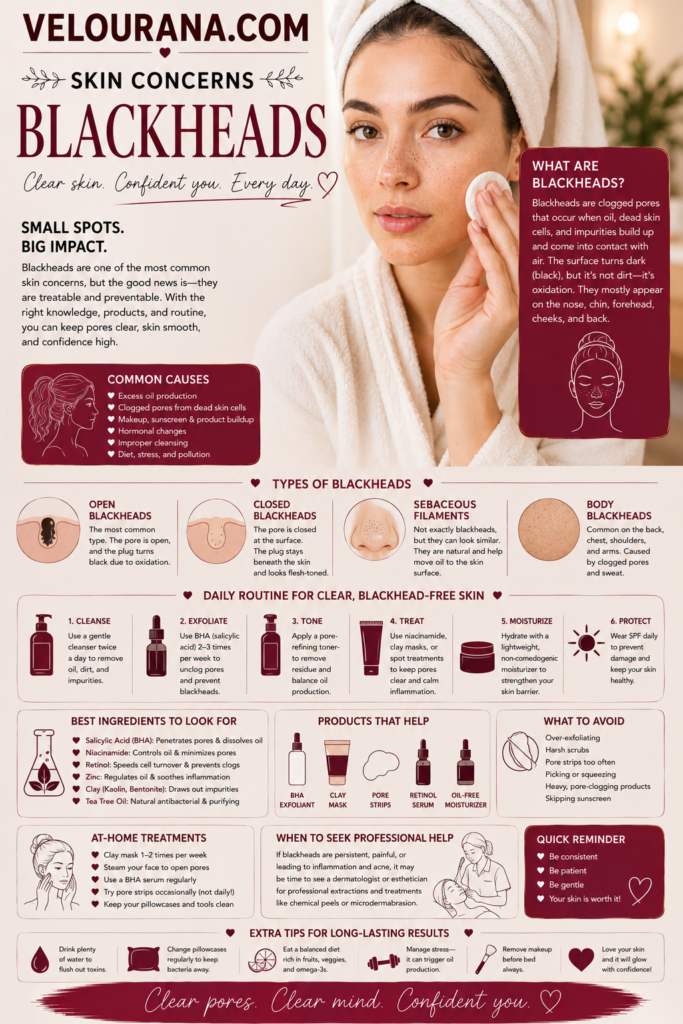
CATEGORY: Blackheads
There is a particularly frustrating quality to blackheads that distinguishes them from many temporary skin concerns. A blemish may appear, heal and disappear. Dryness may settle once the skin barrier recovers. A patch of irritation can resolve after its trigger is removed. Blackheads, however, often seem to operate according to a different rhythm. They can be extracted, exfoliated, masked and apparently eliminated, only to reappear in precisely the same places weeks later.
For someone carefully maintaining a skincare routine, that recurrence can feel like failure. Perhaps the cleanser is not strong enough. Perhaps the exfoliant has stopped working. Perhaps the pores were never properly emptied. Perhaps another treatment is required.
Yet recurring blackheads do not necessarily indicate that anything has gone wrong. Their persistence makes considerably more sense once the skin is viewed not as a static surface but as living tissue in continuous renewal. Sebaceous glands continue producing sebum. Cells continue forming and shedding within follicles. Hormonal signals continue influencing oil production. Products continue interacting with the skin. The follicle from which yesterday's blackhead was removed does not retire from service once it has been cleared.
This is the central difficulty of blackhead care: removing a blackhead and changing the conditions that encourage blackheads to form are two different objectives.
The first can sometimes be accomplished in minutes. The second takes time.
Understanding that distinction changes the way recurring congestion should be approached. Instead of repeatedly declaring war on individual dark dots, effective care becomes a question of influencing an ongoing biological cycle—gently enough that the skin remains healthy, consistently enough that new congestion becomes less frequent, and realistically enough that normal pores are not mistaken for a problem that must somehow be eliminated.
The Follicle Does Not Stop Working After a Blackhead Is Removed
The satisfying moment when a blackhead disappears can create the impression that the problem has been solved at its source. The visible plug is gone, the follicular opening looks clearer, and the skin appears smoother. But what has actually happened is much narrower: material occupying one follicle has been removed or reduced at a particular moment in time.
The biological machinery surrounding that follicle remains active.
Sebaceous glands continue secreting sebum into the follicular canal. Keratinocytes continue developing and shedding. The follicular lining continues participating in the process through which cellular material eventually reaches the surface. If those materials once again accumulate instead of moving outward normally, another comedo can develop.
This is why blackheads frequently recur in familiar areas. The nose, central forehead and chin often contain prominent sebaceous activity, and individual skin characteristics can make particular regions more susceptible to congestion. Clearing those areas does not permanently change their anatomy.
A useful analogy is not a dirty pipe that needs to be cleaned once, but a pathway through which material is continuously moving. The objective is to support normal movement and reduce obstruction rather than expecting the pathway to remain permanently empty.
This distinction also explains why dramatic extraction sessions can produce impressive photographs without necessarily producing impressive long-term results. Before-and-after images capture two moments. They cannot show what the same follicles will be doing six weeks later.
Long-term blackhead control therefore depends less on how completely the skin can be emptied during one treatment and more on how successfully the routine influences what happens between treatments.
That is a subtler form of progress. It may mean that blackheads become smaller, fewer or slower to return. The nose may remain visibly porous while becoming considerably less congested. Extraction may become less necessary. The texture of the skin may gradually look more even without ever becoming completely poreless.
Those changes can be easy to overlook when success has been defined as the permanent disappearance of every dark point.
A better definition of success begins with accepting that skin is continuously functioning.
Sebum Is Part of the Story, but Oil Is Not the Enemy
Blackheads are strongly associated with oily skin, and the connection has an obvious biological basis. Sebum contributes to the material involved in comedone formation. Areas with greater sebaceous activity are therefore frequently areas in which congestion becomes particularly noticeable.
It is tempting to conclude that the solution is simply to remove as much oil as possible.
That conclusion is where many blackhead routines begin to become unnecessarily aggressive.
Sebum is not waste. It forms part of the complex mixture of lipids present at the skin surface and contributes to the skin's normal protective environment. A face producing visible oil is not malfunctioning merely because shine appears during the day.
The problem in comedonal acne is more complicated than the presence of oil alone. Sebum interacts with keratinous material within the follicle, while abnormalities in follicular keratinization contribute to the formation of the plug. The result is therefore not equivalent to pouring too much oil onto a clean surface. It is a process occurring within a biological structure.
This helps explain an observation familiar to many people with blackhead-prone skin: extremely strong cleansing may make the face feel less oily for several hours without meaningfully solving recurring congestion.
Surface oil has been removed. The underlying tendency has not necessarily changed.
Repeated attempts to degrease the skin can also make a routine increasingly difficult to tolerate. A cleanser that leaves the face tight may be followed by an alcohol-heavy toner, then an exfoliating acid, then a clay mask. Each step seems logical when considered individually because each promises to address oil or congestion. Together, however, they may produce a face that feels tight immediately after cleansing and oily again later in the day, while remaining dotted with blackheads.
The presence of oil after cleansing is not evidence that the cleanser failed. Sebaceous glands are supposed to continue functioning.
This is one reason blackhead care benefits from abandoning the language of "stripping" and "deep cleaning." These expressions suggest that clearer skin requires increasingly forceful removal.
A more useful objective is regulation and prevention.
A gentle cleanser can remove excess surface oil, sunscreen, makeup and daily residue. A carefully selected active ingredient can address follicular congestion. A suitable moisturizer can support comfort and barrier function. The routine can then be repeated consistently without requiring the skin to endure a daily cycle of stripping and recovery.
The distinction sounds modest, but over months it can determine whether a routine remains sustainable.
Skin Renewal Creates a Moving Target
The skin is continually renewing itself, and this renewal is essential to understanding why blackheads cannot be treated as inert objects.
Within the follicular environment, cellular turnover and keratinization influence whether material moves outward normally or contributes to an obstruction. When cells accumulate abnormally together with sebum, a microscopic comedo can begin developing before anything obvious is visible at the surface.
By the time a blackhead is large enough to attract attention in the mirror, its formation did not begin that morning.
This delayed visibility has important consequences for evaluating skincare.
Suppose someone begins using a treatment intended to reduce comedonal acne on Monday. By Friday, several blackheads are still visible. It is easy to conclude that the treatment has failed. Yet existing comedones and developing microcomedones do not disappear simply because a new routine has been used for several days.
The skin needs time.
This is one reason acne treatments are normally evaluated over weeks rather than days. The objective is not only to alter the appearance of lesions already visible but to influence the ongoing formation of future lesions.
The difference between immediate cosmetic change and biological change becomes crucial here.
A pore strip can produce immediate cosmetic change because it physically removes material from the surface and follicular openings. A clay mask can temporarily reduce the sensation of oiliness. An exfoliating treatment may leave the skin feeling smoother after one use.
A preventive acne treatment operates on a different timetable.
Its success may first become apparent not because today's blackheads suddenly disappear, but because fewer new ones are developing several weeks later. That improvement is much harder to photograph dramatically, yet it is potentially far more meaningful.
People often abandon effective approaches precisely because they are waiting for the wrong type of evidence.
They expect an overnight transformation from something designed to influence a biological cycle. When it fails to provide one, they switch products. The next treatment begins before the first has been properly assessed. Then another follows.
Eventually the routine becomes a sequence of experiments rather than a coherent strategy.
For recurring blackheads, patience is not passive. It is part of the mechanism through which a sensible routine can be evaluated.
The Difference Between Clearing a Pore and Preventing a Comedo
Blackhead treatment becomes much easier to understand when interventions are divided conceptually into two groups: those that mainly change what is visible now and those that help reduce what develops later.
The distinction is not absolute. Some treatments can contribute to both. But thinking this way prevents immediate appearance from becoming the only measure of effectiveness.
Extraction illustrates the first category perfectly. When performed appropriately, the contents of an open comedo can be removed. The improvement is immediate because the obstruction itself has been physically addressed.
Yet extraction does not instruct the sebaceous gland to stop producing sebum. It does not permanently change follicular keratinization. It cannot guarantee that the same follicle will never become congested again.
Preventive treatments work differently.
Salicylic acid is widely used in comedonal skincare because it can help exfoliate and clear clogged pores. Retinoids occupy an important position in acne treatment because they influence cellular processes involved in comedone formation. These approaches make more sense as ongoing management than as emergency attacks on individual blackheads.
This is why consistency can outperform intensity.
Imagine two approaches to the same congested nose. In the first, nothing is done for several weeks, followed by an aggressive evening involving steaming, squeezing, scrubbing and multiple exfoliating products. The nose may look dramatically clearer the next morning, but it has also experienced considerable mechanical and chemical stress.
In the second approach, the skin is cleansed gently, a suitable comedonal treatment is used consistently at a tolerable frequency, moisturizer supports the barrier when necessary, and extraction is not performed compulsively.
The second routine may provide fewer dramatic moments. Over time, however, it is better aligned with the recurring nature of the problem.
Blackheads reward maintenance more than spectacle.
This principle can also reduce the temptation to judge products by sensation. A treatment does not need to burn, sting or create visible peeling to be doing something useful. Conversely, a product that creates an intense sensation is not necessarily reaching deeper into the pore or producing superior results.
The biology of comedone prevention is quieter than skincare advertising often suggests.
Why the Nose Can Seem Impossible to Clear
For many people, the nose is the centre of blackhead frustration. It can appear covered with tiny dark or greyish points even shortly after cleansing, exfoliation or extraction.
Part of the difficulty is that not every visible dot on the nose is necessarily a blackhead.
Sebaceous filaments are normal structures associated with follicles and the movement of sebum toward the skin surface. They can become particularly visible on the nose, where sebaceous activity is prominent. Their appearance may be pale, greyish, yellowish or darker depending on the skin, oil and lighting.
Because they can resemble small blackheads, they are frequently treated as though they were pathological blockages that must be removed permanently.
That expectation is almost guaranteed to produce frustration.
A sebaceous filament can become less noticeable after cleansing or extraction, but the follicle continues producing and transporting sebum. The structure can therefore become visible again. Its return does not necessarily indicate that the pore has become "clogged again" in the same way an open comedo has formed.
This distinction matters enormously in the age of magnifying mirrors and high-resolution phone cameras.
Under ordinary conversational distance, skin that looks smooth and healthy may reveal dozens of visible follicles when photographed closely under harsh directional light. Once a person begins searching for them, normal structures can start looking like defects.
The result may be endless extraction of the nose.
Material emerges when pressure is applied, reinforcing the belief that the treatment was necessary. Several days later the dots return, which is interpreted as proof of severe congestion. More extraction follows.
The cycle can continue indefinitely because the target itself was unrealistic.
True blackheads can certainly occur on the nose, often alongside visible sebaceous filaments. The useful goal is not to pretend the distinction is always obvious without professional examination, but to recognize that a permanently spotless, poreless nose is not a realistic biological standard.
Sometimes the most important improvement in a blackhead routine is learning what not to treat.
When Too Much Treatment Creates a Second Skin Problem
Recurring blackheads can provoke escalating treatment.
A person begins with a cleanser. When blackheads remain, an exfoliating toner is added. Then a serum. Then a scrub twice a week. Then a clay mask. Then an extraction tool. Perhaps a retinoid is introduced as well. Each addition has a rationale, yet the combined routine can become far more aggressive than any individual product suggests.
Eventually the original concern—blackheads—is accompanied by a second one: irritation.
The skin may become tight after washing. Moisturizer begins to sting. Flaking develops around the mouth or nose. Previously comfortable sunscreen suddenly burns. Redness becomes more persistent. Makeup catches on dry areas.
At this point, continuing to increase exfoliation because congestion remains visible can become counterproductive.
Irritation does not prove that impurities are being pushed out or that pores are undergoing a necessary cleansing phase. Skin can simply be irritated.
This distinction is especially important because some acne treatments can produce an adjustment period or dryness when introduced. That possibility should not be transformed into the belief that severe discomfort must be endured for a product to work.
Tolerability determines consistency.
A theoretically effective routine that repeatedly has to be stopped because the skin becomes painfully irritated may ultimately be less useful than a simpler routine used reliably.
This is where moisturizer becomes strategically important even for oily skin.
Moisturization is sometimes viewed as contradictory when the problem involves sebum and clogged pores. But hydration and oil production are not identical concepts, and formulations vary widely. A lightweight, appropriately chosen moisturizer can make active treatments easier to tolerate without turning blackhead care into a heavy, occlusive routine.
The same reasoning applies to cleansing.
Washing more frequently or more aggressively is not automatically beneficial simply because the skin is oily. Cleansing should perform its job without becoming another treatment that the skin must recover from.
When blackhead care is functioning well, the surrounding skin should not have to be sacrificed in order to improve the pores.
Hormones, Genetics and the Limits of Perfect Control
Skincare culture often creates the impression that every visible skin characteristic is the direct result of a product choice.
If pores are congested, something in the routine must be wrong. If the forehead becomes oily, the wrong moisturizer must have been used. If blackheads return, exfoliation must have been insufficient.
Products certainly matter, but they operate within biology they did not create.
Sebaceous activity is influenced by hormones. Acne susceptibility has genetic components. Follicular characteristics vary among individuals. Age changes the behaviour and appearance of skin. Climate can affect how oily or dry the face feels. Certain medications and medical conditions can alter acne patterns.
This means two people can follow similar routines and experience very different levels of congestion.
One person may use little more than cleanser, moisturizer and sunscreen while rarely developing a blackhead. Another may maintain an excellent routine and still require ongoing acne treatment to keep comedones controlled.
The second person has not necessarily failed at skincare.
Recognizing these biological differences is important because unrealistic responsibility often leads directly to overtreatment. If every blackhead is interpreted as proof that the routine has been insufficiently rigorous, the logical response is always to do more.
But sometimes the skin simply has a stronger tendency toward comedonal acne.
The objective then becomes management rather than permanent conquest.
This is similar to the way naturally oily skin may remain naturally oily even when well cared for. Improvement does not necessarily mean transforming it into dry skin. It may mean fewer clogged pores, less excessive shine, better comfort and a routine that keeps breakouts under reasonable control.
A sustainable skincare strategy respects the limits of what cosmetics can change.
This does not diminish the value of treatment. It makes treatment more rational.
Product Formulation Matters More Than the Word on the Front
When blackheads repeatedly return, attention often shifts toward ingredients. Salicylic acid, retinoids, niacinamide, alpha hydroxy acids and various botanical extracts may all appear in discussions of congested skin.
Ingredients matter, but ingredient recognition alone is not the same as formulation understanding.
A product is an entire system. Concentration, pH where relevant, vehicle, supporting ingredients, texture, frequency of use and compatibility with the rest of the routine can all influence how it behaves on the skin.
Two products containing the same headline ingredient may therefore feel very different.
This is particularly relevant for people who assume that combining several products containing acne-focused ingredients will necessarily produce faster results. The opposite can happen when the cumulative routine becomes irritating.
It is often more useful to ask what role a product performs.
Does the cleanser remove makeup and sunscreen comfortably? Does the treatment address comedonal congestion? Does the moisturizer maintain comfort without feeling excessively heavy? Does the sunscreen provide protection in a texture the person is willing to use consistently?
Once each product has a defined role, duplication becomes easier to identify.
A routine does not necessarily become more sophisticated because every step contains an exfoliating ingredient.
In fact, some of the most effective supporting products may be deliberately unexciting. A simple cleanser and uncomplicated moisturizer can create the conditions in which a targeted active treatment is tolerated successfully.
The active treatment receives the attention, but the supporting routine often determines whether it can be used consistently.
This is another reason blackhead management should be viewed as a system rather than a collection of products.
Measuring Progress Without Becoming Trapped by the Mirror
Recurring blackheads can be difficult to evaluate because people rarely remember precisely how their skin looked several months earlier.
Daily inspection exaggerates small fluctuations. One morning the nose looks clearer. Three days later several dots appear darker. A week later the forehead seems bumpier. Without a longer perspective, every change can feel significant.
A more useful measure of progress considers patterns.
Are blackheads forming as frequently as before? Are they smaller? Is the overall texture smoother? Is extraction becoming less tempting because fewer obvious plugs are present? Is the routine causing less irritation? Are inflammatory breakouts also improving or worsening?
These questions evaluate the direction of the skin rather than demanding perfection on a particular morning.
Photography can sometimes help when used sensibly. A photograph taken under similar lighting and at a normal distance every few weeks may provide a more objective comparison than daily examination under magnification.
The key phrase is normal distance.
Magnifying mirrors have practical uses, but they can transform ordinary skin texture into a landscape of apparent defects. Pores that are almost invisible socially become enormous. Tiny sebaceous filaments become targets. Minute irregularities begin demanding treatment.
The closer the inspection, the easier it becomes to create an impossible standard.
Skin is not manufactured plastic. Even beautifully maintained skin has follicles, fine lines, hairs, texture and variations in tone.
Blackhead treatment should improve a genuine concern without teaching someone to regard normal anatomy as unacceptable.
When Recurrence Signals That the Strategy Needs to Change
Although some degree of recurrence is normal, persistent blackheads can sometimes indicate that the current strategy is simply not adequate.
The important distinction is between impatience and genuine lack of response.
If a suitable treatment has been used correctly for only several days, it is usually too early to judge long-term comedonal improvement. If a well-designed routine has been followed consistently for an appropriate period and congestion remains substantial, reconsideration becomes more reasonable.
Sometimes the issue is adherence. A treatment intended for regular use may be applied only when the skin looks particularly congested.
Sometimes irritation limits effectiveness because the product is used aggressively for several nights, stopped for two weeks, then restarted aggressively.
Sometimes another product in the routine is contributing to congestion.
And sometimes over-the-counter skincare is simply insufficient for the severity or type of acne present.
This is where dermatological assessment becomes valuable.
A dermatologist can distinguish comedonal acne from conditions that may resemble it, evaluate whether inflammatory acne is also present, recommend appropriate medications when indicated and perform professional comedone extraction in selected circumstances.
Professional advice becomes particularly important when acne is painful, inflammatory, scarring or psychologically distressing, or when repeated self-treatment has produced significant irritation without adequate improvement.
There is no advantage in spending months escalating cosmetic products when the skin requires medical treatment.
Likewise, professional treatment should not be interpreted as evidence that skincare has failed. Acne exists on a spectrum. Some cases are readily controlled with over-the-counter products; others benefit substantially from prescription therapy.
Knowing when the problem has moved beyond cosmetic experimentation is part of intelligent skincare.
A Better Way to Think About Recurring Blackheads
The recurring blackhead becomes much less mysterious once the expectation of permanent extraction is abandoned.
A follicle is not permanently cured because its contents have been removed. Sebaceous glands remain active. Skin cells continue renewing. Hormonal influences continue. Genetic tendencies remain. Environmental conditions change. Products are applied every day.
Blackhead-prone skin therefore requires a strategy built around continuity.
That strategy does not need to be complicated.
Gentle cleansing can keep the surface comfortable and remove daily accumulation. A well-chosen treatment can address comedonal formation. Moisturization can preserve tolerance. Sunscreen can protect the skin during the day. Products likely to aggravate congestion can be reconsidered. Extraction can be treated as an occasional intervention rather than a daily ritual.
Above all, enough time must be allowed for the routine to reveal whether it is actually changing the pattern.
The most meaningful improvement may not be waking up one morning with absolutely no visible pores. It may be reaching a point several months later and realizing that blackheads are no longer commanding constant attention.
The nose still has pores, but fewer are conspicuously congested. The chin is smoother. The forehead no longer requires weekly extraction. The skin tolerates its routine without chronic stinging or peeling. Individual blackheads can appear without triggering an immediate urge to attack them.
That is a much more realistic form of clear skin.
It also reflects a broader truth about skincare: successful treatment often involves managing biological tendencies rather than erasing them.
The recurring blackhead is not necessarily proof that the previous treatment failed. It is evidence that the skin continues to function. What matters is whether the conditions inside and around the follicle are gradually becoming less favourable to persistent obstruction.
Once blackheads are viewed through that longer lens, skincare becomes less reactive.
There is no need to chase every pore. No need to punish oily skin for producing oil. No need to mistake irritation for progress or immediate extraction for permanent treatment.
Instead, the emphasis shifts toward something less dramatic but considerably more powerful: understanding the cycle, influencing it consistently, and allowing healthy skin enough time to respond.
The End Velourana
 Discover More From Our Family of Websites
 ZodiacBearing (Astrology, Tarot, Numerology, Angel Numbers & Spiritual Guidance)
 Velourana (Beauty, Makeup, Hair Care, Skincare & Beauty Tips)
 HavenBearing (Home, Living, Organization, Décor & Everyday Inspiration)
 PawBearing (Pet Care, Dog Breeds, Animal Health, Training & Pet Products)
 PsyCatherine (Notes From the Journal of a Psychologist on Real Life)

