
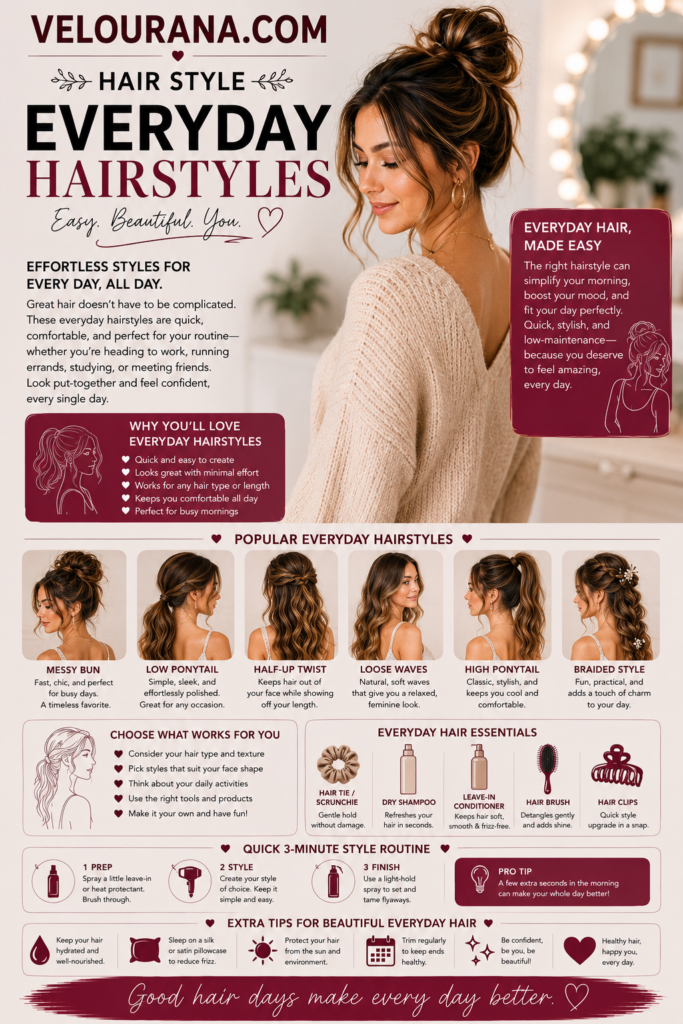
CATEGORY: Everyday Hairstyles
Busy mornings have a way of changing the standards by which a hairstyle is judged. A beautifully styled head of hair may sound appealing when there is plenty of time, but when breakfast is unfinished, messages are arriving, work is waiting and the clock is moving faster than expected, practicality suddenly matters just as much as appearance.
This is where a good everyday hairstyle proves its value.
It should not require twenty carefully executed steps. It should not depend on every strand behaving perfectly. It should not collapse because the wearer walked outside, put on a coat or rushed for a train. Most importantly, it should not demand so much attention that getting ready becomes stressful.
The most useful quick hairstyles are built around efficiency rather than haste.
There is a difference.
Haste means trying to perform a complicated routine faster. Efficiency means removing the parts of the routine that are not actually necessary.
Perhaps the whole head does not need restyling because only the front changed overnight. Perhaps yesterday's waves are still attractive enough to become a ponytail. Perhaps natural texture can remain visible instead of being straightened first. Perhaps the easiest solution to flattened roots is changing the part rather than reaching immediately for a hot tool.
Once everyday hairstyling is approached this way, a rushed morning does not automatically have to become a bad-hair morning.
The objective is simply to identify what will make the greatest visual difference in the time available.
The First Minute Should Be Spent Looking at the Hair, Not Automatically Restyling It
A surprising amount of morning styling time can be wasted because the routine begins before the hair has actually been assessed.
Someone wakes up, sees that the hairstyle is no longer exactly as it was the previous day and assumes everything needs to be done again.
Usually, it does not.
Hair changes unevenly overnight.
The crown may flatten while the lengths remain smooth.
One side may develop a bend.
The front may separate differently.
Curls may lose definition in only a few areas.
The ends may still look completely polished.
Before beginning, it is useful to look at the complete shape.
If most of the hair is already working, the quickest hairstyle will usually preserve it.
This is particularly valuable for long or dense hair because complete restyling can take substantial time.
A few deliberate adjustments around the face may make the entire hairstyle look refreshed.
Changing the part can alter the crown instantly.
Gathering the upper sections can hide irregular roots while preserving attractive lengths.
A ponytail can turn yesterday's texture into today's movement.
A bun can use hair that no longer looks ideal loose.
The first decision should therefore be based on what the hair actually needs that morning, not simply on what was done the previous morning.
A Good Haircut Does Much of the Everyday Styling Before You Begin
The easier a haircut is to live with, the less work it generally requires every morning.
Layers can create natural movement.
Face-framing sections can give the front a recognizable shape even when the rest of the hair is minimally styled.
A well-proportioned bob can look deliberate with little more than attention to the ends.
Curly and coily cuts that respect natural volume can make the overall silhouette easier to restore after sleeping.
This is one reason everyday hairstyle expectations should reflect the haircut.
If a cut is designed around movement, trying to make every strand perfectly uniform may work against it.
If the haircut is blunt and architectural, attention to the perimeter may create more impact than spending time styling the crown.
The haircut provides the structure.
Everyday styling should usually refine that structure rather than reinvent it.
This becomes particularly important during busy periods because a hairstyle that requires complete reconstruction every morning is difficult to sustain.
The best everyday hair often begins long before the morning routine, with a cut that works naturally with the hair's texture, density and normal styling habits.
A Low Ponytail Can Look Finished in Minutes
The low ponytail is one of the most efficient hairstyles available because almost every part of it can be adjusted according to the amount of time available.
At its simplest, the hair can be gathered at the nape and secured.
If another minute is available, the front can be refined.
A center part creates a cleaner, more symmetrical appearance.
A side part produces a softer effect.
The crown can remain sleek or retain a little volume depending on preference.
The lengths do not need to be perfectly straight or curled.
Existing texture can become part of the ponytail.
Yesterday's waves can create movement.
Natural curls can create fullness.
Straight hair can produce a simple clean line.
A small section of hair can be wrapped around the fastening when a more polished finish is wanted, although this is optional rather than necessary.
The hairstyle succeeds because the silhouette is clear.
The front is controlled.
The hair is gathered deliberately.
The lengths move together.
This can make even imperfect second-day hair look considerably more organized.
A low ponytail also transitions easily through different parts of the day. It can work for the office, errands or lunch and can later become a bun if the hair needs to be completely secured.
That adaptability is exactly what a useful everyday hairstyle should provide.
A Mid-Height Ponytail Creates Instant Energy
Moving the ponytail slightly higher changes its character.
The hair gains more movement because the lengths fall from a higher point.
The crown can appear more lifted.
The face can look more open.
This can be especially useful when the hair feels flat after sleeping.
Instead of trying to recreate root volume throughout the entire head, gathering the hair upward can change the silhouette immediately.
The finish can remain soft.
The crown does not necessarily need to be pulled tightly.
A little natural texture can remain.
The front can be directed according to preference.
For fine hair, a ponytail with some movement through the lengths can create the impression of more body.
For dense hair, the style organizes volume without eliminating it.
Curly and coily textures can produce particularly expressive ponytails because the natural fullness remains visible.
The key is comfort.
The ponytail should feel secure without creating unnecessary tension.
A quick hairstyle loses much of its usefulness if it becomes uncomfortable before lunchtime.
The High Ponytail Can Rescue Hair That Has Lost Its Shape
There are mornings when the lower hair still looks good but the crown has become difficult.
A high ponytail can solve both problems simultaneously.
The upper hair is gathered into a new shape, while the existing movement through the lengths becomes part of the finished style.
This works particularly well when waves or curls remain from previous styling.
Instead of trying to recreate the original loose hairstyle, the texture can be repurposed.
The result may actually look more deliberate because the ponytail gives the movement a clear direction.
A high ponytail can be sleek or softer depending on the desired finish.
The front can be controlled completely or a few natural face-framing pieces can remain.
The ponytail itself can stay textured.
It does not need to be re-curled simply because some sections are looser than others.
Once gathered, those variations often blend naturally.
This is an important principle for rushed styling.
Changing the structure of the hairstyle can make minor inconsistencies disappear without correcting them individually.
The Low Bun Is One of the Fastest Routes to Polished Hair
When loose hair is not cooperating, a low bun can create immediate order.
The style is especially effective on second- or third-day hair because the existing texture often makes the hair easier to gather.
The bun can be compact and smooth or slightly softer depending on the situation.
A clean center part with a controlled low bun can look minimalist and sophisticated.
A side part creates a different character.
A softer crown and a few deliberate face-framing pieces make the same basic hairstyle more relaxed.
The bun itself does not need complicated construction for everyday wear.
The objective is a clear, secure shape that remains comfortable.
Long hair can be twisted before being secured.
Medium hair may form a smaller knot.
Dense hair may need a stronger fastening or more distributed support.
Fine hair can create an elegant compact bun without trying to imitate the volume of thicker hair.
The front usually determines how finished the hairstyle appears.
Taking a short amount of time to shape the part and hairline can make a simple bun look considerably more deliberate.
This is one of the highest-value adjustments in quick styling because the back can remain extremely simple while the visible front looks polished.
A Soft Bun Works Better When Imperfection Is Allowed
Not every everyday bun needs a smooth surface.
A softer bun can be created from existing waves, curls or natural texture.
The crown can retain some volume.
The sides can move backward without being completely flattened.
The bun can contain visible texture rather than forming one uniform shape.
This is particularly useful when the hair has already been styled on a previous day.
Instead of brushing away every remaining wave, the movement can contribute to the bun.
The result looks intentionally softer.
The important distinction is between softness and randomness.
If sections are falling out everywhere, the style may simply need more security.
If a few selected pieces create movement while the main structure remains stable, the effect can look effortless.
The hairstyle should still have a recognizable shape.
This allows a quick bun to feel stylish without requiring the precision of formal event hair.
A Claw-Clip Twist Can Transform Hair Almost Instantly
The claw-clip twist has become an everyday favorite because it combines speed, adjustability and visible structure.
The hair is gathered, twisted upward and secured.
Depending on the length, the ends can remain visible, fold downward or be tucked into the style.
The exact result changes with the hair.
Long hair creates a larger twist.
Medium hair can produce a compact shape.
Dense hair creates more volume around the clip.
Fine hair may produce a cleaner, narrower silhouette.
Natural texture adds dimension without requiring additional styling.
The clip itself should be appropriate for the amount of hair.
A clip that is too small may continually loosen.
One that is unnecessarily large may feel heavy or visually dominate the hairstyle.
The strongest everyday accessories are the ones that actually perform their job comfortably.
A claw clip is also valuable because the hairstyle can be changed easily.
The hair can be released later.
It can become a ponytail.
The twist can be repositioned.
There is no complicated structure to dismantle.
This flexibility makes it particularly useful for workdays and travel.
Half-Up Hair Can Fix the Front Without Touching the Lengths
When the lower hair still looks attractive but the upper sections do not, a half-up style is one of the most efficient solutions.
The sides and crown can be gathered at the back, instantly controlling the area most visible around the face.
The lower hair remains unchanged.
This works particularly well with waves, curls and textured second-day hair because the movement through the lengths is preserved.
Straight hair can also look polished when the upper section is secured cleanly.
The style can be extremely simple.
A small elastic creates a half ponytail.
A clip creates a softer arrangement.
The sides can be twisted before being secured if a little more detail is wanted.
The crown can be lifted gently if the hair has flattened overnight.
The entire transformation can take only a few minutes because there is no need to restyle the lower sections.
For busy mornings, this is exactly the kind of technique that creates a large visual change from a small amount of work.
A Change of Part Can Be a Hairstyle in Itself
Changing the part is one of the fastest ways to alter the appearance of loose hair.
Hair that has been resting in the same direction can become flat along the roots.
Moving the part slightly can create immediate lift because the roots are being asked to fall differently.
A center part creates symmetry.
A side part can produce more volume and a stronger sweep.
An off-center part offers a subtle change without dramatically altering the appearance.
This technique is particularly useful when the lengths already look good.
There is no reason to restyle everything simply because the crown lacks energy.
The new part can provide enough change to make the hairstyle feel refreshed.
Face-framing sections may need a small adjustment so that they follow the new direction naturally, but this still requires far less work than a complete styling session.
Small structural changes often provide the best solutions on rushed mornings.
The Front Sections Deserve Priority When Time Is Limited
If only a few minutes are available, the front is usually the most valuable place to spend them.
These sections frame the face and are visible during conversation, photographs, video calls and mirror checks throughout the day.
The back can be imperfect without attracting much attention.
A badly positioned fringe is much harder to ignore.
Curtain bangs can be redirected.
A side fringe can be smoothed.
Long face-framing layers can be given a gentle outward movement.
Shorter pieces can be controlled around the hairline.
Once the front sits correctly, the remainder of the hair often appears more styled automatically.
This is especially useful with loose hair.
The lengths may need almost no work if the front creates a clear shape.
The same principle applies to ponytails and buns.
A simple fastening at the back can look sophisticated when the front has been handled deliberately.
Quick styling is therefore partly about understanding visual priority.
Not every section contributes equally to the final impression.
Straight Hair Can Be Refreshed Without Straightening Everything Again
Straight or previously straightened hair often survives overnight better than it initially appears.
The lengths may still be smooth while one or two sections have developed bends.
The crown may be flatter.
The ends may curve differently.
A complete straightening session is rarely necessary in this situation.
The changed areas can be corrected selectively.
If one side has bent from sleeping, only that area may need attention.
If the front has lost its direction, the lengths can remain untouched.
If the ends still look polished, there is no reason to repeatedly pass heat through them.
The hair can also be converted into another style.
A low ponytail uses the existing smoothness.
A bun benefits from controlled lengths.
A half-up style can hide an imperfect crown.
This approach makes everyday straight styling more efficient while reducing unnecessary repetition.
Wavy Hair Can Look Better When the Morning Routine Does Less
Wavy hair naturally contains irregularity.
Trying to make every section form the same wave each morning can consume a great deal of time without necessarily producing a better everyday result.
Instead, the overall silhouette can guide the refresh.
If most of the wave remains attractive, only the visibly flattened or unusually shaped sections need attention.
The front can be refined.
The crown can be lifted.
The lengths can remain natural.
If the wave pattern has become too inconsistent to wear loose, a half-up style can immediately create more structure.
A ponytail turns the waves into movement.
A braid organizes them.
A bun uses their texture.
This flexibility makes wavy hair particularly well suited to quick styling.
The natural movement is already doing part of the work.
Curly Hair Does Not Need Every Curl Refreshed Before Leaving the House
Curly hair can look dramatically different after sleeping, but the complete pattern rarely needs to be reconstructed every morning.
The silhouette is usually more important than individual perfection.
A flattened area at the back can be reshaped.
A few front curls can be refreshed.
The crown can be adjusted.
If the majority of the hair remains defined, it can stay as it is.
When the loose style no longer feels cohesive, the texture can become part of another hairstyle.
A high ponytail or puff can create an immediate new shape.
A half-up style controls the upper sections.
A bun gathers the curls while allowing selected pieces to remain visible.
The natural pattern continues to provide the visual interest.
The morning routine simply gives it direction.
This can be far quicker than attempting to make every curl identical.
Coily Hair Can Create Fast Styles Through Shape and Volume
Coily hair offers many possibilities for quick everyday styling because volume itself can become part of the design.
A puff can create a strong silhouette with relatively little manipulation.
A high or low bun can organize the hair.
A half-up arrangement can preserve volume while opening the face.
Twists or braids from an existing style can be repositioned.
A headband can change the front instantly.
The goal does not need to be making the hair smaller or smoother.
It can be shaping the existing volume into a deliberate form.
This is especially valuable on rushed mornings because natural texture does not need to be erased before styling can begin.
The texture is already the foundation.
Short Hair Can Often Be Refreshed by Correcting Only One Area
Short hair has less length to manage, but sleeping can alter its shape noticeably.
One side may flatten.
The crown may stand differently.
A fringe can change direction.
Because the haircut itself creates most of the silhouette, correcting the most disrupted area may be enough.
A bob may need attention only through the front and ends.
A pixie may need reshaping through the crown.
A fringe can be redirected while the rest remains untouched.
Short hair demonstrates particularly clearly why selective styling works.
The goal is not to restyle every strand.
It is to restore the shape of the haircut.
Braids Are Valuable When the Day Will Be Long
A braid can be an excellent choice when the hairstyle needs to remain manageable for many hours.
Long hair is kept controlled.
Wind becomes less disruptive.
The style can transition easily between work, errands and travel.
A simple low braid requires little time.
A side braid changes the appearance without adding much complexity.
Two braids can create a more casual style.
A small braid can also become part of loose or half-up hair when the wearer wants detail rather than complete containment.
Existing texture can make the braid more dimensional.
There is no requirement for every section to be perfectly smooth.
In fact, a little natural movement can make an everyday braid feel softer and more modern.
The front should still be considered because this is what makes the braid look deliberate rather than purely functional.
A clear part, a little crown shape or controlled face framing can elevate the entire style.
Accessories Can Replace Several Minutes of Styling
The right accessory can create both function and visual interest.
A headband can control a difficult hairline.
A barrette can secure one side.
A decorative clip can create a half-up style.
A claw clip can replace a more complicated bun.
A scrunchie can turn a ponytail into a more visible styling choice.
The accessory should not merely hide hair that has not been styled.
It should contribute to the silhouette.
A headband paired with natural texture can look deliberate.
A clean low ponytail with a simple accessory can appear polished.
A clip positioned at the back can become the focal point of a half-up style.
This is especially useful when there is little time because the accessory performs two jobs at once.
It holds the hair and completes the look.
Heat Styling Should Be Used Where It Changes the Result Most
When a morning is rushed, there is little value in heat-styling sections that already look acceptable.
A few targeted adjustments can produce most of the visual benefit.
The front may need smoothing or movement.
One side may need correction.
The ends may need a small amount of direction.
The rest can remain.
This is particularly important for long hair because a complete straightening or curling session can consume substantial time.
Selective styling also prevents the routine from becoming an automatic repetition of yesterday's work.
The tool is used because a section needs it, not simply because it is part of the usual sequence.
This creates a more responsive routine.
Some mornings may require almost no heat.
Others may need a little more.
The amount of work reflects the actual condition of the hair.
The Best Busy-Morning Hairstyle Can Be Chosen the Night Before
A small amount of preparation can simplify the following morning considerably.
This does not require an elaborate overnight routine.
It can be as simple as thinking about what tomorrow will involve.
If the morning will be extremely rushed, the hair can be arranged overnight in a way that supports the intended style.
If a ponytail is planned, preserving perfectly styled ends may be unnecessary.
If the hair will be worn loose, protecting the existing shape becomes more useful.
If a bun or braid is likely, natural second-day texture may be an advantage.
The purpose is not to create another complicated task before bed.
It is to avoid doing work at night that will simply be undone the following morning.
Everyday efficiency improves when one styling decision supports the next.
A Hairstyle Should Be Able to Adapt When the Day Changes
The morning hairstyle does not always need to remain the evening hairstyle.
Loose hair can become a ponytail.
A ponytail can become a bun.
Half-up hair can be gathered completely.
A braid can be undone to reveal additional texture.
A claw-clip twist can be released.
This flexibility is valuable when a day includes work, exercise, errands and social plans.
Instead of trying to create one hairstyle that is perfect for every situation, it can be easier to choose a starting style that converts naturally.
A few accessories carried in a bag may be enough.
This makes the hairstyle part of the day rather than something that must be protected from it.
Looking Polished Quickly Is Mostly About Making Fewer, Better Decisions
Busy-morning hairstyling becomes much easier once the expectation of complete transformation is removed.
The hair does not need to begin from zero.
Yesterday's texture can remain.
Natural waves can remain.
Curls and coils can remain.
The crown can be adjusted without touching the ends.
The front can be styled without rebuilding the back.
Loose hair can become half-up.
A difficult second-day style can become a ponytail.
A ponytail can become a bun.
A clip can replace several minutes of pinning.
The most important question is not, “How can I style all of my hair quickly?”
It is, “What does my hair actually need to look intentional today?”
Sometimes the answer is the front.
Sometimes it is the crown.
Sometimes it is simply gathering the hair into a better shape.
This shift changes the entire morning routine.
Instead of racing through a long sequence, the wearer responds to the hair in front of her.
Fine hair can preserve lightness.
Dense hair can organize its volume.
Straight hair can keep yesterday's smooth lengths.
Wavy hair can use its natural movement.
Curly hair can refresh selected sections.
Coily hair can build a style around natural volume.
Short hair can regain its shape through a few directional changes.
The hairstyle becomes faster because unnecessary work disappears.
That is the real secret of easy everyday hair.
Speed does not come from learning to perform complicated styling faster.
It comes from understanding which parts of the styling were never necessary in the first place.
Once that becomes familiar, even a very busy morning can produce hair that looks polished, comfortable and deliberate.
Not because every strand is perfect.
Because the complete hairstyle makes sense.
The End
Velourana.
 Discover More From Our Family of Websites
 ZodiacBearing (Astrology, Tarot, Numerology, Angel Numbers & Spiritual Guidance)
 Velourana (Beauty, Makeup, Hair Care, Skincare & Beauty Tips)
 HavenBearing (Home, Living, Organization, Décor & Everyday Inspiration)
 PawBearing (Pet Care, Dog Breeds, Animal Health, Training & Pet Products)
 PsyCatherine (Notes From the Journal of a Psychologist on Real Life)

