
CATEGORY: Bridal Hairstyles
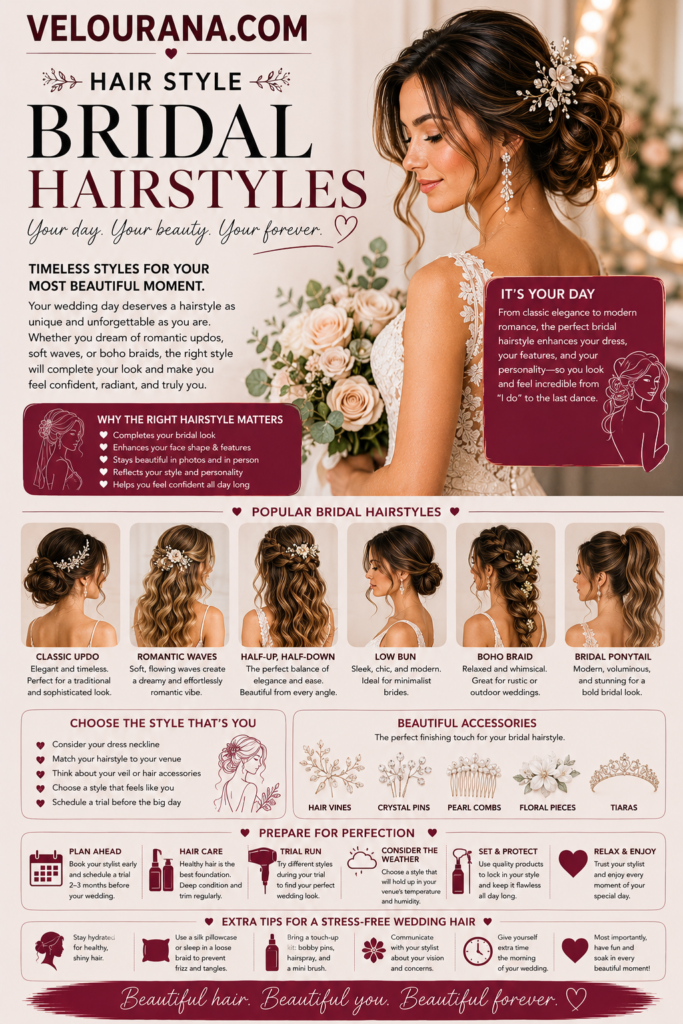
A bridal hairstyle carries an unusual responsibility. It has to look beautiful in person, complement the dress, work with the veil or other accessories, photograph well from several angles and remain comfortable enough to wear through hours of movement, conversation, photographs and celebration. At the same time, it should still feel like the person wearing it.
That final requirement is easy to underestimate.
Wedding styling can create pressure to choose something more elaborate simply because the occasion is important. Someone who normally loves loose, uncomplicated hair may suddenly feel that an intricate sculpted updo is expected. Someone who almost always wears her hair away from her face may be encouraged toward cascading waves because they appear romantic in photographs.
Neither choice is inherently wrong. The difficulty begins when the hairstyle becomes disconnected from the bride.
The most successful bridal hair usually feels elevated rather than disguised.
It may be more polished than an everyday hairstyle. The waves may be more deliberate, the bun more structured, the ponytail more refined or the accessories more decorative. Yet there is often something recognizable underneath the occasion styling.
Choosing that hairstyle begins with understanding the complete bridal look rather than considering the hair in isolation.
The neckline matters.
The dress silhouette matters.
The veil matters.
Jewelry matters.
Hair length and density matter.
The ceremony location matters.
Weather may matter enormously.
The bride's normal relationship with her hair matters too.
A bridal hairstyle is therefore not simply a choice between wearing the hair up or down. It is a balancing exercise between aesthetics, practicality and identity.
When those elements work together, the hair does not compete with the bride or the dress.
It completes the picture.
The Dress and Hairstyle Should Belong to the Same Visual Story
A wedding dress occupies a large amount of visual attention, which means the hairstyle should be considered in relation to its proportions and details.
A highly embellished gown can support several different approaches. An elaborate hairstyle can continue the decorative mood, while a simpler hairstyle can create contrast and allow the dress to remain dominant.
A minimalist dress creates equally interesting possibilities. Sleek hair can reinforce the clean aesthetic, while soft waves or a textured bun can introduce romance and movement.
There is no universal rule stating that a particular dress requires a particular hairstyle.
The useful question is whether the elements feel intentional together.
The neckline provides an especially practical starting point.
A high neckline already occupies considerable visual space around the shoulders and neck. An updo can reveal that structure clearly, although loose hair can also work when softness is desired.
A strapless or off-the-shoulder dress exposes more skin around the upper body, allowing loose waves to occupy some of that space beautifully. An updo creates a different effect by emphasizing the shoulders, collarbones and neckline.
A detailed back deserves consideration as well.
If lace, buttons, embroidery or an architectural back is an important feature of the gown, wearing all of the hair down may hide part of it. A bun, ponytail or strategically positioned half-up style can allow the detail to remain visible.
The hairstyle does not have to obey the dress.
It should communicate with it.
Start With the Bride's Natural Style Identity
Before considering trends, photographs or accessories, it is useful to think about how the bride normally feels most attractive.
Someone who almost always wears her hair loose may feel surprisingly exposed in a severe updo.
Someone who prefers her hair away from her face may spend the entire wedding day adjusting loose front sections.
A bride who loves polished, minimalist styling may not feel comfortable with an intentionally undone bohemian hairstyle, even if it looks beautiful in inspiration photographs.
This does not mean bridal hair should look ordinary.
It means the transformation should have a recognizable starting point.
A person who loves ponytails can wear an exceptionally polished bridal ponytail.
Someone who lives in buns can choose a beautifully constructed low chignon.
Someone who prefers loose hair can elevate it with waves, volume, carefully shaped front sections or accessories.
Someone who enjoys half-up hairstyles can use that familiar silhouette while making the finish significantly more sophisticated.
There is emotional value in recognition.
Wedding photographs will remain long after individual hairstyle trends have changed. A style that feels connected to the bride's normal aesthetic can age more naturally because it represents the person rather than only the fashion of the moment.
Wearing Bridal Hair Down Creates Romance and Movement
Loose bridal hair can look effortless, although achieving that appearance often requires considerable preparation.
The attraction is obvious.
Hair moving over the shoulders creates softness. Waves can interact beautifully with light. Long lengths add visual movement to photographs, and the hairstyle can feel less formal than a traditional updo.
Loose bridal waves range from broad, polished Hollywood-inspired shapes to softer modern bends and relaxed textured movement.
The amount of definition changes the personality of the style.
Highly organized waves create glamour and precision.
Larger, separated curls create volume and romance.
Soft bends feel contemporary and relaxed.
The appropriate choice depends partly on the dress and partly on the bride.
Length influences the result as well.
Very long hair creates dramatic movement but carries more weight, which can affect how strongly curls or waves remain defined as the day progresses.
Medium-length hair can hold broad movement beautifully because it has enough length to create shape without the same amount of weight.
Shorter hair can still create an elegant loose bridal style through polished texture, strategic volume and accessories.
Wearing the hair down also requires practical thought.
The hair will interact with the shoulders, dress and potentially the veil. Outdoor conditions can influence its shape. Repeated touching can gradually change face-framing sections.
These considerations do not make loose hair unsuitable.
They simply mean that the desired softness should be engineered rather than assumed.
The Bridal Updo Remains Timeless Because It Solves Several Problems at Once
Updos have remained central to bridal styling because they combine elegance with practicality.
The hair is largely controlled.
The neck and shoulders remain visible.
Dress details can be revealed.
A veil can often be positioned clearly.
The hairstyle can maintain a recognizable silhouette without the lengths constantly moving against clothing.
Yet the term “bridal updo” describes an enormous range of styles.
A sleek low bun can look architectural and modern.
A textured chignon can feel romantic.
A high bun can create drama and height.
A twisted updo can appear soft and intricate.
A deliberately loose arrangement can create an almost effortless effect while still keeping the majority of the hair secured.
The position of the updo matters significantly.
A low bun creates visual weight near the nape and often feels sophisticated and understated.
A higher bun exposes more of the neck and can create a stronger, more formal silhouette.
A centered style creates symmetry.
A slightly asymmetric arrangement introduces softness and movement.
The finish matters just as much.
Sleek surfaces communicate precision.
Visible texture creates dimension.
Loose pieces around the face can soften an otherwise structured shape.
An updo should therefore be chosen as a complete design rather than simply as the decision to put the hair up.
Low Buns Can Move From Minimalist to Romantic With Small Changes
The low bun has become one of the most versatile bridal hairstyles because its basic structure can support dramatically different aesthetics.
A smooth center-parted bun can look exceptionally modern.
A softer bun with visible twists can feel romantic.
A fuller chignon creates classic bridal elegance.
Loose face-framing pieces can make the style more relaxed.
The placement can also alter the proportions.
A bun positioned directly at the nape feels different from one sitting slightly higher.
The volume of the bun should make sense in relation to the bride's head shape, hair density and overall styling.
Hairpieces and extensions can sometimes be incorporated professionally when additional fullness is desired, but the objective should be proportion rather than simply maximum size.
The bun also creates an excellent foundation for accessories.
Pins can be placed around one side.
A comb can sit above the bun.
Flowers can be incorporated into the shape.
A veil may be positioned according to its design and the intended final appearance.
Because the hairstyle itself is relatively contained, decorative elements can become particularly visible.
That makes restraint important.
If the dress, jewelry, veil and hair accessory are all highly detailed, the complete look can become visually crowded.
The bun may be simple precisely because other elements are elaborate.
Half-Up Bridal Hair Offers a Beautiful Compromise
Some brides want the romance of loose hair but the security and openness of an updo.
Half-up styling provides a natural compromise.
The upper sections are controlled, keeping hair away from the face, while the lower lengths remain visible and mobile.
This can be particularly flattering with long or medium hair.
The crown can have volume.
The sides can be twisted, braided or smoothly swept backward.
The lower hair can be curled, waved or kept relatively straight.
Accessories can be positioned where the upper sections meet, creating a natural focal point.
Half-up hair also works well with many veil placements because the secured section can provide a clear structural area for professional positioning.
The style can range from extremely polished to deliberately relaxed.
A smooth crown with glossy waves creates a refined look.
Soft twists and loose curls create more romance.
A small braid can introduce detail without turning the hairstyle into a fully braided design.
The balance between the secured upper portion and loose lower hair should be considered carefully.
Taking too much hair upward can make the style resemble an incomplete updo.
Taking too little may not provide enough control around the face.
The most successful version usually creates a clear silhouette from every angle.
Bridal Ponytails Can Be as Formal as Traditional Updos
A ponytail may sound too ordinary for bridal hair until the everyday version is separated from the professionally styled version.
A bridal ponytail can be sleek, sculptural and exceptionally sophisticated.
The base can be smooth and polished.
The ponytail itself can remain straight, develop large waves or carry voluminous curls.
A section of hair can conceal the fastening, creating a more continuous finish.
Face-framing pieces can soften the front.
The height changes the mood dramatically.
A low ponytail feels elegant and restrained.
A mid-height ponytail creates movement while maintaining sophistication.
A higher ponytail can feel glamorous and energetic.
This style can be particularly effective for brides who naturally prefer wearing their hair tied back.
It keeps the face open while preserving the visual presence of long hair.
The ponytail also moves beautifully, which can add energy to photographs and dancing.
The dress should be considered, particularly if the ponytail falls over important back detailing.
Its length and placement can be adjusted so that the hair and gown do not compete unnecessarily.
Braids Can Add Detail Without Dominating the Hairstyle
Braids have a natural association with romantic and bohemian bridal styling, but they do not need to become the entire hairstyle.
A small braid can act almost like an accessory.
It can travel through a half-up style.
It can disappear into a bun.
It can add texture to one side of an updo.
It can frame the crown before merging into loose waves.
This restrained use of braiding can add visual interest while keeping the overall style sophisticated.
More elaborate braided hairstyles can also work beautifully when they match the wedding aesthetic.
Outdoor celebrations, garden weddings and relaxed destination ceremonies can provide an especially natural context for softer braided styles.
The braid should still relate to the rest of the hair.
If the lower lengths are very polished, an extremely loose rustic braid above them may feel disconnected.
If the entire hairstyle has soft texture, the braid can share that character.
Consistency of finish helps the different elements appear intentional.
Short Hair Can Be Exceptionally Bridal Without Pretending to Be Long
Bridal inspiration often focuses heavily on long hair, which can create the impression that short hair requires extensions to look sufficiently formal.
It does not.
A short haircut can become bridal through precision, texture, volume and accessories.
A bob can be styled sleek and glossy.
It can carry soft waves.
The ends can curve inward for a polished vintage influence or remain straighter for a modern finish.
A pixie can use directional texture, controlled volume or a decorative headpiece.
Hairpins, headbands, combs and veils can become particularly striking because they are not competing with large amounts of hair.
The haircut itself should remain visible.
Trying to transform short hair into an imitation of long bridal hair can overlook the sophistication that made the cut attractive in the first place.
A bride who normally wears short hair may look most recognizably herself when that shape is celebrated rather than concealed.
Curly Bridal Hair Does Not Need to Be Straightened Before It Can Become Formal
Natural curls can create extraordinary bridal hairstyles.
The texture already provides movement, volume and visual complexity.
The styling process can therefore focus on definition, shape and placement rather than automatically replacing the curl pattern.
Loose curls can be worn down.
The upper sections can be gathered into a half-up style.
Curls can be arranged into a textured updo.
A ponytail can showcase the natural pattern.
Face-framing curls can remain visible around a secured style.
The decision should depend on what the bride wants rather than on an assumption that formal hair must be straight or conventionally smoothed.
Curly hair can also support accessories beautifully because the texture creates natural visual depth around decorative elements.
The key is ensuring that the accessory remains secure and that its placement complements rather than overwhelms the curl pattern.
A bridal trial becomes particularly valuable when the natural texture varies significantly with weather or styling conditions.
Seeing how the chosen design behaves over several hours can reveal more than looking at it immediately after completion.
Coily Hair Offers Extraordinary Possibilities for Bridal Styling
Coily and tightly textured hair can support an enormous range of bridal looks without requiring the natural texture to be hidden.
Sculptural updos can use the hair's natural volume.
Defined coils can remain visible.
Twists can become part of the design.
A high arrangement can create dramatic height.
A low textured style can feel elegant and romantic.
Accessories can be integrated into the shape rather than simply placed on top of it.
Straightened bridal styles are also an option when that is genuinely what the bride wants.
The important point is choice.
Natural texture should not be treated as an obstacle between the bride and a formal hairstyle.
It can be the foundation of the formal hairstyle.
The same principle applies to protective styling. Braids and twists can become sophisticated bridal designs when the structure, finish and accessories are coordinated with the complete look.
The wedding hairstyle should celebrate the hair rather than suggest that only one texture qualifies as elegant.
The Veil Must Be Considered Before the Hairstyle Is Finalized
A veil can alter the practical requirements of a bridal hairstyle significantly.
Its weight, length, attachment and intended placement all matter.
A small lightweight veil creates different demands from a long cathedral veil.
The hairstyle should provide an appropriate location for secure professional placement without compromising the intended silhouette.
This is one reason the veil should ideally be available during the bridal hair trial.
The bride can see how it interacts with the hairstyle rather than imagining the result.
Placement changes the appearance too.
A veil positioned above a low bun creates a different silhouette from one placed beneath it.
A veil attached around a half-up section interacts differently with loose waves.
A high placement can create more volume around the head, while a lower placement can allow the hairstyle itself to remain more visible.
There is no single correct arrangement.
The important thing is that the veil and hair are designed together rather than treated as separate decisions made at the last moment.
Hair Accessories Should Have a Purpose Within the Design
Bridal hair accessories can transform a simple hairstyle.
A pearl pin can introduce subtle light.
A decorative comb can create a focal point.
A headband can add structure.
Flowers can reinforce a romantic or natural aesthetic.
A tiara can create formality and drama.
The accessory should, however, have a visual purpose.
It may connect the hair with the jewelry.
It may repeat details from the dress.
It may introduce contrast to an otherwise minimalist look.
It may fill an area of the hairstyle that would otherwise appear visually empty.
What it should not do is exist simply because bridal hair is expected to contain decoration.
A beautifully constructed hairstyle can stand alone.
Accessories are optional.
When they are used, scale matters.
A delicate hairstyle can be overwhelmed by an enormous decorative piece.
A very full textured updo may visually absorb an accessory that looked substantial when held in the hand.
The trial provides an opportunity to judge these proportions accurately.
Bridal Hair Should Be Designed From the Back as Well as the Front
Everyday hairstyling is often judged primarily in the mirror.
Bridal hair will be photographed from everywhere.
The front matters because it frames the face.
The sides matter during conversations and profile photographs.
The back matters during the ceremony, while walking down the aisle and in photographs of the dress.
An updo should therefore have a deliberate back silhouette.
A half-up hairstyle should look complete where the sections join.
A ponytail should have a polished base.
Loose waves should fall coherently rather than appearing beautifully styled only around the face.
The hairstyle should also make sense from above and below when photographs are taken from different positions.
This does not mean every angle must contain elaborate detail.
Often, the strongest bridal styles have a clear shape that remains recognizable from every direction.
That three-dimensional quality distinguishes event hairstyling from a style created only for a front-facing photograph.
Weather Can Be Part of the Hairstyle Decision
A hairstyle exists in an environment.
An indoor winter ceremony creates different conditions from an outdoor summer wedding near the sea.
Humidity can influence texture.
Wind can move loose sections.
Heat can affect comfort.
The bride does not need to choose a completely practical hairstyle at the expense of everything she loves, but environmental conditions deserve realistic consideration.
Someone planning an outdoor celebration in humid weather may prefer a hairstyle that can tolerate a little natural texture developing over time.
A very rigid expectation of perfectly smooth loose hair can create unnecessary concern if the natural texture reacts strongly to humidity.
A textured updo, ponytail or half-up style may allow changes to blend more naturally.
Wind deserves similar consideration.
Loose front sections that look beautifully delicate indoors can behave very differently outside.
The solution may be slightly more secure placement rather than eliminating softness completely.
The hairstyle should be capable of living through the actual wedding, not merely surviving the first photograph.
Comfort Is Part of Bridal Beauty
A hairstyle can look spectacular and still be wrong if it becomes uncomfortable after an hour.
Very tight styling can create tension.
Heavy extensions or accessories can change how the hairstyle feels over time.
Large numbers of pins can become noticeable.
A veil can add additional weight.
These factors should be assessed during the trial whenever possible.
The bride should move naturally.
Turn the head.
Look downward.
Sit.
Walk.
Notice whether anything pulls.
A wedding day can last many hours.
The hairstyle needs to remain wearable throughout the ceremony, photographs, meal and celebration.
Comfort also affects appearance indirectly.
A bride who constantly touches, adjusts or pulls at her hair will gradually change the style.
A secure, comfortable hairstyle can largely be forgotten.
That is one of the best qualities bridal hair can have.
The Bridal Hair Trial Is a Design Session, Not Merely a Preview
A trial offers much more than the opportunity to see whether a chosen hairstyle looks attractive.
It allows assumptions to be tested.
A style that looks perfect in an inspiration photograph may behave differently with another hair length, density, texture or haircut.
The proportions may need adjustment.
The part may look better slightly changed.
The bun may need to sit higher or lower.
The face-framing sections may need to be softer.
The accessory may be too large.
The veil placement may change the entire appearance.
These discoveries are useful.
The purpose of a trial is not to prove that the original idea was correct.
It is to develop the strongest version of the idea for the actual bride.
Photographs from multiple angles can also be useful because the mirror and camera do not always communicate a hairstyle in exactly the same way.
The bride can evaluate the front, sides and back.
She can also observe how the style changes after several hours rather than judging it only immediately after completion.
That information can guide final adjustments for the wedding day.
Timeless Bridal Hair Is Usually More Personal Than Trend-Driven
Wedding hairstyle trends can be wonderful sources of inspiration.
They introduce new shapes, accessories and interpretations of classic styles.
The difficulty comes when a trend becomes more important than the bride.
Wedding photographs remain for decades.
A hairstyle does not need to avoid every contemporary influence to age well. Almost every bridal look reflects its era to some degree.
What tends to remain appealing is coherence.
The hairstyle suits the person.
It complements the dress.
It makes sense with the hair.
It feels intentional.
A sleek bun can be timeless on one bride and completely disconnected on another.
Loose romantic waves can look effortless on one person and uncomfortable on someone who never wears her hair down.
The most enduring choice is therefore not necessarily the most traditional.
It is the one that looks believable.
The Best Bridal Hairstyle Lets the Bride Stop Thinking About Her Hair
There is an interesting contradiction at the heart of bridal hairstyling.
Enormous attention can go into creating the hairstyle, but once the wedding begins, ideally the bride should not need to think about it very much.
The hair should feel secure.
The front should feel comfortable.
The accessories should remain in place.
The veil should work with the style.
The bride should be able to move, embrace people, sit, dance and turn her head naturally.
The hairstyle should participate in the day rather than demand constant maintenance.
That is why the best bridal choice cannot be judged only by how impressive it looks immediately after styling.
It has to function.
Loose waves need to remain attractive as they soften.
An updo should remain comfortable as the hours pass.
A ponytail should continue to feel secure.
A half-up style should control the front while allowing the lower hair to move.
Natural curls and coils should be styled in a way that respects their texture and the conditions in which they will be worn.
Short hair should be celebrated rather than treated as though it needs to imitate long hair.
Accessories should enhance rather than burden the design.
The dress and hairstyle should support one another.
Most importantly, the bride should recognize herself.
A wedding is already an extraordinary version of an ordinary day. The clothing is different. The setting may be different. The photographs are more formal. Every detail has received unusual attention.
The hair can rise to that occasion without becoming a costume.
Perhaps the familiar loose waves become smoother and more deliberate.
Perhaps an everyday ponytail becomes glossy, voluminous and beautifully shaped.
Perhaps naturally curly hair becomes an intricate textured updo.
Perhaps a simple bob receives immaculate movement and a striking accessory.
Perhaps long hair is gathered into a low chignon that reveals the back of the dress.
The possibilities are almost endless, but the principle remains consistent.
The hairstyle should make sense when everything is seen together.
Not merely the hair.
Not merely the dress.
Not merely the veil.
The entire person.
When that balance is achieved, bridal hair does not need to shout for attention. It becomes part of the complete visual memory of the day: polished enough for the occasion, secure enough for the celebration, distinctive enough to feel special and personal enough that years later, the bride can still look at the photographs and recognize herself.
The End
Velourana.
 Discover More From Our Family of Websites
 ZodiacBearing (Astrology, Tarot, Numerology, Angel Numbers & Spiritual Guidance)
 Velourana (Beauty, Makeup, Hair Care, Skincare & Beauty Tips)
 HavenBearing (Home, Living, Organization, Décor & Everyday Inspiration)
 PawBearing (Pet Care, Dog Breeds, Animal Health, Training & Pet Products)
 PsyCatherine (Notes From the Journal of a Psychologist on Real Life)

