
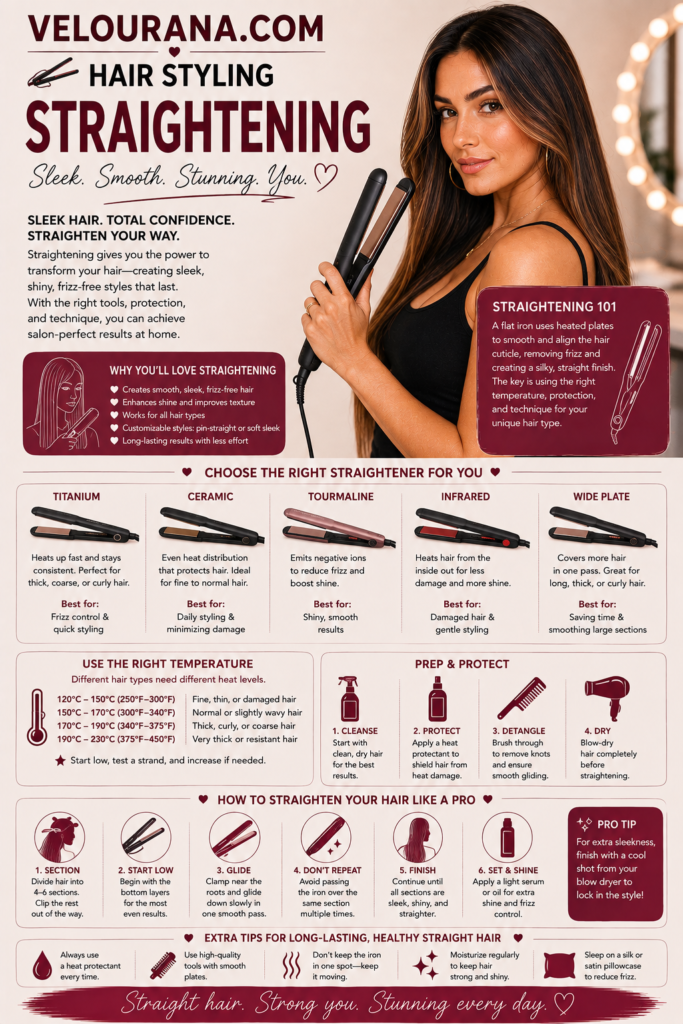
CATEGORY: Straightening
Straightening is often associated with one very specific image: perfectly smooth hair lying close to the head from roots to ends. That finish can be striking when it is intentional, particularly with sharp bobs, precise center parts and highly polished styles. It is not, however, the only way straightened hair can look.
Hair can be straight and still have volume.
It can be sleek while retaining movement. Layers can remain visible. The crown can have lift. Face-framing pieces can sweep away from the face. The ends can curve gently rather than hanging in a rigid line.
The difference comes from treating straightening as hairstyling rather than simply texture removal.
When every section is pulled downward and repeatedly pressed from the roots to the ends, the natural result is a flatter silhouette. The hair may become extremely smooth, but the same technique can remove much of the space that gives a hairstyle body.
A more dimensional straight style uses different techniques in different areas.
The roots may need elevation.
The middle lengths may need smoothness.
The front may need direction.
The ends may need a slight bend.
Shorter layers may need enough separation to remain visible.
Once these objectives are separated, it becomes easier to understand why maximum flatness is unnecessary for many straight hairstyles.
The objective becomes controlled smoothness.
This is particularly useful for fine hair, where excessive compression can make the hairstyle appear less full. It can also transform long layered hair, which may look almost one-length when every section is pressed tightly downward.
Dense hair benefits in another way. Instead of trying to eliminate its natural abundance, straightening can organize that volume into a smoother silhouette.
The result remains recognizably straight.
It simply looks alive.
Root Volume Must Be Preserved From the Beginning
Root volume is difficult to recover if the entire styling process has encouraged the hair to lie tightly against the scalp.
This is why volume should be considered before the straightener reaches the first section.
If hair is blow-dried before straightening, the direction of the blow-dry can influence the final silhouette considerably. Drying every section straight downward can create a very smooth foundation, but it can also establish flatness at the roots.
When more body is desired, the roots can be dried with some elevation.
The crown can be directed upward or backward.
The front can be positioned according to the desired part.
The sides can remain more controlled so that the hairstyle does not become unnecessarily wide.
This creates the basic architecture before direct straightening begins.
Once the straightener is introduced, there may be little reason to place it extremely close to the scalp on every section if the root is already smooth enough.
The tool can concentrate on the areas where additional refinement is needed.
This is particularly relevant for naturally straight or lightly wavy hair. The roots may already be sufficiently smooth, while the middle lengths contain irregular bends.
Beginning the straightener slightly lower can preserve more of the existing root volume.
Different textures require different approaches, of course. Stronger waves, curls or coils may require more root refinement when a thoroughly straight result is desired.
Even then, direction matters.
The root can be smoothed without necessarily being pulled aggressively downward.
The objective is to create straightness while preserving enough space for the hair to retain body.
The Crown Determines Whether Straight Hair Looks Full or Flat
The crown has a disproportionate influence on the overall silhouette.
A small amount of elevation at the top can make the entire hairstyle appear fuller, even when the lengths remain sleek.
Conversely, a very flat crown can make substantial hair appear less voluminous.
This makes the crown one of the most important areas to treat independently.
Instead of automatically straightening crown sections downward, they can be lifted slightly away from the scalp while being refined.
The exact technique depends on the hair and tool, but the directional principle remains useful.
The hair should not be trained into flatness if flatness is not the desired result.
The crown can also be divided into sections that follow the intended final movement.
Hair that will eventually fall backward can be styled with that direction in mind.
Hair around a center part can retain gentle elevation on either side.
A side part can use more root movement through the heavier side to create a natural sweep.
Once the crown has enough smoothness, repeated passes should be avoided.
Additional straightening can gradually remove the volume that the earlier preparation created.
The finished crown should integrate with the lengths.
It does not need obvious height.
Often, the most flattering volume is subtle enough that it is noticed as fullness rather than as deliberate lifting.
Straightening Fine Hair Is Primarily About Preserving Space
Fine hair can become smooth very quickly.
This is both an advantage and a challenge.
Because the strands often respond readily to styling, there may be little need for repeated passes. Yet the familiar routine of straightening every section from the scalp downward can compress the hairstyle unnecessarily.
Fine hair looks fuller when the strands occupy space.
Root lift creates space vertically.
Layer separation creates space through the lengths.
A slight curve at the ends creates space around the perimeter.
These small structural choices can create significantly more visual body without changing the actual amount of hair.
Preparation matters as well.
Heat protection should be used according to the product instructions, but the overall styling routine should avoid unnecessary weight if volume is the objective.
Several heavy smoothing layers can make fine hair behave differently before the straightener is even used.
The hair may become beautifully conditioned but less responsive to volumizing techniques.
A balanced routine provides enough preparation for controlled styling while allowing the strands to remain mobile.
Section size should reflect density rather than strand thickness alone.
Fine hair can still be dense.
If a large amount of fine hair is placed into one section, the straightener may not interact with it consistently. This can encourage another pass.
A manageable section is more efficient.
Once it is smooth, move on.
Fine hair often looks better when straightening stops slightly earlier than the instinct for perfection suggests.
A little natural body can be visually valuable.
Dense Hair Can Be Sleek Without Losing Its Abundance
People with thick or dense hair sometimes approach straightening as a process of reducing volume.
That may be appropriate when an extremely compact finish is desired, but density can also be one of the greatest advantages of straightened hair.
Smooth dense hair can look exceptionally rich.
The challenge is organization.
If the hair is straightened in oversized sections, the surface may become sleek while the interior remains textured. The natural response is to repeat the pass or increase the intensity of styling.
Better sectioning usually provides more control.
Lower layers can be refined first.
Middle sections follow.
The upper surface is styled last.
This allows the straightener to work through manageable amounts of hair and makes it easier to distinguish finished sections.
The lower layers do not necessarily need the same cosmetic perfection as the visible surface. They need enough straightening to integrate into the silhouette.
The upper hair, crown and face-framing pieces can then receive more precise attention.
This creates a hierarchy.
Density remains, but it is directed.
The roots can retain some natural fullness.
The lengths become smoother.
The ends fall into a coherent shape.
The finished hairstyle can be sleek without looking compressed.
A Sleek Blow-Dry Can Reduce the Amount of Flat-Iron Work
Straightening does not need to begin with the flat iron.
For many textures, the blow-dry determines how much direct straightening is required afterward.
A controlled blow-dry can elongate waves, curls or coils and organize the hair into a smoother foundation. If the final objective is straight hair with movement, this foundation does not need to be perfectly flat.
It needs to be manageable.
The dryer and brush can perform much of the broad transformation.
The straightener can then perform the detailed refinement.
This division of work can make the finished result look softer because the flat iron is not responsible for every aspect of the style.
The roots can retain the lift created during drying.
The lengths can be polished selectively.
The ends can be shaped according to the haircut.
Naturally straight hair may need even less flat-ironing after a controlled blow-dry. A few visible sections may be all that require additional refinement.
Wavy hair may need more attention through areas where the pattern remains visible.
Curly and coily hair may involve a more substantial stretching stage before the final refinement.
The exact process depends on the hair, desired finish and tools.
The principle is consistent: make each stage contribute something necessary.
There is little reason to create a perfectly smooth blow-dry and then repeatedly straighten every strand as though no preparation had occurred.
The Straightener Can Create Direction Instead of Only Removing Texture
A flat iron is often moved in one direction: downward.
That creates straightness, but it also creates a particular silhouette.
Changing the direction of the movement can produce different effects while the hair remains straight.
At the crown, a section can be guided slightly upward before continuing downward.
At the front, the tool can travel away from the face.
Through the ends, the movement can curve inward or outward.
These are not curling techniques in the conventional sense.
They are directional adjustments.
A small change in wrist position near the end of the section can soften an otherwise rigid perimeter.
A face-framing piece can remain straight through most of its length while developing enough outward movement to open the face.
A crown layer can be smooth while still occupying more space than the hair underneath it.
These details prevent straightened hair from looking mechanically uniform.
The hair remains sleek.
It simply has architecture.
Face-Framing Layers Should Not Be Pulled Straight Down Automatically
The front sections of a haircut usually have a specific purpose.
They may soften the cheekbones, frame the jaw, open the face or connect bangs with longer layers.
Straightening them directly downward can remove much of that intention.
Curtain bangs provide a clear example.
Their characteristic shape depends on outward movement. Making them completely straight and vertical can turn them into two disconnected pieces beside the face.
Instead, the hair can remain smooth while being directed outward.
Longer face-framing layers can follow the same movement more gently.
A side fringe can be polished while retaining the curve required to sit naturally.
The shorter length of these sections also means they may respond more quickly to heat than the longer hair.
They should not automatically receive identical treatment.
One effective pass may provide all the smoothness and direction required.
The section can then be allowed to settle.
The front often needs less styling than the back but has greater visual influence.
Precision therefore matters more than repetition.
Long Layers Need Separation to Remain Visible
Long layered hair can look almost one-length when it is straightened into a completely flat sheet.
The haircut has not disappeared, but the different sections are lying too closely together for the eye to distinguish them easily.
Preserving a little separation changes this.
The crown can retain volume.
Shorter upper layers can be directed slightly outward or backward.
The longest sections can remain straighter and smoother.
Face-framing pieces can move away from the face.
The result is still unquestionably straight hair, but the layers become visible again.
This is particularly useful for fine long hair.
Separation creates the impression of more body because the sections no longer occupy exactly the same plane.
Dense layered hair benefits differently. The technique distributes volume rather than allowing the entire mass to fall in one heavy shape.
The straightener should therefore follow the architecture of the haircut.
Different lengths can receive slightly different directions.
Uniformity of texture does not require uniformity of movement.
Straight Ends Create Precision, but Soft Ends Create Movement
The treatment of the ends determines whether straightened hair looks sharp, soft or somewhere between the two.
Completely straight ends create a strong line.
This can be particularly effective on blunt bobs, long one-length cuts and modern minimalist styles.
A slight inward curve creates a softer perimeter.
It can make long hair appear more flowing and give a bob a rounded finish.
An outward flick can make shorter layers more visible and introduce a playful quality.
None of these options requires a conventional curl.
The movement can be extremely subtle.
The straightener simply changes direction near the bottom of the section.
The amount of curvature should correspond to the hair length.
Short sections respond quickly.
Very long hair can accommodate a broader movement.
The ends should not be repeatedly manipulated in pursuit of perfect symmetry.
Natural variation can make the hairstyle look more fluid.
If the overall silhouette is balanced, every individual end does not need to behave identically.
The Roots and Ends Should Not Automatically Receive Equal Heat
Long hair contains different histories along the same strand.
The roots are relatively new.
The ends may have existed for years.
During those years, they have experienced washing, brushing, environmental exposure, friction, styling and possibly chemical processing.
Yet a conventional straightening routine often treats the entire strand identically.
The tool begins near the root and travels through the ends.
If the root remains textured, the complete pass is repeated.
The ends therefore receive another round even when they were already straight.
A more selective approach can avoid this automatic repetition.
If the upper portion genuinely needs additional refinement, attention can remain there when the tool and technique allow it.
If the ends are already smooth, they can be left alone.
This becomes especially relevant for long, lightened or frequently styled hair.
The oldest areas deserve deliberate handling.
The goal is not to avoid styling the ends.
They are visually important.
It is to style them because they need shaping, not simply because every pass happens to finish there.
Wavy Hair Often Needs Refinement Rather Than Complete Compression
Naturally wavy hair can be an ideal candidate for straight hair with volume because the original texture already creates body.
The challenge is smoothing the pattern without eliminating every trace of that fullness.
A controlled blow-dry can reduce much of the visible wave.
The flat iron can then refine sections where the texture remains irregular.
The roots may need relatively little direct straightening if they already look polished.
This preserves more volume.
The middle lengths can be smoothed.
The ends can be shaped.
Some natural lift can remain underneath the finished surface.
The result can look straight without looking unnaturally flat.
This approach is particularly effective for people who alternate between wearing their natural waves and straightening. The finished style remains connected to the natural character of the hair rather than feeling like its complete opposite.
Straightening becomes refinement.
The natural body remains an asset.
Curly Hair Can Become Straight Without Becoming Flat
Curly hair contains natural volume, and that volume does not have to disappear when the texture is straightened.
If the desired result is a fuller straight finish, the preparation can focus on elongating and smoothing the curl pattern while preserving some root body.
A controlled blow-dry can create much of the transformation.
The flat iron then refines the lengths.
Sectioning is important because curly hair may contain substantial density even when the individual strands are fine.
Smaller sections allow the tool to work more consistently and reduce the temptation for repeated passes.
The roots can be treated according to the desired finish.
For maximum sleekness, more root refinement may be appropriate.
For a straight blowout effect, some natural elevation can remain.
The choice should be deliberate.
Straightening does not have only one acceptable destination.
A full straight style can be every bit as polished as a very flat one.
The difference is silhouette, not quality.
Coily Hair Can Retain Magnificent Volume in a Straight Style
Coily hair can create an especially dramatic straight transformation because the natural texture contains substantial shape and often considerable density.
The process should be planned in stages rather than approached as a battle between the hair and the straightener.
Preparation creates manageability.
An appropriate stretching or drying stage can organize the texture.
The straightening stage then refines the result.
Working with controlled sections is essential for consistency.
The finished style can retain significant root volume if that is the desired aesthetic.
Smooth lengths combined with natural fullness can create a powerful silhouette.
There is no requirement for straightened coily hair to lie completely flat against the scalp.
In fact, retaining some of its natural abundance can make the finished style more distinctive.
The goal should determine the technique.
If sleekness is wanted, the process can move toward sleekness.
If body is wanted, the roots should not be unnecessarily compressed.
The tool should serve the hairstyle rather than impose one definition of straightness.
A Bob Can Be Straight and Full at the Same Time
Bobs demonstrate clearly that straightness and volume are not opposites.
A blunt bob can be extremely sleek through the surface while retaining enough root lift to prevent the shape from looking collapsed.
The perimeter can remain sharp or curve gently inward.
A long bob can carry more movement through the front and crown.
The key is maintaining balance.
Too much root volume can distort the strong geometry of the cut.
Too little can make the hair cling to the head.
The ideal amount depends on the haircut and desired aesthetic.
The straightener can refine the surface while the root structure created during preparation remains intact.
The ends then complete the silhouette.
Because the perimeter is highly visible, consistency matters more than dramatic movement.
The result should appear intentional.
A straight bob does not need elaborate styling.
It needs controlled shape.
Fine Straight Hair Can Benefit From Leaving Some Sections Alone
One of the simplest ways to preserve volume is not to straighten hair that is already sufficiently straight.
This sounds obvious, yet styling routines often become automatic.
The hair is divided.
The straightener is heated.
Every section receives a pass.
For naturally straight fine hair, this may be unnecessary.
Perhaps the lower layers already look smooth.
Perhaps only the front has developed an awkward bend.
Perhaps the ends need polishing.
Perhaps the crown needs nothing at all.
Selective straightening can produce the same overall impression with less manipulation.
The visible surface determines much of how the hairstyle is perceived.
If that surface is polished and the underlying hair already integrates naturally, there may be no benefit in treating every hidden section.
This approach also preserves some natural texture and body beneath the hairstyle.
The hair can look smoother without looking reduced.
Second-Day Straight Hair Should Be Assessed Before It Is Restyled
Straightened hair often survives overnight better than expected.
The problem is usually not complete loss of the style.
It is localized change.
The crown may flatten.
The roots around the hairline may begin recovering their natural texture.
One side may develop a bend.
The front may lose its sweep.
The ends may still look excellent.
A complete straightening session would address all of these areas, but it would also restyle hair that did not need attention.
A selective refresh is more precise.
The changed section can be corrected.
The rest remains untouched.
This is especially useful for preserving volume because repeated full-head straightening can gradually make the style flatter.
The first day may have a beautifully full crown.
After another complete session, the roots become smoother and closer to the scalp.
After another, the hairstyle may become progressively more compressed.
Targeted refreshing avoids this pattern.
The goal is to maintain the style, not continually intensify it.
Movement Makes Straight Hair Look More Natural
Hair moves constantly.
It shifts when a person walks.
It falls over the shoulders.
It moves behind the ears.
It changes when the head turns.
A straight hairstyle that can participate in this movement usually looks more natural than one that appears fixed.
This is why the finishing stage matters.
The hair does not necessarily need to be heavily brushed after straightening, but the sections should integrate enough that the hairstyle moves as a whole.
Layers can remain separate without looking disconnected.
The front can sweep without appearing curled.
The ends can have direction without looking rigid.
The crown can retain volume without appearing artificially raised.
The finished style should feel cohesive.
Product can support smoothness or hold when appropriate, but excessive weight or rigidity can work against the natural movement that gives straight hair its elegance.
The objective is control without stiffness.
Straight Hair With Volume Depends on Restraint
Creating straight hair without making it flat does not require complicated tricks.
It requires avoiding unnecessary removal of volume.
Do not flatten roots that are already smooth enough.
Do not straighten sections simply because they are part of the routine.
Do not repeatedly pass through ends that are already polished.
Do not pull every face-framing piece vertically downward when the haircut is designed to move away from the face.
Do not force every layer into the same plane.
Instead, decide what each section needs.
The crown may need lift.
The visible surface may need smoothness.
The middle lengths may need refinement.
The front may need direction.
The ends may need shape.
Another section may need nothing.
That distinction is what turns straightening into a professional-looking styling process.
Fine hair retains more apparent density because it keeps space at the roots.
Dense hair remains luxurious because its natural abundance is organized rather than erased.
Wavy hair keeps some of the body created by its original texture.
Curly and coily hair can become smooth while preserving a fuller silhouette.
Layered hair retains dimension.
Bobs maintain structure.
Long hair keeps movement.
And the finished style still looks straight.
There is no contradiction between sleekness and volume.
The two can coexist when different parts of the hairstyle are treated according to their actual purpose.
Smoothness belongs primarily to the surface.
Volume belongs primarily to the silhouette.
Movement belongs to the way the sections interact.
A successful straight style controls all three.
The hair reflects light cleanly because the surface is polished. It appears full because the roots have not been unnecessarily compressed. It moves because the layers and ends have been allowed to retain direction.
The result is not simply hair from which texture has been removed.
It is a complete hairstyle.
Straight, polished and controlled, but still dimensional enough to look like living hair rather than a perfectly flat sheet.
That balance is what allows straightening to look effortless even when every important detail has been considered.
The End
Velourana.
 Discover More From Our Family of Websites
 ZodiacBearing (Astrology, Tarot, Numerology, Angel Numbers & Spiritual Guidance)
 Velourana (Beauty, Makeup, Hair Care, Skincare & Beauty Tips)
 HavenBearing (Home, Living, Organization, Décor & Everyday Inspiration)
 PawBearing (Pet Care, Dog Breeds, Animal Health, Training & Pet Products)
 PsyCatherine (Notes From the Journal of a Psychologist on Real Life)

