CATEGORY: Heat Protection
Heat protection is often discussed as though every head of hair requires essentially the same solution: apply a protective product, choose a styling tool and begin. In practice, hair responds to both products and heat in remarkably different ways. A lightweight spray that disappears beautifully into fine, straight hair may provide an entirely different styling experience on dense curls. A rich cream that helps coarse lengths feel controlled may overwhelm hair that naturally loses volume easily. Even two people with apparently similar hair can need different approaches because their color history, styling habits, length and overall condition are not the same.
This makes heat protection a much more individual part of hair care than it initially appears.
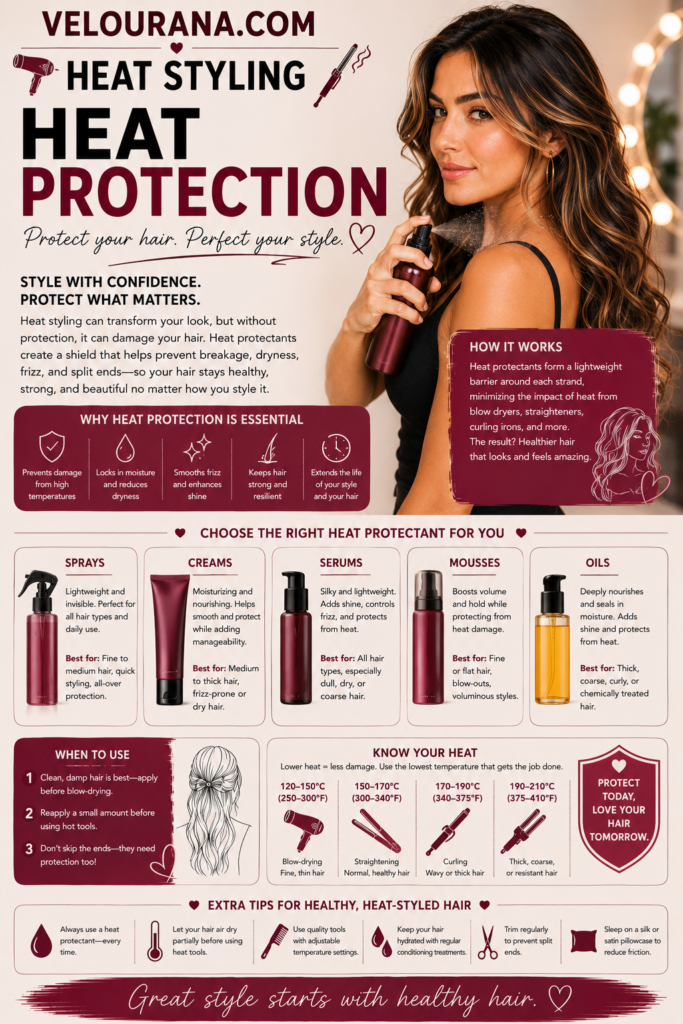
The purpose remains consistent. When hair is exposed to blow-dryers, curling irons, straighteners and other heated styling tools, sensible protection can form part of a routine designed to reduce unnecessary stress while improving the way the hair behaves during styling. But the best protective routine is not simply the one involving the greatest amount of product. It is the one that allows the hair to be styled efficiently without compromising the qualities that make its particular texture attractive.
Fine hair should still feel light. Thick hair should remain manageable without becoming coated. Straight hair should retain movement and shine. Wavy hair should be able to preserve or transform its natural pattern according to the desired style. Curly and coily textures should not be treated as though their natural volume must first be eliminated before heat protection becomes relevant.
The condition of the hair matters just as much as its natural type. Hair that has been lightened, colored repeatedly or frequently exposed to heat may require a more cautious approach than untreated hair with similar density. Long hair introduces another consideration because its oldest ends have experienced years more handling than the newest growth at the scalp.
Understanding these differences changes heat protection from a generic step into a more intelligent styling strategy.
The question is no longer simply whether heat protectant has been applied.
It becomes whether the entire routine makes sense for the hair being styled.
Fine Hair Needs Protection Without Losing Its Natural Lightness
Fine hair can be deceptive because a large amount of it can create considerable density even though the individual strands remain relatively delicate. This distinction between strand thickness and overall density is important. Someone can have fine hair and still have an abundant head of it, while another person may have fine strands with much lower density.
What these variations often share is sensitivity to weight.
A protective product that leaves a rich coating may make fine hair appear flatter, particularly around the roots. If several styling products are layered before blow-drying and then additional products are applied before curling, the cumulative effect can become more noticeable than any individual formula.
The answer is not to abandon heat protection. It is to make the routine more selective.
Lightweight products can be particularly useful when the desired hairstyle depends on bounce and movement. Distribution matters because fine hair can become overloaded in isolated areas if a spray or cream is concentrated unevenly. Applying a suitable amount according to the product directions and distributing it carefully gives protection a better chance of becoming part of the hairstyle rather than sitting visibly on top of it.
Technique becomes equally important.
Fine hair may respond to styling relatively quickly, so there is little reason to continue exposing a section to heat after the desired shape has formed. During blow-drying, the ends can become dry before the roots. Continuing to direct heat through the entire length because the scalp area remains damp creates unnecessary exposure where it is no longer required.
The dryer can instead concentrate on the area that still needs drying.
With curling, fine hair can often develop visible movement without extremely small sections. The appropriate section size depends on density and the tool, but the objective should remain efficiency. Once the curl forms, it can be allowed to cool rather than being repeatedly reheated in an attempt to make it last.
Cooling is particularly valuable because it provides another way of supporting the shape without simply increasing temperature.
Fine straight hair also benefits visually from the space that curling creates between strands. A relatively soft curl can make the hairstyle appear considerably fuller. Heavy finishing can then work against this effect by causing the strands to group together and fall closer to the head.
The protective routine should therefore preserve what the styling is trying to create.
If the objective is volume, the preparation should not remove that volume before the curling even begins.
Thick and Dense Hair Benefits From Control More Than Excessive Heat
Thick hair creates a different styling challenge. The temptation is often to assume that more hair automatically requires more heat. In reality, density frequently creates a sectioning problem rather than a temperature problem.
When a very large section is placed around a curling iron or between straightening plates, the tool may not interact with all of the strands consistently. The outer hair receives the strongest contact while the interior remains less affected. The natural response is often to repeat the process, increasing cumulative exposure without correcting the underlying issue.
Smaller, more manageable sections can make the tool more effective.
The same principle applies to blow-drying. Dense hair can appear dry on the surface while retaining moisture underneath, particularly around the roots. Working systematically allows the airflow to reach those hidden areas rather than repeatedly heating the already-dry surface.
This may require patience, but it creates a more controlled result.
Product choice can be different as well. Thick or coarse-feeling hair may tolerate richer protective formulas more comfortably than fine hair, particularly when smoothing and manageability are part of the desired finish. Even then, there is a difference between enough product and unnecessary accumulation.
The hair should remain responsive.
If it feels excessively coated, styling can become more difficult rather than easier.
Dense hair also offers an opportunity for selective heat styling. Not every internal section necessarily needs the same degree of polish as the visible surface when the intended hairstyle is soft and voluminous. A blowout can be constructed so that the upper layers carry the most obvious finish while the lower hair contributes body.
Similarly, naturally textured dense hair may not need to be transformed into perfectly uniform strands before curling. Depending on the intended result, some natural movement can remain part of the finished hairstyle.
Protection becomes more effective when the styling objective is clear.
If smoothness is required, the technique can be organized around smoothness.
If volume and texture are required, there is no advantage in using additional heat to erase texture that will immediately be recreated afterward.
Straight Hair Often Needs Less Correction Than It Receives
Naturally straight hair may seem like the simplest texture to heat style, but it can still be exposed to more heat than necessary.
Someone with already-straight hair may use a straightener to create additional smoothness, polish the ends or control isolated areas of irregularity. That can be effective, but it does not necessarily require treating the entire head as though a major texture transformation is taking place.
If most of the hair already lies smoothly, selective styling can be enough.
The same applies to blow-drying. Directional airflow and appropriate brush work can create a polished finish before a straightener is introduced. If the blow-dry has already achieved the desired result through most of the lengths, there is little value in automatically passing another heated tool over every section.
Curling naturally straight hair creates a much greater transformation, and this is where preparation and cooling become especially important.
Because the hair naturally tends toward straightness, large curls may gradually relax. The solution is not automatically higher heat. Creating an appropriate initial curl, allowing it to cool and delaying aggressive brushing can help preserve enough structure for the hairstyle to soften attractively.
Long straight hair introduces the additional influence of weight. A curl that initially appears stronger than desired may become a broad wave after the lengths settle.
Recognizing this behavior prevents unnecessary re-curling.
Straight hair can also show product accumulation clearly. Too much protective or finishing product can reduce movement and make otherwise clean lengths appear heavy. A formula and application method suited to the individual hair can therefore make a considerable difference.
The ideal protected finish should still look like healthy, moving straight hair after styling—not hair that has been visibly coated in preparation for the tool.
Wavy Hair Offers More Than One Styling Direction
Wavy hair presents an interesting heat-protection question because it can be styled in several fundamentally different directions.
The natural wave can be preserved and enhanced.
It can be stretched into a smoother blowout.
Selected pieces can be curled to make the existing pattern more consistent.
Or the entire hairstyle can be transformed into a more deliberately curled or straightened finish.
Each choice requires a different amount of intervention.
When natural waves are being preserved, diffusing can provide a way to dry the hair while maintaining its existing movement. Heat protection still belongs in the routine when heated airflow is being used, but the technique is very different from a high-tension smoothing blowout.
The diffuser distributes airflow more broadly and allows the wave pattern to remain relatively undisturbed.
When a smooth finish is desired, the hair may instead be dried with controlled tension and directional airflow. This creates a foundation that may reduce the amount of direct-contact styling required afterward.
If only selected waves are inconsistent, a curling tool can refine those pieces without being applied automatically to the entire head.
This selective approach can be particularly effective because naturally wavy hair often looks best when some variation remains. A perfectly identical curl pattern may remove the organic character that made the texture attractive in the first place.
Heat protection should therefore work with the styling decision rather than dictate it.
The question becomes how much transformation is actually required.
If the natural texture is already close to the intended result, less intervention may produce a more convincing hairstyle.
Curly and Coily Hair Require Protection That Respects Texture and Transformation
Curly and coily hair can experience some of the most dramatic transformations through heat styling, but there is no reason to assume that straightening is the default objective.
Heat may be used simply to dry and define the natural texture.
Diffusing can support curl formation while reducing the disturbance that strong uncontrolled airflow might create. The hair remains curly; heat is being used to complete and support the style rather than erase its natural pattern.
When a stretched or straightened finish is desired, the process changes considerably.
A blow-dryer may first elongate the texture. A straightener may then refine the result. Because several stages can be involved, planning becomes especially important. If the blow-dry creates a smooth, controlled foundation, the direct-contact tool does not need to correct as much irregularity afterward.
This is a recurring principle across hair types: one efficient stage can reduce the work demanded from the next.
The protective product should also make sense for the texture and styling method. Curly and coily hair may respond well to formulas that provide additional conditioning or smoothing qualities, but the exact needs vary enormously. Density, strand diameter, porosity, previous chemical treatment and the desired final finish all influence how a product feels and performs.
There is no benefit in assuming that every curly texture requires the heaviest possible formula.
The hair should remain manageable and flexible.
When curls are being preserved, the protective routine should avoid unnecessarily disrupting the pattern. When they are being stretched, the technique should aim for efficiency rather than repeatedly reheating sections until every trace of natural texture disappears.
A broader curled finish can also be created after stretching. In that case, the preparation should consider the entire sequence. Blow-drying the hair completely straight with repeated heat only to curl every section immediately afterward may involve more work than creating a sufficiently smooth foundation and allowing the curling stage to provide the final shape.
The desired endpoint should guide the journey.
Color-Treated and Lightened Hair Need a Condition-Based Approach
Natural texture alone cannot determine how hair should be heat styled.
Chemical history can significantly change the way hair feels and responds. Hair that has been colored repeatedly, lightened or otherwise chemically processed may have different styling needs from untreated hair of the same apparent thickness.
This makes observation particularly important.
If the hair has become more fragile-feeling, dry, porous or difficult to manage, the heat routine should respond accordingly rather than continuing unchanged simply because an older routine once worked.
Heat protection becomes part of a broader strategy of minimizing unnecessary exposure.
This may mean choosing a styling method that requires fewer passes. It may mean allowing more of the hairstyle to be created during blow-drying so that a straightener has less work to do. It may mean refreshing only selected curls rather than reheating the entire head the following day.
The ends deserve particular attention because they often contain the greatest history of chemical and mechanical exposure.
On long highlighted or lightened hair, the newest growth near the scalp and the oldest ends are not equivalent simply because they belong to the same person. The ends have existed longer and may have experienced several more rounds of coloring, washing, brushing and styling.
A single temperature strategy applied without thought from roots to tips ignores that difference.
The objective should be creating a cohesive hairstyle while allowing different areas to receive only the amount of intervention they need.
Heat protection becomes more intelligent when it responds to condition rather than relying exclusively on hair-type labels.
Long Hair Requires Special Attention to Its Oldest Lengths
Length changes the heat-protection equation even when the hair has never been chemically treated.
The ends of very long hair may be several years older than the newest growth. During that time they have experienced countless washes, brushes, nights of friction, environmental exposure and styling sessions.
They are also physically farther from the scalp and often receive less natural lubrication.
This does not mean long hair should not be heat styled. It means the styling routine should recognize that the entire strand does not have an identical history.
During blow-drying, the ends often lose moisture sooner than the roots. The dryer can therefore be redirected as the hair progresses rather than repeatedly traveling over already-dry areas.
During curling, modern styles frequently allow the ends to remain softer or slightly straighter. When that suits the desired look, there is no reason to force them into the most intensely heated part of every curl.
Straightening can also become more selective. If the ends are already smooth, repeated passes simply because another area needs refinement are unnecessary.
Long hair also encourages repetition because the styling process takes time. A person may forget which sections have already been treated, particularly when working through dense lengths.
Organized sectioning solves more than a convenience problem.
It reduces accidental duplication.
Finished hair can be kept separate from unfinished hair, making it easier to know exactly where heat has already been applied.
This simple organizational habit can contribute meaningfully to a more controlled routine.
Short and Medium Hair Have Different Heat-Protection Priorities
Short hair experiences less weight and often requires less time to dry, but the proximity of heated tools to the scalp and face can make precision especially important.
The styling objective may also depend more on direction than on dramatic transformation.
A short bob can be smoothed through the surface and given a slight bend at the ends. A pixie can gain lift through the top. A medium layered cut can be blow-dried into substantial volume or curled into broad movement.
These styles do not necessarily require every section to receive maximum heat.
Short hair often responds visibly to relatively small changes in direction. A bend through the front can transform the entire silhouette. A lifted crown can change the shape without intensive styling through every strand.
Medium hair provides more room for curls and waves but still carries less weight than very long hair. It can therefore retain heat-created movement quite effectively.
This is useful because the initial curl may not need to be as strong as it would on much longer lengths.
Understanding this can prevent over-styling.
If medium hair naturally holds a large curl well, there is little reason to create a very tight initial pattern simply because that technique is useful for someone with waist-length hair.
Protection improves when styling responds to proportions rather than following a universal recipe.
Product Texture Should Complement the Finished Hairstyle
Heat protectants can provide additional cosmetic effects beyond their primary protective role. Depending on the formula, they may help with detangling, smoothing, shine, manageability or control.
These additional qualities should support the hairstyle being created.
A voluminous blowout needs movement. A product combination that makes the hair extremely heavy may work against that objective.
A sleek style has different priorities. Smoothing and control may be more valuable, particularly on hair prone to expansion or irregular texture.
A curled hairstyle needs enough flexibility for the sections to move after they have cooled.
This is why selecting products solely according to the words “heat protection” on the packaging can miss part of the decision.
The entire formula affects the styling experience.
Application timing matters as well. Some products are designed for damp hair before blow-drying. Others may be intended for use before styling dry hair. Some have specific instructions regarding application and temperature.
Those instructions should take priority over assumptions.
Using a product correctly is part of using it effectively.
Layering should also remain purposeful. A leave-in conditioner, styling cream, heat protectant, volumizing product and finishing product may each have an individual role, but the combination can behave differently from any one product alone.
If the hair becomes difficult to style under multiple layers, simplifying the routine may produce a better result.
Protection should not require sacrificing the quality of the hairstyle.
Heat Protection Continues After the First Styling Day
One of the easiest ways to increase cumulative heat exposure is to recreate the entire hairstyle every morning.
Often, that is unnecessary.
A curled style may retain substantial movement overnight while losing shape only around the face. A blowout may remain smooth through the lengths while the roots need refreshing. Straight hair may develop a bend in one area from sleeping while the remainder still looks polished.
Assessing the hair before reaching for a heated tool creates an opportunity for selective styling.
Only the sections that genuinely need attention are addressed.
This approach is useful for every hair type, but it becomes particularly valuable for long, color-treated or frequently styled hair because it reduces repeated exposure over time.
Heatless methods can also extend or transform a style between heated sessions.
Large rollers can restore shape and volume. Braids can turn a fading blowout into waves. Twists can introduce movement. An existing curled style can be incorporated into a ponytail, bun or half-up hairstyle rather than being completely reconstructed.
These are not compromises unless the wearer dislikes the result.
They are simply additional styling options.
A protective routine becomes much easier to maintain when it includes several ways of wearing the hair rather than depending on one heated finish every day.
The Best Heat Protection Is Personal Rather Than Generic
Hair categories are useful because they provide a starting point, but they should never become rigid rules.
Fine hair often prefers lightness, yet some fine hair is extremely dense.
Thick hair may tolerate richer products, yet individual strands can still have areas of sensitivity.
Straight hair may require very little transformation for a sleek finish but considerable technique to retain curls.
Wavy hair can move toward either greater definition or greater smoothness.
Curly and coily hair can be dried in its natural pattern, stretched, straightened or reshaped into entirely different curls.
Color treatment, length and previous styling further change every one of these situations.
The most effective heat-protection routine therefore begins by observing the actual hair rather than forcing it into a generic category.
How quickly does it dry?
Where does it become dry first?
How easily does it hold a curl?
Which areas require the most smoothing?
Does a particular product leave it light or heavy?
Are the ends behaving differently from the newer growth?
How much of the hairstyle genuinely needs to be recreated the following day?
Those observations gradually create a routine more useful than any universal formula.
The protective product remains important, but it becomes one part of a larger method.
The hair is prepared appropriately.
The tool is chosen according to the desired result.
Sections are sized according to density.
Temperature is used with purpose.
Heat is directed toward the areas that actually need it.
Finished sections are not repeatedly revisited without reason.
The hairstyle is allowed to cool and settle before unnecessary corrections are made.
Most importantly, the natural qualities of the hair are not treated as obstacles.
Fine hair is allowed to remain light.
Thick hair is given enough organization to make styling efficient.
Straight hair retains its fluidity.
Wavy hair keeps the option of natural movement.
Curly and coily textures can be preserved or transformed according to choice rather than assumption.
Processed hair receives consideration based on its present condition, while long hair is treated with awareness that its oldest ends have a very different history from its newest roots.
That is what individualized heat protection ultimately means.
It is not a different rulebook for every possible hair category. It is a willingness to adjust technique when the hair provides evidence that adjustment is needed.
Heat styling can then become both more creative and more controlled.
Instead of relying on greater temperature, more product or repeated passes whenever a style proves difficult, the process becomes increasingly precise. The right section is chosen. The necessary area is styled. The movement is allowed to form. The hair is left alone when the desired result has already been achieved.
And because the routine works with the hair rather than against it, protection no longer feels like an additional obligation placed before styling.
It becomes part of good styling itself.
The End
Velourana.
 Discover More From Our Family of Websites
 ZodiacBearing (Astrology, Tarot, Numerology, Angel Numbers & Spiritual Guidance)
 Velourana (Beauty, Makeup, Hair Care, Skincare & Beauty Tips)
 HavenBearing (Home, Living, Organization, Décor & Everyday Inspiration)
 PawBearing (Pet Care, Dog Breeds, Animal Health, Training & Pet Products)
 PsyCatherine (Notes From the Journal of a Psychologist on Real Life)