
CATEGORY: Blow-Drying
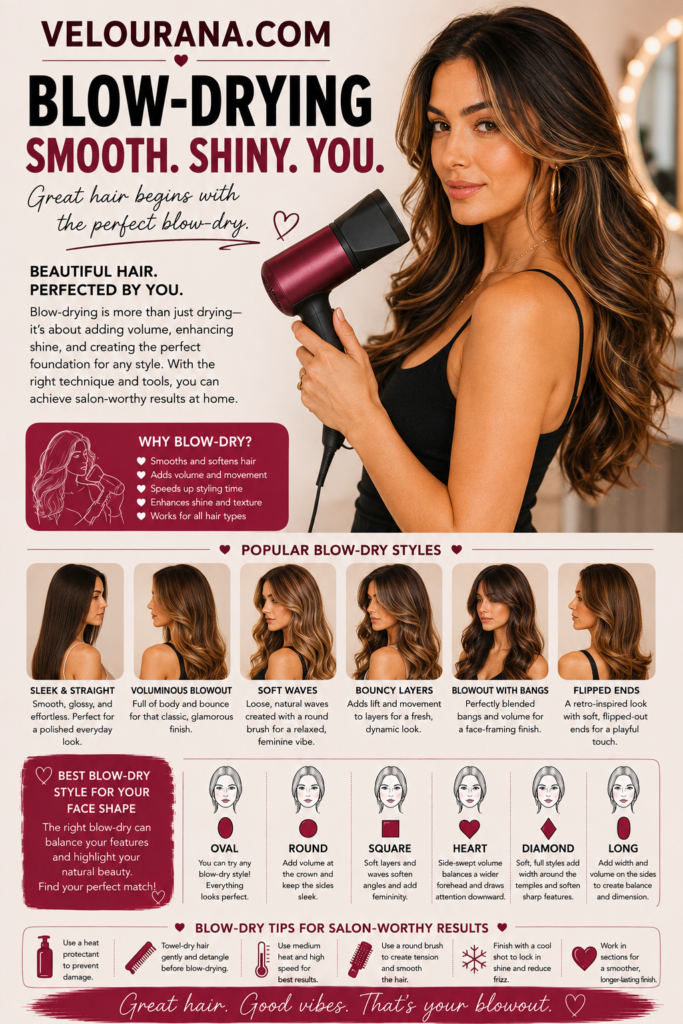
A good blowout should not look as though the hair has been forced into submission. The most convincing result still has movement. The roots are controlled without appearing pasted to the scalp, the lengths feel smooth without looking flat, and the ends curve naturally rather than sitting rigidly in one direction. Achieving that balance depends less on using maximum heat and more on understanding how hair changes while it dries.
Blow-drying is essentially a race between moisture loss and shape. As water leaves the hair, the strands gradually become less responsive to repositioning. If the roots dry flat, creating lift later becomes harder. If the ends dry in an awkward bend, correcting them requires additional work. If an entire section is already dry before a round brush ever reaches it, the styling stage becomes more about reheating than shaping.
This is why the strongest blowouts are built progressively. Moisture is reduced first, then the hair is sectioned and shaped while enough flexibility remains to influence the final result. The dryer, brush and direction of the section work together. When the technique is controlled, there is less need to repeatedly pass over the same hair.
The Blowout Begins Before the Round Brush
Hair that is still dripping wet is usually not ready for detailed brush styling. At that stage, the main job is reducing excess moisture. A towel can absorb some of it, provided the hair is pressed or squeezed rather than rubbed aggressively. The dryer can then remove additional moisture while the hands separate the strands and keep them moving.
This early stage does not need to create the finished hairstyle. It simply prepares the hair for more precise work.
How dry the hair should become before sectioning depends on density and the desired finish. Fine hair may reach the styling stage quickly. Thick or very dense hair can hold moisture deep inside, particularly near the roots. Long hair may feel almost dry through the ends while remaining noticeably damp closer to the scalp.
The goal is not reaching a specific percentage that applies to everyone. It is reducing enough water that each later section can be shaped efficiently rather than spending most of the round-brush work simply evaporating moisture.
Detangling also matters before detailed styling begins. A round brush should not have to perform two completely different jobs at once. If it is fighting knots while also trying to create tension and movement, control is reduced. When the lengths have already been gently detangled, the brush can move continuously through each section.
Sectioning Is What Makes a Blowout Look Consistent
Blow-drying the entire head as one mass often produces exactly the inconsistency people are trying to avoid. The outer hair becomes dry first. Interior sections remain damp. The front gets repeated attention because it is visible, while the back may receive far less control. Finished sections fall into wet ones and lose their shape.
Sectioning solves much of this.
The lower hair can be separated first while the upper sections remain clipped away. Once one area is dry and shaped, another is released. The process continues methodically until the crown and front are reached.
The size of each section should reflect the density of the hair. A section that is too thick prevents airflow from reaching the strands inside. The outside may look smooth while the interior remains damp. The brush also loses control because too much hair spills around it.
A manageable section should sit comfortably on the brush and respond as one unit. The dryer should be able to follow the entire width without repeatedly returning to areas that were missed.
This methodical construction may initially appear slower than grabbing large sections, but it is often more efficient because finished hair does not need to be corrected repeatedly.
The Dryer and Brush Need to Move as One System
The most important coordination in a smooth blowout is the relationship between the brush and the airflow.
The brush creates tension and direction. The dryer follows.
If the brush moves downward while the dryer remains stationary, concentrated heat is left behind on one area. If the dryer moves randomly while the brush holds the section elsewhere, the air is no longer helping to shape the hair.
The two should travel together.
For a smoother finish, the concentrator nozzle can direct airflow along the length of the section rather than blasting it from multiple directions. The brush guides the hair, and the dryer follows that path.
This makes the process easier to understand. The brush tells the hair where to go. The dryer removes moisture while the hair is in that position.
The nozzle does not need to touch the hair. It simply provides precision. Holding the dryer at a reasonable distance while keeping it moving gives control without concentrating unnecessary heat on one spot.
Root Direction Creates the Volume Before the Ends Are Styled
The roots determine whether the hairstyle will feel lifted or flat.
If the crown is dried completely downward in its resting position, trying to create substantial volume later requires more effort. If the roots are elevated while drying, they can retain more movement once released.
This is where overdirection becomes useful.
A crown section can be lifted upward or slightly away from the direction in which it will eventually fall. As it dries, the root is encouraged to sit with more space beneath it. When the hair returns to its natural position, some of that lift remains.
This technique does not need to be used everywhere.
In many hairstyles, the crown benefits from additional elevation while the sides look better with less volume. Creating maximum lift across the entire head can produce excessive width instead of a balanced silhouette.
Volume is most effective when it is placed.
The roots near the front may need lift for an open shape. The crown may need height. The lower sides may need smoother direction so the hairstyle does not expand unnecessarily.
The blowout becomes more flattering when these areas are treated differently.
The Round Brush Determines the Scale of the Movement
A round brush is not simply a tool for making the hair smooth. Its diameter influences the shape.
A larger barrel creates broader movement. The curve is gradual, making it useful for long hair, large waves and blowout-style volume. The ends can become rounded without looking tightly curled.
A smaller barrel creates a stronger bend. This is useful for shorter layers, bangs and sections where more obvious movement is desired.
The haircut should guide brush size. A long section wrapped around a very small barrel can become more curled than intended. A short fringe placed around an oversized brush may not gain enough control.
The brush should fit the section and the desired movement.
The goal is not wrapping as much hair as possible around the barrel. The brush should be able to move through the section without becoming trapped. Blow-drying is a continuous process. The hair is guided, heated by moving air, released and shaped progressively.
Smoothness Comes From Consistency, Not Maximum Tension
Tension is useful because it organizes the strands as they dry. But there is a difference between controlled tension and aggressive pulling.
The brush should have enough grip to keep the section aligned. The scalp should not feel as though the hair is being dragged.
When the section size is appropriate and the airflow is directed correctly, less force is needed. The brush and dryer can do their work gradually.
This is particularly important around the hairline, where repeated pulling can feel uncomfortable quickly. A polished blowout should not depend on making the temples or scalp hurt.
Smoothness is produced by consistent direction, manageable sections and controlled airflow.
The Ends Decide Whether the Blowout Looks Finished
The ends are where a blowout reveals its personality.
Hair can be dried smooth through the roots and mid-lengths yet still look unfinished if the ends simply hang without intention.
They can turn inward for a rounded, contained shape. They can curve outward for a more open and layered silhouette. They can remain relatively straight for a cleaner finish. Long layers can alternate gently, creating broad movement rather than one uniform curve.
The final pass through each section is therefore important.
Instead of allowing the brush to leave the hair abruptly, the ends can be guided into the desired direction while the remaining moisture disappears.
This does not require repeatedly heating the same area. Once the end has been shaped and dried, continuing to work it provides little additional benefit.
Face-Framing Layers Deserve Separate Attention
The sections around the face influence the appearance of the entire blowout more than many parts hidden in the back.
Long face-framing layers can sweep away from the cheeks to create openness. They can curve inward to create a softer, more enclosed shape. Curtain bangs can be encouraged to separate and move outward rather than drying flat against the forehead.
These pieces are often shorter than the rest of the hair and can dry quickly.
Waiting until the entire head has been finished may mean they have already settled in an unwanted direction.
For this reason, the front sometimes benefits from being shaped earlier.
A blowout can be relatively simple through the back and still look polished if the crown and face framing are handled well.
Curtain Bangs Need Shape More Than Extreme Volume
Curtain bangs work because they open from the center and move away from the face.
The objective is not creating a large bump at the roots.
Instead, the roots need enough movement to avoid lying flat, while the ends curve outward and blend into longer layers.
A brush that suits the length can guide each side independently.
Once the sections are dry, they can be allowed to cool briefly in their intended shape.
The result should look like part of the haircut rather than two separately curled pieces.
Layered Hair Is Where a Blowout Can Become Most Expressive
Layers create multiple lengths, and a blowout can reveal each one.
Shorter sections around the crown can gain lift. Mid-length layers can create body. Long layers can form the foundation beneath them. Face-framing pieces can move independently from the back.
When every section is dried in exactly the same direction, some of that structure can disappear.
A more dimensional blowout allows the haircut to do what it was designed to do.
The shorter pieces may move outward while the longest sections remain softer. The ends can alternate subtly rather than forming one rigid shape. This gives the hair movement when the head turns rather than making it behave like one solid sheet.
Straight Hair Can Be Smooth Without Becoming Flat
Straight hair often responds clearly to blow-drying because the new direction is easy to see.
A smooth blowout does not need to remove every trace of volume.
The crown can remain lifted while the lengths stay relatively straight. The ends can receive only a slight curve. This creates a polished appearance without making the hairstyle feel pressed against the head.
Straight hair can also reveal inconsistencies more easily because there is less natural texture to disguise them. Good sectioning and airflow direction therefore become especially important.
The reward is a very clean finish when the technique is controlled.
Wavy Hair Can Be Redirected Rather Than Completely Erased
Naturally wavy hair already contains movement.
A blowout can stretch that texture into broader curves rather than attempting to make the hair perfectly straight.
This can create a soft result that retains body.
The roots can be smoothed while the lengths maintain broad movement. Face-framing sections can be directed deliberately. The natural wave can help create volume instead of being treated only as something to remove.
Alternatively, if the goal is to preserve the wave pattern itself, a diffuser becomes more appropriate than a round brush.
The desired finish should determine the technique.
Diffusing Is a Different Form of Blow-Drying
A diffuser spreads the airflow across a larger area.
Rather than concentrating air along a section held under tension, it allows waves and curls to dry closer to their natural grouped shape.
This changes the purpose of the dryer.
With a concentrator and brush, the hair is being redirected.
With a diffuser, the objective is usually preserving or encouraging existing texture.
The hair can be positioned so that the roots retain volume without constantly disturbing the curl pattern.
The airflow and temperature should still be controlled. A diffuser changes distribution; it does not make heat irrelevant.
Curly Hair Can Be Styled Toward More Than One Finish
Curly hair does not have one correct blow-drying method.
If natural curl definition is the goal, diffusing can preserve the pattern.
If a stretched or smoother blowout is wanted, the hair can be worked in sections under controlled tension.
These are different styling decisions.
A smooth blowout does not need to pretend the natural texture never existed. Broad movement can remain through the ends. The hairstyle can have body rather than becoming completely flat.
When preserving curls, the opposite principle applies: excessive brushing would break apart the natural groups, so the technique should minimize unnecessary disturbance.
Coily Hair Can Be Dried With Texture or Stretch
Coily hair can also be approached according to the desired result.
A diffuser can support natural texture.
Controlled tension can create a stretched finish.
Braids, twists and other preparation methods can influence the way the hair behaves before or after drying.
The important point is that stronger pulling is not automatically better styling.
Sectioning, direction and steady technique create control.
The hairline and scalp should remain comfortable.
Fine Hair Needs Volume Without Weight
Fine hair often responds dramatically to relatively small amounts of root lift.
The main risk is overwhelming it with too much product or flattening it through overworking.
A lighter preparation can preserve movement. The crown can receive deliberate lift, while the lengths remain simple. A large round brush can create broad body rather than tight curls.
The finished style does not need exaggerated volume.
Even a small increase in space between the roots and scalp can make the hair appear fuller.
Thick Hair Needs Control Over Moisture More Than Additional Heat
Dense hair often creates the opposite challenge.
The outer layer can appear dry while the interior remains damp.
Increasing the temperature is not always the most effective answer.
Smaller sections allow airflow to reach the inside.
Removing more initial moisture before detailed brush work can reduce total styling time.
The hair becomes easier to manage because the dryer is no longer trying to evaporate a large amount of water through one thick section.
Patience at this stage often leads to a faster overall process.
Long Hair Benefits From Separating Drying From Styling
Very long hair can make blow-drying feel exhausting when every centimeter is round-brushed from the moment the hair is wet.
A more efficient routine separates moisture removal from detailed shaping.
The hair is partially dried first.
Then only the remaining moisture is removed under controlled brush tension.
This means the brush is used when it can actually influence the finish rather than spending most of its time simply helping water evaporate.
The ends should also be monitored because they can dry before the roots. There is no benefit in repeatedly exposing already-dry ends while another area is still wet.
Medium Hair Can Create Strong Bounce
Medium lengths are especially responsive to round-brush styling because there is enough length to create movement without the weight of very long hair pulling everything downward.
The ends can turn inward or outward.
Layers can lift.
The crown can retain bounce.
The hairstyle can therefore look noticeably different according to relatively small changes in brush size and direction.
Short Hair Depends on Root Control
Short hair has less length through which to create broad curves, so direction at the root becomes critical.
The fingers can lift sections while general moisture is removed.
A smaller brush can refine longer areas.
The fringe can be shaped separately.
The finished result depends on where the hair is encouraged to sit rather than on creating large curls through the lengths.
Bobs Show Exactly How Much the Ends Matter
A bob can appear rounded, sharp, soft or playful depending on the final few centimeters.
Turning the ends inward creates a contained silhouette.
Leaving them straighter produces a cleaner edge.
Directing them outward changes the entire character.
The haircut remains identical.
Only the blow-drying direction changes.
This is a clear example of why blow-drying is a styling process rather than simply a drying process.
Cooling the Shape Before Releasing It
Once a section has been dried and shaped, allowing it to cool briefly can help preserve the movement.
Some dryers include a cool-shot function for this purpose.
A section can remain around the brush momentarily while cooler air passes over it.
This is particularly useful around the crown, face framing and ends where movement matters most.
The hair should already be dry at this stage.
Cooling is part of finishing the shape, not a substitute for completing the drying process.
A Blowout Should Be Finished Before It Is Overhandled
Freshly styled sections may initially appear slightly more curved than the final desired result.
Long hair often relaxes under its own weight.
Layers settle.
Sections begin blending.
Brushing aggressively through the entire hairstyle immediately can remove more movement than intended.
It is often better to let the hair settle first.
Then the sections can be blended gently.
The Final Texture Should Look Connected
A good blowout should not resemble a collection of separate round-brushed pieces.
The crown should connect with the sides.
The face framing should blend into the longer layers.
The ends should move together naturally.
This is where light finishing with the fingers or brush can help.
The goal is integration.
The structure created section by section should ultimately look like one hairstyle.
Finishing Product Should Support the Result
The final product choice depends on what the blowout is meant to do.
Fine hair that needs movement may not benefit from a heavy finishing layer.
Dry-feeling lengths may appreciate a small amount of an appropriate smoothing product.
A voluminous blowout may need a different finish from a sleek one.
The product should support the shape rather than flattening or obscuring it.
Applying more is not automatically better.
Humidity Will Still Interact With the Hair
A blowout is temporary styling.
Once the hair returns to the environment, humidity and natural texture continue influencing it.
Straight hair may gain movement.
Wavy hair may begin returning toward its natural pattern.
Curly or coily hair may contract.
The degree varies.
A realistic blowout should therefore be judged not only by how it looks immediately after styling but also by how it behaves through ordinary movement and weather.
A Blowout Can Be Refreshed Rather Than Recreated
If the hairstyle still looks generally good the following day, the entire head may not need another full drying and styling session.
The front can be reshaped.
The crown can be lifted selectively.
The ends can be redirected.
Bangs can receive separate attention.
Targeted refreshing avoids repeatedly exposing areas that do not actually need restyling.
The Best Blowout Is Built Around the Haircut
The blow-dryer cannot create a different haircut, but it can reveal or hide what is already there.
Layers become visible when they are given movement.
A blunt perimeter becomes stronger when the ends remain controlled.
Curtain bangs work when their outward direction is supported.
A bob changes character according to its final curve.
The technique should therefore begin with the haircut rather than trying to impose the same blowout shape on everyone.
Smoothness, Volume and Movement Need to Work Together
A successful blowout rarely depends on one quality alone.
Too much focus on smoothness can flatten the hairstyle.
Too much volume can create unnecessary width.
Too much curl can make the result feel different from a blowout.
The strongest finish balances them.
The surface looks controlled.
The crown has enough lift.
The lengths move.
The ends have direction.
Each element supports the others.
Why Technique Matters More Than Maximum Heat
The fastest possible temperature setting cannot replace good sectioning.
It cannot compensate for a brush that is too small for the section.
It cannot create root lift if the roots have already dried flat.
It cannot make a damp interior section behave as though it is finished.
The real efficiency comes from preparation.
Excess water is removed first.
The hair is detangled.
Sections are controlled.
The roots are directed before they set.
The brush and dryer move together.
Airflow follows the length.
The ends are shaped intentionally.
Finished sections are left alone.
These decisions reduce unnecessary repetition.
That is where better blow-drying comes from.
When Drying Becomes Styling
Every blow-dry removes moisture.
A true blowout does something more.
It uses that transition from wet to dry to decide where the hair will sit.
The roots can lift instead of collapsing.
The crown can gain shape.
Face-framing sections can sweep outward.
Layers can separate.
The ends can curve.
Straight hair can become smoother without becoming flat. Waves can be stretched into broader movement. Curls can be diffused or redirected. Fine hair can gain visual fullness, while dense hair can become more controlled through deliberate sectioning.
The dryer provides the airflow and heat.
The brush provides tension and shape.
But the final result comes from timing and direction.
The hair is most responsive while it is still drying.
Once that moment is used deliberately, blow-drying becomes far more than removing water.
It becomes a way of translating the haircut into movement—creating smoothness where it is wanted, volume where it is useful and shape that looks deliberate without forcing every strand into the same rigid finish.
The End
Velourana.
 Discover More From Our Family of Websites
 ZodiacBearing (Astrology, Tarot, Numerology, Angel Numbers & Spiritual Guidance)
 Velourana (Beauty, Makeup, Hair Care, Skincare & Beauty Tips)
 HavenBearing (Home, Living, Organization, Décor & Everyday Inspiration)
 PawBearing (Pet Care, Dog Breeds, Animal Health, Training & Pet Products)
 PsyCatherine (Notes From the Journal of a Psychologist on Real Life)

