CATEGORY: Updos
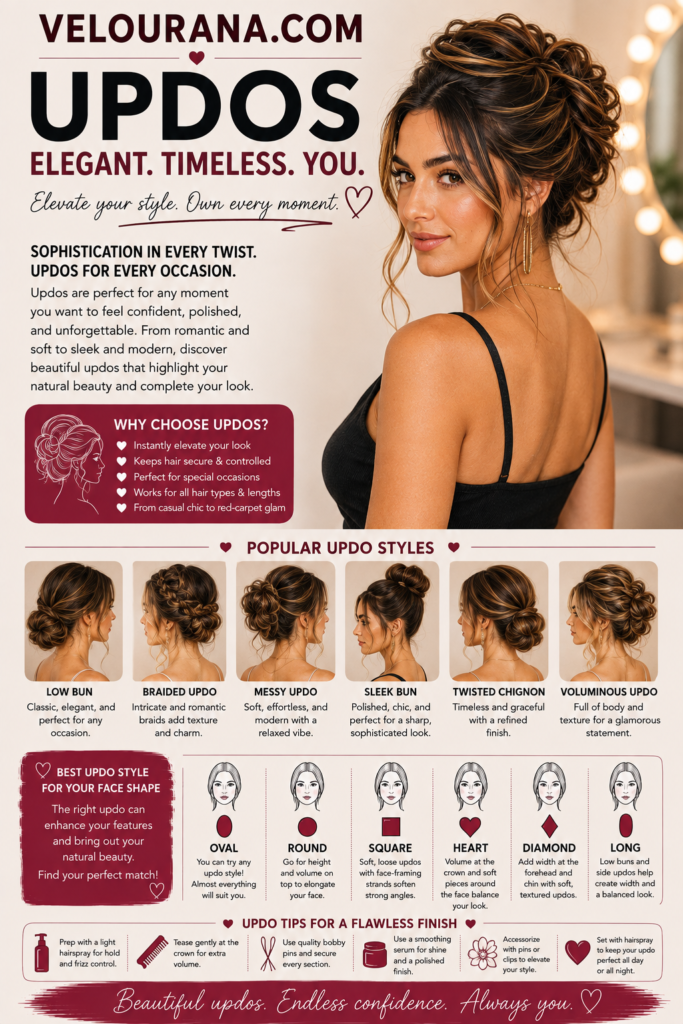
Textured updos sit somewhere between polished structure and completely relaxed styling. They are gathered hairstyles, but they do not depend on every strand lying perfectly flat. Their appeal comes from visible movement: soft waves through the crown, loosely twisted sections, irregular loops, dimensional curls, widened braids and carefully chosen pieces around the face.
The result can look effortless.
The construction usually is not.
A successful textured updo still needs a stable foundation. The hair must remain supported. The volume needs to sit in deliberate areas. Loose pieces should frame rather than overwhelm the face. The back should maintain a recognizable shape instead of gradually collapsing into unrelated sections.
This balance between control and softness is what makes textured updos so adaptable.
They can be worn high, low or somewhere between. They can be built from straight hair that has been given temporary movement, naturally wavy hair, curls, coils, braids or twists. The final structure may resemble a bun, chignon, French twist or collection of individually pinned sections.
The defining quality is not one particular technique.
It is visible dimension.
Instead of creating one continuous smooth surface, the hairstyle allows the eye to see how different sections of hair move through the structure.
Texture Changes the Way an Updo Uses Volume
Smooth hair tends to compress when gathered.
The strands lie close together.
A bun becomes compact.
A twist creates a clean surface.
Textured hair occupies space differently.
Waves create separation.
Curls create loops.
Braids add ridges.
Twists create spirals.
The same amount of hair can therefore produce a visually larger updo simply because the strands are no longer behaving as one flat mass.
This is particularly useful when softness is part of the desired result.
The hairstyle does not need enormous physical volume.
It needs enough variation in direction and surface to create dimension.
The Foundation Still Needs to Be Secure
A textured updo should not be built by leaving everything loose from the beginning.
That often creates instability.
The better approach is establishing security first.
A ponytail can provide an anchor.
Pins can create a hidden foundation.
A small bun can support outer sections.
A twist can establish the direction.
Once the main structure is stable, selected pieces can be loosened and arranged.
This creates the appearance of effortlessness without sacrificing durability.
Softness Works Best When It Is Added Deliberately
After the foundation is secure, the hairstyle can be adjusted gradually.
A small crown section can be lifted.
One side can be loosened slightly.
A loop can be widened.
Face-framing pieces can be released.
The bun can be expanded.
These changes should happen incrementally.
Pulling large amounts of hair at once can destroy the underlying structure.
Texture should soften the hairstyle, not remove its architecture.
Low Textured Updos Create Romantic Shape
Low placement is particularly compatible with soft texture.
The hair travels toward the nape.
The crown can retain a little volume.
Side sections can twist or overlap.
The gathered structure may become a loose bun or chignon.
Because the visual weight sits low, the hairstyle feels understated even when the back contains considerable detail.
This can create a romantic effect without requiring elaborate accessories.
A Soft Low Chignon Can Be Built From Waves
Hair that already contains waves can be gathered loosely near the nape.
Instead of twisting everything into one tight coil, sections can be folded and pinned separately.
The wave pattern remains partly visible.
One section curves over another.
The ends disappear gradually.
The result feels more dimensional than a conventional smooth chignon.
The Crown Should Connect Naturally With the Bun
A low textured bun can look disconnected if the crown is completely flattened.
Allowing a small amount of lift creates a smoother visual transition.
The head develops a gentle curve.
The bun appears to belong to that shape rather than sitting as a separate object at the nape.
This is one of the most important proportional choices in soft low updos.
High Textured Updos Create More Drama
Moving the structure upward changes the personality.
The hairstyle gains height.
The gathered shape becomes more visible from the front.
Loose curls or loops can create substantial volume near the crown.
A high textured bun can feel energetic and decorative while preserving softness.
The main challenge is balance.
Too much volume at the top without enough connection through the crown can make the style appear top-heavy.
A High Messy Bun Is a Textured Updo When the Shape Is Controlled
The term “messy bun” can suggest complete randomness.
A successful high textured bun usually has deliberate structure.
The base is secure.
The main mass sits in one defined area.
Selected loops are widened.
Some ends remain visible.
Face-framing pieces soften the front.
The hairstyle looks relaxed because the surface is irregular, not because the construction is unstable.
Mid-Height Textured Updos Offer Natural Balance
A mid-height position can be particularly practical.
The hair remains away from the neck.
The bun does not sit so high that heavy hair becomes uncomfortable.
The structure remains visible from the side.
This placement works well for textured buns, twisted updos and pinned curls.
It can feel formal or casual according to the finish.
Straight Hair Can Still Create a Textured Updo
Naturally straight hair does not need to remain sleek.
Temporary waves, bends or loose curls can be introduced before gathering.
Heatless braids can create movement.
Rollers can provide broad curves.
Twists can change the direction of the strands.
Once the hair has some texture, the updo can use that movement to create volume.
The objective does not need to be turning straight hair into defined curls.
Even subtle bends can make the final structure more dimensional.
Heatless Waves Are Excellent Preparation
Hair worn in braids overnight can produce an ideal foundation.
The wave pattern provides natural irregularity.
The crown becomes easier to lift.
The bun appears fuller.
Shorter layers may fall softly rather than sticking straight out.
This makes heatless texture particularly useful when the intended updo should feel relaxed.
Day-Old Blowout Hair Can Also Work Beautifully
A blowout that has lost some of its original smoothness may still contain broad movement.
That movement can become useful inside an updo.
The crown retains body.
The ends curve naturally.
The lengths do not compress as tightly as completely straight hair.
The style can therefore evolve rather than being completely restyled.
Wavy Hair Naturally Supports Soft Structure
Wavy hair already contains the kind of movement textured updos need.
The roots may remain slightly lifted.
The sides can twist naturally.
The bun contains bends.
Face-framing pieces curve easily.
There is often no reason to remove the wave before styling.
The updo can simply organize it.
Natural Waves Create Useful Irregularity
The wave pattern rarely behaves identically everywhere.
One section bends more strongly.
Another remains softer.
This variation can make the updo look more natural.
The goal does not need to be perfect uniformity.
A textured hairstyle often benefits from allowing the natural pattern to influence the surface.
Curly Hair Creates Dimension Without Additional Preparation
Curly hair can become a textured updo almost immediately because the individual sections already have form.
The curls can be gathered loosely.
Some can be pinned.
Others can remain visible.
The crown can retain volume.
The structure does not need to become smooth.
The curl pattern itself creates much of the decoration.
Curls Can Be Pinned Individually
One effective approach is avoiding one solid bun altogether.
Instead, curls are arranged around a central foundation.
One loop is pinned.
Another overlaps it.
A third fills the side.
The updo develops gradually.
This preserves the natural curl shape and creates substantial depth.
Individual Pinning Creates a Sculptural Result
Because each section can occupy a different direction, the hairstyle becomes three-dimensional.
Some curls sit closer to the head.
Others project outward.
A few remain visible near the edges.
The overall structure can still be balanced even though no two sections are identical.
Coily Hair Can Create Powerful Textured Updos
Coily textures naturally provide volume and structure.
Twists can become part of the design.
Braids can create pathways toward the gathered section.
The hair can form high sculptural shapes or low textured buns.
Natural texture can remain visible throughout.
The updo does not need to depend on complete smoothing to look deliberate.
Coils Can Become the Main Visual Feature
A gathered style can simply organize the volume rather than hide it.
The upper hair can remain textured.
The updo can preserve expansion.
The silhouette may be broad, high or asymmetrical.
The structure still controls where the hair sits, but the natural texture determines the surface.
Fine Hair Can Benefit Significantly From Texture
Fine hair often appears much fuller once it contains movement.
A smooth bun may become compact.
A textured bun occupies more visual space.
Waves create separation between strands.
Braids introduce ridges.
Twists create direction.
The available hair becomes more visually substantial without needing unrealistic volume.
Fine Hair Should Avoid Being Compressed Too Early
If the hair is gathered extremely tightly before the updo is built, much of the apparent volume disappears.
A secure but not overly compressed foundation preserves more fullness.
The outer sections can then be arranged loosely.
The result looks larger and softer.
Fine Hair Often Benefits From Smaller Face-Framing Sections
Leaving too much hair loose around the front removes density from the back.
A few narrow pieces can create softness without weakening the updo.
The amount of hair should be allocated carefully.
This keeps both the front and back visually balanced.
Thick Hair Requires Control More Than Additional Volume
Dense hair already provides abundant material.
The challenge is preventing the textured updo from becoming excessively large.
The hair can be divided into sections.
Some areas can remain more compact.
Only selected parts need loosening.
The structure gains dimension without expanding uncontrollably.
Thick Hair Can Be Easier to Manage in Separate Sections
Rather than twisting the entire length into one enormous bun, several sections can be created.
One becomes the foundation.
Another crosses over it.
A third fills the opposite side.
This distributes the bulk.
The final updo remains unified visually.
Long Hair Offers More Material for Texture
Long hair can create substantial loops, braids and twists.
The length can wrap several times.
It can be divided into multiple sections.
The challenge is hiding or distributing the ends without creating one extremely dense area.
Textured styling helps because the hair does not need to follow one perfectly compact path.
Very Long Hair Can Be Spread Across a Wider Structure
Instead of concentrating all the length into a central bun, sections can be pinned across a broader portion of the back.
The result becomes flatter and wider.
This can be more comfortable and visually balanced.
The updo still contains all of the hair, but the volume is distributed.
Medium Hair Can Create Excellent Textured Shapes
Medium hair often works particularly well because the lengths are long enough for twisting and pinning but short enough to remain light.
The bun can stay compact.
Shorter layers naturally create softness.
The structure can be adjusted without carrying excessive weight.
Layers Are an Advantage in Textured Updos
Layered hair does not behave like one solid length.
That can be difficult in extremely sleek styling.
In textured updos, it becomes useful.
Shorter pieces create movement.
The crown gains variation.
Face-framing layers can remain free.
The bun becomes less uniform.
The haircut helps create the softness.
Short Layers Can Remain Visible
Not every strand needs to disappear.
A few shorter ends can emerge from the bun.
Nape pieces can soften the lower edge.
Temple layers can frame the face.
As long as the overall structure remains intentional, these sections can improve the hairstyle.
Face-Framing Pieces Are Central to the Textured Look
The front often determines whether a soft updo feels elegant or simply unfinished.
One or two pieces on each side can be enough.
They can sit near the temples.
They can fall toward the cheeks.
Longer sections can frame the jaw.
The texture should connect naturally with the rest of the hairstyle.
Curled Face-Framing Pieces Can Create a Romantic Effect
When the updo itself contains waves or curls, the front can continue that movement.
The sections do not need identical curls.
A soft bend can be enough.
The objective is connection.
The front should feel like an extension of the same hairstyle.
Straight Face-Framing Pieces Create Contrast
Textured updos can also work with straighter front sections.
This creates a cleaner frame against a more dimensional back.
The contrast can feel modern.
The pieces should still appear deliberate rather than accidentally left out.
Curtain Bangs Work Particularly Well
Curtain bangs naturally separate from the longer lengths.
They can remain completely outside the updo.
Their outward movement softens the face.
The gathered hair behind them creates structure.
The result combines an open front with a dimensional back.
Full Bangs Can Balance Large Updos
A substantial textured bun may create considerable visual weight behind the head.
A full fringe adds weight at the front.
This can create balance.
The bangs remain structured while the updo remains soft.
The contrast can be especially effective.
Side Bangs Add Direction
A long side fringe can sweep toward the updo.
The movement begins at the forehead and continues toward the back.
This works particularly well with asymmetrical textured styles.
The front and back share one directional idea.
Center Parts Can Provide Structure Against Soft Texture
A center part creates clear geometry.
The rest of the hairstyle can remain much looser.
This contrast often works beautifully.
The front feels organized.
The bun or chignon can be irregular.
The part prevents the softness from becoming visually chaotic.
Side Parts Naturally Support Asymmetry
A side part creates unequal distribution from the beginning.
One side can carry more volume.
The updo can sit slightly off-center.
Loose sections can vary.
The style feels directional rather than strictly balanced.
No Visible Part Creates a More Relaxed Front
The hair can be brought backward softly without one defined division.
The roots can remain lifted.
Small irregularities stay visible.
This works particularly well with high textured buns and loosely pinned styles.
Twists Are Fundamental to Textured Updos
Twisting is one of the easiest ways to create directional texture.
A side section can twist toward the back.
Another can cross over it.
The remaining lengths can form a bun.
Because the technique is simpler than braiding, it can create detail without overwhelming the hairstyle.
Large Twists Create Soft Pathways
Using larger sections creates broad movement.
The twist does not need to be extremely tight.
Its outer edges can be loosened.
The result forms a soft line across the side of the head.
This works particularly well in low updos.
Small Twists Create More Intricate Texture
Several narrow twists can feed into one central structure.
The back becomes more detailed.
Layered hair can be easier to manage because shorter pieces are incorporated gradually.
The final result may look complex even though each section uses the same simple technique.
Braids Can Add Stronger Pattern
A textured updo can include one braid without becoming a fully braided style.
A narrow braid can travel from the temple.
A fishtail can wrap around the bun.
A Dutch braid can create one raised pathway.
The braid introduces more obvious structure against softer surrounding hair.
Widened Braids Work Particularly Well
A compact braid can look too rigid beside a loose updo.
Gently expanding its edges helps it blend.
The braid becomes broader.
The pattern remains visible.
The texture feels more consistent with the rest of the hairstyle.
A Braided Crown Can Feed Into a Textured Bun
One braid can travel across the upper head and end in a low or side-positioned bun.
The braid provides framing.
The bun provides volume.
Loose front pieces can soften everything further.
The hairstyle gains structure without becoming completely braided.
Loose Buns Form the Core of Many Textured Updos
A bun does not have to consist of one tightly wrapped coil.
The hair can form loops.
Sections can fold rather than twist.
The ends can tuck into different areas.
The shape can remain slightly irregular.
This creates a bun with more visible internal movement.
Looping Creates Volume Without Excessive Wrapping
Instead of repeatedly winding long hair around one base, the length can be folded into loops.
Each loop occupies space.
Pins hold them in position.
The bun becomes broader.
This can create a soft, airy structure.
Folded Sections Can Produce a Chignon-Like Shape
Sections can be folded inward toward the nape.
The ends disappear beneath.
The surface remains soft because the folds are not pulled flat.
The result resembles a textured chignon rather than a conventional spiral bun.
A Messy Chignon Should Still Have a Defined Center
The outer surface can be relaxed.
The main mass should still remain in one coherent area.
If the entire structure spreads unpredictably, the hairstyle loses its identity.
A stable central foundation allows the edges to remain soft.
Pinned Curls Can Create the Most Dimensional Texture
Hair that has been curled or naturally forms curls can be pinned in multiple directions.
One section may curve upward.
Another can loop sideways.
Another disappears underneath.
This creates shadows, depth and variation.
The hairstyle becomes almost sculptural.
Curls Should Not All Be Flattened Into the Same Shape
If every curl is compressed identically against the head, much of the natural texture disappears.
Allowing some loops to remain visible preserves dimension.
The updo becomes more expressive.
Heatless Curls Can Be Used Directly
Hair released from fabric rods, rollers or pin curls can become an updo without being brushed completely smooth.
The existing sections can be pinned.
The curls already provide structure.
This can save styling time and preserve movement.
Second-Day Curls Often Create Better Softness
Fresh curls can sometimes be extremely defined.
After a day, they soften.
That looser movement can be ideal for textured updos.
The sections remain curved but are easier to blend.
The hairstyle gains a natural softness.
Second-Day Hair Is Often Excellent for Textured Updos
The roots do not need to remain perfect for a loose style.
Previous waves can stay.
The ends can be pinned.
The crown can be reshaped.
The updo creates a new composition from existing texture.
This extends the useful life of a previous hairstyle.
A Ponytail Can Provide a Hidden Foundation
Many textured updos become easier when a ponytail anchors the back.
The tail can be divided.
Sections can wrap around the base.
Some can loop.
Others can twist.
The original elastic remains hidden beneath everything.
This creates stability while preserving a soft exterior.
A Small Hidden Bun Can Support Larger Outer Sections
Another useful structure is creating a small compact bun first.
The remaining hair is then arranged around it.
The internal bun provides something for pins to grip.
The visible hairstyle can remain loose.
The support stays hidden.
Hidden Architecture Is the Secret Behind Many Effortless Styles
A hairstyle may appear as though several loose sections simply happened to fall perfectly into place.
Underneath, there may be elastics, pins and a stable central form.
This is not contradictory.
The relaxed appearance depends on that hidden structure.
Without it, the style would not remain relaxed for long.
Pins Should Be Used Strategically
Textured updos often require several pins, but they do not need to be placed randomly.
Each should have a purpose.
One anchors the foundation.
Another shapes a loop.
Another secures a loose edge.
A final pin hides an end.
This creates stronger support with less hardware.
Pins Can Also Determine Volume
A section pinned close to the scalp creates less volume.
The same section pinned farther outward creates more.
Pins therefore do more than secure.
They sculpt the updo.
Decorative Pins Can Become Part of the Texture
Small visible pins can sit inside the structure.
Pearls can punctuate curls.
Metallic details can follow twists.
The accessory should complement the movement rather than cover it.
A Decorative Comb Can Anchor One Side
Combs work particularly well in low textured updos.
They can sit above the chignon.
They can enter from one side.
The accessory provides a focal point while the hair remains soft.
Flowers Work Naturally With Dimensional Styles
A flower can sit beside a loose bun.
Small floral details can be placed through braided or twisted sections.
The organic shape of flowers often complements the irregular movement of textured hair.
Scale should remain proportional.
Ribbons Can Add Another Soft Material
A ribbon can tie beneath a low bun.
It can weave through a braid.
It can wrap around the base.
Because the hairstyle already contains movement, a soft fabric element can integrate naturally.
Accessories Should Not Hide the Hair's Texture
The purpose of a textured updo is allowing the surface of the hair to remain visible.
An accessory that covers most of the structure can defeat that.
The strongest choices usually emphasize selected areas while leaving the twists, curls and loops readable.
Hair Color Becomes More Dimensional in Textured Updos
Movement changes how color appears.
Highlights cross one another.
Balayage creates lighter curves.
Darker roots form depth beneath brighter ends.
Natural gray strands create lines through twists.
The irregular surface makes the color more visible from multiple angles.
Highlights Can Outline Individual Sections
A lighter strand moving through a twist can reveal its exact direction.
A curl with tonal variation becomes easier to see.
The color helps describe the structure.
Balayage Can Create Natural Contrast in the Bun
Lighter ends may appear prominently around the outer loops.
The darker root area remains closer to the head.
This creates built-in contrast.
The hairstyle can look richly detailed without additional decoration.
Natural Gray Hair Can Create Beautiful Texture
Silver and darker strands intermingle.
Inside an updo, they move in different directions.
The texture becomes even more visible.
A soft chignon can showcase natural gray particularly well because several surfaces catch the light.
The Neckline Becomes More Visible
Gathering the lengths away from the shoulders exposes clothing and jewelry.
A low textured updo may sit near the neckline.
A high one clears it completely.
This relationship can influence placement.
High Collars May Work Better With Slightly Higher Placement
A chignon positioned directly against a high collar can become crowded.
Moving it upward slightly can create separation.
Open necklines allow more freedom.
The hairstyle should consider the surrounding silhouette.
Earrings Become More Important
Loose hair can hide earrings.
An updo reveals them.
Face-framing pieces may partially cover the area, but jewelry still receives more visibility.
The hairstyle and accessories become part of one composition.
Textured Updos Can Be Formal Without Looking Stiff
Softness does not automatically make a hairstyle casual.
A controlled low chignon with loose waves and hidden pins can be highly formal.
The distinction lies in intentional construction.
The hairstyle remains secure.
The volume is balanced.
The texture is deliberate.
The surface simply avoids absolute smoothness.
Formal Texture Benefits From Restraint
A few visible curls may be enough.
One braid may be enough.
Some crown softness may be enough.
Trying to maximize every type of texture simultaneously can reduce elegance.
A formal textured updo often works best when one or two forms of movement dominate.
Everyday Textured Updos Can Be Much Faster
The same principles can be simplified.
A loose bun.
A few pins.
A claw clip.
A twist at the nape.
A high messy knot.
The style can retain natural texture without requiring elaborate preparation.
Claw Clips Are Natural Tools for Quick Textured Updos
The hair can be twisted upward and secured.
The ends remain visible.
Waves or curls create volume above the clip.
Face-framing pieces stay loose.
The hairstyle feels intentionally undone.
A Clip Can Hold Only Part of the Structure
The clip does not need to contain every strand.
Some hair can be folded underneath.
Other sections can fall over the top.
This creates more dimension than a completely compressed twist.
A Textured Updo Can Change Throughout the Day
Small pieces may loosen.
The crown can soften.
Curls can expand.
The bun may shift slightly.
For this category, some evolution is often welcome.
The hairstyle can look better after losing a little initial precision.
Too Much Loosening Still Creates Instability
There is a limit.
If the central foundation begins moving, the hairstyle may collapse.
The outer texture can soften.
The structural anchors should remain firm.
The Style Can Be Rebuilt Without Starting Over
A loose section can be repinned.
A bun can be adjusted.
A clip can replace several pins.
The underlying texture remains.
This makes the hairstyle relatively forgiving.
Textured Updos Can Transition Into Loose Hair Beautifully
When the pins are removed, the hair may retain additional movement.
Twisted sections can become waves.
A bun can create broad curves.
Braids may leave bends.
The updo can therefore influence the next hairstyle.
Comfort Remains Essential
A textured appearance does not require a painfully tight foundation.
The updo can remain secure through proper distribution.
Pins can share the weight.
A lower position can help with dense hair.
The scalp should not need to carry the structure through one aggressive elastic.
Heavy Hair Often Benefits From Lower Placement
Long dense hair can create a large high updo.
It can also become tiring to wear.
Moving the structure toward the middle or nape can reduce the sensation of weight.
The hairstyle can still look substantial.
Fine Hair Needs Fewer Heavy Accessories
A large clip or heavy decorative piece can overwhelm a smaller updo.
Lighter accessories may be more appropriate.
The goal is to support the hairstyle rather than make the hair support the accessory.
The Hairline Can Remain Soft
One of the defining qualities of textured updos is that the hairline does not need to appear rigid.
Small strands can remain natural.
Temple pieces can stay loose.
The roots can contain movement.
This can make the hairstyle both more comfortable and more harmonious.
The Updo Should Still Look Deliberate From the Front
Softness should not eliminate structure entirely.
The part can be clear.
The crown can have balanced volume.
Face-framing pieces can be selected.
The front should look as considered as the back.
The Side Profile Reveals the Volume Distribution
A textured bun may look beautiful from behind but too flat from the side.
Crown height can correct this.
A high structure may appear too large relative to the front.
Loosening selected areas can connect the shapes.
The hairstyle should be considered three-dimensionally.
The Back Should Have a Readable Shape
Even when several curls, twists and loops are present, the viewer should still understand the overall form.
Is it a bun?
A chignon?
A vertical structure?
A side updo?
Texture should decorate the shape rather than obscure it completely.
Asymmetry Can Be Beautiful
One side does not need to mirror the other.
A twist can sit higher.
The bun can move slightly sideways.
One face-framing piece can be longer.
A cluster of curls can create more volume on one side.
Intentional asymmetry can make the style feel more organic.
Balance Matters More Than Symmetry
A hairstyle can be asymmetrical and still feel balanced.
The visual weight on one side may be offset by face framing or crown volume on the other.
The objective is not identical distribution.
It is a composition that feels stable.
The Best Textured Updo Uses the Hair's Existing Qualities
Fine hair benefits from preserving volume.
Dense hair benefits from strategic control.
Straight hair can use temporary bends.
Wavy hair can preserve movement.
Curly hair can retain visible loops.
Coily hair can create strong sculptural volume.
Layered hair can allow shorter pieces to participate.
The hairstyle becomes stronger when it works with the hair rather than forcing every texture toward one standard result.
Texture Should Have a Purpose
Adding waves, curls, twists and braids simply because they are available can make an updo unnecessarily complicated.
Each texture should contribute something.
Waves can create softness.
Braids can create pattern.
Twists can create direction.
Curls can create volume.
Loose sections can frame the face.
Once the objective is clear, the technique becomes easier to choose.
One Dominant Texture Often Creates the Strongest Result
A loosely twisted chignon may not need several braids.
A curled updo may not need additional rope twists.
A braided bun may need only a little crown softness.
Visual hierarchy creates sophistication.
The eye knows what to notice.
Why Textured Updos Continue to Feel Modern
Highly polished updos will always have a place, but textured styles offer something different.
They allow the hair to retain individuality.
Natural movement remains visible.
Layers can participate.
Color becomes dimensional.
The hairstyle looks constructed without appearing rigid.
This adaptability allows the style to evolve with changing preferences while keeping the same fundamental updo structures underneath.
When Imperfection Becomes Structure
A textured updo succeeds because it does not demand that every strand disappear into one perfect surface.
A wave can remain visible.
A curl can project outward.
A braid can widen.
A twist can soften.
A few ends can escape.
Yet all of these details still belong to one controlled shape.
That is the distinction.
The hairstyle is not unfinished.
Its finish is deliberately dimensional.
Fine hair can use texture to create apparent fullness. Thick hair can divide its volume into manageable sections. Straight hair can gain movement before being pinned. Waves, curls and coils can become part of the architecture rather than something that needs to be smoothed away.
The updo can sit high, low, central or to one side.
It can contain one bun or several overlapping sections.
It can be decorated or completely minimal.
What matters is the relationship between the secure foundation and the softer surface.
The structure holds.
The texture moves.
And when those two qualities are balanced carefully, an updo can look elegant without feeling rigid, polished without appearing overworked and relaxed without ever looking accidental.
The End
Velourana.
 Discover More From Our Family of Websites
 ZodiacBearing (Astrology, Tarot, Numerology, Angel Numbers & Spiritual Guidance)
 Velourana (Beauty, Makeup, Hair Care, Skincare & Beauty Tips)
 HavenBearing (Home, Living, Organization, Décor & Everyday Inspiration)
 PawBearing (Pet Care, Dog Breeds, Animal Health, Training & Pet Products)
 PsyCatherine (Notes From the Journal of a Psychologist on Real Life)