CATEGORY: Updos
An updo is not simply a hairstyle in which the hair has been pinned upward. It is a way of redistributing the entire visual weight of the hair.
When hair is worn loose, much of its shape exists around the shoulders, chest and back. When it is gathered into an updo, that volume moves closer to the head. The neck becomes visible. The shoulders become clearer. The profile changes. Details that might disappear inside loose lengths—such as twists, braids, curls and carefully positioned sections—become part of the structure.
This is why two updos made from exactly the same hair can look dramatically different.
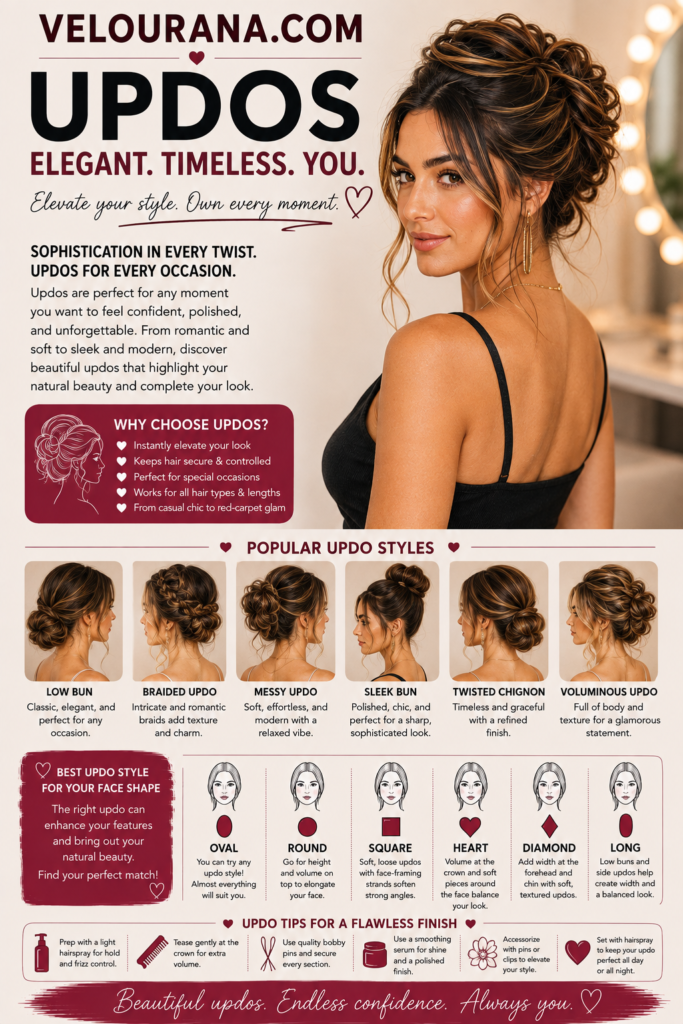
A high bun creates vertical lift.
A low chignon concentrates the shape near the nape.
A loose textured updo creates softness around the head.
A sleek twisted style emphasizes clean lines.
A braided updo introduces visible pattern.
A deliberately undone style allows small pieces to escape and creates movement around the face.
The most flattering choice therefore depends less on following one supposedly perfect updo and more on understanding where the hairstyle places its volume, how tightly it controls the roots, what happens around the face and how the finished shape relates to the natural length and texture of the hair.
Once those elements are understood, updos become far more versatile than they initially appear.
The First Decision Is Where the Updo Should Sit
Placement determines much of the silhouette before any detailed styling begins.
An updo can sit high near the crown, around the middle of the back of the head or low near the nape.
Each position changes the direction of the hair.
High placement pulls the eye upward.
Mid-height placement creates balance.
Low placement keeps the visual weight closer to the neck and often produces a quieter, more understated effect.
The same twisted bun can therefore look energetic when positioned high and elegant when moved lower.
There is no universally correct placement.
The objective is choosing the position that supports the desired result.
High Updos Create Vertical Lift
A high updo redirects much of the hair upward.
The sides rise.
The crown becomes more prominent.
The gathered structure may remain visible from the front.
This creates an energetic silhouette and can make even a simple bun feel dramatic.
Long hair can create substantial volume because all of the length is concentrated near the crown.
Curly and coily textures can produce especially dimensional high updos because the natural volume becomes part of the elevated shape.
Straight hair can create a cleaner and more sculptural version.
The important point is that height itself becomes one of the hairstyle's main features.
The Highest Possible Position Is Not Always Necessary
A high updo does not need to sit directly on top of the head.
Moving the structure slightly backward can preserve lift while creating a more balanced profile.
This can also improve comfort when the hair is long or dense.
The difference of only a few centimeters can change how the hairstyle looks from the side and how the weight feels on the scalp.
Placement should therefore be adjusted rather than treated as a fixed formula.
Mid-Height Updos Offer Natural Balance
A mid-height updo sits around the central back portion of the head.
It avoids the strong elevation of a top bun and the downward emphasis of a low chignon.
This makes it extremely adaptable.
The structure can be sleek.
It can be braided.
It can contain curls.
The crown can remain smooth or softly lifted.
Because the placement itself is relatively neutral, texture and finish can become the main sources of personality.
Low Updos Create Understated Sophistication
Low updos gather the hair around the nape or slightly above it.
The strands travel mainly backward and downward.
The upper silhouette remains relatively calm.
This position works particularly well for chignons, low twisted buns, braided buns and softly pinned styles.
A center part can create symmetry.
A side part can introduce direction.
A part-free brushed-back finish can make the hairstyle minimal.
The low position does not automatically make the style formal, but it provides a natural foundation for an understated look.
Crown Volume Changes the Entire Character
Placement alone does not determine the silhouette.
The crown can be flat, smooth and controlled, or it can retain visible lift.
A sleek crown creates cleaner lines.
A softly elevated crown creates a rounder profile.
A textured crown can make the hairstyle feel relaxed.
This is why an updo should be considered as a complete shape rather than simply a bun or twist attached to the back of the head.
The journey toward the gathered structure matters as much as the structure itself.
Sleek Updos Emphasize Direction
In a sleek updo, the surface of the upper hair becomes an important design element.
The strands follow clear pathways toward the gathered section.
A center part divides those pathways symmetrically.
A side part creates asymmetry.
Brushing everything backward removes the visible division and creates continuous movement.
Straight hair makes these lines particularly obvious, but sleek roots can also contrast beautifully with textured buns, curls or braids.
The upper section and gathered structure do not need identical textures.
Sleek Should Not Mean Painfully Tight
Polish does not require excessive tension.
Hair can be directed smoothly without being pulled aggressively at the temples or hairline.
The updo needs enough stability to remain in position.
Beyond that point, additional tightness does not necessarily improve the appearance.
Comfort is especially important when the hairstyle is intended to remain in place for many hours.
A refined surface should come from control, not discomfort.
Soft Updos Preserve Movement
At the opposite end of the spectrum, an updo can deliberately retain softness.
The crown may remain slightly loose.
The sides can contain natural texture.
A few pieces can fall near the ears.
Face-framing layers can remain outside.
The gathered structure itself can be gently expanded rather than compressed.
This creates an updo that feels less architectural and more fluid.
The hairstyle still has structure.
It simply does not advertise every securing point.
Face-Framing Pieces Can Completely Change an Updo
Because most of the hair is removed from around the face, the sections that remain become especially noticeable.
One narrow strand near each temple creates subtle softness.
Longer layers around the cheeks produce more obvious framing.
Jaw-length pieces can create a romantic effect.
Natural curls can remain free and provide movement.
The amount should be deliberate.
Leaving too much hair outside can weaken the visual relationship between the front and the updo.
A few well-positioned sections are often more effective.
Curtain Bangs Pair Naturally With Updos
Curtain bangs already create an independent front structure.
The center opens.
The outer sections sweep toward the temples.
Behind them, the remaining hair can travel toward a bun, twist or chignon.
This creates a natural division of roles.
The bangs frame the face.
The updo controls the longer lengths.
High placement creates stronger contrast between the soft front and elevated back.
Low placement produces a gentler continuation.
Full Bangs Create a Strong Front Element
A full fringe can remain completely separate from the updo.
The bangs define the forehead.
The remaining hair moves away from the face.
This can create a striking silhouette because the front retains substantial visual weight even though the lengths have been gathered.
A sleek bun emphasizes the contrast.
A textured updo softens it.
Side Bangs Introduce Direction
Long side-swept bangs can flow toward the updo or remain partly free.
Allowing them to sweep across the forehead creates movement before the eye reaches the gathered structure.
This works particularly well with low side-positioned chignons and asymmetrical updos.
The front and back can follow the same directional idea.
The Bun Is the Foundation of Many Updos
The bun remains one of the most adaptable updo structures.
Hair is gathered, twisted or wrapped and secured into a compact form.
But the final result depends on how tightly the hair is wrapped, where the bun sits and what texture existed before it was formed.
A tight high bun can look sleek and graphic.
A large low bun can feel elegant.
A loose textured bun can appear effortless.
A braided bun introduces visible pattern.
The basic principle is simple, but its interpretations are nearly endless.
High Buns Concentrate the Hair Near the Crown
A high bun creates immediate lift because both the roots and the gathered length move upward.
The bun may remain visible from the front depending on its height and size.
This makes it a strong visual feature.
Fine hair can create a smaller, delicate bun.
Dense hair can produce a larger structure.
Wavy, curly and coily textures can create additional dimension without requiring the surface to become perfectly smooth.
A Top Knot Creates an Even More Elevated Shape
The top knot sits particularly high and often has a more compact structure.
It can be sleek or deliberately relaxed.
Straight hair can create a clean twisted knot.
Textured hair can produce a fuller shape.
Because the structure sits so high, the front and side profile become especially important.
A little adjustment in placement can determine whether the knot feels balanced or excessively forward.
Low Buns Create a Different Mood
Moving the same basic structure to the nape changes everything.
The roots travel backward rather than strongly upward.
The bun becomes less visible from the front.
The neck and profile receive more attention.
A low bun can remain simple and practical or become highly refined depending on the finish.
This versatility explains why it appears so frequently in both everyday and formal styling.
The Chignon Is a Classic Low-Updo Structure
A chignon generally concentrates the hair around the lower back of the head.
The lengths may be rolled, folded, twisted or pinned into place.
The resulting shape can be smooth and compact or soft and dimensional.
A center part can create a very clean interpretation.
A side part makes the front more directional.
Loose face-framing pieces can soften the formality.
The hairstyle is defined less by one rigid technique than by the elegant concentration of the hair around the nape.
A Chignon Can Be Minimal
The hair does not need to contain elaborate curls or braiding.
Smooth roots can lead into one simple rolled structure.
The securing points can remain hidden.
The silhouette itself provides enough interest.
This minimalist approach works particularly well when the intention is to emphasize clean proportions.
A Textured Chignon Creates More Dimension
Waves or curls before gathering can change the chignon dramatically.
Instead of forming one perfectly smooth mass, the hair contains visible movement.
Sections overlap.
Small curves remain apparent.
The structure becomes softer.
This can create a romantic effect while preserving the elegance of low placement.
French Twists Create Vertical Structure
The French twist organizes the hair differently from a circular bun.
Instead of wrapping around one central base, the hair is directed vertically and folded inward.
This creates an elongated structure along the back of the head.
The silhouette can be exceptionally clean.
A polished version emphasizes the vertical line.
A softer interpretation can allow some volume through the crown and a few loose pieces around the face.
The twist demonstrates that an updo does not need to be round.
Vertical Updos Can Make the Back Shape Appear Longer
A bun concentrates volume around one area.
A vertical twist distributes it across a longer section.
This can change the perceived proportions of the head and neck.
The eye follows the structure upward and downward rather than around one central mass.
This makes vertical updos particularly distinctive.
Braided Updos Introduce Pattern
Braiding changes an updo by giving the gathered hair visible internal structure.
A braid can be wrapped into a bun.
Several braids can be pinned together.
Braids can travel from the front or sides toward a central updo.
A crown braid can become the updo itself.
The woven pattern adds detail without requiring decorative accessories.
The hair becomes its own ornament.
A Braided Bun Is One of the Simplest Combinations
The hair can first be gathered into a ponytail.
The tail is braided.
The braid is then wrapped around the base and secured.
This produces a bun with visible woven texture.
A tightly braided version creates a compact pattern.
A gently widened braid produces a larger and softer bun.
The technique can be positioned high, mid-height or low.
Fishtail Braids Create Finer Updo Texture
A fishtail braid contains smaller repeated crossings.
When wrapped or pinned into an updo, those details create a more intricate surface.
The braid can be widened before pinning to increase volume.
Highlighted or multidimensional hair can make the pattern particularly visible because different tones move through the structure.
Crown Braids Redistribute the Hair Around the Head
Instead of concentrating all of the hair at one point, a crown braid follows the head itself.
The braid may travel around the perimeter and be pinned into a continuous shape.
This creates a very different silhouette from a bun.
The volume is distributed.
The pattern becomes visible from several angles.
The hairstyle can feel romantic, traditional or modern depending on how polished the braid remains.
Halo Braids Can Frame the Entire Head
A halo-style braid creates a continuous or nearly continuous woven structure around the head.
The face becomes the central open area.
Loose front pieces can soften the result.
A more compact braid creates a cleaner effect.
A widened braid produces greater visual volume.
The hairstyle demonstrates how an updo can contain all of the hair without creating one obvious central bun.
Twists Offer Softer Structure Than Braids
Twisting creates visible direction without the repeated woven pattern of braiding.
Side sections can be twisted backward.
Several twists can meet at the nape.
The lengths can be rolled into a low bun.
The hairstyle gains texture while remaining relatively soft.
Twists can also be easier to loosen and reshape than tightly constructed braids.
Rope Twists Can Become Sculptural Updos
Two sections twisted together create a rope-like structure.
That rope can then be wrapped around itself.
The resulting bun contains visible spiraling lines.
Long hair can create particularly dramatic shapes because the rope has enough length to circle the base several times.
The structure remains simple but visually distinctive.
Multiple Twists Can Create a Complex-Looking Updo
Several small sections can be twisted independently and pinned toward one central area.
Because each section follows a slightly different pathway, the final hairstyle can appear intricate.
Yet the technique may be simpler than constructing one complicated braid.
This approach is particularly useful for textured or layered hair because shorter sections can be incorporated gradually.
Curled Updos Use Individual Sections as Building Blocks
Hair can be curled before being pinned.
Instead of wrapping the entire length into one bun, individual curls or sections can be arranged around a central point.
This creates visible dimension.
The hairstyle can become soft and romantic.
The exact placement does not need to be perfectly symmetrical.
Natural variation often improves the effect.
The Curls Do Not Need to Be Identical
Uniform curls can create a very polished updo, but slight differences often make the structure look more natural.
One section can curve upward.
Another can overlap.
A third can disappear underneath.
The updo gains depth because the hair is not behaving as one solid mass.
Naturally Curly Hair Already Contains Useful Structure
Curly hair does not necessarily need to be straightened and recurled before becoming an updo.
Its natural pattern can provide the dimension.
The roots can remain textured.
Curls can be gathered loosely.
Selected sections can be pinned while others remain visible.
This creates an updo that works with the hair rather than replacing its character.
Coily Hair Can Create Strong Sculptural Updos
Coily textures offer substantial possibilities for elevated shapes, twists, braided structures and gathered styles.
The natural volume can become part of the silhouette.
High updos can create dramatic height.
Low styles can concentrate texture around the nape.
Twists and braids can provide additional structure.
The style should remain secure without depending on excessive tension at the hairline.
Straight Hair Can Create Exceptionally Clean Updos
Straight hair makes direction highly visible.
A sleek low bun can appear almost architectural.
A French twist can create a continuous vertical surface.
A top knot can become extremely compact.
Because the hair does not contain much natural texture, the structure itself becomes more prominent.
This makes straight hair particularly suited to minimalist updos.
Wavy Hair Naturally Softens Structured Styles
Waves prevent the surface from appearing completely flat.
Even when the hair is gathered into a bun, small bends remain.
This can make a basic updo feel more dimensional.
The waves can also create volume before the hair is pinned.
A low bun made from pre-waved hair may appear larger and softer than one made from completely straight lengths.
Fine Hair Benefits From Strategic Volume
Fine hair can create beautiful updos without needing to imitate the scale of dense hair.
The important issue is where the available volume is placed.
A little crown lift can improve the profile.
Gentle waves can increase apparent density.
A braid can be widened before being wrapped.
Sections can be pinned loosely rather than compressed into the smallest possible shape.
The goal is not artificial enormity.
It is making effective use of the hair that is present.
Fine Hair Often Looks Better With Controlled Scale
A smaller chignon can look elegant.
A compact high bun can look deliberate.
A narrow French twist can feel sophisticated.
There is no requirement for every updo to be oversized.
Proportion is more important than volume alone.
Thick Hair Creates Substantial Updos Naturally
Dense hair provides plenty of material for buns, braids and twists.
The resulting structures can become large without much effort.
The challenge is often controlling weight.
A very high bun made from long, thick hair may become uncomfortable.
Low placement can reduce the amount of upward redirection.
Multiple securing points can distribute the structure more effectively than relying on one excessively tight base.
Very Long Hair Creates Both Possibilities and Challenges
Long hair can wrap around a bun several times.
It can create substantial braids.
It can form elongated twists.
But the additional length also adds weight and requires somewhere for the ends to go.
An effective updo should incorporate the full length without producing unnecessary bulk in one area.
Sometimes dividing the hair into sections makes this easier.
Medium Hair Is Extremely Versatile for Updos
Medium lengths often provide enough hair for buns, twists and braids without the weight of very long hair.
The structures can remain compact.
Shorter layers may create softness around the front and nape.
A French twist can work beautifully.
Low buns can remain proportional.
Several small sections can be pinned individually when one large structure is not possible.
Shorter Layers Do Not Automatically Prevent an Updo
Layered hair may not gather perfectly into one smooth shape.
That does not mean an updo is impossible.
Short pieces can remain free around the face.
Sections at the nape can be incorporated separately.
Twists can capture shorter layers gradually.
A textured finish can make small escaped pieces look intentional.
The hairstyle should adapt to the haircut.
Layered Hair Can Actually Improve Soft Updos
Different lengths create natural variation.
Some pieces sit closer to the head.
Others extend into the bun.
Face-framing layers remain visible.
The updo gains dimension.
Trying to force every layer into one perfectly smooth structure can remove some of the haircut's most attractive qualities.
Heatless Texture Can Become Excellent Updo Preparation
Hair that has been braided, rolled, twisted or wrapped overnight may already contain movement.
That texture can provide volume and grip for an updo.
Heatless waves can create a fuller low bun.
Fabric curls can be pinned individually.
Braid waves can add dimension to a loose chignon.
The previous style becomes preparation for the next one.
Second-Day Hair Can Be Particularly Suitable
An updo does not require the hair to look perfect when worn loose.
Roots can be reorganized.
Lengths can be pinned.
Previous waves can become texture.
A curl that has lost some definition can disappear inside a bun or become part of a softly pinned section.
This makes updos useful for extending a styling cycle rather than beginning again from zero.
Day-Old Curls Can Create Beautiful Pinned Shapes
Curls often soften after being worn.
When loose, they may no longer have the original uniformity.
Inside an updo, that variation can become an advantage.
Different sections can be pinned separately.
The hairstyle gains movement.
The original curl pattern does not need to be restored completely.
The Low Ponytail Is a Useful Starting Point
Many updos become easier when the hair is first gathered into a ponytail.
A low ponytail can become a chignon.
It can be braided and wrapped.
It can be twisted upward.
It can be divided into several sections and pinned.
The ponytail provides an anchor.
The remaining styling happens around that secure point.
A High Ponytail Can Become a Bun Quickly
The same principle applies higher on the head.
Once the ponytail is secure, the tail can be twisted and wrapped.
It can be braided first.
It can be divided and pinned.
The position of the ponytail determines the position of the final updo.
This makes ponytail-based construction particularly useful for controlling placement.
Not Every Updo Needs a Ponytail Foundation
Some styles benefit from freer construction.
A French twist can gather the hair directly.
Braided crowns distribute the hair without one central elastic.
Several twisted sections can meet gradually.
Curled updos may use pins rather than a single base.
The best foundation depends on the desired shape.
Hidden Pins Allow the Hair to Remain the Focus
In polished updos, securing points are often most effective when they disappear.
Pins can be placed underneath folds.
They can enter the bun from less visible angles.
The hair then appears to hold its shape without obvious hardware.
This creates a cleaner result.
Visible Pins Can Also Become Decorative
There is no rule that every pin must disappear.
Decorative pins can become part of the hairstyle.
Several can be arranged deliberately.
Metallic or embellished pieces can create focal points.
The distinction is intention.
A visible securing element should look like a design choice rather than an accidental exposed pin.
Combs Can Decorate Low Updos Beautifully
A decorative comb can sit above or beside a low chignon.
The updo provides a stable structure.
The accessory adds detail without needing to dominate.
This works especially well when the rest of the hairstyle remains relatively simple.
Barrettes Can Emphasize the Gathering Point
A barrette can sit across the area where twists meet.
It can decorate the top of a low bun.
It can secure selected sections.
The horizontal line of the accessory can contrast with the vertical or circular movement of the hair.
Ribbons Can Soften an Updo
A ribbon can wrap around a bun.
It can tie beneath a low style.
It can be incorporated into a braid before the braid is pinned.
The fabric introduces a softer material alongside the hair.
The result can range from subtle to decorative depending on width and placement.
Pearls and Decorative Elements Should Support the Structure
Small embellishments can be distributed through braids, twists or curls.
They can create points of light across the hairstyle.
But the underlying updo should remain readable.
If the decoration overwhelms the shape, the hairstyle can lose visual clarity.
A few strategically placed elements may have more impact than covering every section.
Updos Showcase Hair Color Differently From Loose Styles
Gathering the hair changes the way different tones interact.
Highlights that normally fall vertically may curve around a bun.
Balayage ends can become concentrated in the outer part of a chignon.
Lighter pieces can cross darker sections inside braids.
The hairstyle reorganizes the color.
This can make dimensional coloring especially noticeable.
Highlights Can Reveal the Direction of Twists
When a highlighted strand travels through a twist, its pathway becomes easy to see.
The color effectively outlines the structure.
This can make a relatively simple technique appear more detailed.
Braids benefit from the same effect.
Balayage Can Create Contrast Inside a Bun
If the ends are lighter than the roots, wrapping the lengths into a bun can place those lighter tones around the outer structure.
The result may contain natural contrast without any additional decoration.
A loose bun can showcase this particularly well because several surfaces remain visible.
Natural Gray Hair Can Create Beautiful Updo Dimension
Gray, silver and white strands often create their own internal highlights.
When twisted or braided, they form visible lines through darker areas.
A sleek updo can emphasize those pathways.
A textured style can blend them into a more complex metallic surface.
The hairstyle can showcase natural color rather than concealing it.
The Neck Becomes Part of the Overall Silhouette
One of the most significant changes created by an updo is the exposure of the neck.
Loose hair normally occupies space around it.
An updo removes that visual weight.
The neck appears longer and more defined simply because it becomes visible.
This changes how the hairstyle interacts with clothing and jewelry.
Earrings Become More Prominent
Large earrings that might disappear inside loose hair become clearly visible.
Even small earrings gain more space.
This does not mean an updo requires statement jewelry.
It simply changes the visual relationship.
The hairstyle opens areas that were previously covered.
Necklines Become More Visible
High collars, open backs, detailed shoulders and unusual necklines can all become more prominent when the hair is gathered.
The hairstyle and clothing therefore influence each other.
A low bun may sit near a high collar.
A high updo clears the entire neck.
A side chignon creates asymmetry around the shoulders.
These relationships can help determine placement.
Formal Updos Do Not Need to Be Complicated
Complexity is not the same as elegance.
A smooth low bun can be formal.
A clean French twist can be formal.
A simple braided chignon can be formal.
What creates refinement is often the consistency of the finish and the clarity of the shape.
Adding more elements does not automatically improve the hairstyle.
One Strong Structural Idea Is Often Enough
If the chignon is beautifully shaped, it may not need several braids.
If the French twist creates a strong vertical line, excessive accessories may distract from it.
If a crown braid is already detailed, additional curls and decorative pieces may be unnecessary.
The eye benefits from knowing where to focus.
Relaxed Updos Still Need Structure
An intentionally messy bun is not simply an unsecured bun.
A soft chignon still has an anchor.
A loose braided updo still has a readable pattern.
The apparent effortlessness sits on top of an underlying structure.
This is what separates deliberate softness from a hairstyle that is simply falling apart.
Controlled Imperfection Can Make an Updo More Natural
Perfect symmetry is not always necessary.
One side can contain slightly more volume.
A curl can sit higher than another.
A few pieces can escape.
The bun can be slightly irregular.
These differences can create movement.
Trying to correct every tiny variation may make the hairstyle unnecessarily rigid.
The Updo Should Look Good From More Than One Angle
An updo is a three-dimensional structure.
The front may look beautiful while the side profile feels flat.
The back may contain an attractive bun while the crown appears compressed.
The hairstyle should therefore be considered from several viewpoints.
Front.
Side.
Back.
The transitions between them matter.
The Side Profile Is Especially Important
From the side, the relationship between crown volume and the gathered structure becomes clear.
A high bun may need enough crown lift to connect naturally with the base.
A low chignon may benefit from a gentle curve through the back of the head.
A French twist relies heavily on its vertical profile.
Small adjustments can improve these proportions considerably.
The Back Should Have a Clear Focal Point
When the hairstyle is viewed from behind, the structure should be understandable.
Perhaps the focal point is one bun.
Perhaps it is a vertical twist.
Perhaps several braids meet centrally.
Perhaps the braid itself circles the head.
A clear focal point prevents the style from becoming visually confused.
Updos Can Be Adjusted for Everyday Wear
Not every updo needs to be saved for an event.
A low twisted bun can take only minutes.
A high bun can manage long hair efficiently.
A braided ponytail can become a bun.
A claw clip can create a quick French-twist-inspired shape.
The category includes many practical styles as well as elaborate ones.
A Claw Clip Can Create a Fast Updo
The hair can be gathered and twisted upward.
A claw clip secures the central section.
The ends can remain free or be tucked.
This creates a quick vertical shape without extensive pinning.
The result can be sleek or relaxed depending on how the roots and ends are handled.
Long Hair Can Be Folded Into the Clip
When the lengths extend beyond the clip, they can be folded downward before securing.
This contains more of the hair.
Alternatively, the ends can remain visible at the top for a casual effect.
The clip becomes both the securing mechanism and a visible accessory.
Medium Hair Works Naturally With Clip Updos
Medium lengths often fit comfortably inside a twist.
Some ends may remain visible.
Face-framing layers can stay free.
The hairstyle can be created quickly while still producing a clear updo silhouette.
Updos Can Transition During the Day
A hairstyle does not need to remain in exactly one form.
A braided ponytail can become a braided bun.
A high ponytail can become a top knot.
A low ponytail can become a chignon.
A bun can be released into waves.
This flexibility makes gathered styles practical for changing situations.
An Updo Can Also Preserve Texture for Later
Hair that remains twisted or braided for several hours may develop additional bends.
When released, it can have a different texture from when it was first gathered.
The hairstyle can therefore function both as a finished look and as a temporary setting method.
Comfort Should Influence the Structure
An updo carries the weight of the hair in a concentrated area.
The higher and heavier the structure, the more noticeable this can become.
Long dense hair may benefit from lower placement.
Several pins can distribute support.
A large structure does not need to depend on one painfully tight elastic.
The hairstyle should remain comfortable for its intended duration.
Pins Should Support Rather Than Pull
Pins are most effective when they anchor sections into a stable foundation.
They should not need to force large amounts of hair into an unnatural position.
Using several strategically positioned pins can be more comfortable than relying on one point of extreme tension.
The Hairline Should Remain Comfortable
Sleek updos can still respect the front hairline.
The hair can be smoothed without being stretched aggressively.
Small natural hairs do not necessarily need to be forced into the main structure.
The finish can remain polished while allowing realistic movement.
Repeating the Same Tight Updo Every Day Is Unnecessary
Placement can change.
A high bun can be followed by a low one.
A twist can replace a ponytail-based style.
The part can move.
Tension can vary.
Different approaches create visual variety and avoid treating exactly the same sections of hair identically every day.
The Best Updo Works With the Existing Hair
A successful style does not require every head of hair to behave identically.
Fine hair can create smaller elegant structures.
Dense hair can create substantial shapes.
Straight hair can emphasize clean lines.
Waves can provide softness.
Curls can create dimension.
Coils can create sculptural volume.
Layers can remain visible rather than being treated as obstacles.
The hairstyle should respond to these characteristics.
Choosing an Updo by the Desired Effect
The enormous number of possible updos becomes easier to navigate when the desired effect is identified first.
For height, choose an elevated bun or top knot.
For understated elegance, consider a low chignon.
For vertical structure, use a French twist.
For visible pattern, introduce braids.
For softness, preserve crown volume and face-framing sections.
For quick practicality, use a simple bun or claw-clip twist.
For natural texture, allow curls, waves or coils to remain part of the structure.
The technique then follows the objective.
An Updo Is Ultimately About Redistributing Shape
The transformation created by an updo is not simply that the hair becomes shorter because the lengths have been pinned away.
The entire composition changes.
Volume that once existed around the shoulders moves upward or backward.
The neck becomes visible.
The face becomes more open.
The crown gains importance.
The back of the head becomes a place for structure.
A bun concentrates the volume.
A chignon keeps it low.
A French twist stretches it vertically.
Braids create pattern.
Curls create dimension.
Twists create direction.
Small loose sections return softness to the front.
That is why updos can range from extremely practical to exceptionally elegant without abandoning the same fundamental principle.
The hair is gathered, but it does not disappear.
It is reorganized.
Its length becomes shape.
Its texture becomes structure.
Its color becomes part of the pattern.
And once placement, volume, texture and finish are treated deliberately, an updo stops being simply a way to put the hair up.
It becomes a way to redesign the entire silhouette.
The End
Velourana.
 Discover More From Our Family of Websites
 ZodiacBearing (Astrology, Tarot, Numerology, Angel Numbers & Spiritual Guidance)
 Velourana (Beauty, Makeup, Hair Care, Skincare & Beauty Tips)
 HavenBearing (Home, Living, Organization, Décor & Everyday Inspiration)
 PawBearing (Pet Care, Dog Breeds, Animal Health, Training & Pet Products)
 PsyCatherine (Notes From the Journal of a Psychologist on Real Life)