
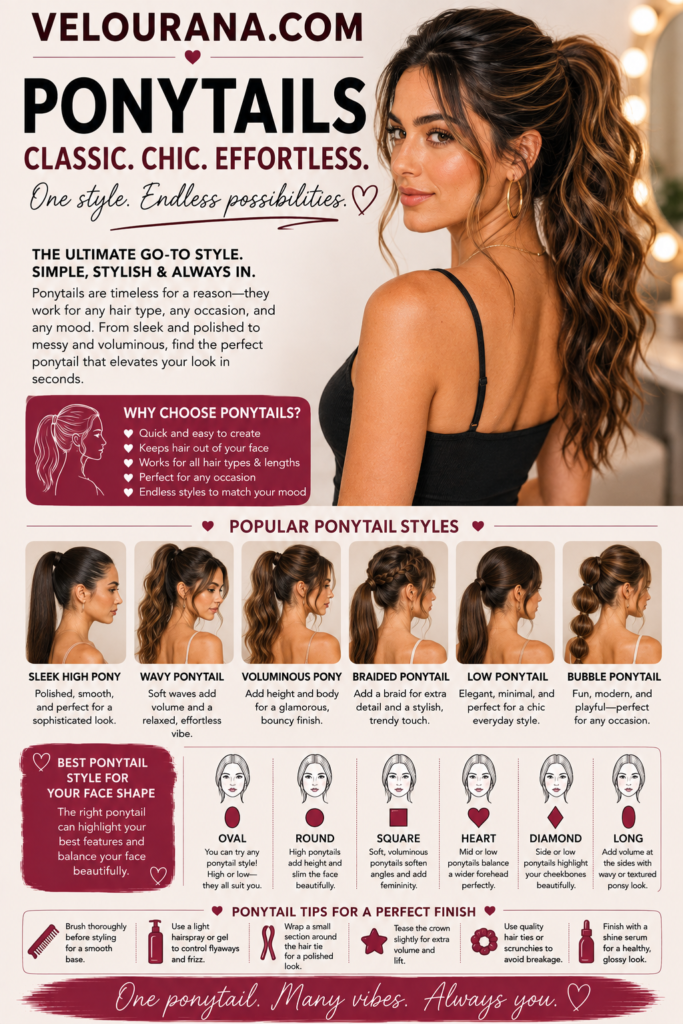
CATEGORY: Ponytails
The ponytail may be one of the simplest hairstyles ever created, but simplicity does not mean that every ponytail looks the same. Moving the gathering point only a few centimeters can change the entire silhouette. Altering the amount of tension at the crown can make the style appear sleek or relaxed. Leaving face-framing pieces free can soften the front, while pulling everything back creates a cleaner and more graphic effect.
A ponytail can be athletic, elegant, romantic, minimal, polished or deliberately undone.
It can emphasize length or make thick hair feel lighter around the face. It can showcase curls, waves, layers or color. It can sit high enough to create visible lift, low enough to feel understated or somewhere in the middle for a balanced everyday shape.
The hairstyle is essentially built from one decision—where the hair is gathered—but that decision influences almost everything else.
Understanding height, direction, texture and proportion makes it much easier to create a ponytail that looks intentional rather than simply convenient.
Ponytail Height Changes the Entire Silhouette
The most important structural choice is the height of the ponytail.
A high ponytail directs the hair upward before allowing the lengths to fall. This creates visible lift and makes the ponytail itself more prominent from the front and sides.
A mid-height ponytail sits closer to the natural curve at the back of the head. It usually creates a balanced silhouette without feeling especially dramatic.
A low ponytail directs the hair backward and downward. The crown tends to appear smoother, and the overall effect becomes quieter and often more sophisticated.
None of these positions is universally better.
They simply create different visual effects.
The High Ponytail Creates Lift and Energy
A high ponytail naturally changes the direction of the upper hair.
The sides move upward.
The crown is gathered toward a higher point.
The loose lengths fall from above rather than from the nape.
This gives the hairstyle a sense of vertical movement.
Long hair can look especially dramatic because the ponytail falls from a high position and remains visible behind the shoulders.
Waves and curls can increase the effect by adding volume to the tail.
Straight hair creates a cleaner, more streamlined interpretation.
The Exact High Point Matters
A ponytail does not need to sit directly on top of the head to feel high.
A gathering point around the upper back of the head can create substantial lift while remaining easier to wear.
Moving higher increases visibility from the front.
Moving slightly lower creates a softer profile.
This allows the high ponytail to be adjusted rather than treated as one fixed hairstyle.
A Mid-Height Ponytail Is Naturally Versatile
The middle position avoids the extremes of both high and low placement.
The roots do not need to travel dramatically upward.
The hair does not need to be pulled completely downward either.
This often makes the style comfortable and balanced.
A mid ponytail can be sleek.
It can be loose.
It can contain curls or waves.
The crown can remain smooth or slightly lifted.
Because the placement is neutral, the finish becomes the main source of personality.
The Low Ponytail Creates Understated Elegance
A low ponytail usually sits around the nape or just above it.
The hair travels backward with relatively little upward movement.
This creates a calmer silhouette.
A center part can make the style feel clean and symmetrical.
A side part introduces more movement through the front.
A part-free, brushed-back finish creates another interpretation entirely.
The low ponytail can be extremely simple while still appearing deliberate.
A Low Ponytail Does Not Need to Be Flat
Low placement and flatness are not the same thing.
The crown can retain volume even when the ponytail sits near the nape.
A little softness at the roots changes the entire profile.
Instead of the hair being pulled tightly against the scalp, it can rise slightly before moving backward.
This creates a more relaxed and dimensional result.
The gathering point remains low, but the upper silhouette becomes softer.
Crown Volume Changes the Character of Any Ponytail
Two ponytails positioned at exactly the same height can look completely different according to what happens at the crown.
A smooth crown creates control.
A lifted crown creates softness and volume.
A textured crown creates a more relaxed finish.
The roots therefore deserve as much attention as the tail itself.
The ponytail is not simply the hair hanging from the elastic.
It includes the entire pathway leading toward that elastic.
A Sleek Ponytail Emphasizes Direction
In a sleek ponytail, the hair is controlled from the hairline toward the gathering point.
The direction becomes obvious.
The sides follow clean lines.
The crown remains smooth.
The ponytail emerges as the primary moving element.
Straight lengths can make this effect especially graphic.
Curly or textured lengths create a striking contrast between the controlled upper hair and the fuller tail.
Sleek Does Not Need to Mean Painfully Tight
A polished surface should not depend on excessive pulling.
The hair can be directed neatly without creating unnecessary discomfort around the temples or hairline.
The elastic needs enough security to hold the style, but the scalp should remain comfortable.
A ponytail that looks controlled does not need to feel restrictive.
A Relaxed Ponytail Uses Softness Deliberately
The opposite approach allows some movement around the roots.
The crown can remain slightly loose.
Small pieces can escape near the ears.
Face-framing layers can remain outside.
The ponytail itself may contain natural waves or curls.
This does not make the hairstyle unfinished.
When the softness is balanced, it becomes part of the design.
Face-Framing Pieces Can Transform the Front
Leaving a few sections loose around the face changes the relationship between the ponytail and the haircut.
Instead of every strand traveling backward, some continue framing the cheeks.
This can soften a high ponytail.
It can make a low ponytail feel more romantic.
It can preserve the effect of layered face framing.
The pieces do not need to be symmetrical.
Natural variation can create a relaxed finish.
Curtain Bangs Work Naturally With Ponytails
Curtain bangs are particularly compatible with ponytails because they already separate from the longer lengths.
They can remain completely free while the rest of the hair is gathered.
The center opens.
The sides frame the face.
The ponytail creates structure behind them.
A high ponytail makes the contrast stronger.
A low ponytail creates a softer continuation from the bangs toward the back.
Full Bangs Create a Stronger Front Shape
A blunt or full fringe can remain completely independent of the ponytail.
The fringe defines the forehead.
The remaining hair moves backward.
This creates a clear division between the front and the gathered style.
A sleek ponytail can emphasize that contrast.
A softer ponytail can make it less severe.
The bangs do not need to be incorporated simply because the rest of the hair is tied back.
Side Bangs Can Flow Into the Ponytail
Long side-swept bangs can either remain loose or gradually join the gathered hair.
Leaving them free creates more movement around the face.
Directing them backward creates a cleaner line.
The choice depends on whether the front should remain soft or become part of the overall sweep.
A Center Part Creates Symmetry
A center-parted ponytail divides the front into two clear sections.
Each side travels backward toward the same gathering point.
This works particularly well with low and mid-height ponytails.
The result can feel polished even when the tail itself remains naturally textured.
The part provides structure.
The lengths provide movement.
A Side Part Adds Direction
A side part changes the distribution of hair across the front.
One side becomes broader.
The other becomes narrower.
This creates asymmetry before the hair even reaches the ponytail.
Low ponytails can look particularly elegant with this arrangement because the front gains movement while the back remains understated.
A Brushed-Back Ponytail Removes the Visible Part
The hair can also be directed backward without maintaining an obvious part.
This creates continuous movement from the hairline toward the gathering point.
A high ponytail can become more athletic or dramatic.
A mid-height ponytail can feel modern and clean.
A low version can look minimal.
The absence of a visible part makes the direction of the hair itself the defining feature.
Straight Ponytails Create Clean Lines
Straight hair makes ponytail structure extremely easy to see.
The roots move toward the elastic.
The tail falls downward.
The result can be simple and graphic.
Long straight hair can create a particularly strong vertical line.
A blunt haircut emphasizes the perimeter.
Layers create lighter movement through the tail.
The hairstyle does not need additional curl to look complete.
Wavy Ponytails Add Softness and Dimension
Waves make the tail appear broader.
Different sections catch light at different angles.
Layers become more visible.
The ponytail moves more freely.
The upper hair can remain smooth while the tail retains waves, creating contrast.
Alternatively, the roots can remain softly textured as well, producing a more continuous finish.
Curly Ponytails Can Become Dramatic Focal Points
Curly hair gives the ponytail natural volume.
The gathered roots create structure while the tail expands into texture.
A high placement can make the curls especially visible.
A low placement creates a fuller shape near the upper back.
The curls do not need to be forced into one identical pattern.
Their natural variation contributes to the dimension of the hairstyle.
Coily Ponytails Can Create Beautiful Sculptural Volume
Coily textures can produce ponytails with significant presence.
The upper hair can remain textured or be directed more smoothly toward the gathering point.
The tail can retain its natural volume.
Higher placement creates a lifted, expansive silhouette.
Lower placement changes where that volume sits.
The style should respect the hairline and remain comfortable rather than relying on extreme tension.
Fine Hair Benefits From Preserving Density in the Tail
When hair is fine, the way it is gathered matters.
Pulling too many shorter layers away from the tail can make the remaining lengths appear sparse.
A well-positioned ponytail can preserve the visual density.
The tail can also be loosened slightly after securing so that the roots do not appear completely compressed.
Waves or gentle bends can increase the apparent fullness of the lengths.
Fine Hair Can Use Texture to Create a Fuller Ponytail
A completely straight fine ponytail may appear narrow because all of the strands fall together.
Adding natural or heatless movement separates the lengths.
The tail occupies more space.
Even gentle waves can make a noticeable difference.
The objective does not need to be creating large curls.
Small changes in movement can create greater visual fullness.
Thick Hair Creates Naturally Substantial Ponytails
Dense hair provides plenty of material for the tail.
The main challenge may be securing it comfortably.
The elastic needs enough strength to support the weight without requiring excessive tightness.
A high ponytail can feel heavier because the hair is suspended from a higher point.
A lower placement may distribute the weight more comfortably.
The ideal height therefore depends not only on appearance but also on how the hairstyle feels after several hours.
Long Hair Makes Placement Especially Important
Long hair creates a strong relationship between ponytail height and visible length.
A high ponytail begins farther from the shoulders and may make the tail appear especially dramatic.
A low ponytail begins near the nape and allows the hair to fall almost immediately down the back.
Both can showcase length differently.
The weight of very long hair should also be considered.
A secure style should remain comfortable.
Medium Hair Creates a Compact, Bouncy Tail
Medium lengths can create particularly lively ponytails.
The tail is short enough to retain bounce.
Layers can move freely.
A high ponytail may curve outward before falling.
A mid-height version can feel balanced and practical.
The hairstyle can look substantial without carrying the weight associated with very long hair.
Shorter Layers Can Create Natural Texture Around the Ponytail
Layered hair does not always enter a ponytail perfectly.
Short sections may escape around the ears or nape.
This can be treated as a flaw or incorporated deliberately.
For relaxed styles, those pieces can soften the silhouette.
For polished styles, they can be secured selectively.
The haircut determines what is realistic.
A ponytail should work with the existing lengths rather than requiring every strand to behave as though the hair were one length.
Long Layers Add Movement to the Tail
Long layers can make a ponytail appear more dimensional.
The shorter sections create volume near the upper part of the tail.
Longer pieces extend beneath them.
Waves and curls emphasize this difference.
The ponytail becomes less like one solid rope of hair and more like a moving layered shape.
A Wrapped Elastic Creates a More Finished Appearance
One of the simplest ways to change a basic ponytail is concealing the elastic.
A small section from underneath the tail can be wrapped around the base.
The end is then secured discreetly.
This replaces the visible band with hair.
The hairstyle immediately appears more intentional.
The technique works with high, mid and low ponytails.
The Wrapped Section Can Remain Smooth
For a polished effect, the section can be wrapped neatly around the base.
Each turn follows the previous one.
The securing point remains hidden underneath.
This creates a clean cylindrical finish.
Straight and sleek ponytails show the detail particularly clearly.
A Looser Wrap Creates a Softer Finish
The section does not always need to form a perfect smooth band.
A slightly relaxed wrap can suit wavy or textured ponytails.
The hair maintains some natural movement.
The base feels integrated with the rest of the hairstyle rather than becoming an isolated polished detail.
Ribbons Can Change a Ponytail Immediately
A ribbon introduces movement and decoration without changing the underlying construction.
The ponytail itself can remain extremely simple.
A narrow ribbon creates subtle detail.
A larger bow becomes a focal point.
The ends can fall alongside the hair and extend the vertical line.
This works especially well with low and mid-height ponytails.
Scrunchies Create a Softer Base
A scrunchie changes the visual weight of the securing point.
Instead of disappearing, the accessory becomes part of the hairstyle.
A larger scrunchie can make a high ponytail feel playful.
A smaller one can soften a low ponytail.
The fabric also creates a different relationship with the hair than a narrow visible elastic.
Barrettes Can Decorate the Area Above the Ponytail
A barrette does not necessarily need to secure the entire hairstyle.
It can sit above the base as a decorative feature.
This works particularly well with low ponytails where the back of the head remains clearly visible.
The accessory can emphasize the gathering point without carrying all of the hair's weight.
A Ponytail Can Be Combined With Braids
The upper hair can be braided before entering the ponytail.
A small side braid can travel toward the elastic.
Two braids can meet at the back.
The tail itself can remain loose.
This creates detail without sacrificing the recognizable ponytail shape.
The braid functions as a pathway.
The ponytail remains the main structure.
The Tail Itself Can Become a Braid
A standard ponytail can transform immediately when the loose lengths are braided.
The roots remain organized through the ponytail.
The tail gains a second level of structure.
A conventional three-strand braid creates one effect.
A fishtail creates another.
Multiple small braids can create texture.
The hairstyle can therefore evolve without rebuilding the base.
A Bubble Ponytail Uses Repeated Sections
The bubble ponytail divides the tail with several securing points.
Each section between the elastics is expanded slightly to create a rounded shape.
The result is more sculptural than a conventional ponytail.
Long hair provides more space for repeated bubbles.
Medium hair can create a shorter version.
The sections can remain uniform for a polished effect or slightly irregular for a softer style.
Bubble Size Changes the Character
Large expanded sections create a dramatic pattern.
Smaller bubbles feel more restrained.
The spacing between elastics determines how many sections appear.
The amount of expansion determines how rounded they become.
This allows the same basic technique to range from subtle to highly decorative.
A Twisted Ponytail Adds Detail Near the Base
Sections above the elastic can be twisted before the tail is secured.
Alternatively, a small opening can be created above a low ponytail and the tail passed through it.
This creates a turned structure at the base.
The result adds detail while keeping the lower lengths completely loose.
It is particularly effective on low ponytails because the twist remains visible at the back.
Multiple Twists Can Create More Structure
Side sections can be twisted independently and brought toward a central ponytail.
The crown remains relatively soft.
The twists create visible lines.
The tail emerges beneath them.
This creates a hairstyle that feels more elaborate without requiring a full updo.
The Ponytail Can Sit Off-Center
The gathering point does not need to sit exactly in the middle.
A slightly off-center low ponytail introduces asymmetry.
A side ponytail makes that asymmetry much stronger.
The hair can fall over one shoulder.
This changes both the front and back silhouette.
The style can feel soft and romantic or deliberately playful depending on the texture and finish.
Side Ponytails Showcase the Length From the Front
A traditional ponytail often hides much of the hair behind the body.
Moving the tail toward one side brings the lengths forward.
Long waves become visible beside the shoulder.
Curls can frame one side.
The hairstyle therefore preserves the convenience of gathered hair while keeping more of the length visible from the front.
A Low Side Ponytail Works Well With Waves
Soft waves complement the asymmetry naturally.
The upper hair can sweep toward one side.
The ponytail sits near the lower side of the head.
The lengths continue over the shoulder.
Face-framing pieces can remain loose on the opposite side to balance the composition.
High Ponytails Can Create the Appearance of More Length
When the tail begins higher, more of it may remain visible behind the head before disappearing behind the shoulders.
The elevated base can make the hairstyle feel longer and more dramatic.
This is particularly noticeable when the hair is straight or gently waved.
The effect comes from placement rather than any actual change in length.
Double-Ponytail Techniques Can Create Additional Visual Fullness
Two ponytails can sometimes be positioned vertically so that the upper section conceals part of the lower one.
From the outside, the hairstyle may read as one fuller, longer ponytail.
The upper section contributes volume.
The lower section extends the visible length.
The effectiveness depends on the haircut, density and texture.
The sections should blend naturally rather than appearing obviously separate.
A Ponytail Can Preserve Heatless Texture
Hair that has been braided, rolled or wrapped overnight does not need to be worn loose the following morning.
The texture can become the foundation for a ponytail.
Heatless waves create a fuller tail.
Large curls add movement.
A heatless blowout can produce rounded ends.
This can make an extremely quick ponytail look much more styled.
Day-Old Waves Can Be Ideal for Ponytails
Texture that has softened after a day of wear may no longer look as defined when the hair is loose.
That does not make it unusable.
Gathering it into a ponytail reorganizes the movement.
The tail can appear full and dimensional.
Face-framing pieces can retain the softer waves.
The hairstyle can extend the usefulness of a previous style without requiring complete restyling.
A Ponytail Can Be an Effective Second-Day Hairstyle
The upper hair can be gathered while the lengths remain textured.
This makes ponytails particularly practical when the roots and ends are behaving differently.
The roots gain structure.
The tail preserves movement.
The hairstyle does not require both areas to look identical.
The Nape Matters in High Ponytails
When the ponytail moves upward, shorter hairs at the nape may not reach the gathering point.
This is common in layered or medium-length hair.
For a relaxed style, some of those pieces can remain free.
For a more polished result, they can be directed upward and secured discreetly.
The solution should reflect the haircut rather than creating excessive tension in an attempt to capture every short strand.
The Hairline Matters in Sleek Ponytails
A sleek ponytail places more visual attention on the hairline because the front is fully exposed.
The direction of the roots becomes prominent.
The part, if present, needs to feel deliberate.
Small natural variations around the hairline do not need to be treated as imperfections.
The objective is an organized shape, not an artificial surface.
Comfort Should Influence Ponytail Height
A hairstyle that looks excellent for ten minutes may not be useful if it becomes uncomfortable after an hour.
High ponytails can concentrate the weight of long or thick hair at one elevated point.
Lower ponytails often feel lighter.
Mid-height placement may provide the best compromise.
Changing the position slightly can significantly alter comfort without changing the overall appearance dramatically.
Repeated Tight Placement Can Be Avoided
Wearing the ponytail at exactly the same point with strong tension every day is not necessary.
The height can vary.
The direction can change.
A low style can follow a high one.
A braid or bun can replace it on another day.
Variety is useful not only visually but also because it avoids repeatedly treating the same sections of hair in exactly the same way.
A Ponytail Can Look Polished Without Becoming Severe
Polish comes from intention.
The part is deliberate.
The crown has the desired amount of volume.
The elastic is positioned correctly.
The tail has a coherent texture.
The front works with the haircut.
None of these requires the hair to be pulled as tightly as possible.
A softly controlled ponytail can look every bit as finished as an extremely sleek one.
A Relaxed Ponytail Should Still Have Structure
The opposite is also true.
A relaxed ponytail is not simply a loose elastic placed randomly.
Its softness should have direction.
Perhaps the crown is lifted.
Perhaps two face-framing pieces remain free.
Perhaps the tail contains waves.
Perhaps the gathering point sits deliberately low.
The style works because the looseness is balanced by a clear overall shape.
Hair Color Becomes More Dimensional in a Ponytail
Gathering the hair changes where different colors sit.
Highlights that normally fall vertically are redirected toward the base.
Balayage becomes concentrated through the tail.
Lighter face-framing pieces can remain visible at the front while darker roots travel backward.
The hairstyle can therefore reveal color placement differently from wearing the hair loose.
Waves Showcase Balayage Particularly Well
Wavy ponytails cause highlighted sections to cross and overlap.
The tail catches light at several angles.
Lighter ends become more visible.
A simple ponytail can therefore showcase dimensional coloring surprisingly effectively.
Natural Gray Hair Can Look Striking in a Sleek Ponytail
Silver and gray strands create natural variation.
When the hair is gathered smoothly, those strands form visible lines traveling toward the base.
The tail then reorganizes them again.
Straight hair creates a particularly clear effect.
Waves and curls make the tonal variation more multidimensional.
The Ponytail Can Be Minimal and Still Feel Complete
A ponytail does not require braids, accessories, curls, ribbons or elaborate construction.
Sometimes the strongest version is simply well positioned.
A clean center part.
A low gathering point.
A smooth tail.
Or perhaps a high ponytail with natural curls and no additional detail.
The hairstyle already contains a strong structural idea.
Everything else is optional.
The Best Height Depends on the Desired Effect
Choosing a ponytail becomes easier when the question changes from “Which height is best?” to “What should this hairstyle do?”
For lift and visibility, move higher.
For balance and versatility, stay around the middle.
For understatement and softness, move lower.
For drama, add texture or length.
For polish, control the upper surface.
For relaxation, preserve movement at the roots.
The hairstyle can then be designed around an objective rather than copied as a fixed formula.
A Ponytail Is Really a Study in Direction
At its simplest, the ponytail gathers hair into one point.
But everything before and after that point matters.
The front moves backward.
The sides travel upward, horizontally or downward according to placement.
The crown can flatten or lift.
The tail can fall straight, expand into curls, move through waves or become another structure entirely.
That is why such a simple hairstyle can produce so many different effects.
Change the gathering point and the silhouette changes.
Change the texture and the personality changes.
Change the front and the relationship with the face changes.
Change the accessory and the level of decoration changes.
The basic construction remains recognizable through all of them.
A ponytail can therefore be one of the quickest hairstyles in a routine while still offering enormous room for personal expression.
It can be practical without looking purely functional.
It can be elegant without becoming complicated.
And when its height, tension, texture and finish are chosen deliberately, one elastic and one gathering point can create a complete hairstyle with remarkably little effort.
The End
Velourana.
 Discover More From Our Family of Websites
 ZodiacBearing (Astrology, Tarot, Numerology, Angel Numbers & Spiritual Guidance)
 Velourana (Beauty, Makeup, Hair Care, Skincare & Beauty Tips)
 HavenBearing (Home, Living, Organization, Décor & Everyday Inspiration)
 PawBearing (Pet Care, Dog Breeds, Animal Health, Training & Pet Products)
 PsyCatherine (Notes From the Journal of a Psychologist on Real Life)

