
CATEGORY: Heatless Hairstyles
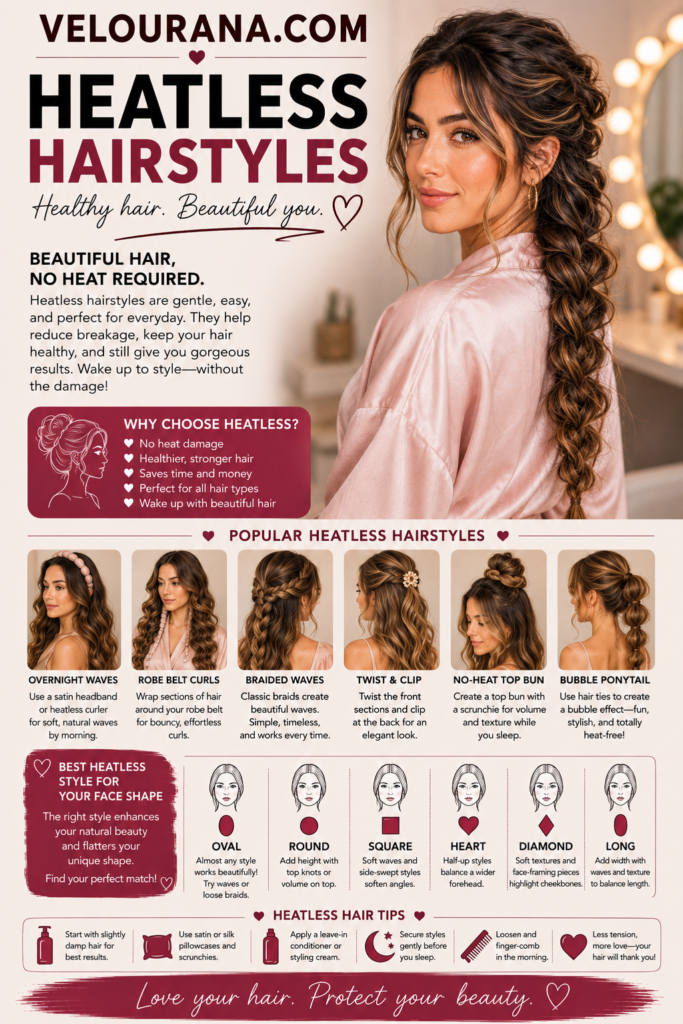
Heatless waves are one of the easiest ways to change the appearance of the hair without committing to a highly structured curl pattern. Unlike defined ringlets, waves do not need every section to follow an identical shape. Their beauty often comes from variation: some bends are stronger, others are softer, the roots may remain relatively smooth, and the movement can become progressively more noticeable toward the ends.
This makes heatless waves particularly adaptable.
They can soften naturally straight hair without making it look dramatically curled. They can organize existing waves, add body to fine lengths, encourage texture through long layered hair or create a more relaxed finish after the hair has been worn in braids or buns. Depending on the method, the result can resemble broad beachy movement, loose S-shaped waves, soft bends around the face or a fuller, more voluminous texture.
The basic principle is simple. Hair is arranged into a shape and given enough time to settle into it. Braids create repeated bends. Twists encourage spiraling movement. Buns create broader curves. Fabric wraps and large rollers can produce more rounded waves. Even the way hair is tied or folded can influence how it falls once released.
What makes the result convincing is not perfect repetition.
Natural-looking waves usually benefit from some irregularity. The front may move away from the face while the back falls more loosely. The ends may remain slightly straighter. Some sections may combine into broader curves. This is often what separates a soft heatless wave from a hairstyle that looks obviously set.
The technique should therefore create movement without making the hair look as though every strand was forced into exactly the same pattern.
The Difference Between Waves and Curls Begins With Scale
The easiest way to understand heatless waves is to think in terms of size.
A small rod creates a tighter curve. A large rod creates a broader one. Several narrow braids produce many small bends. One or two large braids create fewer, wider waves. A tightly twisted small bun can produce stronger movement than one large loose bun.
The larger the structure, the softer the eventual shape tends to become.
This is why someone looking for relaxed waves often benefits from resisting the temptation to create too many tiny sections.
More sections provide control, but they also increase definition.
If the goal is loose movement, broader sections are usually more appropriate.
The hair does not need to emerge from the set looking exactly like the final hairstyle. Some heatless sets initially appear stronger and then relax naturally under the weight of the hair. Long hair in particular may soften within the first hour after release.
The desired final result should therefore be considered together with how quickly the individual hair tends to relax.
Braids Are the Simplest Route to Soft Waves
Braids remain one of the most reliable heatless methods because they require no specialized tools and can be adjusted easily.
One large braid creates a broad pattern through the lengths. The upper hair usually remains relatively smooth while the wave becomes more visible farther down.
Two braids create greater symmetry and allow each side to be shaped independently.
Four or more braids produce increasingly defined texture.
For a relaxed wave, one or two relatively loose braids are often enough.
The braid should remain secure, but it does not need to be tightened aggressively. Excessive tension can make the pattern more pronounced than intended and create unnecessary pulling at the roots.
Where the braid begins also affects the result.
A low braid leaves the upper portion smoother.
A French or Dutch braid begins closer to the scalp and can create movement higher on the head.
Someone who wants volume near the crown may prefer the latter, while someone who prefers sleek roots with textured lengths may find a conventional low braid more suitable.
The ends deserve attention as well. If the final few centimeters are tied sharply with a tight elastic, they can develop a distinct bend that looks unrelated to the rest of the wave. A softer securing method or careful placement can help the ends remain more natural.
Two Braids Can Create an Easy Everyday Wave
Dividing the hair into two sections is one of the most practical methods for medium and long lengths.
The hair can be parted centrally or divided more loosely according to where the movement should fall.
Each side is braided toward the ends.
The braids can be worn during the evening or overnight.
Once released, the two sides generally produce fairly balanced waves.
The front sections can be braided slightly away from the face to create a more open frame.
The braid itself does not need to be particularly intricate.
The objective is not showcasing the braid.
It is using the woven shape to influence the hair temporarily.
This is one of the reasons braid waves work well as part of an ordinary routine. The setting process is itself a wearable hairstyle.
Twists Create Softer, More Continuous Movement
Braids create repeated angles.
Twists create rotation.
This difference changes the texture after release.
A two-strand twist can produce movement that feels softer and more spiral-like than the repeated bends of a braid.
Large twists create broad waves.
Smaller twists create more definition.
The method can be especially effective on naturally wavy or curly hair because it encourages the texture to follow a more consistent direction without completely replacing its natural pattern.
Straight hair can also respond well, particularly when the twists are large and allowed enough time to set.
A few large twists may produce exactly the level of movement wanted for a relaxed hairstyle.
There is no need for every section to begin and end at precisely the same height.
Slight variation can make the finished texture feel more natural.
Twisted Buns Create Broad, Loose Curves
A bun takes the twist principle and adds another layer of wrapping.
The hair is rotated and then coiled around itself.
This creates larger curves through the lengths.
One large bun generally produces the softest result.
Two buns can create stronger and more balanced movement.
Several small buns increase definition substantially.
For natural-looking waves, one or two are often sufficient.
A low bun tends to keep the roots smoother.
A high bun changes the direction of the upper hair and can add more root lift.
The hair does not need to be wound as tightly as possible.
A very tight bun can create sharper bends and may also become uncomfortable.
A controlled but slightly looser structure usually suits a soft-wave objective better.
Two Low Buns Can Produce Balanced Movement
One effective method is dividing the hair into two sections, twisting each gently and wrapping them into low buns near the nape or lower sides.
The two sections allow more even setting than one central bun.
The lower placement minimizes dramatic root lift.
The waves begin more noticeably through the mid-lengths.
Wrapping each side in a mirrored direction can encourage the movement to frame the face more symmetrically.
Once released, the two sections can be separated gently with the fingers.
The result often feels softer than braid waves because the hair has followed a continuous curve rather than repeated crossings.
Fabric Wrapping Can Create Larger, Flowing Waves
Soft fabric rods and similar wrapping methods are particularly useful when the desired movement should be broader and more rounded.
The hair is wrapped around a large cylindrical support.
Because the diameter is wider than that of many traditional rollers, the resulting pattern can feel more like a loose wave than a tight curl.
Wrapping direction matters strongly.
The front sections can be directed away from the face.
The back sections can follow a similar direction or alternate according to the desired result.
Large sections create softer movement.
Smaller sections increase definition.
This is one of the most useful methods for someone who likes the appearance of a loose curling-iron wave but wants to create it without applying direct heat.
Large Rollers Can Create a Blowout-Like Wave
Heatless rollers are not only for traditional curls.
Large rollers can create volume, rounded ends and broad movement.
Instead of producing a spiral, they encourage the hair into a smooth curve.
The result can resemble a blowout more closely than a conventional curl set.
Crown sections can be rolled with elevation to create root lift.
Front sections can be directed away from the face.
Lower sections can be rolled in a way that encourages the ends to curve rather than remain completely straight.
The final effect is often less obviously “curled” than other heatless methods.
This makes large rollers particularly useful for someone who wants body and movement rather than a clearly defined wave pattern.
Slight Dampness Can Help the Hair Take the Shape
Heatless waves can be created on dry hair, but a small amount of moisture may strengthen the set for some textures.
The key is moderation.
Hair that is soaking wet and then placed into thick braids, buns or fabric wraps may still be wet many hours later.
Dense hair can take particularly long to dry inside these structures.
Slightly damp hair is often easier to manage.
It has enough moisture to respond to the set without becoming trapped inside a wet structure all night.
There is no one correct moisture level because hair porosity, density and strand thickness all affect drying.
The useful principle is simple: the hair should have enough time to reach a stable state before it is released.
Dry Hair Can Produce Softer, More Flexible Waves
For people whose hair sets easily, starting dry may be sufficient.
This can create a softer result and removes the concern that inner sections remain damp.
A little natural texture or a small amount of styling support may be enough to help the wave hold.
The result may not be as strong as a damp set, but that can be an advantage when a subtle finish is wanted.
Heatless styling does not always need maximum definition.
Sometimes the goal is simply preventing the hair from falling completely flat.
The Hair Must Be Fully Released From the Set Before It Can Be Judged
One of the most common mistakes is evaluating the hairstyle immediately after removing the braids or rollers.
At that moment, the sections may look too separated.
The wave pattern may seem too strong.
The roots may reveal the lines created during sectioning.
This is normal.
The hair often needs a few minutes to settle.
Long hair may relax slightly under its own weight.
Separate sections begin falling together.
The pattern becomes softer.
It is usually better to make small adjustments first rather than brushing aggressively through the hair immediately.
Finger Separation Creates the Most Natural Finish
For relaxed waves, fingers are often the safest finishing tool.
Large sections can be divided gently.
The roots can be loosened.
Obvious gaps between the set sections can be reduced.
This preserves the underlying movement while making the hairstyle feel less constructed.
Someone who wants more volume can separate further.
Someone who wants stronger definition can leave larger sections intact.
The amount of handling becomes part of the styling decision.
Brushing Can Turn Curls Into Waves
If the initial heatless set produces stronger curls than desired, brushing may transform them into broader waves.
Individual sections merge.
The pattern becomes more continuous.
The hairstyle gains softness.
This can create a classic, flowing appearance, particularly after rollers or large fabric curls.
But brushing also removes definition.
Someone who already has a loose wave may end up with almost no pattern left after too much brushing.
The initial strength of the set should determine how much finishing it can tolerate.
Alternating Direction Can Prevent the Waves From Combining Too Much
When every section is wrapped in the same direction, neighboring curls may merge into one large movement.
This can be attractive when a coordinated wave is desired.
Alternating direction creates more separation.
One section moves forward.
The next moves backward.
The hair is less likely to collapse into one continuous curl.
This can create a more relaxed, naturally irregular result.
Around the face, however, many people prefer consistent outward direction because it keeps the front open.
The back can then use more variation.
The Front Sections Deserve Their Own Plan
The pieces around the face are often the most visible part of a heatless wave.
They determine whether the hairstyle feels open, closed, soft or heavily curled.
These sections can be wrapped separately even if the rest of the hair uses a simpler method.
Someone sleeping in two braids, for example, may choose to leave the front pieces outside and wrap them around a small roller.
Someone using buns can twist the face-framing sections individually.
This extra attention can make the final hairstyle appear much more polished without complicating the entire set.
Straight Hair Often Benefits From Stronger Initial Structure
Naturally straight hair varies significantly in how well it holds heatless movement.
Some develops obvious waves after a single braid.
Other straight hair relaxes rapidly.
When the pattern tends to disappear quickly, beginning with slightly stronger definition may help.
Two braids may work better than one.
A smaller fabric rod may create a more durable shape than a very thick one.
Setting time may need to be longer.
The finished goal can still be soft waves.
The initial structure simply needs to anticipate how much the hair will relax.
Fine Straight Hair Can Gain Body Without Needing Strong Curls
Fine hair often responds well to large rollers, loose braids and buns because even subtle movement can make the hair appear fuller.
The wave creates space between the strands.
The ends no longer fall in one perfectly straight line.
The crown can gain lift.
The objective does not need to be dramatic curl definition.
A small increase in body may be enough to transform the appearance.
Wavy Hair Can Use Heatless Styling as a Reset
Naturally wavy hair may contain different patterns across the head.
Some sections wave strongly.
Others remain almost straight.
Heatless techniques can bring more consistency without requiring hot tools.
Large twists can encourage the hair into a common direction.
Braids can introduce a more uniform pattern.
A loose bun can soften areas that have become irregular.
The natural wave will still influence the final result, which often creates a more organic finish than trying to impose a completely unrelated texture.
Curly Hair Can Use Larger Heatless Sets for Softer Movement
Curly hair does not always need heatless styling to become curlier.
Sometimes the objective is the opposite: creating a broader, more stretched wave.
Large twists, braids or rollers can reorganize the curl pattern temporarily.
The hair retains texture but may fall in larger sections.
This can provide a different appearance without relying on straightening followed by recurling.
The method should work with the natural elasticity of the hair rather than attempting to eliminate it completely.
Coily Hair Can Use Braid-Outs and Twist-Outs for Defined Movement
Braiding and twisting have long been central techniques for shaping tightly textured hair without direct heat.
The final pattern depends on section size, moisture, tension and how the sections are separated after release.
Larger braids create broader definition.
Smaller ones create more texture.
Twists produce a different pattern again.
The hairstyle should remain comfortable at the roots, and the natural texture should be treated as the foundation rather than something that needs to be hidden.
Fine Hair Needs Enough Density Left in Each Wave
Very tiny sections can create a large amount of texture, but they may also make fine hair appear overly expanded or frizzy once separated.
Larger sections can produce smoother movement.
The best result often comes from using fewer sections than someone with dense hair might use.
This preserves visual coherence and prevents the hairstyle from becoming too fragmented.
Thick Hair Benefits From More Sections for Practical Reasons
Dense hair may require more sections not because tighter waves are necessarily desired, but because huge sections can be difficult to dry and control.
A thick braid can remain damp internally.
A large bun can become bulky.
Dividing the hair into several moderate sections can create more reliable results.
Those sections do not need to be tiny.
The aim is simply preventing too much hair from being trapped in one dense structure.
Long Hair Naturally Stretches the Wave
The longer the hair, the more weight pulls downward after release.
A curl that appears strong immediately after unwrapping may become a loose wave within an hour.
This can be desirable.
Someone with very long hair may intentionally create a stronger set than the final hairstyle requires.
By the time the hair settles, the movement becomes softer.
Understanding this relaxation makes heatless styling more predictable.
Medium Hair Can Produce More Bounce
Medium lengths carry less weight.
The wave may remain stronger.
This can make broad heatless methods particularly effective because the hair does not immediately stretch them downward.
A few large braids or rollers may provide enough movement.
The hairstyle can feel full without becoming heavily curled.
Layers Create Natural Variation
Layered hair often looks especially attractive with heatless waves because different lengths respond independently.
Shorter layers may gain more bounce.
Longer ones fall more heavily.
Face framing can move away from the cheeks.
The lower lengths create broader movement.
This variation makes the final texture feel less uniform and therefore more natural.
The set should accommodate those lengths rather than forcing them all into one enormous section.
Shorter Layers Can Be Set Separately
If front or crown layers repeatedly escape from braids or buns, they can receive their own smaller twist or roller.
This allows their direction to be controlled without changing the method used on the longer hair.
The shorter pieces may require less time to set because there is less length and weight.
They should still be released gently so that they connect naturally with the rest of the hairstyle.
Heatless Waves Can Begin Only Through the Ends
Not everyone wants texture from the roots downward.
The hair can remain smooth through the upper portion and gain movement only through the last third or half of the length.
Low braids are useful for this.
Large rollers can be placed primarily at the ends.
A low bun can create broad curves below the nape.
This produces an understated finish and keeps the roots relatively sleek.
Waves Can Also Begin Higher for Greater Volume
When the goal is a fuller hairstyle, the set can begin closer to the scalp.
French braids can introduce movement near the crown.
Rollers can lift the roots.
Twists can begin higher.
The result increases volume through more of the hair.
The method should still avoid unnecessary tension around the hairline.
Heatless Waves Can Be Part of the Day, Not Just the Night
The setting process can double as a daytime hairstyle.
A pair of braids can be worn through the afternoon and released before an evening event.
A low bun can create movement while keeping the hair neatly contained during work.
Twists can be worn as a half-up style and released later.
This makes heatless styling particularly efficient.
The hair does not simply sit hidden while it sets.
It can already look intentional.
Daytime Setting Can Also Solve the Sleep Problem
Not everyone enjoys sleeping with fabric rods, rollers or several buns.
There is no requirement to do so.
Heatless styling depends on time, not sleep.
Several daytime hours can create the same principle.
This can be especially useful for dense hair because the style can be checked before release rather than being opened automatically simply because morning has arrived.
Comfort Should Determine Which Technique Becomes a Habit
A method may create beautiful waves but still be unsuitable if it is uncomfortable enough that it is rarely used.
Braids are often easy to sleep in.
One large padded rod may work well for some people and bother others.
Rollers can be positioned differently depending on sleeping position.
Buns may be the simplest choice for someone who dislikes equipment around the head.
A realistic routine matters more than following whichever heatless technique happens to be fashionable.
Heatless Does Not Mean Tensionless
Avoiding heat does not automatically make every method gentle.
A braid can be excessively tight.
A bun can pull aggressively at the scalp.
A wrap can create unnecessary tension along the hairline.
The hair should be secure, not painful.
The purpose is shaping the lengths.
There is no benefit in replacing heat with another form of avoidable stress.
Soft Ties and Careful Securing Can Improve the Final Shape
The securing method can create marks.
A very tight elastic may leave an obvious indentation at the end of a braid or around a ponytail.
Softer ties can reduce this.
Pins can sometimes hold sections without compressing them.
Fabric ties can work well for buns.
The securing tool should support the heatless pattern rather than introducing a separate one.
Humidity Can Change the Finished Wave
Once the hair is released, the environment becomes another variable.
Humidity can encourage the natural texture to return.
Straight hair may lose some set.
Wavy hair may become more textured.
Curly hair may begin contracting.
This does not mean the technique was unsuccessful.
It means the final hairstyle continues interacting with the environment.
A realistic expectation includes how the hair behaves outside the setting process.
The Wave Does Not Need to Last for Days to Be Useful
Heatless styling is sometimes judged by extreme longevity.
But not every hairstyle needs to last several days.
A wave that looks beautiful for one day has still served its purpose.
The advantage may be variety rather than permanence.
Someone can wear braids one day and loose waves the next without introducing heat into the transition.
The technique becomes part of a flexible styling routine rather than a competition to achieve the longest possible hold.
Heatless Waves Often Look Better When They Are Not Too Perfect
Natural hair rarely repeats one identical curve across every section.
Heatless waves can benefit from respecting that.
One side may loosen slightly more.
The front can have a larger sweep.
The lower sections can remain softer.
The ends may be straighter.
These differences can make the hairstyle feel less engineered.
A perfectly repeated wave pattern has its own beauty, but it creates a more deliberate finish.
For relaxed, natural-looking movement, variation is often an advantage.
Learning the Hair's Response Makes the Process Easier
The first attempt may produce waves that are too tight.
The next may be too loose.
The hair may still be damp after one method.
Another may create too much root volume.
These results are information.
Changing one factor at a time makes the process more predictable.
Use larger sections.
Start with drier hair.
Wrap the front differently.
Try fewer braids.
Move the buns lower.
Over several attempts, the method becomes adapted to the individual hair rather than copied from a generic routine.
The Best Heatless Wave Looks Like It Belongs to the Hair
The most successful result is not necessarily the wave with the strongest definition.
It is the one that works naturally with the haircut, texture and density.
Fine hair may need only broad movement to appear fuller.
Thick hair may benefit from more sectioning so the waves remain controlled.
Long layers may look best with different amounts of movement through different lengths.
Naturally wavy hair may need only a little encouragement.
Straight hair may require a stronger initial set.
There is no single correct version.
When the Hair Moves Without Looking Overstyled
Heatless waves are at their best when the method disappears from the final hairstyle.
The viewer does not need to see the braid that created the bend or the bun that produced the curve.
Only the movement remains.
The roots can stay relatively natural.
The front can sweep away from the face.
The mid-lengths can develop broad bends.
The ends can remain soft.
Instead of every section announcing that it was carefully curled, the hair simply looks as though it has more life.
That is the particular strength of heatless waves.
They do not need to imitate the precision of a curling iron.
They can create something looser and less repetitive.
Braids provide texture. Twists create rotation. Buns create broad curves. Fabric wraps and large rollers add rounded movement. The hair's own weight and natural texture then soften those shapes into something more individual.
The result may be subtle or dramatic, but the principle remains the same.
Heat is not the only way to create movement.
Sometimes time, direction and a few carefully arranged sections are enough to change the entire way the hair falls.
The End
Velourana.
 Discover More From Our Family of Websites
 ZodiacBearing (Astrology, Tarot, Numerology, Angel Numbers & Spiritual Guidance)
 Velourana (Beauty, Makeup, Hair Care, Skincare & Beauty Tips)
 HavenBearing (Home, Living, Organization, Décor & Everyday Inspiration)
 PawBearing (Pet Care, Dog Breeds, Animal Health, Training & Pet Products)
 PsyCatherine (Notes From the Journal of a Psychologist on Real Life)

