
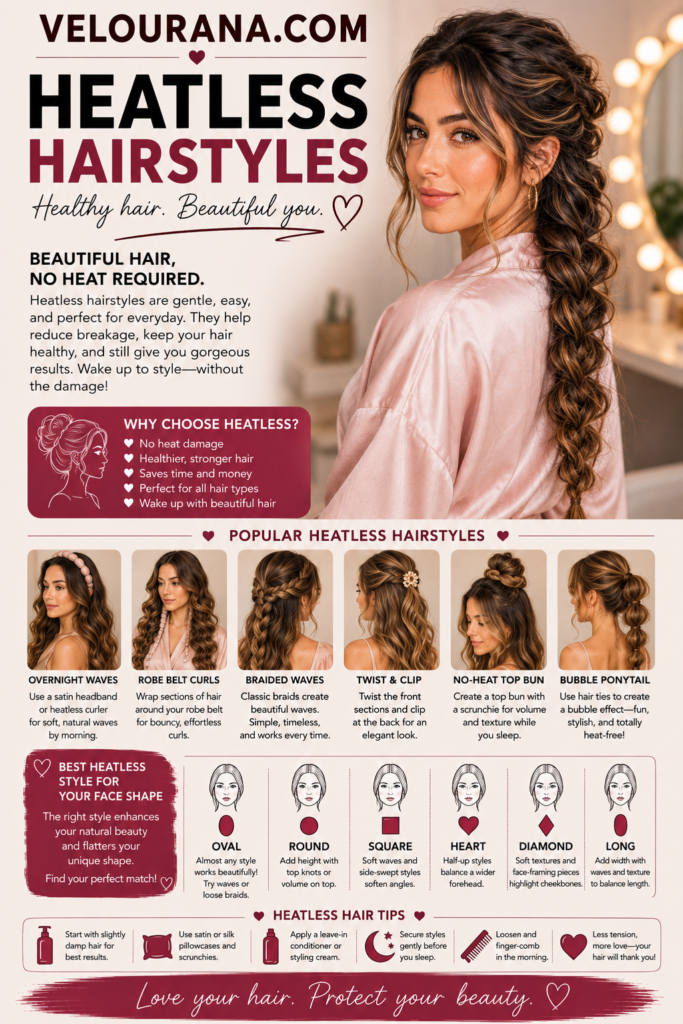
CATEGORY: Heatless Hairstyles
Overnight heatless curls have an obvious appeal. Instead of standing in front of a mirror in the morning and styling section after section with a curling iron, the shaping process happens during hours that would otherwise be spent sleeping. The hair is wrapped, braided, twisted or rolled before bed and released the following morning.
When the method works well, the result can range from relaxed waves to large rounded curls or tighter spirals.
But successful overnight curls involve more than wrapping the hair around whatever happens to be available and hoping for the best by morning.
The hair has to be divided appropriately. The chosen method has to suit its length and density. The sections need enough time to set. The hair should not be so wet that the interior remains damp for hours. The structure must be secure enough to survive movement during sleep but comfortable enough that it does not turn the entire night into an argument with a curling rod.
Most importantly, the expected result should match the method being used.
A thick fabric rod and large sections are unlikely to create the same pattern as numerous small flexi rods. Two braids will not produce the same movement as pin curls. A loose bun cannot be expected to create the same definition as carefully wrapped individual sections.
Heatless curling becomes far easier to understand once each method is treated as a different way of temporarily shaping the hair rather than as interchangeable versions of the same technique.
What Actually Happens While the Hair Is Wrapped Overnight
When hair is arranged around a curved structure and left there for several hours, it is encouraged to retain some of that shape when released.
The effect can be strengthened when the hair begins with a suitable amount of moisture, but moisture needs to be approached carefully.
Very wet hair wrapped densely around fabric or rollers can remain wet inside the structure for much longer than expected. The outside may feel dry in the morning while the inner layers are still damp.
If the hair is released at that stage, the curl may initially appear strong and then relax rapidly.
This is one reason slightly damp hair is often more practical than soaking-wet hair for overnight techniques.
Dry hair can also be used.
The resulting movement may be softer depending on the individual's texture and how readily the hair takes a temporary set.
There is no universal moisture level that works identically for everyone.
The important objective is allowing the hair enough opportunity to settle into the imposed shape and, when moisture is used, enough time to become appropriately dry before release.
Curl Size Begins With the Size of the Structure
Before deciding which overnight technique to use, it helps to decide what kind of movement is actually wanted.
Large, soft waves require a different structure from tight curls.
A thick heatless curling rod creates a broad curve because the hair is wrapped around a large diameter.
A small flexi rod creates a much tighter curve.
A large roller encourages broad rounded movement.
A narrow roller produces more concentrated curl.
The same principle applies when no tool is used.
One large braid creates broader bends than six small braids.
A single loose bun produces a gentler pattern than several small twisted buns.
The scale of the structure becomes the scale of the resulting movement.
Section Size Changes the Result Just as Much
The diameter of the rod or roller is only part of the equation.
The amount of hair wrapped around it matters as well.
A large section contains more strands competing for space around the same structure. The resulting curl is usually broader and may be less defined.
A smaller section can conform more closely to the shape.
This generally increases definition.
Smaller sections can also dry more efficiently than one thick mass of damp hair.
However, they require more time to prepare.
This creates one of the central trade-offs in overnight styling.
Fewer sections are faster and often create softer results.
More sections take longer to arrange but provide greater control and definition.
The Soft Heatless Curling Rod
The long padded curling rod has become one of the most recognizable methods of overnight heatless styling.
The rod is positioned across the top of the head so that one end hangs down each side.
The hair is divided and progressively wrapped around it.
Once the lengths have been incorporated, the ends are secured.
The principle is extremely simple.
Instead of wrapping hair around a heated barrel for several seconds, it remains around a soft cylinder for several hours.
The diameter is much larger than many curling irons, so the resulting shape often leans toward broad curls or waves rather than very tight ringlets.
The exact outcome depends on how the hair is wrapped.
Wrapping Away From the Face Creates an Open Frame
The direction of the front sections has a disproportionate effect on the finished hairstyle.
Wrapping them away from the face encourages the resulting movement to open outward.
This can create a sweeping frame around the cheeks.
If the front sections are wrapped toward the face instead, the movement falls differently.
Neither direction is inherently correct.
The important point is recognizing that the wrapping direction will still be visible after the rod is removed.
The front should therefore be treated deliberately rather than simply incorporated wherever it fits.
Adding Hair Progressively Can Create Continuous Spirals
Instead of placing one enormous section around the rod, hair can be added progressively as the wrapping moves downward.
This creates a continuous pattern along the side of the head.
The technique can also help distribute the hair more evenly.
Dense hair may need particularly careful distribution because too much hair concentrated in one part of the rod can create inconsistent drying and uneven curls.
The Rod Should Be Secure Without Pulling
An overnight structure has to survive several hours of movement.
That does not mean it should be painfully tight.
The rod should remain positioned without pulling aggressively at the hairline.
The ends should be secured comfortably.
If the entire arrangement feels uncomfortable before lying down, sleep is unlikely to improve it.
Adjusting the placement slightly backward can sometimes reduce pressure around the forehead.
The method should work with the sleeping position rather than against it.
Robe-Belt Curls Use the Same Fundamental Geometry
A soft robe belt can function similarly to a dedicated curling rod.
It provides a long cylindrical structure around which the hair can be wrapped.
The belt is usually softer and may flatten more than a purpose-made rod, which can influence the exact shape.
Nevertheless, the basic principle remains the same.
The hair follows a curved path for several hours.
The result is often broad movement.
The technique became popular partly because it demonstrated that heatless curling does not necessarily depend on specialized equipment.
The shape matters more than the label attached to the object creating it.
Sock Curls Offer Greater Sectioning Flexibility
Socks can be used as individual soft supports.
Rather than wrapping both sides around one long central rod, several sections can be created across the head.
Each section wraps around its own piece of fabric.
This offers more control over placement.
Four large sections can create broad curls.
More numerous sections can increase definition.
The socks can also be positioned so that bulky securing points remain away from areas that press directly against the pillow.
Comfort remains an important part of the technique because an overnight method that repeatedly interrupts sleep is unlikely to become a useful routine.
Flexi Rods Can Create More Defined Curls
Flexi rods are narrower than many padded heatless curling rods and can therefore produce more concentrated shapes.
The hair is divided into sections and wrapped around each rod.
The rod bends to hold the hair in place.
Different diameters allow the curl size to change.
Large flexi rods create broader spirals.
Small ones can create tighter curls.
Because each section is controlled independently, flexi rods offer considerably more precision than one large wrap.
Flexi Rod Placement Influences Volume
Where the rod sits relative to the scalp affects how the curl begins.
Sections wrapped with some elevation can create more root lift.
Sections directed downward may keep the roots flatter.
The rods around the crown can therefore be positioned differently from those near the lower back of the head.
This is one advantage of working with individual sections.
The entire head does not have to receive identical treatment.
Foam Rollers Create Rounded Movement
Foam rollers provide another soft overnight option.
Hair is wrapped around each roller from the ends toward the scalp.
The result can create rounded curls with a different character from spiral wrapping.
Large rollers can produce smooth volume and broad curves.
Smaller rollers create stronger curl.
The roller's position also influences the final direction.
Sections around the face can be rolled away from it.
Crown sections can be elevated for volume.
The back can be arranged according to how much fullness is desired.
Roller Placement Should Consider the Pillow
A technically perfect roller set can become impractical if every roller sits exactly where the head needs to rest.
Overnight styling has an additional design requirement that daytime setting does not.
It needs to accommodate sleep.
Rollers can sometimes be arranged slightly higher, farther toward the sides or in patterns that leave more comfortable resting areas.
The exact placement depends on sleeping position.
Comfort is not an irrelevant detail.
It determines whether the method is realistically repeatable.
Pin Curls Avoid Bulky Rollers
Pin curls offer a more compact alternative.
A section of hair is wound into a circular shape and secured relatively flat against the head.
Because there is no large roller protruding outward, the style can feel less bulky.
The technique also provides precise control over curl direction.
Each section can be wound individually.
The diameter of the pin curl determines the approximate scale of the resulting movement.
Larger circles create broader curls.
Smaller ones create tighter definition.
Pin Curls Require More Preparation but Offer More Control
The disadvantage is time.
Creating multiple consistent pin curls requires more sectioning than simply making two braids or wrapping the hair around one padded rod.
The advantage is precision.
The front can be treated differently from the crown.
The ends can be controlled carefully.
Different directions can be used across the head.
This makes pin curls useful when the finished shape matters more than the speed of preparation.
Braids Are the Simplest Overnight Setting Method
For many people, braiding remains the easiest way to create overnight texture.
There is no additional tool.
The hairstyle is secure.
The hair remains contained during sleep.
The result can be adjusted simply by changing the number and size of the braids.
One large braid creates gentle movement.
Two braids create more consistent waves.
Several smaller braids create tighter texture.
French and Dutch braids can bring the pattern closer to the roots.
Braid Waves Are Different From Wrapped Curls
A braid does not create a circular curl.
It creates repeated bends.
This distinction matters.
Someone wanting large spiral curls may be disappointed by braid waves even if the technique works perfectly.
The result has a different geometry.
Braid waves can look beautifully natural, particularly when separated gently in the morning.
But the method should be chosen because that wave pattern is wanted, not simply because it is heatless.
Two Braids Are an Excellent Low-Effort Option
Dividing the hair into two sections and braiding each side takes relatively little time.
The arrangement is usually comfortable.
The hair remains contained.
The resulting waves can be fairly balanced.
The braids can begin higher when texture is wanted closer to the roots.
Starting lower keeps the upper hair smoother.
This small adjustment changes the finished style substantially.
Multiple Braids Create More Texture
Increasing the number of braids reduces the amount of hair in each one.
The bends become smaller and more numerous.
The resulting hairstyle can gain significant volume.
Hair that already has natural wave may become particularly textured.
Straight hair may develop a more obvious repeated pattern.
The method is useful when definition is more important than creating large flowing curls.
Twists Create Softer Spiral Movement
Two-strand twists provide another overnight option.
The hair is divided into sections and twisted.
The resulting pattern tends to be less angular than braid waves.
Large twists can create broad movement.
Smaller twists create more definition.
Natural waves, curls and coils can respond particularly well because the technique can reinforce existing texture while organizing it into a more consistent pattern.
Twist-Out Results Depend Strongly on Section Size
A few large twists may create only subtle changes.
Numerous smaller twists can produce much stronger definition.
The amount of moisture used also influences the set.
Dense sections require enough drying time.
The twists should not be released simply because morning has arrived if the hair remains noticeably damp inside.
Bantu-Knot-Inspired Sets Can Create Strong Curves
Sections of hair can be twisted and wrapped into small knots.
Each knot concentrates the hair into a compact circular structure.
When released, the lengths can develop pronounced curls or waves.
The size of each section determines the scale.
Larger knots create broader movement.
Smaller sections create tighter results.
Because the hair is wrapped densely, drying time should be considered carefully when the style begins damp.
One Large Bun Creates a Much Softer Result
Not everyone wants a head full of defined curls.
A single loose bun can create gentle movement with minimal effort.
The hair is gathered and wrapped into a broad shape.
After several hours, the lengths may develop curves.
The result is usually much softer than rollers or rods.
This makes the technique useful for hair that needs only a little movement rather than a complete transformation.
Two Buns Can Create More Balanced Waves
Dividing the hair before creating the buns increases control.
Each side can be wrapped independently.
The movement becomes more noticeable.
The direction can also be mirrored so that both sides frame the face appropriately.
This remains one of the simplest options for someone who wants more than one loose bun can provide but does not want to arrange numerous rollers.
Several Small Buns Increase Definition
More sections create more curves.
The same principle repeats throughout heatless styling.
A head divided into several twisted buns will generally emerge with more texture than hair placed into one large bun.
The preparation takes longer, but the result can become substantially more defined.
Straight Hair May Need More Deliberate Setting
Naturally straight hair varies enormously in how readily it retains heatless curls.
Some hair develops strong waves easily.
Other straight hair begins relaxing shortly after release.
Smaller sections, sufficient setting time and appropriate starting moisture may help create stronger definition.
The desired result should also be realistic for the individual hair.
A softer wave that lasts may be more useful than attempting to force extremely tight curls that disappear quickly.
Wavy Hair Can Use Overnight Styling to Organize Existing Movement
Naturally wavy hair already contains bends.
Heatless methods can encourage those bends to follow a more consistent direction.
Large twists can strengthen broad movement.
Braids can create more uniform waves.
Fabric rods can encourage larger spirals.
The technique does not need to replace the natural pattern.
It can refine it.
Curly Hair Can Be Reset Into Different Curl Shapes
Curly hair can also use rods, twists and braids to reorganize its temporary pattern.
Larger sections may create stretched, broader curls.
Smaller rods can create more concentrated spirals.
Twists can provide definition.
The natural texture remains an important influence on the final result.
Heatless styling does not erase the underlying hair.
It works with it.
Coily Hair Can Use Twists, Braids and Rods for Definition
Coily textures can respond beautifully to section-based heatless styling.
Twists can create defined twist-outs.
Braids can produce braid-out patterns.
Flexi rods can introduce spirals.
The section size and starting condition of the hair determine much of the result.
Comfortable root tension remains important.
The style should organize the lengths without requiring painful pulling at the scalp.
Fine Hair Needs Less Material in Each Section
Fine hair can become overwhelmed by very large sections.
The curl may lack definition because too much hair is wrapped together.
Using manageable sections allows the hair to follow the shape more closely.
At the same time, excessively tiny sections may produce much more volume than desired.
The ideal size depends on whether the goal is broad movement or defined curls.
Fine Hair Can Also Be Easily Flattened Overnight
The way the hair is positioned matters.
A large structure sitting directly on the crown can compress root volume.
Placing curls strategically can help preserve lift.
The morning finishing process can also restore movement at the roots without disturbing the lengths excessively.
Thick Hair Requires Attention to Drying
Dense hair is one of the clearest cases where more sections can be beneficial.
A large damp section wrapped around a thick rod may still be wet inside by morning.
Dividing the hair more thoroughly increases exposed surface area.
The preparation takes longer, but the set may become more reliable.
Starting with less moisture can also be useful when the hair naturally takes a long time to dry.
Very Long Hair Can Produce Looser Results Through Weight
Long hair provides enough length for dramatic heatless curls, but it also has weight.
That weight can stretch the pattern once the hair is released.
Large curls may gradually become waves.
This does not necessarily mean the set failed.
It is simply part of how length influences the final shape.
Using smaller initial curls can sometimes compensate when a looser finished result is expected.
Medium Hair Can Retain More Bounce
Medium lengths carry less weight.
Curls may therefore remain more elevated.
The hair also requires fewer turns around rods or rollers.
This can make overnight methods relatively straightforward.
The main challenge may be capturing shorter layers consistently.
Layers Should Not Always Be Wrapped Together
A heavily layered haircut contains sections with very different lengths.
Trying to force them all around one large rod can create uneven ends.
Face-framing layers may benefit from their own section.
Short crown layers can use smaller rollers.
Longer back sections can use larger structures.
Heatless styling becomes more controlled when the haircut is acknowledged rather than treated as one uniform length.
The Ends Need Attention During Wrapping
Poorly positioned ends can become one of the most visible problems the following morning.
If the final few centimeters are bent sharply or trapped awkwardly, they may dry into that shape.
The ends should follow the curve of the rod, roller or twist as smoothly as possible.
This small detail can make the difference between a polished curl and one that ends in an unintended kink.
The Roots Do Not Need to Be Curled
Some hairstyles look better when the roots remain relatively smooth.
The wrapping can begin around ear level.
Braids can start lower.
The upper hair can remain loose before entering the structure.
This creates movement primarily through the mid-lengths and ends.
The result can feel more relaxed than curls beginning directly at the scalp.
Root Volume Requires Different Placement
If volume is wanted near the crown, the hair needs to be positioned accordingly.
Rollers can lift sections upward before wrapping.
Braids can begin higher.
The front can be directed away from the face.
A heatless curling rod can be positioned so the upper sections gain some elevation.
The curl pattern and root volume are related but not identical goals.
Both should be considered separately.
The Morning Release Should Be Slow
After several hours of setting, it is tempting to remove everything quickly.
That can disturb the pattern unnecessarily.
The hair should be unwound rather than pulled.
Braids can be opened gently.
Rods should be removed in the direction of the curl.
Pins should be taken out without dragging through neighboring sections.
The first few minutes after release determine how much of the set remains intact.
The Hair May Look Too Curly Initially
A fresh overnight set can appear much tighter than the intended final style.
This is not necessarily a problem.
The curls may relax naturally after several minutes.
They can also be separated carefully.
Long hair will often loosen under its own weight.
It is usually easier to soften a curl that is initially slightly stronger than desired than to recreate definition after an overly loose set.
Fingers Offer the Most Controlled Separation
Running fingers selectively through the curls allows them to be divided without completely destroying their pattern.
One large spiral can become two or three softer sections.
The roots can be loosened.
Obvious gaps from sectioning can be reduced.
This creates a more natural final appearance.
Brushing Creates a Completely Different Finish
A brush can merge individual curls into larger waves.
The hairstyle becomes softer and more continuous.
This can create a classic flowing effect, especially with large roller or pin-curl sets.
But brushing also removes definition.
Someone who wants visible spirals may prefer finger separation.
The morning finishing method should therefore match the desired final texture.
Do Not Judge the Set Before It Settles
Immediately after release, the hair can appear exaggerated.
Sections may look separate.
The roots may still show the pattern of the wrapping.
After several minutes of gentle adjustment, the hairstyle often changes significantly.
Allowing the hair to settle before making aggressive corrections can prevent unnecessary overhandling.
Sleep Protection Can Help Preserve the Arrangement
Movement against bedding can loosen braids, displace rollers or create friction around loose sections.
Keeping the setting structure contained can help it survive until morning.
The exact approach depends on the chosen method and what feels comfortable.
The important objective is preventing the arrangement from unraveling while avoiding anything excessively tight around the head.
Comfort Determines Whether the Method Is Sustainable
A heatless curling technique may produce excellent results and still be unsuitable as an overnight routine if it repeatedly disrupts sleep.
This is why experimentation matters.
Someone who dislikes a large rod across the head may prefer braids.
Someone who finds braids create the wrong texture may prefer soft rollers positioned strategically.
Someone who dislikes any equipment in bed may use twists or buns.
The best method is not simply the one that creates the most dramatic photograph the following morning.
It is the one that can realistically become part of the person's routine.
Overnight Curls Can Be Prepared Earlier in the Evening
The hair does not have to be wrapped immediately before sleep.
Setting it earlier provides additional drying and shaping time.
This can be particularly useful for dense hair.
The arrangement can remain in place while reading, working at home or completing an evening routine.
By bedtime, the hair has already spent several hours in its new shape.
This may also allow someone to use slightly less bulky methods during actual sleep.
A Daytime Set Can Produce the Same Principle
There is nothing inherently magical about sleeping.
The method works because the hair remains arranged for sufficient time.
Someone who works from home or has several free hours can create the set during the day and release it later.
This avoids the comfort problem entirely.
Overnight styling is convenient because sleep provides uninterrupted time, not because the hair knows it is nighttime.
Consistency Comes From Learning the Hair's Response
The first attempt with a heatless method may not produce the ideal result.
Perhaps the hair was too damp.
Perhaps the sections were too large.
Maybe the rod was too thick.
The front sections may have been wrapped in the wrong direction.
These are useful observations.
Changing one variable on the next attempt makes the method more predictable.
The goal is not repeatedly following a generic tutorial exactly.
It is learning how that tutorial needs to be adapted to the individual hair.
Stronger Is Not Always Better
Very tight curls are not automatically a more successful heatless result.
If the desired hairstyle is a loose wave, creating extreme definition simply adds more work during the finishing stage.
The initial set should anticipate how the hair naturally relaxes.
Hair that loses curl quickly may benefit from beginning more defined.
Hair that holds shape strongly may need a larger rod or fewer sections.
The ideal starting curl depends on the desired final curl.
Overnight Heatless Styling Is Ultimately a Time Exchange
Hot tools use temperature to change the temporary shape of hair quickly.
Heatless techniques replace much of that speed with time.
The hair is arranged and left.
Several hours do the work that a hot barrel might accomplish in seconds.
This makes the method particularly compatible with nighttime because those hours are already available.
The preparation happens once.
The setting happens while the wearer is doing something else.
Waking Up to Hair That Is Already Shaped
The greatest practical advantage of overnight curls is not simply that they avoid a curling iron.
It is that much of the styling process has already happened before the morning begins.
The braid is released.
The rod is unwound.
The rollers are removed.
The curls are separated and adjusted.
Instead of constructing the entire hairstyle from straight or unshaped hair, the morning begins with movement already present.
The quality of that movement depends on decisions made the previous evening: section size, moisture, wrapping direction, tool diameter, placement and setting time.
Once those variables are understood, overnight heatless curls become much less mysterious.
Large structures create broad movement.
Smaller structures create tighter definition.
Fewer sections produce softer patterns.
More sections provide greater control.
Braids create bends.
Twists create rotating movement.
Rollers create rounded curls.
Fabric wraps encourage broad spirals.
The best method is not universal.
It is the one that produces the desired shape on the individual hair while remaining comfortable enough to wear for the necessary time.
That is when overnight styling becomes genuinely useful—not as a promise of effortless perfection every morning, but as a practical way to let time create much of the hairstyle before the day has even started.
The End
Velourana.
 Discover More From Our Family of Websites
 ZodiacBearing (Astrology, Tarot, Numerology, Angel Numbers & Spiritual Guidance)
 Velourana (Beauty, Makeup, Hair Care, Skincare & Beauty Tips)
 HavenBearing (Home, Living, Organization, Décor & Everyday Inspiration)
 PawBearing (Pet Care, Dog Breeds, Animal Health, Training & Pet Products)
 PsyCatherine (Notes From the Journal of a Psychologist on Real Life)

