CATEGORY: Half-Up Hairstyles
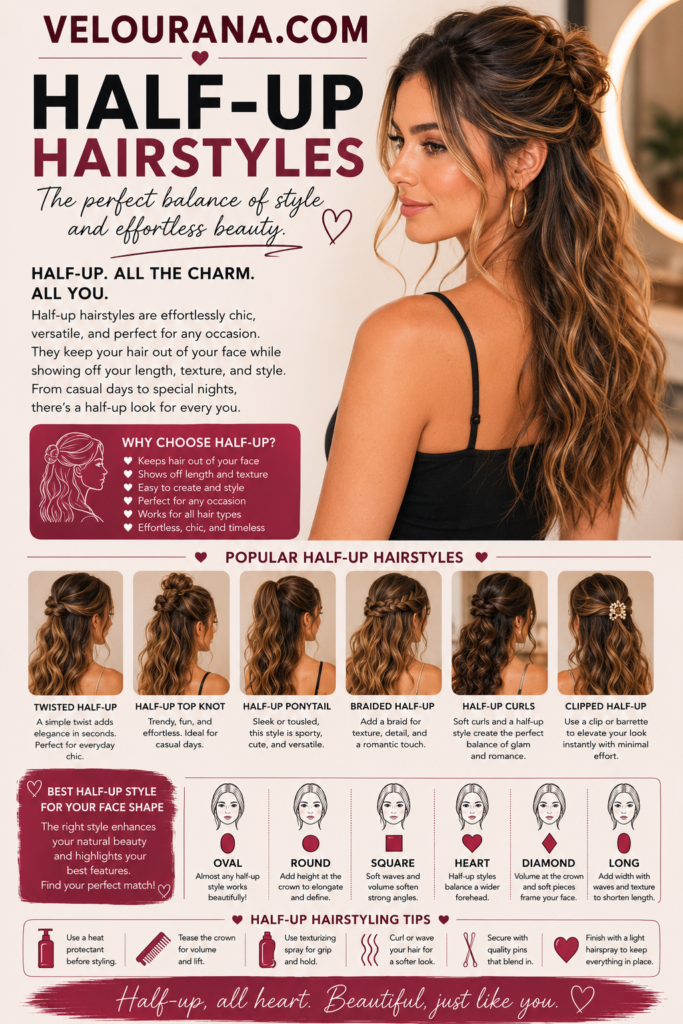
Half-up hairstyles already offer one of the most useful balances in hairstyling: enough structure to clear the face and shape the crown, but enough loose hair to preserve length, movement and texture. Adding braids takes that balance further. Instead of simply gathering the upper section into a ponytail or fastening it with a clip, the hair itself becomes part of the decoration.
A braid can be almost invisible, appearing as a narrow detail near one temple before disappearing into the back of the hairstyle. It can also become the central feature, stretching across the crown or forming a wide woven section that sits above loose waves. Two braids can create symmetry. One asymmetrical braid can introduce direction. French and Dutch techniques can gradually collect hair from around the face, while fishtail braids create finer texture once the upper sections meet behind the head.
The appeal lies in what remains untouched.
The majority of the hair can still fall naturally around the shoulders and back. Long layers remain visible. Waves continue moving. Curls retain their volume. Straight hair keeps its smooth length. The braid changes only the section necessary to create the desired structure.
This makes half-up braided styling particularly adaptable. It can be intricate without becoming a complete updo and decorative without requiring the entire head of hair to be manipulated. A few carefully selected sections can transform the appearance while allowing the haircut itself to remain visible.
The Braid Should Belong to the Loose Hair
A successful half-up braided hairstyle should feel like one complete design rather than a braid sitting on top of unrelated loose lengths.
That connection often comes from texture.
If the lower hair is worn in soft waves, a rigidly tight braid with perfectly flattened roots may create a strong contrast. That can certainly be intentional, but when softness is the objective, loosening the braid slightly allows it to communicate more naturally with the movement underneath.
Straight hair creates a different opportunity. The clean surface makes the braided pattern particularly easy to see. A narrow braid can create enough detail without changing the polished quality of the lower lengths. A larger braid can become the primary texture while everything beneath remains sleek.
Curly and coily hair can allow natural texture to remain visible inside the braid itself. There is no requirement to smooth every section until its original movement disappears. The braid can organize the hair while still looking like part of the same texture that remains loose below.
The amount of hair incorporated also influences harmony. A very large braid made from a substantial portion of fine hair may leave the lower lengths looking unexpectedly sparse. On dense hair, the same size braid may create perfect balance because plenty of volume remains underneath.
Half-up styling works best when both sections—the braided upper hair and the loose lower hair—still look complete.
Small Braids Can Make a Large Difference
One of the simplest versions requires very little hair.
A narrow section near each temple can be braided backward and secured where the two sides meet. Almost the entire head remains loose, but the front becomes clearer and the back gains an obvious point of interest.
This works especially well for someone who wants a braided hairstyle without losing the appearance of wearing their hair down.
The braids can be traditional three-strand braids, which create a familiar repeated pattern. They can be rope braids for a softer spiral effect or narrow fishtails when finer detail is wanted.
Even their position can change the result.
Braids beginning close to the hairline become visible immediately from the front. Starting them slightly farther back allows bangs, curtain pieces or face-framing layers to remain free.
The sections may travel straight backward, angle slightly upward toward the crown or descend gently toward a lower meeting point.
These are small structural changes, but they affect the silhouette significantly.
When the braids meet, their ends can simply be secured beneath a small section of hair. They can cross over one another and be pinned invisibly. They can join into a small ponytail, continue into another braid or disappear into a half-up bun.
The hairstyle can therefore begin with the simplest possible braid and still provide several finishing options.
For fine hair, these smaller sections are particularly useful because they preserve density through the loose lengths. Instead of taking large portions from both sides, only enough hair is used to establish the braided detail.
On thick hair, small braids provide another benefit: they introduce decoration without trying to control all of the natural volume. The hair can remain abundant while the braids function almost like built-in accessories.
French and Dutch Braids Can Shape the Entire Upper Section
French and Dutch techniques create a stronger relationship between the braid and the scalp because additional hair is gradually incorporated as the braid travels.
This makes them ideal when the objective is not simply decoration but actual control around the face.
A French braid can begin near one temple and move toward the back, collecting shorter sections as it goes. The braid sits relatively close to the surrounding hair, creating a softer woven pathway.
A Dutch braid uses the opposite crossing direction and appears raised above the surface. This makes the pattern much more visible. Even a relatively narrow Dutch braid can become an important part of the hairstyle because its structure sits prominently against the loose hair beneath it.
Two matching braids can create symmetry.
Each can begin near the front and travel toward the crown, where they meet. Once they reach the back, several things can happen. The remaining sections can form a small ponytail. They can be twisted into a bun. They can become one central braid that continues several inches before ending.
A single braid creates a more directional style.
It may begin on one side, travel across the crown and finish near the opposite side. This can create the impression of a partial braided crown while leaving most of the hair loose.
The difference between a French and Dutch braid becomes particularly noticeable when the hairstyle is widened after completion. A gently loosened Dutch braid can become broad and dimensional, almost resembling a woven band across the head. A French braid usually creates a more integrated effect.
Neither is inherently more elegant.
They simply produce different relationships between the braid and the loose lengths.
The decision should reflect how strongly the braid is meant to announce itself.
Fishtail and Waterfall Braids Bring Finer Detail
Some half-up hairstyles benefit from braiding techniques that feel less substantial and more intricate.
The fishtail braid is especially effective when two upper sections have already been brought together. Instead of continuing into a conventional three-strand braid, the combined hair can be divided into two sections and woven into a short fishtail.
Only a few inches may be necessary.
The braid becomes a decorative centerpiece at the back while the rest of the hair remains loose around it.
A longer fishtail creates a stronger vertical element. It can extend over the loose hair, creating an interesting contrast between woven detail and flowing length.
The sections can remain compact for precision or be loosened gently to increase width.
Hair color can make the effect particularly striking. Highlights repeatedly cross from one side of the fishtail to the other, making the pattern easier to see. Balayage creates changing tones through the woven section. Natural gray strands can appear almost like fine ribbons.
The waterfall braid uses a different idea.
Instead of collecting every strand into the structure, selected pieces are released as the braid travels. Those sections fall through the braid and become part of the loose hair below.
This makes the technique almost perfectly suited to half-up styling because the braid and the loose hair are physically connected.
The braid forms a horizontal or gently diagonal pathway while new strands continue falling downward beneath it.
On wavy hair, these released sections can create beautiful movement because they join the existing waves. Straight hair produces a cleaner visual contrast between the woven line and the vertical strands beneath it. Curly hair creates more dimensional separation.
The technique can appear elaborate, but its strongest feature is not complexity. It is continuity. The braid does not simply sit above the loose hair; it actively releases strands into it.
Texture Determines How the Hairstyle Comes to Life
The same half-up braided structure can appear completely different according to hair texture.
On straight hair, precision becomes highly visible. The crossings of a braid are easy to read, and even small sections can create clear detail. This allows the lower lengths to remain completely straight without making the hairstyle feel unfinished. The braid itself supplies the texture.
A smooth half-up braided style can therefore be very minimalist. The upper sections remain controlled, the braid creates one concentrated area of detail, and the lower hair falls in an uninterrupted surface.
Adding bends or waves changes the mood but is not necessary for the hairstyle to work.
Wavy hair creates a softer result immediately. Natural movement remains visible in the sections entering the braid and continues through the lengths underneath. The boundary between braided and loose hair becomes less rigid.
This can be particularly effective when the braid is gently loosened after securing. Instead of a compact woven line sitting above waves, the braid takes on some of the same softness.
Curly hair creates volume at multiple levels. The upper braids can control sections near the temples while the curls below remain expansive. Some curls can remain free around the face rather than being forced into the braid.
A half-up braided style on curls does not need to become sleek in order to look deliberate. The braid can remain textured.
Coily hair provides another range of possibilities. Braids and twists can create strong visible structure through the upper section while the lower texture remains full. The gathered section might become a braided crown, two side braids or a small braided bun above loose coils.
The contrast between controlled weaving and natural volume can become the central feature of the style.
In every texture, the most convincing result usually comes from allowing the braid to organize the hair rather than trying to make the entire head behave like another texture.
Bangs and Face-Framing Layers Can Remain Part of the Haircut
One of the major advantages of half-up styling is that the front does not need to be completely pulled away from the face.
Bangs can remain exactly where they normally sit.
A full fringe can provide a strong front while the braids begin behind it. Curtain bangs can open around the face and blend naturally into the upper style. Wispy bangs create softness against a more structured braid.
Longer face-framing sections offer another possibility.
They can remain loose from the beginning, creating movement around the cheeks and jaw while the sections behind them are braided.
This can make a relatively strong Dutch-braided style feel much softer.
The decision should be made according to the haircut rather than assuming every strand must participate.
Someone with cheekbone-length layers may find those sections particularly attractive left free. Someone who wants maximum practical control can incorporate longer front pieces into French braids as they travel backward.
The same braid can therefore create either an open, soft front or a more completely gathered one.
The structure should respect how the wearer actually likes their hair around the face.
The Crown Can Be Sleek, Soft or Voluminous
Braids do not determine the entire upper silhouette.
The crown still offers another design choice.
Keeping the hair close to the head creates a cleaner appearance. This can make raised Dutch braids especially prominent because the braid itself becomes the primary source of volume.
Preserving a little crown lift creates a softer profile.
The braid can begin behind that volume rather than flattening it.
For formal half-up styling, a modest amount of crown height can create an elegant shape without becoming exaggerated.
The important thing is balance.
If the crown contains significant volume and the braid is also extremely broad, the upper section may begin dominating the loose hair below.
If everything above is very flat while the lower curls are exceptionally full, the hairstyle may feel divided.
Neither contrast is automatically wrong, but it should be intentional.
Half-up styling is always a conversation between two sections of hair. The upper design should complement the amount of movement and volume that remains underneath.
Fine and Thick Hair Need Different Proportions
Half-up braided hairstyles provide an excellent example of why inspiration photographs should be interpreted rather than copied literally.
A photograph may show two enormous braids crossing a full head of long hair while an equally abundant amount remains loose underneath.
That result depends heavily on density.
Fine hair may not have enough material to allocate such large sections to the braid without weakening the loose portion.
A smaller braid can often produce a much stronger overall result.
The detail remains visible, the front is controlled and the lower lengths retain their fullness.
Gentle widening after braiding can increase apparent width without requiring significantly more hair.
Thick hair provides greater freedom.
Larger sections can be removed from the sides while the lower hair still remains substantial. Broad Dutch braids, braided crowns and half-up braided buns become easier to support visually.
Dense hair may even benefit practically because the upper braids remove some volume from around the face without gathering everything into one heavy updo.
The correct scale is therefore the scale that allows both the braid and the loose hair to look intentional.
Half-Up Braided Buns Combine Three Different Forms
Once braiding and half-up styling are combined, adding a bun creates another layer of transformation.
The upper hair first becomes a braid.
Then that braid becomes a compact shape.
The lower hair remains loose beneath it.
A simple version might involve two small side braids meeting in a small bun at the back.
A more dramatic version can use Dutch braids traveling from the front toward a high half-up bun.
A fishtail can be wrapped into a small textured knot.
Several thin braids can be arranged around the same central point.
The bun naturally remains smaller than a full bun because only part of the hair is used.
This scale can look particularly attractive against long flowing lengths.
The upper section creates a concentrated focal point while the hair below preserves movement.
This is one of the reasons the style can look elaborate without becoming visually heavy.
There is significant detail, but it occupies only a limited area.
Accessories Can Be Used Sparingly
Braids already provide decoration, so half-up braided hairstyles rarely need a large number of accessories.
A small barrette can conceal the point where two braids meet.
A ribbon can be incorporated into a narrow braid.
Decorative pins can appear selectively within the woven structure.
A simple bow can sit beneath a braided crown and allow the lower hair to remain the visual background.
The key is deciding what should be the focal point.
If the braid is broad and intricate, too many accessories can compete with it.
If the braiding is minimal, one stronger accessory may provide the additional visual interest the hairstyle needs.
Sometimes no accessory is necessary at all.
Dimensional hair color can already make the braid highly visible, and the woven hair itself becomes the decoration.
Comfort Should Remain Invisible but Important
Half-up braids can look secure without being tight.
Because only part of the hair is involved, excessive tension is rarely necessary.
The temples and hairline deserve particular care.
French and Dutch braids beginning near the front should collect hair progressively rather than relying on aggressive pulling. Small strands that do not comfortably reach the braid can remain loose.
A hairstyle can be neat because its sections are controlled, not because the scalp is under constant tension.
This is especially important for styles worn for many hours.
Dense hair can create more weight even in a half-up section, so the point where the braids meet should be supported adequately.
Several pins may distribute support more comfortably than one extremely tight elastic.
A beautiful style should be easy enough to wear that comfort does not become the dominant experience.
The Hairstyle Can Evolve Naturally Through the Day
A freshly completed braid may begin relatively compact.
As the hair moves, the sections can soften.
Small pieces may emerge.
The crown may gain a little volume.
The lower lengths can become more relaxed.
For soft half-up styles, this evolution often improves the appearance.
The braid begins integrating more naturally with the loose hair.
A highly polished version requires more initial control if the exact structure needs to remain unchanged.
The intended mood should determine how much natural softening is acceptable.
One of the strengths of the category is that it does not depend on absolute perfection.
The loose lower hair already introduces movement, so the upper braid can tolerate some evolution without losing its identity.
From Simple Detail to Complete Hairstyle
The beauty of half-up braiding is how little hair may be required to create a visible transformation.
Two tiny braids can change the front.
A fishtail at the back can turn a simple half-up ponytail into something decorative.
A Dutch braid across the crown can become the central feature of an otherwise loose hairstyle.
A waterfall braid can weave structure directly into flowing hair.
The basic haircut remains visible throughout.
Long layers still move.
Medium lengths still maintain their shape.
Waves, curls and coils remain part of the hairstyle rather than disappearing into an updo.
This makes half-up braids particularly useful for someone who enjoys the appearance of loose hair but wants more than simply leaving it down.
When the Braid Becomes the Bridge Between Structure and Movement
A complete braid transforms loose hair into one contained structure.
A complete updo removes much of the visible length.
The half-up braided hairstyle does neither.
It uses weaving only where structure is useful and leaves the rest free.
That is what gives the style its balance.
The braid can control the temples, shape the crown or create a focal point at the back. Below it, the hair continues moving naturally.
Fine hair can use small braids to preserve density. Thick hair can support dramatic woven sections while remaining abundant underneath. Straight hair makes the pattern precise, waves soften it, curls create layered volume and coils can produce powerful combinations of structure and natural texture.
The braid does not need to dominate.
It only needs to connect.
When that connection is successful, the upper and lower sections stop feeling like separate hairstyles.
The braid becomes the bridge between them—turning part of the hair into pattern while allowing everything beneath it to remain beautifully, deliberately free.
The End
Velourana.
 Discover More From Our Family of Websites
 ZodiacBearing (Astrology, Tarot, Numerology, Angel Numbers & Spiritual Guidance)
 Velourana (Beauty, Makeup, Hair Care, Skincare & Beauty Tips)
 HavenBearing (Home, Living, Organization, Décor & Everyday Inspiration)
 PawBearing (Pet Care, Dog Breeds, Animal Health, Training & Pet Products)
 PsyCatherine (Notes From the Journal of a Psychologist on Real Life)