
CATEGORY: Buns
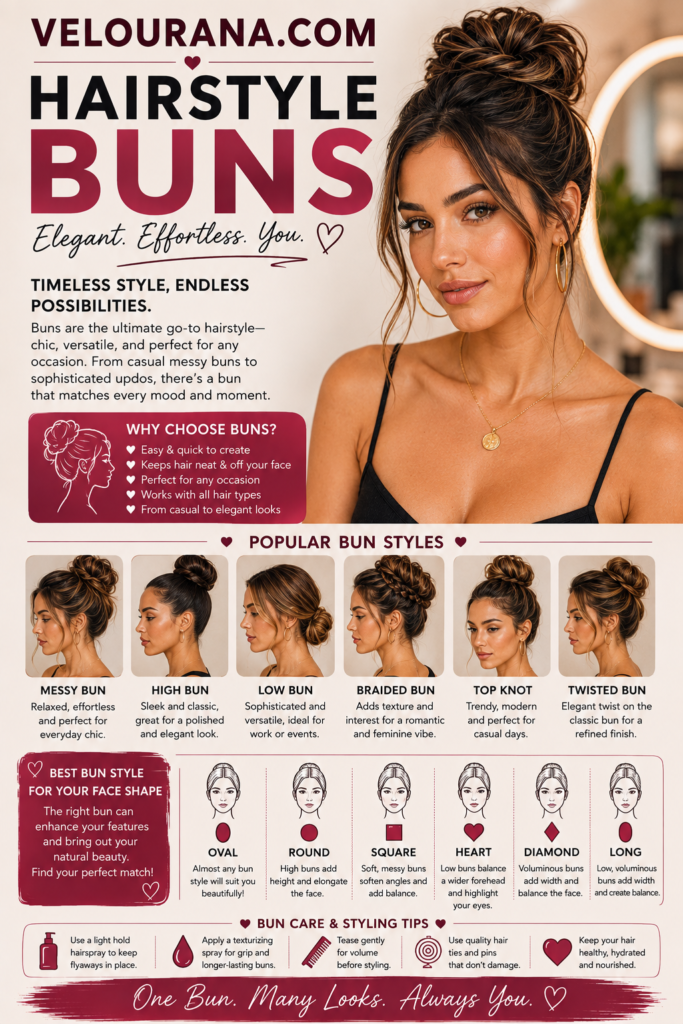
A low bun does not rely on height or dramatic volume to attract attention. Its character comes from restraint. By gathering the hair close to the nape, the hairstyle keeps much of its structure behind the head, allowing the face, neckline and natural shape of the head to remain prominent. It can look exceptionally polished when the surface is smooth, quietly romantic when the crown is softened, or completely effortless when natural texture is allowed to remain visible.
This apparent simplicity is deceptive.
Two low buns positioned in exactly the same place can look entirely different because of the way the hair reaches them. A precise center part and sleek roots create clean geometry. A side part introduces movement. Hair swept backward without a visible part creates another silhouette entirely. Add volume at the crown and the style becomes softer. Release a few pieces around the face and the mood changes again.
The construction of the bun itself offers just as much variation. Hair can be twisted into a compact coil, folded into a wider shape, braided before being wrapped, divided into several sections or arranged into a loose chignon. The finished form can be small and discreet or broad enough to become the main feature when viewed from behind.
What remains consistent is the low placement.
Sitting close to the nape gives the hairstyle a naturally grounded quality. It avoids the strong vertical emphasis of a top knot and the more energetic character of a high bun. Instead, the eye travels backward and downward, following the hair toward a compact point near the neck.
That relationship between simplicity and refinement is one reason the low bun has remained so adaptable.
The Nape Creates a Natural Foundation
Hair naturally falls toward the back and shoulders, so gathering it at the nape requires relatively little redirection compared with lifting everything toward the crown. This can make the low bun feel physically more relaxed, particularly on long or dense hair.
The position also provides a useful foundation for many different constructions.
A ponytail can be created first and then twisted. The hair can be gathered directly without a visible elastic. Two sections can be brought together from either side. Braids can travel toward the nape before becoming part of the bun.
Because the final shape sits low, it can also rest relatively close to the head rather than projecting outward.
This creates the characteristic compact silhouette associated with many low-bun styles.
The Sleek Low Bun Is Defined Before the Bun Begins
In a highly polished low bun, the front and sides are as important as the knot at the back.
The hairline is controlled.
The part is intentional.
The surface remains smooth as the hair travels toward the nape.
There is a visual continuity between the roots and the finished bun.
A center part creates perhaps the clearest version of this structure. The hair divides into two balanced sections and moves backward toward the same point. From the front, the hairstyle appears minimal. From the side, the direction becomes visible. From behind, the bun completes the geometry.
The actual knot can remain extremely simple because the surrounding structure already creates sophistication.
This is an important principle in understated hairstyling. More detail is not always necessary. When placement, surface and proportion are controlled carefully, simplicity can become the defining feature.
A Center Part Gives the Style Symmetry
The center-parted low bun has an almost architectural quality.
The front is divided evenly.
Both sides follow similar pathways toward the nape.
The bun becomes the meeting point.
When the roots are sleek, the symmetry is particularly clear. When they are softer, the center part still provides enough organization to keep the hairstyle balanced.
Curtain bangs can interrupt this symmetry gently while preserving the central division.
Long face-framing layers can remain free.
A full fringe can sit in front of the part entirely.
The hairstyle therefore does not require one specific haircut to maintain its balanced appearance.
A Side Part Introduces Movement
Move the part away from the center and the hairstyle becomes less static.
One side carries more hair.
The front may sweep across the forehead.
The direction toward the bun becomes slightly diagonal rather than completely symmetrical.
This can soften the overall appearance even when the bun itself remains sleek.
A deep side part creates a stronger effect, while a subtle off-center part produces only a slight shift.
The low placement provides stability while the front creates movement.
Brushing the Hair Back Removes the Geometry of a Part
A low bun can also be worn without any visible division at the front.
The hair moves backward as one continuous surface.
This can create a streamlined appearance, particularly when the roots are smooth.
Alternatively, the hair can be directed backward more loosely, preserving volume and natural texture.
The absence of a part makes the direction of the hair itself more important.
The eye follows the movement from the forehead and temples toward the nape.
The result can be clean or relaxed depending on how controlled that movement remains.
A Soft Crown Changes the Profile
One of the easiest ways to make a low bun less severe is to preserve some volume through the crown.
Instead of pulling every strand tightly against the scalp, the upper hair remains slightly elevated.
From the side, this creates a gentle curve before the hair descends toward the bun.
The adjustment can be subtle.
Too much volume may overwhelm a small bun or make the hairstyle feel disconnected.
A modest amount can create balance and prevent the upper head from appearing flattened.
This is particularly useful when the bun itself sits very close to the nape.
The Classic Twisted Low Bun
Perhaps the simplest construction begins by gathering the hair low and twisting the length.
As the twist becomes tighter, it naturally begins to coil.
The hair is wrapped around the base and secured.
The resulting bun has a visible spiral direction.
Straight hair makes this structure particularly clear.
Wavy and curly hair create a softer surface.
The amount of twisting changes the finished shape. A tight twist produces a compact bun. A looser twist occupies more space and allows more texture to remain visible.
This basic method can be completed quickly, yet small changes in tension and wrapping can create noticeably different results.
A Folded Bun Creates a Broader Shape
The hair does not always need to be twisted into a circular coil.
It can be folded.
The length may be turned inward, tucked underneath or arranged horizontally across the nape.
This creates a broader silhouette.
Instead of a clearly circular bun, the hairstyle may resemble a smooth roll or elongated chignon.
The ends can disappear completely inside the structure.
This makes the finished style appear particularly clean.
Folded constructions are useful when the goal is elegance without obvious spiraling.
The Chignon Expands the Idea of the Low Bun
The distinction between a low bun and a chignon is not always precise in everyday language. Chignon is often used for low updos in which the hair is deliberately arranged rather than simply wound around itself.
The result may involve rolling, folding, twisting or overlapping sections.
This allows the shape to become wider and more sculptural.
A polished chignon can have an almost seamless surface.
A softer one can contain visible twists and irregular sections.
Both retain the defining low placement.
The chignon demonstrates how sophisticated the low-bun concept can become without requiring the hairstyle to move away from the nape.
The Loose Low Bun Depends on Controlled Imperfection
A relaxed low bun often looks as though the hair was gathered without much thought.
Creating that impression successfully requires balance.
If every section is loosened equally, the hairstyle can lose its shape.
If nothing is loosened, it may appear too formal.
The most convincing softness usually comes from variation.
Some volume remains at the crown.
The sides may sit relatively close to the head.
A few pieces escape near the ears or temples.
The bun itself contains irregular loops or twists.
The overall structure remains stable even though the surface is not perfectly controlled.
This is what separates an intentionally relaxed bun from one that is simply falling apart.
Face-Framing Pieces Give the Bun a Different Personality
Because the bun sits behind the head, the front styling becomes especially important.
A few loose sections can change the entire impression.
Shorter pieces around the temples create subtle softness.
Longer layers near the cheekbones or jaw become more visible.
Curled sections can create a romantic effect.
Natural waves can remain almost untouched.
Straight pieces can frame the face more quietly.
There is no requirement for perfect symmetry. One side can contain slightly more movement than the other.
The objective is to connect the compact structure at the back with the face at the front.
A Completely Clean Hairline Creates Another Kind of Elegance
Soft pieces are not essential.
A low bun can be equally effective when the face is completely exposed.
The hair is directed cleanly away from the forehead and temples.
The jaw and cheekbones become more prominent.
The bun itself remains understated behind the head.
This creates a minimalist result in which there is very little visual distraction.
The success of the style depends on clean proportions rather than decoration.
Bangs Can Remain Entirely Separate
Low buns work particularly well with fringes because the front and back of the hairstyle can function almost independently.
Blunt bangs can remain exactly as they would with loose hair.
Curtain bangs can frame the face.
Wispy bangs create softness against a more polished bun.
Long side bangs can sweep backward gradually without needing to reach the nape.
This means a low bun can dramatically change the lengths while preserving the familiar identity of the haircut from the front.
Fine Hair Can Create a Beautiful Small Bun
The low bun does not need substantial volume to look complete.
Fine hair often produces a compact knot at the nape.
That smaller scale can suit the understated character of the hairstyle perfectly.
Trying to enlarge it excessively can sometimes make the construction more complicated than necessary.
If additional fullness is desired, the length can be wrapped more loosely or folded rather than tightly twisted.
A braided ponytail can also create additional surface texture before it is wrapped.
The crown can retain a little volume to balance the smaller bun.
These changes work with the available density instead of pretending there is more hair than actually exists.
Dense Hair Can Create a Substantial Shape
Thick hair naturally produces a larger low bun.
The length may wrap several times.
The finished shape can extend farther across the nape.
This can look impressive, but managing the weight becomes important.
Dividing the hair into sections can make construction easier.
One section can form the central foundation.
Another can wrap around it.
Alternatively, two twists can meet and be secured together.
The final appearance can still be unified even though the internal construction uses multiple sections.
This prevents the entire mass of hair from depending on one tightly twisted coil.
Long Hair Offers More Construction Options
Long hair can be folded, wrapped, braided or twisted several times.
The ends can disappear easily within the structure.
A large chignon becomes possible without additional material.
The challenge is deciding what to do with the excess length.
Repeatedly wrapping it around the same base can create a dense, projecting bun.
For a flatter result, the hair can be distributed across a wider area.
This changes length into width rather than thickness.
Long hair therefore offers flexibility, but thoughtful distribution creates a more controlled shape.
Medium Hair Can Be Particularly Well Suited to Low Buns
Medium lengths often reach the nape comfortably even when they cannot form a substantial high bun.
This makes low placement practical.
The resulting bun may be smaller, but the proportions can look natural.
Shorter layers that escape around the front can become intentional framing.
Pieces near the nape may need gentle securing rather than aggressive pulling.
A compact low bun can make medium-length hair appear completely transformed while requiring less length than many people expect.
Layers Introduce Natural Texture
When hair is cut into layers, the ends do not all reach the same point.
As the hair is twisted into a bun, some shorter pieces may emerge.
In a relaxed style, this can create attractive texture.
Small ends interrupt the otherwise continuous surface.
The bun looks less uniform.
For a sleek result, more careful securing may be necessary.
The haircut therefore influences the natural character of the updo.
Rather than treating layers as a problem, the style can be designed around them.
Straight Hair Creates Clean Lines
Straight hair makes the direction toward the nape easy to see.
A center part appears precise.
A twist remains clearly defined.
A folded bun can create a smooth surface.
This makes straight hair particularly suited to minimal low buns.
The same texture can also create a softer style.
Leaving the roots less controlled and loosening the bun introduces movement even without natural waves.
The difference comes from construction rather than hair type alone.
Wavy Hair Brings Its Own Movement
Waves create texture before the bun is formed.
The roots may remain slightly lifted.
The sides develop natural bends.
The bun contains visible curves.
This can make a low updo feel relaxed without requiring extensive manipulation.
A few loose sections around the face often fall naturally into the style.
The wave pattern can remain visible rather than being smoothed away.
This creates continuity between the loose pieces and the gathered hair.
Curly Hair Creates a Rich Surface
A curly low bun can retain considerable texture.
The curls may form loops within the shape.
Some can remain visible around the edges.
The bun does not need to become one smooth coil.
This gives the hairstyle dimension.
The roots can remain naturally full or be controlled more closely depending on the intended finish.
Loose curls around the face can make the transition from the front to the gathered back especially harmonious.
The objective is not necessarily to hide the curl pattern.
The bun can provide structure while the curls provide the surface.
Coily Hair Can Create Compact or Voluminous Low Buns
Coily textures offer substantial flexibility because the hair can create shape without needing to lie completely flat.
The bun can remain compact or become broader depending on length, density and preparation.
Twists or braids can be incorporated before the hair is wrapped.
Natural texture can remain visible throughout the style.
The edges do not need to be pulled aggressively to create a polished result.
A controlled hairstyle can still respect the natural texture and the comfort of the scalp.
Braiding the Length Adds Detail
One of the easiest ways to transform a simple low bun is to braid the gathered hair before wrapping it.
A traditional three-strand braid creates a visible woven surface.
When wrapped around the base, sections of the braid remain recognizable.
The bun gains detail without changing its placement.
A fishtail creates a finer pattern.
A rope braid creates a spiral effect.
The choice of braid determines the texture of the finished bun.
Side Braids Can Lead Into the Bun
Braiding does not need to begin after the hair has been gathered.
A small braid can start near the temple and travel toward the nape.
Two braids can approach the bun from opposite sides.
A larger French or Dutch braid can become part of the entire upper structure.
This creates a visual journey toward the bun.
Instead of the roots simply being swept backward, the hair develops detail before reaching its final point.
Twists Can Replace Braids
Two sections from the sides can be twisted toward the nape.
They can meet above the bun or become part of it.
This creates softer detail than a clearly woven braid.
Twists are particularly effective on wavy and curly hair because the natural texture blends into them easily.
The hairstyle gains movement without becoming visually complicated.
A Side Low Bun Changes the Balance
The bun does not have to sit directly in the center.
Moving it behind one ear creates asymmetry.
The hair travels farther across one side of the head.
From the front, a portion of the bun may become visible.
A side part can reinforce the direction.
Loose pieces can balance the opposite side.
The same low placement remains, but the hairstyle becomes more decorative and directional.
The Bun Can Sit Directly at the Nape or Slightly Above It
Even within the category of low buns, small differences in height matter.
A bun positioned directly at the base of the neck feels particularly grounded.
Move it slightly upward and more of the neck becomes visible.
The hairstyle begins approaching a mid-height bun while retaining its low character.
The ideal position depends on comfort, hair length and the desired silhouette.
The Shape Can Be Round, Horizontal or Irregular
A bun is not required to form a perfect circle.
A tightly wrapped coil naturally creates a rounded shape.
A folded chignon can extend horizontally.
Several twists can create an irregular, organic form.
A braided bun may have visible ridges.
A loose bun can contain loops of different sizes.
The shape should reflect the intended finish rather than conform to one standard idea of what a bun must look like.
The Ends Can Be Hidden Completely
Tucking the ends inside the bun creates a clean finish.
This is particularly effective with sleek and formal styles.
The viewer sees a continuous structure without an obvious beginning or end.
Long hair makes this easier because the ends can be wrapped underneath existing sections.
Pins can secure them invisibly.
The resulting bun appears almost self-contained.
Visible Ends Can Make the Style More Relaxed
In a softer bun, the ends do not always need to disappear.
A few can remain visible beneath the knot.
They can project slightly from the sides.
Layered ends can create texture naturally.
The important distinction is intention.
Visible ends should contribute to the relaxed character rather than making the structure appear unfinished.
Accessories Can Transform a Minimal Bun
Because the basic low bun is understated, it provides an excellent background for accessories.
A single decorative pin can become highly visible.
A barrette can sit above the bun.
A ribbon can wrap around its base.
Small ornaments can be placed within a braided version.
The accessory can therefore determine whether the hairstyle feels casual, romantic or formal without requiring the bun itself to be rebuilt.
A Minimal Bun May Need Nothing Added
Decoration is optional.
A clean low bun can be most effective when nothing competes with its shape.
The part, surface and compact knot provide enough structure.
This is particularly true when the hair has dimensional color.
Highlights, balayage or natural gray strands can create visible movement as they travel toward and around the bun.
The hair itself becomes the decoration.
Color Changes Direction Inside the Bun
Loose hair usually displays highlights vertically.
In a bun, those strands curve.
They cross one another.
They disappear and reappear.
Lighter ends may become concentrated inside the wrapped shape.
This reorganizes the visual pattern of the color.
A simple twist can therefore reveal dimensions that were less noticeable when the hair was worn down.
A Low Bun Exposes the Neckline
Moving the hair away from the shoulders changes more than the hairstyle.
The neck becomes visible.
Collars and necklines become more prominent.
Earrings are easier to see.
The overall upper silhouette becomes cleaner.
This is one reason low buns work so effectively when clothing or accessories are intended to be visible.
The hairstyle occupies relatively little space while still looking finished.
Comfort Is Part of Good Construction
The low position can be comfortable because the hair does not need to be pulled as far from its natural direction.
That advantage disappears if the roots are tightened excessively.
A secure bun should distribute tension across the hairstyle.
The elastic can provide the initial foundation.
Pins can support the shape.
The twist itself can help hold the structure.
There is no need for the scalp alone to carry all the force.
Heavy Hair Benefits From Distributed Support
Long, dense hair can create a considerable bun at the nape.
If only one or two pins support the entire shape, the hairstyle may pull or collapse.
Several well-positioned pins can distribute the weight.
Dividing the hair during construction can help as well.
Comfort often improves when the structure shares the load rather than concentrating it at one point.
The Hairline Should Not Be Sacrificed for Sleekness
A polished front does not require aggressive pulling around the temples.
The surface can be smoothed while maintaining reasonable tension.
This is especially important for people who wear low buns frequently.
Repeated stress in the same areas can be avoided by changing the part, varying the degree of tension and allowing occasional softness around the hairline.
A hairstyle intended to look refined should not depend on discomfort.
A Low Bun Can Become More Attractive as It Softens
During the day, small changes naturally occur.
The roots may gain a little movement.
Fine hairs can emerge around the temples.
The bun may loosen slightly.
For a soft style, this evolution can make the hairstyle look more natural.
It loses the appearance of having just been constructed.
A sleek formal bun requires more initial control if the exact surface needs to remain consistent.
The intended mood determines whether natural softening is welcome.
The Same Foundation Can Move From Day to Evening
A simple low bun worn during the day can be adjusted without completely restarting.
The crown can be softened.
A few pieces can be released around the face.
The bun can be widened.
A decorative pin can be added.
Conversely, a loose bun can sometimes be tightened and simplified.
The low placement provides a stable foundation for these changes.
Releasing the Bun Can Leave Texture Behind
Twisted hair may retain broad bends when released.
Straight hair can emerge with gentle movement.
Wavy hair may become more defined.
The effect depends on how tightly the hair was wrapped and how long it remained secured.
This means the low bun can indirectly create another hairstyle after it has been removed.
The lengths return, but not necessarily in exactly the same form.
The Low Bun Works Because It Does Not Demand Attention
Many hairstyles create impact by adding height, movement or visible complexity.
The low bun often works by doing the opposite.
It removes the lengths from the shoulders.
It concentrates the hair near the nape.
It allows the face and neck to remain visually open.
This restraint gives other details room to matter.
A center part becomes noticeable.
A few loose curls become significant.
A small braid suddenly has purpose.
A decorative pin can become a focal point.
The hairstyle provides structure without overwhelming everything around it.
Quiet Structure Can Be More Powerful Than Complexity
The most successful low buns are not necessarily the most elaborate.
A beautifully proportioned knot at the nape can look more considered than an updo containing numerous unrelated details.
The simplicity makes mistakes harder to hide, but it also makes good construction more visible.
Placement matters.
The route of the hair matters.
The amount of crown volume matters.
The relationship between the bun and the face matters.
Once those elements are balanced, very little else may be necessary.
Why the Low Bun Remains Timeless
Hair trends repeatedly move between highly styled looks and deliberately relaxed ones, yet the low bun fits comfortably into both worlds.
It can become perfectly sleek when fashion favors precision.
It can become loose and textured when softness returns.
It can incorporate braids when detailed styling is popular or remain completely minimal when restraint feels more contemporary.
The underlying silhouette barely needs to change.
That adaptability protects the hairstyle from belonging too strongly to one moment.
When Simplicity Becomes the Statement
A low bun takes the length of the hair and deliberately removes it from the center of attention.
Instead of displaying movement through the shoulders, it creates one controlled shape near the nape.
That shape may be polished, braided, twisted, folded or intentionally imperfect, but it remains visually grounded.
The rest of the hairstyle can then speak more clearly.
A center part creates symmetry. A side part adds direction. Natural texture brings softness. Face-framing pieces introduce movement. A clean hairline creates minimalism.
Fine hair can form a delicate knot. Dense hair can create a substantial chignon. Straight hair emphasizes clean lines, while waves, curls and coils bring depth to the surface.
None of these versions changes the essential idea.
The hair travels backward, settles near the nape and becomes form rather than length.
It is an extraordinarily simple transformation.
And that simplicity is precisely what allows the low bun to remain one of the most versatile, elegant and enduring ways to wear the hair up.
The End
Velourana.
 Discover More From Our Family of Websites
 ZodiacBearing (Astrology, Tarot, Numerology, Angel Numbers & Spiritual Guidance)
 Velourana (Beauty, Makeup, Hair Care, Skincare & Beauty Tips)
 HavenBearing (Home, Living, Organization, Décor & Everyday Inspiration)
 PawBearing (Pet Care, Dog Breeds, Animal Health, Training & Pet Products)
 PsyCatherine (Notes From the Journal of a Psychologist on Real Life)

