
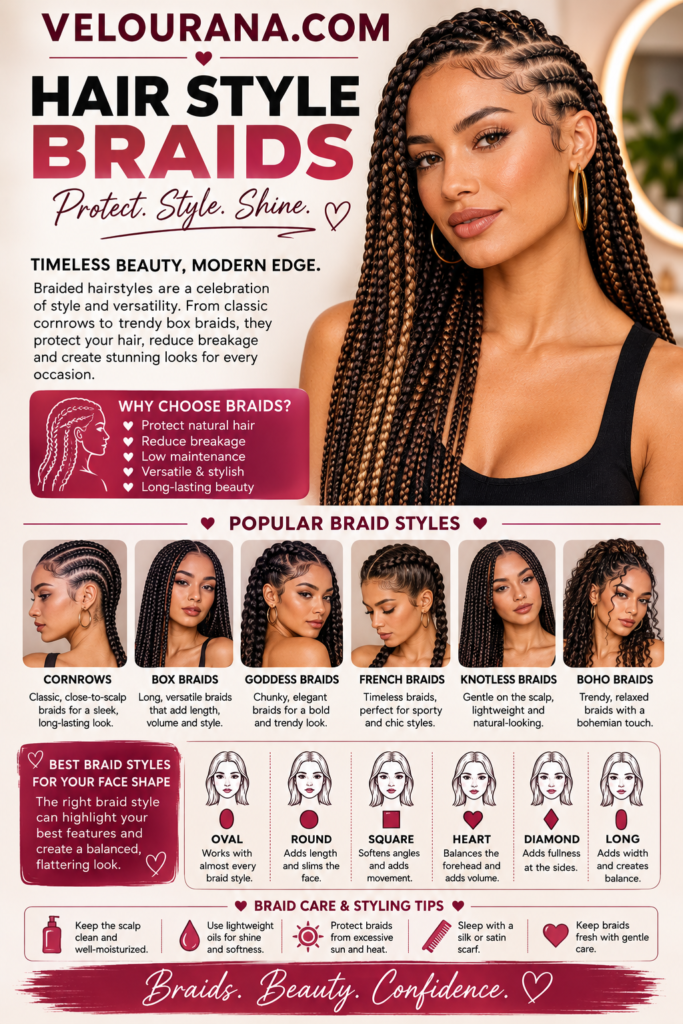
CATEGORY: Braids
Some hairstyles become associated so strongly with a particular era that they eventually feel dated. The French braid has avoided that fate. It has moved through decades of changing hair trends while remaining immediately recognizable, partly because it is less a single hairstyle than a method of building structure into the hair.
A traditional braid begins after the hair has already been gathered into three sections. A French braid does something more architectural. It begins with a smaller section and gradually collects additional hair as it travels across the head. Each new crossing incorporates more of the surrounding hair, allowing the braid to follow the contours of the scalp before continuing into a free-hanging length.
That simple difference creates remarkable versatility.
A French braid can begin high at the crown and travel directly toward the nape. It can start near the forehead, move diagonally across the head or appear as two symmetrical braids. It can contain almost every strand or occupy only a small section within a half-up hairstyle. It can look smooth and disciplined when woven closely or soft and expansive when loosened after completion.
Its practicality is equally important. The technique can keep long hair contained without concentrating everything at one elastic. It can move shorter front sections away from the face, organize layers that might escape from an ordinary braid and remain useful for everything from everyday styling to more elaborate occasions.
The French braid has therefore survived not because there is only one perfect way to wear it, but because the technique changes easily with the hair and the person wearing it.
What Makes a French Braid Different
The defining feature of a French braid is gradual incorporation.
The braid usually begins with three sections, just like a conventional three-strand braid. As the outer sections move toward the center, additional hair from the surrounding area is added before each crossing.
The braid therefore becomes larger as it progresses.
At the beginning, only a relatively small amount of hair may be involved. By the time the braid reaches the nape, most or all of the hair can have been incorporated.
This creates the characteristic woven pathway across the scalp.
The braid is not simply resting on top of the hair. It is connected to it continuously.
That connection is what allows the style to control layers and shorter sections more effectively than a braid beginning only at the nape.
It also makes placement an important part of the design.
A Central French Braid Creates a Strong, Balanced Shape
The classic single French braid often begins near the upper back of the head and travels down the center.
The symmetry gives the hairstyle a calm, organized appearance.
From the front, the hair can remain relatively simple. From the back, the braid becomes increasingly visible as it moves toward the nape and into the free length.
The upper hair can be kept smooth for a polished finish or allowed to retain some natural volume.
The braid itself can be relatively tight and compact or loosened slightly after completion.
These changes may seem small, but they alter the mood considerably.
A smooth, controlled central braid can feel practical and athletic.
A softer version with volume around the crown and a few loose pieces around the face can feel much more relaxed.
The underlying structure remains identical.
Beginning Near the Hairline Makes the Braid More Visible
Moving the starting point forward changes the hairstyle immediately.
When the braid begins near the forehead or front hairline, the woven pattern becomes visible from the front rather than emerging primarily toward the back.
This can be particularly effective when the braid is intended as the central decorative feature.
The starting section should still relate naturally to the surrounding hair.
A very narrow beginning followed by rapidly increasing sections creates a different appearance from a broader, softer start.
The transition should look intentional.
As more hair is collected, the braid develops its full width and continues toward the crown and nape.
Starting Farther Back Preserves Natural Movement Around the Face
Not every French braid needs to begin at the hairline.
Starting farther back leaves the front relatively free.
A center or side part can remain visible.
Curtain bangs can stay outside the braid.
Shorter face-framing layers can fall naturally.
This can make the hairstyle feel less controlled and more like a combination of loose styling and braiding.
The braid becomes a structure through the back while the front retains its own character.
For someone who likes braids but dislikes having every strand pulled away from the face, this can be an especially wearable interpretation.
Two French Braids Create a Completely Different Silhouette
Dividing the hair into two sections and creating one French braid on each side transforms the balance of the hairstyle.
Instead of one central line, the head is divided symmetrically.
The part becomes an important feature.
Each braid follows its own pathway from the front or crown toward the nape.
The result can be compact and practical when the braids are kept close to the head.
Loosen them and the style becomes broader and softer.
The ends can remain braided, be gathered together, or become part of another hairstyle.
Two French braids are also useful because they distribute the hair rather than concentrating all of it into one structure.
On very dense hair, this can make the style easier to manage.
The Parting Matters More With Two Braids
When the hairstyle is divided into two French braids, the central part becomes highly visible.
A straight part creates strong symmetry.
A slightly irregular or deliberately softer division creates a more relaxed effect.
The choice depends on the intended finish.
For a highly polished style, clean sectioning reinforces the precision.
For a casual hairstyle, perfect geometric separation may not be necessary.
What matters is that enough hair is allocated to each side to create the desired balance.
Natural density is not always identical on both sides, so visual symmetry can sometimes matter more than mathematical equality.
A Side French Braid Introduces Direction
A French braid does not need to follow the center of the head.
Beginning near one side and directing the braid diagonally creates movement.
The hairstyle becomes asymmetrical.
The braid can travel toward the opposite side of the nape or continue over one shoulder.
This brings more of the woven detail into view from the front.
It also creates opportunities for the loose hair around the opposite side to remain softer.
A diagonal braid can be particularly effective when combined with a side part because the entire hairstyle follows one general direction.
The braid appears to flow through the hair rather than simply divide it.
A French Braid Can Become a Small Detail
The technique does not require using the entire head of hair.
A narrow French braid can begin near one temple and travel toward the back.
Another can frame the opposite side.
A small section can be braided across the crown while the rest remains loose.
These versions use the technique decoratively.
The braid controls only the section needed to create the pattern.
This makes French braiding useful even for someone who prefers wearing most of their hair down.
A small braid can function almost like a natural headband, moving front sections away from the face without hiding the length.
Half-Up French Braids Combine Structure With Loose Length
A half-up hairstyle can use French braiding to create detail through the upper hair while leaving the lower lengths untouched.
The braid may travel from the front toward the crown and then end.
Two smaller braids can meet at the back.
The braided section can continue into a small ponytail or bun.
The contrast between woven and loose hair gives the hairstyle depth.
Waves beneath the braid create softness.
Straight lengths emphasize the difference between the structured upper section and smooth lower hair.
Curls add volume around the braid.
Because the entire head is not contained, the style retains much of the movement associated with wearing the hair down.
French Braiding Can Lead Into a Ponytail
The braid does not need to continue through the entire length.
It can stop at the nape or crown and transition into a ponytail.
This creates two distinct textures within one hairstyle.
The upper section is controlled through weaving.
The lower length remains free.
A high ponytail can be approached by braiding upward or through selected sections.
A low ponytail can emerge naturally from a braid traveling toward the nape.
This combination is practical because the French braid helps secure shorter upper sections that might otherwise loosen from the ponytail.
At the same time, the lengths remain available for movement.
French Braids Can Become Part of an Updo
Once the braid reaches the nape, the remaining hair does not have to hang freely.
The length can be wrapped into a bun.
It can be tucked underneath.
Several braided sections can meet and become part of a larger updo.
This makes the French braid useful as a structural foundation rather than merely the finished hairstyle.
The woven upper section creates visual interest before the eye even reaches the bun.
A sleek version can appear formal.
A softer braid with gently loosened sections can create a more romantic finish.
The same technique adapts according to how the remaining hair is arranged.
Tension Determines More Than Neatness
One of the most important elements in French braiding is tension.
Too little control while the braid is being constructed can allow the sections to loosen unpredictably.
Too much tension can make the hairstyle uncomfortable and place unnecessary stress on the hairline and scalp.
The goal is consistency.
Each section should be secure enough to maintain the structure without needing to be pulled aggressively.
This becomes especially important when braiding near the temples, where the hair can be more vulnerable to repeated tension.
A secure braid should not require pain.
Tight Braiding and Clean Braiding Are Not the Same Thing
It is easy to assume that a neater braid must be tighter.
In reality, neatness often comes from section control rather than force.
Consistent amounts of hair are incorporated.
The hands maintain the same general position.
The sections remain separated.
The braid follows a deliberate direction.
These elements create precision.
Pulling harder does not automatically improve them.
Learning to distinguish control from tension makes braiding more comfortable and can produce a better-looking result.
A Loose French Braid Requires Structure Underneath the Softness
Relaxed French braids often look as though they were created casually, but the most successful versions usually begin with a reasonably secure foundation.
The braid is constructed first.
Selected sections are then loosened carefully.
This provides much more control than attempting to braid everything extremely loosely from the beginning.
The edges can be widened gradually.
The crown can be softened.
Face-framing pieces can be released.
The result appears relaxed while the underlying braid remains stable.
This is an important distinction between intentional softness and a braid that is simply coming undone.
Straight Hair Creates Clear Definition
Straight hair can display the French braid pattern exceptionally well.
The sections lie smoothly against one another.
Each crossing is easy to see.
The gradual incorporation of hair creates a clean visual pathway down the head.
This clarity makes section consistency particularly noticeable.
It also allows the braid to change dramatically when loosened.
A compact braid can become much broader while still retaining a visible pattern.
Straight hair may sometimes feel slippery during braiding, particularly when very smooth, but careful hand positioning and consistent tension can keep the sections controlled.
Fine Hair Can Produce a Delicate French Braid
Fine hair does not need to create an enormous braid to look attractive.
A narrower braid can appear refined and detailed.
The woven structure itself provides interest.
If additional visual width is desired, the braid can be gently expanded after it is secured.
The surrounding hair can also retain some root volume rather than being flattened completely.
This creates the impression of a softer, fuller hairstyle without pretending the hair has a density it does not naturally possess.
The objective should be proportion.
A braid that suits the actual amount of hair often looks more convincing than one manipulated excessively in pursuit of maximum size.
Thick Hair Gives the Braid Greater Scale
Dense hair can create a substantial French braid with very little effort to increase its apparent width.
The sections are naturally larger.
The woven pattern becomes dimensional.
The braid may feel physically heavier, particularly when the hair is long.
Dividing the hair into two French braids can redistribute that weight.
A single braid can also be kept slightly looser through the lengths if comfort becomes an issue.
Dense hair gives the technique impressive presence, but the style should remain comfortable enough to wear for the intended period.
Wavy Hair Creates Natural Texture Between the Crossings
Wavy hair can make a French braid look softer even when the structure itself is relatively neat.
Small bends remain visible around the sections.
The roots may retain natural volume.
Loose pieces around the face develop movement.
This can create a beautifully balanced result because the braid provides control without eliminating the texture.
There is often no need to straighten wavy hair before braiding.
Doing so changes the character of the finished style.
If the desired result is relaxed, allowing the natural wave to participate can make the braid feel more harmonious.
Curly Hair Can Create a Rich, Dimensional Braid
Curly hair changes the visual surface of a French braid.
The sections do not necessarily lie completely flat.
Texture remains visible within the woven pattern.
The braid can appear substantial even without being extremely wide.
The roots may retain volume while the lengths become organized.
Curly face-framing pieces can be left free to soften the front.
Preparation should focus on making the hair manageable without unnecessarily destroying the curl pattern.
Gentle detangling and thoughtful sectioning can make the process easier.
The braid should work with the texture rather than requiring every curl to become perfectly smooth.
Shorter Layers Can Be Incorporated Gradually
One practical advantage of French braiding is its ability to collect shorter layers along the way.
An ordinary braid beginning at the nape may struggle to contain pieces around the face or crown.
A French braid incorporates them closer to where they naturally sit.
This can keep layered hair more controlled.
Very short pieces may still escape, particularly around the hairline, but the technique generally provides greater containment than gathering everything into one braid at the bottom.
This is one reason French braids remain useful for active days as well as decorative styling.
Bangs Do Not Necessarily Need to Be Braided
A fringe can remain completely separate.
Blunt bangs can stay forward while the braid begins behind them.
Curtain bangs can frame the face.
Longer side bangs can blend partly into the braid or remain loose.
This creates flexibility.
The hairstyle can be structured through the back without requiring the front to become equally controlled.
Leaving the bangs free can also make the braid feel more connected to the wearer's usual haircut.
The Hairline Can Remain Soft
A French braid does not need every fine hair around the face to be pulled tightly backward.
Allowing some natural softness around the hairline can create a more relaxed result.
Small pieces may remain near the temples.
Baby hairs can follow their natural pattern.
The braid itself can still be secure.
This reduces the visual severity that can occur when the front is pulled extremely tightly.
It can also reduce unnecessary stress on delicate hairline strands.
The Crown Can Be Flat or Voluminous
The upper silhouette changes according to how closely the hair is braided against the head.
A smooth, close braid creates a compact profile.
Leaving some volume at the crown creates a softer shape.
This can be controlled before and during braiding.
The choice should match the rest of the hairstyle.
A sporty double braid may benefit from a close structure.
A softer single braid for an evening hairstyle may look more balanced with some crown volume.
Neither is more correct.
They simply create different proportions.
Hair Color Becomes More Visible Inside the Weave
French braids can reveal color variation beautifully because sections repeatedly cross over one another.
Highlights move from one side of the braid to another.
Balayage creates changing brightness as the braid progresses.
Natural gray strands can form visible ribbons within darker hair.
Even subtle tonal differences may become more noticeable once the hair is reorganized into a woven structure.
This gives the braid additional depth without requiring any extra styling detail.
The Braid Can Look Different After Several Hours
A French braid rarely looks exactly the same at the end of the day as it did immediately after styling.
Movement softens the roots.
Small strands may escape.
The woven sections can widen slightly.
Natural texture begins becoming more visible.
For a relaxed hairstyle, this evolution may improve the appearance.
For a highly polished result, more initial control may be necessary.
The intended lifespan of the hairstyle should therefore influence how it is constructed.
Releasing the Braid Creates Another Hairstyle
When a French braid is removed after being worn for several hours, the hair may retain some of its woven pattern.
Straight hair can emerge with visible waves.
Wavy hair may gain additional definition.
The effect depends on the size of the sections, natural texture and whether the hair contained any moisture when braided.
The resulting texture can be worn loose, incorporated into a ponytail or used as the foundation for another hairstyle.
The braid therefore has a life beyond the period in which it remains intact.
Braiding Damp Hair Requires Care
Hair can stretch differently when wet, and some hair types are more vulnerable to breakage in that condition.
A braid constructed on damp hair should therefore not depend on excessive tension.
The hair should be handled gently.
If the purpose is to create waves after the braid dries, a looser structure can often achieve the effect without unnecessary pulling.
Hair should also be able to dry appropriately rather than remaining wet inside a very dense braid for an unnecessarily long period.
The technique should serve the hair, not simply the desired appearance.
Practice Makes the Sectioning More Natural
French braiding can feel difficult initially because the hands are doing several things simultaneously.
Three main sections need to remain separate.
Additional hair must be collected.
Tension has to remain relatively consistent.
The direction needs to be controlled.
At first, this can feel like too many tasks.
Repetition changes that.
The crossing sequence becomes automatic.
The hands begin recognizing how much hair to collect.
Attention can then shift from simply completing the braid to controlling its appearance.
Consistent Sections Create a More Even Pattern
When dramatically different amounts of hair are added from one crossing to the next, the braid can change width unpredictably.
Using reasonably consistent sections creates a more regular progression.
This does not require mathematical measurement.
The eye and hands gradually learn what feels balanced.
For a softer braid, exact uniformity may not even be desirable.
The objective is simply to avoid changes large enough to make the structure look accidental.
Hand Position Influences Control
Keeping the hands relatively close to the head while constructing the attached portion of the braid can make the sections easier to control.
If the braid is repeatedly pulled far away from the scalp during construction, the structure may become loose in places that were not intended to be loose.
Once the braid reaches the nape and becomes free-hanging, the hand position naturally changes.
This transition is one of the small technical details that becomes easier with practice.
The technique begins to feel less like memorizing steps and more like guiding the hair.
French Braids Can Be Practical for Active Days
A well-constructed French braid keeps much of the hair contained along the scalp.
This can make it useful when loose hair would be inconvenient.
The lengths do not swing as freely as they would in a ponytail.
Front sections can be incorporated.
The style can remain relatively stable through movement.
The braid should still be comfortable.
Practicality does not justify excessive tension.
A secure, well-distributed structure is usually more useful than one pulled unnecessarily tight.
The Style Can Move Easily From Day to Evening
One reason the French braid remains versatile is that relatively small changes can shift its character.
During the day, it can be worn simply and securely.
For a softer evening interpretation, the crown can retain more volume, the braid can be gently widened and selected pieces can frame the face.
The end can be wrapped into a low bun.
Accessories can be introduced.
The technique itself does not need to change dramatically.
Its finish does.
Accessories Can Follow the Braided Structure
The woven pathway naturally creates positions for decoration.
A ribbon can become part of the braid.
Small accessories can be placed along selected crossings.
The elastic at the end can be concealed or emphasized.
Decorative elements should complement the pattern rather than obscure it unnecessarily.
A highly dimensional braid may already provide enough visual detail.
A simpler braid can support more ornamentation.
The balance depends on which element is intended to dominate.
A French Braid Does Not Need Perfect Symmetry
Even a central braid does not need every crossing to be identical to look beautiful.
Hair density varies.
Layers influence section size.
Natural texture creates irregularity.
A slight difference from one side to the other can remain completely harmonious.
This is particularly true in softer styles.
The braid should feel controlled, but it does not need to look mechanically manufactured.
The hair is still organic material with its own movement.
Learning One Technique Opens Many Hairstyles
Once the basic French-braiding movement becomes familiar, it can be redirected almost anywhere.
The braid can travel down the center.
It can move diagonally.
It can appear twice.
It can frame the hairline.
It can stop at the crown.
It can become a ponytail.
It can disappear into a bun.
This adaptability is what makes learning the technique so useful.
The skill is not tied to one finished hairstyle.
Why the French Braid Continues to Work
The French braid has remained familiar for generations because its structure solves several styling problems at once.
It controls hair progressively rather than only at one point.
It can incorporate shorter sections.
It distributes the visual detail across the head.
It works with numerous lengths and textures.
It can be practical without looking purely functional.
Most importantly, it can change.
A sleek central French braid and a soft diagonal braid may share the same fundamental technique while producing entirely different impressions. Two compact braids can feel energetic and practical, while a loosened braid flowing into a low bun can become soft and elegant.
The technique provides the framework.
Texture, placement and personal styling determine everything else.
A Classic Technique With No Single Final Form
Perhaps the most interesting thing about the French braid is that there is no definitive version of it.
The familiar crossing pattern is only the beginning.
The braid can start wherever the hairstyle needs structure and travel in whichever direction suits the design. It can gather every strand or only a narrow section. It can disappear into another hairstyle or continue visibly through the ends.
Straight hair gives the weave clarity. Fine hair creates delicacy. Thick hair gives it scale. Waves soften it. Curls bring dimension.
The technique adapts rather than demanding one particular type of hair.
That adaptability is why the French braid remains useful even as hairstyles around it continually change.
It is both a finished style and a building method.
Once the sections begin gathering and crossing, loose hair becomes connected structure. From that structure can come something practical, decorative, understated or elaborate.
And that ability to create many different hairstyles from one beautifully simple principle is precisely what keeps the French braid timeless.
The End
Velourana.
 Discover More From Our Family of Websites
 ZodiacBearing (Astrology, Tarot, Numerology, Angel Numbers & Spiritual Guidance)
 Velourana (Beauty, Makeup, Hair Care, Skincare & Beauty Tips)
 HavenBearing (Home, Living, Organization, Décor & Everyday Inspiration)
 PawBearing (Pet Care, Dog Breeds, Animal Health, Training & Pet Products)
 PsyCatherine (Notes From the Journal of a Psychologist on Real Life)

