
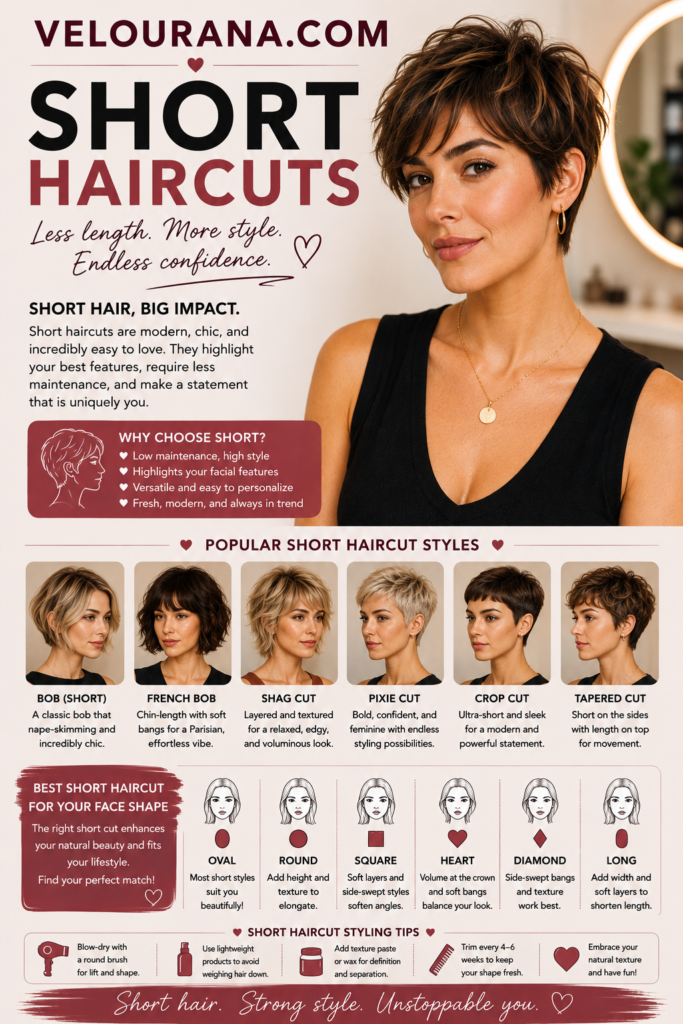
CATEGORY: Short Haircuts
The short shag approaches short hair very differently from a blunt bob or closely controlled crop. Instead of asking the hair to form one clean perimeter, it creates movement through multiple lengths. The crown becomes lighter, the sides develop texture, the fringe often blends directly into the rest of the cut, and the lower edge becomes softer.
The result is a haircut that can feel spontaneous even though its structure is carefully planned.
A good short shag should not look random. The layers may appear irregular, but they still need to create a balanced silhouette. The crown should relate to the sides. The fringe should connect naturally with the face-framing sections. The lower perimeter should remain strong enough to support the shape without becoming heavy.
This is what separates a shag from hair that has simply been thinned or cut into numerous disconnected pieces.
The short shag works especially well for people who want movement to be visible. Natural waves can become stronger. Curls can distribute themselves through several levels. Straight hair can gain texture through styling and deliberate separation.
The haircut can look soft, rebellious, polished, relaxed or almost effortless depending on how the layers are designed.
Its defining quality is not messiness.
It is movement.
The Crown Gives the Shag Its Lift
One of the most recognizable elements of a shag is shorter layering through the crown.
These upper sections weigh less, so they can move more freely.
On fine hair, this can create lift that would be difficult to achieve with a completely solid perimeter.
On thick hair, it can redistribute some of the heaviness away from the lower sections.
Waves may become more visible because the crown is no longer being pulled downward by as much length.
Curls can gain volume higher on the head.
The exact amount of crown layering matters.
Too little and the haircut may simply look like a slightly layered bob.
Too much and the upper section can become disconnected from the lower lengths.
The strongest version creates enough difference for movement without making the haircut feel divided.
The Fringe Often Becomes Part of the Layering
Short shags frequently include bangs because the fringe can become the first layer of the entire structure.
A full fringe can create a strong starting point.
Wispy bangs make the front lighter.
Curtain bangs allow the haircut to open around the face.
Curly bangs can become part of the natural volume.
The important thing is connection.
The fringe should gradually become longer toward the temples and sides rather than ending abruptly.
This creates a continuous progression from the forehead through the cheekbones and into the rest of the haircut.
When the connection is smooth, the shag feels cohesive even though the individual sections remain visibly textured.
Fine Hair Can Wear a Shag With Restraint
The short shag is sometimes associated with extremely heavy layering, but fine hair does not always need such an aggressive structure.
Too many short layers can remove too much density from the lower edge.
This may create volume through the crown while leaving the perimeter unexpectedly sparse.
A softer shag can preserve more weight.
The crown receives enough shaping to create movement.
The fringe remains light rather than excessively dense.
The sides are layered selectively.
The lower perimeter stays substantial enough to support the haircut.
Fine hair does not need dramatic fragmentation to achieve a shag-like effect.
The movement can be subtle and still transform the shape.
Thick Hair Can Support More Dramatic Layering
Dense hair gives the short shag considerable freedom.
There is enough material for multiple layers without immediately compromising the lower perimeter.
This makes stronger crown movement possible.
The sides can contain more texture.
The fringe can be substantial.
The haircut can create a highly dimensional silhouette.
But the same density can also create bulk.
If too much weight remains through the sides, the haircut may become wider than intended.
Internal shaping can help distribute that volume while preserving enough richness to keep the hair looking substantial.
The objective is not to make thick hair appear thin.
The objective is to let the density move.
Straight Hair Needs the Layers to Create the Texture
On straight hair, the structure of the shag becomes especially important because the texture may not appear naturally.
The layers need to provide places for movement to begin.
The crown can be lifted.
The fringe can separate.
The sides can develop piece-like sections.
Without styling, the haircut may look relatively soft and controlled.
Add bends or texture and the different lengths become much more visible.
This makes straight hair surprisingly versatile with a shag.
The haircut can look polished when smooth and far more dramatic when textured.
Waves Naturally Support the Shape
Wavy hair often responds beautifully to shag layering because the shorter sections allow the natural bends to develop more freely.
The crown gains movement.
The sides separate.
The fringe may curve naturally.
The lower perimeter becomes softer.
The haircut can begin looking textured with very little styling.
The wave pattern should still be evaluated carefully.
Some sections may be much wavier than others.
One side can behave differently from the other.
The underneath may curl more strongly than the surface.
A good shag works with these variations rather than trying to make every section identical.
Curls Turn the Shag Into a Three-Dimensional Shape
Curly short shags can be especially expressive because the different lengths influence where the curls sit in space.
Shorter crown curls create height.
Mid-length curls build volume through the sides.
Longer sections preserve the lower silhouette.
The result can become rounder, softer or more expansive depending on the desired shape.
Shrinkage is important.
The shorter the curl becomes, the more its apparent length can change.
The crown and fringe therefore need to be judged according to their dry position rather than their stretched length.
A curly shag should not be forced to imitate the geometry of a straight one.
The curl pattern provides its own architecture.
The Perimeter Should Remain Intentional
A shag does not depend on a blunt lower edge, but the perimeter still matters.
If the ends become too thin, the haircut can lose its foundation.
The lower section should feel deliberately soft rather than accidentally sparse.
The amount of weight left there depends on density.
Fine hair may need a stronger perimeter.
Thick hair can tolerate more fragmentation.
Curly hair may create a naturally irregular edge because individual curls finish at different heights.
The important point is that the haircut should still feel complete when viewed from a distance.
Short Shags Can Be Soft or Dramatic
Not every shag needs extreme contrast between short and long sections.
A soft shag uses longer, more blended layers.
The crown gains movement without becoming very short.
The fringe connects naturally with the sides.
The perimeter remains relatively substantial.
A dramatic shag exaggerates the differences.
The crown is shorter.
The sides become more fragmented.
The fringe may be highly visible.
The lower edge becomes lighter.
These are two ends of the same spectrum.
The correct version depends on how much texture the wearer actually wants to see.
The Part Can Change the Distribution of the Layers
A center part creates relatively balanced movement on both sides.
Curtain bangs work particularly naturally from this position.
A side part redistributes density.
One side gains more volume.
The fringe can sweep more dramatically.
The upper layers overlap differently.
Because the haircut contains multiple lengths, the change can be more noticeable than it would be on a one-length bob.
Someone who regularly changes their part should ideally have enough flexibility in the structure to support both directions.
Air-Drying Can Be One of the Best Ways to Wear a Shag
The short shag often works well when the natural texture is allowed to appear.
Waves can form without being forced.
Curls can settle into their own pattern.
Straight hair can develop subtle irregularities.
The haircut itself provides enough movement that the hair does not need to be transformed completely after every wash.
For someone who prefers low-styling routines, this can be one of the style's greatest advantages.
The haircut still needs to be designed around the natural behavior of the hair.
A shag that only works after extensive heat styling defeats much of the purpose for someone who wants an effortless result.
Blow-Drying Can Create a More Polished Interpretation
The same haircut can be styled into a smoother finish.
The crown can be lifted deliberately.
Face-framing layers can curve away from the cheeks.
The fringe can be controlled.
The ends can be softened without eliminating all the texture.
This creates a more polished version while preserving the underlying movement.
The haircut therefore does not need to remain deliberately undone.
It can move between casual and refined depending on styling.
Texture Products Should Reveal, Not Overpower
Because the haircut already contains movement, styling products do not need to create the entire effect.
Their role is to emphasize separation and control where necessary.
Fine hair may need lightweight support.
Thick hair may benefit from definition without excessive stiffness.
Waves and curls may need products that preserve their natural pattern.
The finished hair should still move.
A shag that becomes rigid loses much of the softness that makes the layered structure attractive.
The Short Shag Can Be More Forgiving as It Grows
One practical advantage of a textured haircut is that growth can sometimes appear less obvious than it does on a highly precise blunt cut.
The crown gradually becomes longer.
The fringe softens.
The perimeter moves downward.
The layers become less pronounced.
Instead of suddenly losing its identity, the haircut slowly transforms.
This does not mean maintenance is unnecessary.
Eventually the weight distribution changes enough that the original shape becomes softer.
But the transition can be relatively graceful.
Growing a Shag Into Medium Hair Can Be Natural
As the perimeter reaches the shoulders, the short shag simply begins behaving like a medium shag.
The crown layers gain weight.
The sides become longer.
The fringe can grow into curtain pieces or longer face framing.
There is no need to remove the layered structure completely.
It can evolve.
This makes the haircut relatively flexible for someone who may eventually want more length.
The Style Can Work With Natural Gray and Dimensional Color
The separation created by shag layers can make tonal variation more visible.
Highlights catch light at different levels.
Natural gray strands become more noticeable as individual pieces move independently.
Silver sections can create texture even without additional coloring.
The layered structure gives color more places to appear.
This can make the haircut look dimensional even when the color itself is simple.
A Shag Should Look Good From More Than One Angle
Because the haircut contains multiple levels of movement, it should be evaluated as a three-dimensional shape.
The front should connect with the sides.
The crown should have enough lift without appearing disconnected.
The back should retain a clear overall silhouette.
The perimeter should support everything above it.
The haircut should not depend on one perfect camera angle.
Its structure needs to make sense from the side and back as well as from the front.
Texture Should Follow the Hair's Natural Tendencies
The easiest shag to maintain is usually the one that uses what the hair already wants to do.
A natural wave can become a feature.
A cowlick can create lift.
A curl can form the fringe.
A side that naturally sweeps outward can become part of the face framing.
Trying to force every section into identical movement can remove the individuality that makes the haircut appealing.
Controlled irregularity is part of the style.
Short Hair Does Not Need a Clean Line to Feel Intentional
The blunt bob proves that a clean perimeter can create strong design.
The shag proves the opposite can also be true.
A haircut can be deliberate even when the ends do not form one perfect line.
Movement can become the organizing principle.
The crown, fringe and sides can establish the shape through different lengths.
The perimeter can remain soft.
The silhouette can still be clear.
This is why short hair offers far more variety than simply choosing between blunt and layered.
The Best Short Shag Has a Reason for Every Layer
A shorter crown creates lift.
A fringe creates framing.
Mid-length layers distribute volume.
Longer sections preserve the perimeter.
Each part contributes something.
This is what gives the haircut coherence.
The layers are not present simply because the style is called a shag.
They create the silhouette.
When the placement matches the density, texture and routine of the person wearing it, the haircut can feel remarkably natural.
When Movement Becomes the Main Feature
The short shag works because it allows short hair to move without relying on a long perimeter.
The crown carries texture.
The fringe begins the layered progression.
The sides create separation.
The ends remain soft.
Natural waves and curls can become stronger, while straight hair gains dimension through the structure itself.
The result can be relaxed without being shapeless and textured without appearing random.
That balance is what makes the haircut distinctive.
A short shag does not try to force every strand into one perfect position.
It creates a framework in which different sections are allowed to behave differently while still belonging to the same overall shape.
For someone who wants short hair that feels less rigid than a blunt bob and less compact than a pixie, that combination can be particularly effective.
The haircut remains unmistakably short.
But instead of being defined primarily by where the hair ends, it is defined by how the hair moves.
The End
Velourana.
 Discover More From Our Family of Websites
 ZodiacBearing (Astrology, Tarot, Numerology, Angel Numbers & Spiritual Guidance)
 Velourana (Beauty, Makeup, Hair Care, Skincare & Beauty Tips)
 HavenBearing (Home, Living, Organization, Décor & Everyday Inspiration)
 PawBearing (Pet Care, Dog Breeds, Animal Health, Training & Pet Products)
 PsyCatherine (Notes From the Journal of a Psychologist on Real Life)

