
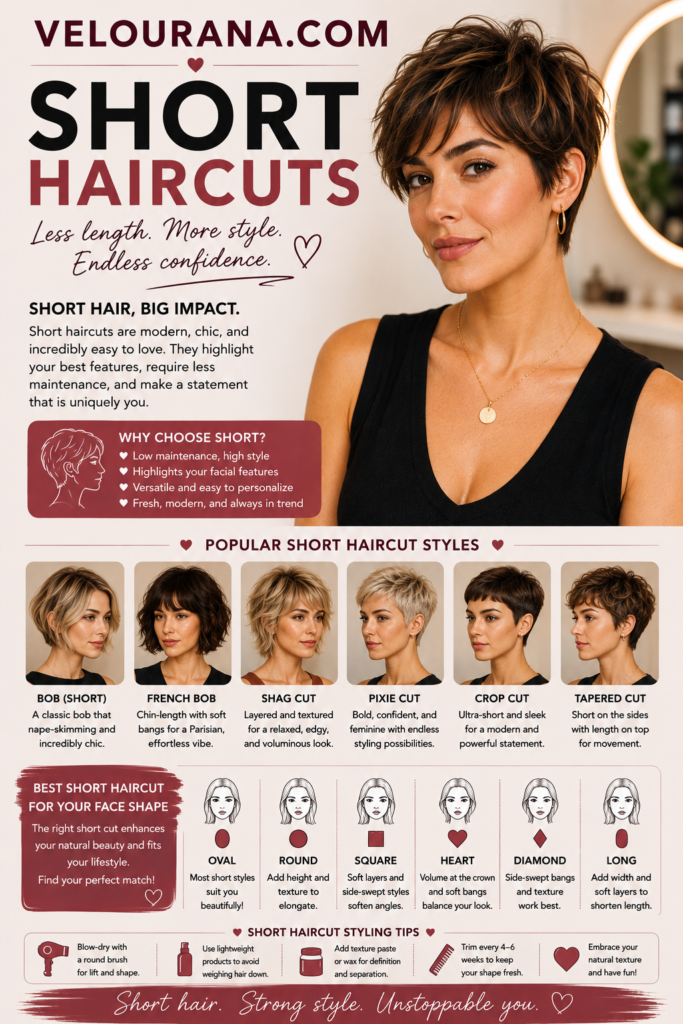
CATEGORY: Short Haircuts
There is something immediately recognizable about a beautifully blunt short haircut. The shape does not depend on complicated layering, dramatic graduation or deliberately separated pieces. Instead, much of its visual strength comes from one simple decision: allowing a large proportion of the hair to meet at a clear, deliberate perimeter.
That simplicity can be remarkably powerful.
On a jaw-length bob, the ends create a strong boundary close to the face. On a slightly longer short cut, the perimeter moves beneath the jaw and gains more freedom to swing. Raise the line toward the ears and the haircut becomes increasingly graphic and compact. In every case, the location of the baseline changes the personality of the cut even when the underlying principle remains the same.
A blunt haircut is often described as though every strand must be mathematically identical in length. In practice, the visible result matters more than such literal uniformity. Subtle internal adjustments may be used to control density, encourage the hair to sit properly or prevent excessive bulk while preserving the appearance of a substantial lower edge.
What defines the style is the strength of that edge.
This makes blunt short hair particularly interesting because there is very little distraction from the structure. The perimeter is close enough to the face and neck to become one of the dominant elements of the entire hairstyle. The surface may be sleek and reflective, naturally wavy, softly curved or even curly, but the underlying shape remains deliberate.
The result can feel minimalist without being plain.
When there are fewer structural elements competing for attention, proportion becomes more important. The exact length, parting, density and natural behavior of the hair determine whether the simplicity feels effortless or overly rigid.
Why the Perimeter Matters So Much
The perimeter of any haircut establishes where the visible mass of the hair ends. With long hair, that line may sit far below the face and have relatively little influence on the upper silhouette. In short hair, it moves into a much more prominent position.
A jaw-length baseline sits directly beside the lower face.
A shorter bob may end around the mouth or ears.
A slightly longer version may sit just beneath the jaw and move freely around the upper neck.
These are relatively small differences in measurement, but visually they can be substantial.
This is one reason choosing a blunt short haircut should involve more than simply requesting a bob. The desired position of the perimeter is part of the design.
Once established, that line gives the haircut its visual weight.
When many strands reach it together, the ends appear substantial. The eye reads the haircut as one strong shape rather than a collection of separate layers.
Blunt Cutting Can Make Fine Hair Appear More Substantial
Fine hair is one of the clearest examples of why perimeter density matters.
When long fine hair contains numerous layers, fewer strands reach the lowest point. If the overall density is limited, the ends can begin appearing transparent or sparse.
Shortening the hair removes those thinner lower lengths.
Keeping the new perimeter relatively blunt allows a greater proportion of the strands to contribute to the same visible edge.
The individual hairs have not become thicker.
The distribution has changed.
This can make the haircut appear noticeably fuller, particularly when the baseline is positioned where the density remains strong.
The effect is often most obvious on straight or slightly wavy hair because the perimeter can be seen clearly.
Fine hair does not necessarily need to be completely devoid of internal shaping. Small adjustments can help the haircut move naturally. But preserving the visual strength of the baseline is often more valuable than introducing layers simply for the sake of having them.
Density Matters as Much as Strand Thickness
Fine hair and thin hair are not necessarily the same thing.
Someone may have fine individual strands but a high number of them. Another person may have coarser strands with lower overall density.
A blunt haircut responds differently in each case.
High-density fine hair can create a surprisingly substantial short shape because many strands gather at the perimeter.
Lower-density hair may still benefit from the same principle, but the ideal length may be particularly important. Moving the baseline higher can sometimes position it where more hair remains available.
This is why copying another person's exact bob length does not guarantee the same result.
The haircut has to respond to the amount and behavior of the actual hair.
Thick Hair Creates a Different Kind of Blunt Bob
On dense hair, a blunt perimeter can become dramatically substantial.
There is no shortage of strands contributing to the baseline.
The result may be bold, architectural and deliberately heavy.
For someone who enjoys that visual weight, very little needs to be done to disguise it.
But thick hair can also expand when shortened.
Long lengths may have been pulling the hair downward. Once that weight is removed, the new bob can become wider than expected.
This is particularly noticeable with coarse, wavy or curly textures.
A blunt appearance can still be preserved while some internal weight is carefully redistributed. The external perimeter remains strong, but the interior does not need to behave as one completely solid block.
This distinction allows dense hair to retain the graphic character of the cut without becoming unnecessarily difficult to manage.
Straight Hair Reveals the Geometry Clearly
Straight hair can make a blunt short haircut look exceptionally precise.
The strands naturally fall in relatively direct lines, allowing the baseline to remain clearly visible.
A center part can create symmetry.
A side part changes the distribution and introduces asymmetry while leaving the perimeter intact.
When the surface is smooth, the simplicity of the structure becomes the main feature.
There are no obvious layers competing with the line.
This can make healthy-looking ends particularly noticeable.
The haircut appears deliberate because every element has visual clarity.
Straight hair can also reveal imperfections more easily, which is why precision in the baseline matters. A difference that disappears inside strong waves may be obvious on a sleek bob.
Wavy Hair Softens the Same Structure
A blunt perimeter does not require straight texture.
Wavy hair can use exactly the same underlying structure while creating a completely different result.
The waves interrupt the visible line.
Some sections bend upward.
Others curve outward or inward.
The ends do not appear to occupy one perfectly horizontal position even though the haircut itself may have been built around a strong baseline.
This creates an appealing contrast.
The structure is controlled, but the surface is relaxed.
Because the lower density remains concentrated, the haircut retains substance even when the waves create separation.
This can be particularly effective for someone who wants natural movement without extensive layering.
The Wave Pattern May Become Stronger After Cutting
Someone moving from long wavy hair to a short blunt bob may discover more texture than expected.
Length creates weight.
Weight stretches waves.
Removing a large portion of the hair can allow the remaining sections to contract and bend more strongly.
The finished haircut may therefore sit higher or appear more voluminous than it did when the hair was wet or stretched.
This should be considered when choosing the final perimeter.
A bob intended to sit precisely at the jaw when straight may appear above it when the natural wave returns.
Neither version is incorrect.
They are simply different expressions of the same length.
Curly Hair Can Interpret Bluntness Through Shape Rather Than a Visible Line
A blunt curly haircut does not necessarily produce a ruler-straight visible perimeter.
Curls contract differently.
Individual sections occupy different heights.
The lower silhouette may appear rounded rather than horizontal.
Yet the principle of preserving density toward the ends can still be used.
Keeping excessive layering out of the lower structure allows the curls to create a substantial perimeter.
The result may have considerable volume.
For some curl patterns, that fullness is exactly the desired effect.
For others, selective shaping may be needed to prevent all the volume from accumulating at one level.
The haircut can still retain a strong overall boundary without demanding that every curl finish in exactly the same apparent position.
Jaw Length Creates a Strong Relationship With the Face
A blunt bob positioned around the jaw is one of the most distinctive versions of the haircut.
The ends sit close to the lower face, making the perimeter impossible to ignore.
When worn straight, the effect can be particularly graphic.
With waves, it becomes softer but remains compact.
The haircut exposes the neck while preserving enough side length to tuck behind the ears.
This combination makes jaw length highly versatile.
It feels unquestionably short without removing so much hair that movement disappears.
A small adjustment above or below the jaw can substantially change the result, so the exact position deserves consideration rather than being treated as a generic measurement.
Slightly Below the Jaw Creates More Movement
Lowering the perimeter gives the hair additional distance in which to move.
The ends swing more freely.
The front can curve toward or away from the face.
Tucking behind the ears becomes easier.
The silhouette is still clearly short, but it begins moving toward the flexibility associated with medium hair.
This can be an excellent choice for someone making a dramatic cut from long hair but wanting to preserve some familiarity.
The strong baseline remains.
The additional length simply makes it less compact.
Above the Jaw Creates a More Graphic Shape
Raise the perimeter and the haircut becomes increasingly bold.
An ear-length or very short bob exposes more of the neck and lower face.
The distance between the crown and baseline becomes smaller, making the haircut appear more concentrated.
Straight hair can create a particularly clean result at this length.
Waves introduce playful movement.
The shorter structure can also reveal growth patterns that longer hair previously concealed.
The haircut becomes less forgiving of assumptions about how the hair will behave, which makes understanding its natural texture particularly important.
A Center Part Emphasizes Balance
A center part distributes the front sections relatively evenly.
On a blunt bob, this can emphasize the symmetry of the haircut.
The two sides fall toward a common perimeter.
The clean structure becomes easy to read.
This does not mean both sides of the hair will behave identically. Natural density and growth patterns can still create differences.
But visually, the center part reinforces the simplicity of the cut.
It is particularly effective when the objective is a sleek, minimal silhouette.
A Side Part Changes the Haircut Without Changing the Perimeter
Moving the part can transform the appearance immediately.
More hair falls toward one side.
The roots may gain additional lift.
One side becomes visually heavier.
The front develops movement.
The baseline itself remains unchanged, yet the haircut feels less symmetrical and often more voluminous.
This illustrates one of the strengths of a simple blunt structure.
Because the haircut is not dependent on complicated layering, styling choices can alter its personality without disturbing the underlying shape.
Tucking One Side Behind the Ear Creates Instant Asymmetry
A blunt bob does not need to be cut asymmetrically to produce an asymmetrical appearance.
Tucking one side behind the ear exposes the cheek and ear while the opposite side remains loose.
The visual weight shifts.
Earrings become more noticeable.
The haircut appears narrower on one side and fuller on the other.
Tucking both sides produces another transformation.
The face opens and the silhouette becomes more compact.
These are extremely simple changes, but short hair magnifies them.
Bangs Can Make a Blunt Haircut Even More Structured
Combining a strong bob perimeter with a blunt fringe creates two clearly defined boundaries.
One frames the forehead.
The other frames the lower portion of the face.
On straight hair, this can create a highly graphic result.
The haircut relies on line and proportion rather than movement.
A lighter fringe changes the effect.
Wispy bangs introduce softness while the lower perimeter remains substantial.
Curtain bangs create another interpretation, allowing the front to move while the bob itself stays blunt.
The bangs do not need to duplicate the character of the perimeter.
Contrast can make the haircut more interesting.
A Blunt Bob Without Bangs Creates an Open Front
Leaving the forehead unobstructed places greater emphasis on the part and the front sections.
A center part creates a clean opening.
A side part creates a sweep.
The front lengths can remain identical to the rest of the perimeter or become subtly longer.
This version can feel especially simple because there are very few structural interruptions.
The haircut depends on the quality of the shape, the natural texture and the way the front falls.
Face Framing Can Be Added Without Destroying the Blunt Effect
A blunt haircut does not have to remain completely one length around the face.
Small amounts of framing can soften the front while preserving the strong lower edge through most of the haircut.
The key is proportion.
If large sections are shortened dramatically, the haircut begins moving toward a layered structure.
If only selected front pieces are adjusted, the overall impression can remain blunt.
This can provide a useful compromise for someone who likes the density of a strong bob but wants more movement around the face.
The Ends Can Curve Inward for a Classic Finish
A slight inward bend creates one of the most familiar ways of styling a blunt bob.
The perimeter follows the shape of the jaw or neck rather than projecting outward.
This can make the haircut appear compact and polished.
The curve does not need to be exaggerated.
A subtle bend may be enough to prevent the ends from appearing rigid.
Straight hair can often achieve this relatively easily during drying, while natural waves may create their own variation.
Flipping the Ends Out Changes the Mood Completely
Direct the same ends outward and the haircut gains a different personality.
The perimeter remains strong, but its movement changes.
Instead of curving toward the neck, the hair moves away from it.
A relatively minimalist haircut suddenly becomes more playful.
This is another example of why structural simplicity does not mean limited styling.
A strong baseline provides a foundation that can support several different finishes.
Sleek Styling Makes the Surface as Important as the Line
When a blunt bob is worn very smooth, the eye notices both the perimeter and the uninterrupted surface above it.
Light reflects across the hair more continuously because there are fewer visible layers breaking the shape.
The result can look exceptionally polished.
But this finish is a styling choice, not an obligation.
The haircut can still work with natural texture.
A good blunt structure should not depend entirely on being perfectly straight unless that is genuinely how the wearer intends to maintain it.
Air-Dried Blunt Hair Can Look Completely Different
Allowing the haircut to dry naturally reveals the actual behavior of the texture.
Small bends become visible.
The ends may turn in different directions.
One side may sit closer to the face.
Natural volume appears at the roots.
This version can feel much more relaxed than the sleek interpretation while preserving the same substantial perimeter.
For someone who normally air-dries, this natural version should be considered before the cut is finalized.
The everyday haircut matters more than the temporary salon finish.
Humidity Can Change the Shape
Short hair is light enough to respond strongly to moisture in the air.
Straight hair with hidden texture may begin developing bends.
Waves can become stronger.
Curly hair may contract and expand.
A blunt haircut preserves its underlying density, but the visible perimeter can become less precise as texture increases.
Someone who expects the haircut to remain geometrically perfect in every environment may need more styling than someone comfortable allowing the surface to change.
The cut itself does not fail when texture appears.
It simply reveals another version of the same structure.
A Strong Perimeter Can Make Healthy Ends More Noticeable
Removing substantial length can eliminate older sections that have experienced years of heat, coloring, friction and environmental exposure.
The new ends may feel significantly stronger.
When those ends are concentrated into a blunt perimeter, the difference becomes visually prominent.
This can make a major short cut feel like a reset.
The haircut does not repair damaged hair.
It removes the portion that has been cut away and establishes a new baseline from the remaining strands.
That distinction is simple but important.
Color Can Look Different After a Blunt Cut
Long color transitions may change dramatically when the hair is shortened.
Balayage placed through the lower lengths can disappear partly or completely.
Highlights become concentrated within a smaller area.
Natural roots may represent a larger proportion of the visible hair.
The strong perimeter can also emphasize differences in tone at the ends.
Someone making a dramatic cut may therefore experience a significant color transformation even without changing the color itself.
Gray and Silver Hair Can Look Striking in a Clean Bob
Naturally gray hair often contains multiple shades.
A simple blunt structure can provide a strong background for that variation.
Silver strands move through darker ones.
Bright sections catch the light.
The clean perimeter prevents the haircut from becoming visually complicated, allowing the color itself to provide dimension.
A sleek finish emphasizes the surface.
Natural waves create more separation between tones.
Both can work beautifully within the same structural idea.
Blunt Does Not Mean Motionless
The term can suggest rigidity, but a blunt short haircut can move considerably.
The entire perimeter can swing because the hair is no longer resting on the shoulders.
A side part creates movement across the forehead.
Tucking and releasing the sides changes the silhouette.
Waves can travel through the lengths.
The ends can bend inward or outward.
The haircut simply keeps more of its density concentrated toward the bottom.
Movement and a strong perimeter are not opposites.
Short Blunt Hair Can Be Surprisingly Versatile
The lack of extensive layering can actually make the haircut adaptable.
It can be sleek one day and naturally wavy the next.
The part can move.
One side can be tucked.
Both sides can be tucked.
Bangs can later be added.
The ends can change direction.
Accessories can alter the front.
The fundamental shape remains stable beneath these variations.
This makes a blunt bob useful for someone who wants a recognizable haircut without necessarily wearing it in exactly the same way every day.
Maintenance Depends on How Exact You Want the Line to Remain
A highly precise perimeter changes as soon as the hair begins growing.
The bob gradually moves lower.
A jaw-length cut begins approaching the neck.
An ear-length version starts covering more of the ears.
The haircut may still look attractive, but its proportions evolve.
Someone who wants to preserve one exact length will need regular reshaping.
Someone comfortable with the bob becoming progressively longer can simply allow the perimeter to travel downward.
The structure often grows gracefully because there are relatively few short internal layers creating competing shapes.
A Blunt Bob Is Particularly Straightforward to Grow
If the eventual goal is medium or long hair, a relatively one-length bob provides a simple foundation.
The perimeter moves downward as the hair grows.
There are fewer short layers waiting to catch up.
Once the ends approach the shoulders, the haircut naturally enters medium-length territory.
The main challenge may be the point at which the ends begin touching the shoulders and turning in different directions.
That is a temporary mechanical effect rather than a structural problem.
The hair can simply continue growing beyond it.
Simplicity Makes Precision More Important
A complicated haircut contains many visual elements.
A simple blunt haircut contains relatively few.
This means those few elements carry greater responsibility.
The perimeter matters.
The length matters.
The part matters.
The way the ends sit matters.
There are fewer distractions if one of these elements does not work well.
This is why minimal haircuts are not necessarily technically simple.
Their apparent simplicity depends on getting the proportions right.
The Haircut Should Suit the Natural Density
A blunt bob should not be selected solely because it looks beautiful on another person.
The density determines how substantial the perimeter becomes.
Fine lower-density hair may produce a delicate but stronger-looking edge.
Very dense hair may create an extremely heavy baseline.
Waves and curls can expand the silhouette further.
The objective is to predict that behavior and choose a length and amount of internal shaping that support it.
The same photograph can therefore lead to different technical decisions on different heads of hair.
The Strongest Version Is the One That Works Beyond the Salon
A freshly styled blunt bob can look exceptionally controlled immediately after cutting.
But the real test begins after the first wash.
How does the hair fall naturally?
Does the perimeter still create an attractive shape when the texture returns?
Can the wearer reproduce the preferred finish without an unrealistic amount of work?
Does the haircut remain comfortable during an ordinary day?
These questions determine whether the style becomes sustainable.
A good short haircut should have an everyday identity, not only a professional blowout identity.
Why the Blunt Short Haircut Continues to Endure
Hair trends repeatedly move between elaborate layering and simpler shapes, but the blunt short haircut never disappears for long.
Its strength comes from an idea that does not depend heavily on fashion.
Concentrating the ends creates definition.
Bringing the perimeter close to the face gives the haircut presence.
Removing excessive length creates movement and exposes the neck.
The simplicity allows texture, color and personal styling to change the result without erasing the underlying structure.
A blunt bob can look minimal, dramatic, relaxed, polished, classic or contemporary depending on the person wearing it.
The same fundamental haircut can behave differently on fine straight hair, dense waves or curls because the natural texture participates in the design.
When a Simple Line Becomes the Whole Design
The beauty of a blunt short haircut is ultimately found in restraint.
There does not need to be a layer at every level or a complicated transition through the crown. There does not need to be dramatic styling or a highly engineered finish.
Sometimes the strongest decision is simply deciding where the hair should end and allowing enough of it to arrive there together.
That line creates density.
It establishes proportion.
It gives the haircut an unmistakable silhouette.
Everything else can then change around it.
The surface can become sleek or wavy. The part can move. The sides can tuck behind the ears. Bangs can be introduced. The ends can curve in or flip outward.
The foundation remains recognizable.
That is why a blunt short haircut can look so simple while offering so much variation. It reduces the structure to one of hairdressing's most fundamental elements—the perimeter—and gives that perimeter enough strength to carry the entire haircut.
The End
Velourana.
 Discover More From Our Family of Websites
 ZodiacBearing (Astrology, Tarot, Numerology, Angel Numbers & Spiritual Guidance)
 Velourana (Beauty, Makeup, Hair Care, Skincare & Beauty Tips)
 HavenBearing (Home, Living, Organization, Décor & Everyday Inspiration)
 PawBearing (Pet Care, Dog Breeds, Animal Health, Training & Pet Products)
 PsyCatherine (Notes From the Journal of a Psychologist on Real Life)

