
CATEGORY: Short Haircuts
Cutting hair short is often described as though it were one decision: keeping the length or removing it. In reality, short hair contains an enormous range of possibilities. A haircut ending around the jaw behaves very differently from one sitting beneath the ears. A softly layered crop has little in common with a precise blunt bob, while a longer pixie can preserve surprising movement despite exposing most of the neck.
This is what makes choosing a short haircut more interesting than simply deciding how many centimeters to remove.
The real decision is about shape.
Long hair has enough weight and distance to create much of its silhouette naturally. Once the hair becomes short, its architecture becomes increasingly visible. The perimeter moves closer to the face. The neck and shoulders become exposed. Layers occupy a greater proportion of the total length. Natural texture can become stronger because there is less weight pulling it downward.
Small differences begin to matter.
A jaw-length perimeter can create a strong frame around the face. Moving that perimeter slightly lower softens the effect and introduces more movement. Raising it toward the ears creates a distinctly shorter silhouette. Keeping the front longer than the back creates another shape entirely.
The haircut can be sleek or textured, blunt or layered, symmetrical or deliberately asymmetrical. It can work with straight hair, encourage waves or give curls an entirely new distribution of volume.
Short hair therefore does not represent one aesthetic.
It is an entire landscape of proportions.
Where Short Hair Actually Begins
There is no absolute boundary separating short hair from medium hair, but the relationship with the shoulders provides a useful reference.
Once the perimeter sits clearly above them, the haircut begins behaving differently.
The ends no longer rest against the shoulders.
The hair swings more freely.
There is less weight through the lower section.
The neck becomes increasingly visible as the perimeter moves upward.
A collarbone cut may still behave much like longer hair, while a jaw-length bob clearly belongs to another category. Move above the jaw and the haircut becomes even more compact.
This gradual change explains why someone can remove only several additional centimeters and feel as though they have received a completely different haircut.
The difference is not simply numerical.
The hair has moved into another relationship with the head, neck and face.
The Jaw-Length Bob Is One of the Most Recognizable Short Shapes
A bob ending around the jaw creates a strong perimeter close to the face.
This proximity gives the haircut immediate presence.
On straight hair, a blunt baseline can look exceptionally precise. The ends form a clear boundary, and the surface of the hair remains relatively uninterrupted.
Waves soften the same structure.
Instead of creating one rigid line, the texture breaks the perimeter into natural movement.
Curly hair interprets the length differently again because shrinkage and volume influence where the silhouette actually sits.
The jaw-length bob can be worn with a center part for a balanced appearance or shifted to one side for greater asymmetry and volume.
It can remain almost completely one length or contain subtle internal shaping.
The fundamental strength comes from the perimeter.
Because the haircut is compact, that perimeter becomes one of its most important visual features.
Moving Slightly Below the Jaw Creates More Softness
A few additional centimeters can change the character of a bob considerably.
When the hair extends below the jaw but remains well above the shoulders, the silhouette becomes less compact.
The front has more room to move.
The ends can curve inward, outward or form natural bends.
The haircut retains the strength of a short perimeter while gaining some of the flexibility associated with medium hair.
This can be particularly useful for someone cutting long hair short for the first time.
The transformation remains obvious, but the additional length provides familiarity.
Some sections may still tuck easily behind the ears.
The front retains enough movement to feel less exposed than a very short crop.
It can therefore provide an approachable entry into short hair without looking like a compromise.
Going Above the Jaw Changes the Proportions Dramatically
Raise the perimeter toward the ears and the haircut becomes much more concentrated around the head.
The neck is exposed.
The jaw is no longer surrounded by a lower curtain of hair.
The sides occupy a smaller vertical area.
This can create a strong, distinctive silhouette.
An ear-length bob can feel graphic when cut bluntly.
Add texture and the same general length becomes softer.
Leave additional length at the front and the haircut develops movement despite the short back.
These variations demonstrate why “short” is not descriptive enough on its own.
The precise location of the perimeter determines how the haircut interacts with the face and neck.
A Blunt Short Cut Makes the Perimeter the Main Feature
Blunt cutting concentrates a large proportion of the hair at approximately the same level.
This creates density through the ends.
Fine hair can benefit significantly from this effect because more strands contribute to the visible perimeter.
The haircut can appear stronger and fuller.
On thick hair, the same technique creates a substantial silhouette.
That may be exactly the objective, particularly for someone who likes a bold bob.
But dense hair can also become bulky when too much weight accumulates at one level.
Internal shaping may then be useful without sacrificing the visible strength of the baseline.
A blunt appearance does not necessarily mean absolutely every strand inside the haircut has identical length.
It means the perimeter remains visually dominant.
Layers Turn a Short Haircut Into a Different Kind of Shape
Layering changes where the hair's weight sits.
Instead of concentrating almost everything at the lower perimeter, selected sections finish higher.
The haircut gains movement.
The crown may develop more lift.
The sides can become softer.
Natural waves and curls may become more visible.
The effect is stronger on short hair because the difference between a short layer and the overall perimeter represents a substantial part of the total haircut.
A layer several centimeters shorter than a long haircut may barely be noticeable.
The same difference within a jaw-length style can alter the entire silhouette.
This makes restraint particularly important.
Layers should create a specific effect rather than being added automatically.
Fine Hair Often Benefits From Simplicity
Shortening fine hair can create an immediate visual improvement when long ends have become sparse.
The new perimeter sits where more strands are present.
The haircut appears denser.
This advantage can be preserved by keeping much of the structure relatively simple.
A strong baseline provides fullness.
Subtle internal layers can add movement.
Face framing can change the front without sacrificing large amounts of density.
Fine hair does not necessarily need numerous short layers to create volume.
Shorter sections may lift more easily, but every strand removed from the perimeter also reduces the number contributing to its fullness.
The most successful balance often comes from deciding exactly where movement is needed and leaving the rest substantial.
Thick Hair Can Become Surprisingly Voluminous When Shortened
Dense hair behaves differently after substantial length is removed.
Long hair uses its own weight to pull itself downward.
Cut that weight away and the hair may expand.
Straight thick hair can gain body.
Waves may become stronger.
Curls can contract considerably.
A short haircut should anticipate this response.
Someone whose long hair appeared relatively controlled may discover that a jaw-length cut creates much greater width.
This does not mean thick hair should not be worn short.
It means the shape needs to distribute the density intelligently.
Layers, internal shaping and careful perimeter placement can create movement while preserving the richness that makes thick hair attractive.
Straight Hair Can Make Short Cuts Look Exceptionally Precise
Straight texture reveals cutting lines clearly.
A blunt bob becomes unmistakable.
An asymmetrical perimeter is easy to see.
A smooth graduation through the back can create a sculpted silhouette.
Because the hair does not naturally disguise transitions with waves or curls, the relationship between sections becomes important.
This precision can be one of the great attractions of straight short hair.
The haircut can rely on simplicity.
A clean perimeter, well-chosen part and subtle curve at the ends may be enough to create a complete style.
Texture can always be introduced through styling when a softer result is wanted.
Wavy Hair Often Discovers More Movement at Short Lengths
Removing weight can transform wavy hair.
The pattern may begin higher.
Individual sections can form stronger bends.
The perimeter becomes less predictable in an attractive way.
A bob that appears relatively simple when stretched may become highly textured when allowed to dry naturally.
This makes natural behavior particularly important when choosing the final length.
A wave can shorten the apparent position of the perimeter.
The ends may sit higher on one side or form different curves around the face.
A successful wavy short cut works with these differences rather than attempting to force every strand into a perfectly straight boundary.
Curly Hair Creates Shape Through Volume
Short curly hair is three-dimensional.
The haircut cannot be understood simply by looking at where the stretched ends reach.
Curls occupy space.
They contract upward.
They move outward.
Their shape changes according to how much weight they carry.
Removing substantial length can therefore create a dramatic transformation.
A curl that was elongated at shoulder length may become much tighter at the jaw.
The crown may gain volume.
The sides may expand.
Layers can redistribute this volume, allowing the silhouette to become rounder or more elongated depending on the desired result.
The natural dry position should guide the haircut.
A short curly style is successful when its overall shape feels balanced, not when every individual curl reaches the same measurement.
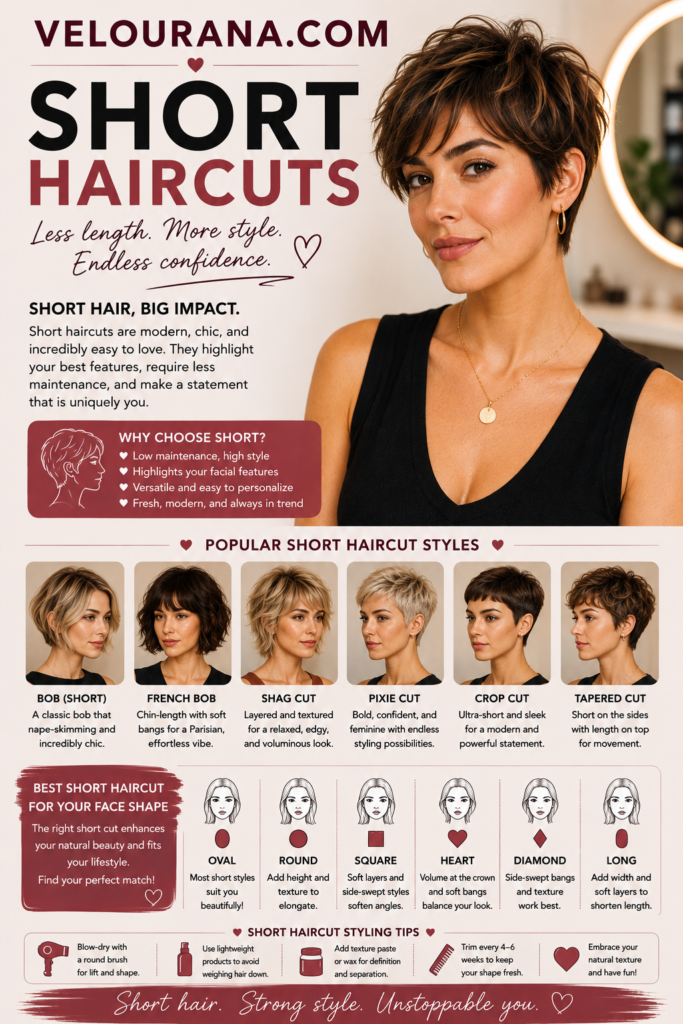
The Bob Is Only One Version of Short Hair
Because the bob is so recognizable, short hair is sometimes discussed as though everything else were simply a variation of it.
There are many alternatives.
A bixie combines the compact quality of a pixie with additional length and movement.
A short shag uses pronounced layers and texture rather than relying on a strong baseline.
A cropped cut concentrates the shape much closer to the head.
An asymmetrical short haircut deliberately keeps one area longer.
A short layered style can preserve softness around the ears and nape without creating a traditional bob perimeter.
These differences allow short hair to accommodate very different preferences.
Someone who dislikes the precision of a blunt bob may love a soft layered crop.
Someone who dislikes heavy layering may prefer an immaculate one-length shape.
The Bixie Occupies a Useful Space Between Bob and Pixie
The bixie combines characteristics of two familiar short cuts.
It generally preserves more length than a traditional pixie, particularly around the crown, sides and front, but remains lighter and more layered than many bobs.
This creates movement.
The ears may be partially covered.
The fringe can be substantial.
The back can remain short enough to expose the neck.
The haircut works particularly well with natural texture because the layers give waves and curls room to move.
Straight hair can create a softer, feathered version.
For someone considering a pixie but hesitant about removing too much length, the bixie can provide an intermediate option.
It also works naturally as a stage when growing a pixie toward a bob.
The Short Shag Makes Layers the Main Event
A short shag approaches structure very differently from a blunt bob.
Instead of concentrating density at the perimeter, the haircut distributes movement through multiple lengths.
The crown may be considerably shorter.
The sides contain texture.
The fringe often connects naturally with the surrounding layers.
The perimeter becomes softer and less dominant.
Natural waves can make this structure especially expressive because the different lengths encourage the pattern to develop throughout the haircut.
Curly hair can create a compact, voluminous interpretation.
Straight hair may require more deliberate styling if a highly separated finish is desired.
The short shag is therefore ideal for someone who wants movement to define the haircut rather than a clean lower line.
Bangs Can Completely Reframe a Short Cut
Short hair already brings the perimeter close to the face.
Adding bangs introduces another important boundary.
A blunt fringe combined with a blunt bob creates strong structure.
Wispy bangs soften the front.
Curtain bangs introduce movement and can merge into cheekbone or jaw-length sections.
A side-swept fringe creates asymmetry.
On a short haircut, the fringe represents a significant proportion of the overall style.
This gives it enormous influence.
A familiar bob can look completely different after changing only the front.
Curtain Bangs Can Work Even With Quite Short Hair
Curtain bangs are often associated with long, flowing layers, but they can adapt beautifully to short hair.
The central pieces remain shorter.
The outer sections gradually become longer toward the temples.
On a jaw-length haircut, they can merge quickly into the main perimeter.
The transition is compact but still visible.
During a blowout, the fringe can sweep outward and create considerable movement around the face.
When air-dried, it may sit much more softly.
Wavy and curly textures can create their own version without requiring the symmetrical polished finish often seen in styled photographs.
A Side Part Can Transform a Simple Bob
Changing the part redistributes the hair immediately.
A center part creates relatively even density on both sides.
Move the part sideways and one side gains additional hair.
The roots can develop more lift.
The front becomes asymmetrical.
A blunt bob that looked minimal with a center part can suddenly feel softer and more voluminous.
Short hair magnifies these changes because the overall silhouette is compact.
The part is therefore not a minor detail.
It can function almost like another structural element of the haircut.
Tucking Hair Behind the Ears Changes the Shape
Many short cuts offer one of the simplest styling transformations imaginable.
Leave the sides loose and the haircut appears fuller.
Tuck one side behind the ear and asymmetry appears.
Tuck both sides and the face opens while the silhouette becomes narrower.
This can make a jaw-length bob look almost like a different haircut from the front.
The ability to tuck the sides is also practically useful.
It keeps hair away from the face without requiring a ponytail.
For someone moving from long hair, this small option can make short hair feel considerably more manageable.
Short Hair Changes the Role of the Neck and Shoulders
Long hair becomes part of the clothing silhouette because it falls across collars, shoulders and the back.
Short hair removes that interaction.
The neckline becomes visible.
High collars no longer disappear beneath the hair.
Earrings may become more prominent.
The shape of the haircut ends before the clothing begins.
This separation can make short hair feel visually clean.
It is also one reason the transformation can seem larger than the actual amount removed.
The haircut changes what is visible around it.
Short Hair Can Feel Lighter Without Necessarily Being Maintenance-Free
Removing substantial length dramatically reduces the physical amount of hair.
Washing is quicker.
Drying is usually faster.
There is less detangling.
There are no long ends becoming trapped beneath clothing.
But daily maintenance depends on the structure.
A naturally textured bob that air-dries well may require very little work.
A precise smooth style may need more deliberate drying.
A short layered crop may react strongly to sleep and need resetting in the morning.
Short hair reduces certain types of maintenance while introducing others.
The relevant question is whether those new requirements suit the wearer's routine.
There Is No Ponytail to Rescue a Difficult Hair Day
This is one of the practical differences people sometimes underestimate before going short.
Long hair can often be gathered quickly when it refuses to cooperate.
Many short haircuts cannot.
The haircut itself remains visible.
This makes compatibility with natural texture and growth patterns particularly important.
A cut that works with the hair's normal behavior provides far more freedom than one requiring extensive correction every morning.
The advantage is that there is much less hair to correct.
A few minutes of wetting, redirecting or styling can often reset the entire shape.
Air-Drying Should Be Considered Before the Hair Is Cut
If the hair is normally air-dried, the short haircut should be chosen according to how it behaves naturally.
Straight hair may develop bends once it reaches the jaw.
Waves may become stronger.
Curls may contract.
A cowlick may become more visible after surrounding weight disappears.
These behaviors should be part of the design.
A haircut that looks excellent only after a professional blowout may become frustrating if the wearer rarely intends to reproduce that styling.
The everyday version matters more than the occasional salon finish.
A Blowout Can Change the Personality of Short Hair
Short hair can also respond dramatically to deliberate styling.
A bob can be smoothed into a sleek surface.
The ends can curve inward.
They can be turned outward for a more energetic finish.
The roots can be lifted for volume.
Bangs can be swept away from the face.
Because there is less length, these changes often require less time than similar styling on long hair.
The result can still be substantial.
A few changes in direction can alter the entire silhouette.
Short Hair Can Make Color More Concentrated
Color behaves differently when there is less length.
Long balayage has considerable distance through which tones can transition.
A short haircut compresses the placement.
Highlights become more visible near the face.
Contrast through the crown can emphasize texture.
A brighter front section can become a major feature.
Removing long hair can also eliminate older colored or sun-exposed ends, leaving more of the newer growth visible.
A dramatic haircut can therefore create a noticeable color change even when no new color is applied.
Natural Gray Can Gain Extraordinary Definition
Short hair can showcase naturally gray and silver strands particularly well.
Mixed tones become concentrated around the head.
A textured cut allows individual silver sections to catch the light.
A sleek bob can emphasize the contrast between darker and lighter strands.
The haircut does not need to disguise the variation.
It can make that variation part of the design.
Because older, potentially more weathered lengths have been removed, the overall appearance may also feel stronger and more deliberate.
The Perimeter Needs More Attention as Hair Gets Shorter
Growth changes a short haircut relatively quickly.
A centimeter added to a bob can noticeably alter where the perimeter sits.
The hair moves from jaw length toward the neck.
A short section around the ears begins covering them.
The nape becomes fuller.
This does not necessarily mean frequent trimming is mandatory.
Someone comfortable allowing the haircut to evolve can simply let it become longer.
Someone wanting to preserve one exact shape will need maintenance sooner.
The haircut's precision determines how noticeable growth becomes.
A Blunt Bob and a Layered Crop Grow Differently
A precise blunt haircut gradually loses its exact position as the perimeter moves downward.
The shape may still look attractive, but it becomes a different length.
A heavily layered short cut changes in another way.
The crown gains weight.
The texture becomes softer.
The sides become fuller.
The haircut gradually loses some of its internal movement.
Understanding how the chosen structure grows can help someone decide whether they want frequent maintenance or a style that evolves more naturally.
Growing Short Hair Does Not Need to Be Awkward
Short hair eventually becomes medium hair if it is allowed to grow.
The transition can be managed as a series of intentional shapes.
A pixie becomes a long pixie.
A long pixie becomes a bixie.
A bixie becomes a short bob.
A jaw-length bob grows toward the neck and shoulders.
Each stage can be reshaped without removing the progress that matters.
This approach makes short hair less intimidating for someone worried about eventually changing their mind.
The haircut is not permanent.
It simply has a different route back to length.
Choosing Short Hair Is Not About Finding Permission
Advice about short hair is often dominated by rules about who supposedly can or cannot wear it.
Face shape is frequently treated as the deciding factor.
That approach ignores how adjustable short hair actually is.
The perimeter can sit at different levels.
The fringe can be short, long or absent.
Volume can be concentrated at the crown or sides.
The haircut can expose the ears or cover them.
The front can remain longer than the back.
These choices change the proportions significantly.
More importantly, a haircut does not need to make every person resemble one standardized ideal.
Someone may want to emphasize their jaw, expose their forehead or show the shape of their neck.
The purpose can simply be aesthetic preference.
The Hair Itself Provides More Useful Information
Texture, density, growth patterns and daily routine often matter more than abstract rules about facial geometry.
A strong cowlick can influence the fringe.
Dense curls determine how much volume appears after weight is removed.
Fine straight hair may benefit from preserving a strong perimeter.
A person who air-dries needs a different structure from someone who enjoys daily blowouts.
Someone who exercises frequently may care about keeping the sides away from the face.
These are practical considerations that affect whether the haircut remains enjoyable after the novelty of the initial transformation has passed.
Cutting Short for the First Time Can Be Done in Stages
Someone with very long hair does not need to move directly to an ear-length bob or pixie.
The first cut can stop below the jaw.
After experiencing that length, the perimeter can move higher later.
A long bob can become a bob.
A bob can become a bixie.
A bixie can become a pixie.
This staged approach provides time to discover how natural texture responds as weight disappears.
It also allows the wearer to decide whether they actually want to continue shorter.
There is no prize for removing all the length in one appointment.
But a Dramatic Change Can Also Be the Point
For some people, gradual change defeats the purpose.
They want the transformation.
Moving directly from long hair to a short bob or crop creates an unmistakable difference.
The neck feels lighter.
The entire silhouette changes.
The hair behaves differently.
The styling routine becomes new.
When that dramatic reset is desired, there is no requirement to approach it cautiously simply because the change is large.
The important thing is understanding what the chosen short structure will actually involve.
Short Hair Is Not One Commitment
The phrase “going short” can sound more permanent than it really is.
A short haircut is simply a position on a continuum of length.
Within that position are dozens of possible structures.
A blunt bob can become layered.
A layered bob can become a bixie.
A bixie can become a pixie.
A pixie can grow back through all of those stages.
Bangs can be added or grown.
The part can change.
Texture can be emphasized or smoothed.
The haircut remains adaptable even though there is less total hair.
What Makes a Short Haircut Successful
The strongest short haircuts are not necessarily the most fashionable or dramatic.
They are the ones in which the length, texture and structure work together.
The perimeter sits where it creates the intended silhouette.
The amount of layering suits the density.
Natural movement is anticipated.
The fringe works with the hairline.
The haircut looks complete in the way it will normally be worn, not only after intensive styling.
These considerations create longevity beyond a trend.
A good short haircut still makes sense when the photograph that inspired it has disappeared from everyone's feed.
When Less Length Creates More Definition
The defining quality of short hair is not simply that much of the length has been removed.
It is what becomes visible after that removal.
The perimeter becomes clearer.
The neck becomes part of the silhouette.
Natural texture can gain strength.
The crown can gain volume.
The relationship between the fringe and face becomes more important.
Small styling changes have greater impact because the haircut occupies a compact area.
This concentration gives short hair its power.
A few centimeters can change the entire shape. A different part can alter the balance. Tucking one side behind the ear can create asymmetry. A wave that would disappear inside long hair can become the defining feature of a bob.
Short hair therefore does not offer fewer possibilities.
It offers possibilities on a smaller scale, where every detail becomes more visible.
That is why choosing the right short haircut is less about deciding how much hair to lose and more about deciding what shape should remain.
The End
Velourana.
 Discover More From Our Family of Websites
 ZodiacBearing (Astrology, Tarot, Numerology, Angel Numbers & Spiritual Guidance)
 Velourana (Beauty, Makeup, Hair Care, Skincare & Beauty Tips)
 HavenBearing (Home, Living, Organization, Décor & Everyday Inspiration)
 PawBearing (Pet Care, Dog Breeds, Animal Health, Training & Pet Products)
 PsyCatherine (Notes From the Journal of a Psychologist on Real Life)

