
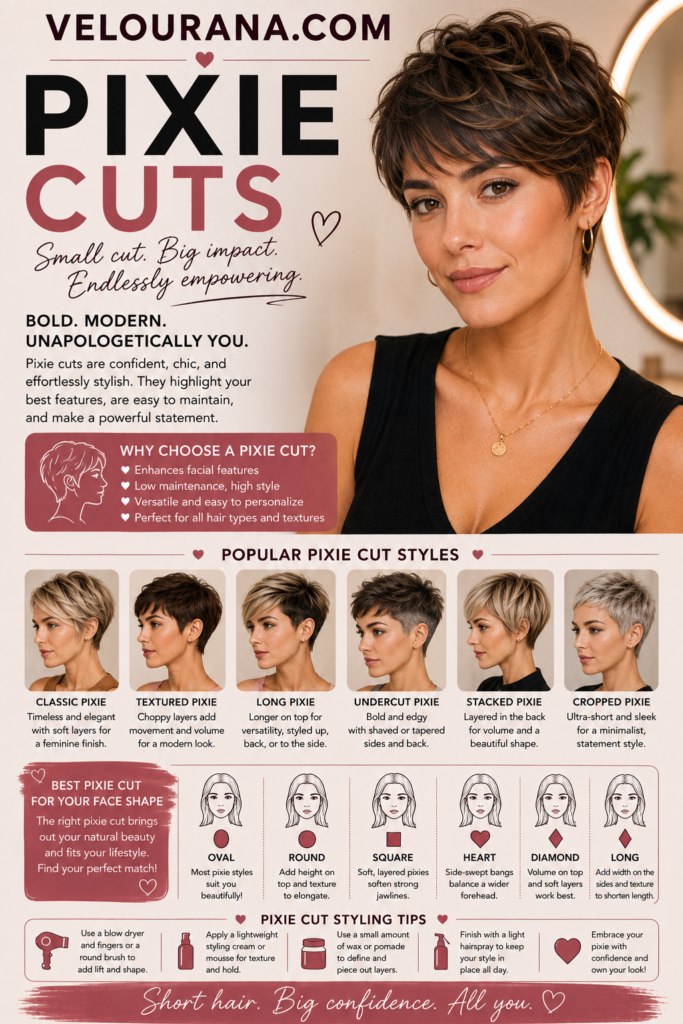
CATEGORY: Pixie Cuts
Growing out a pixie cut is often described as though it were a difficult period that simply has to be endured. The usual story suggests that the haircut looks wonderful while it is short, becomes awkward as soon as it starts growing, and remains that way until enough length has returned to create a bob.
That does not have to be the experience.
A pixie does not grow directly into long hair. It moves through a sequence of lengths, and each of those lengths can be treated as an actual haircut rather than an inconvenient waiting room between two preferred styles. The proportions change gradually. The crown gains weight. The fringe moves toward the eyes and cheekbones. The sides begin covering the ears. The nape becomes fuller and eventually starts creating the lower structure needed for a bob.
The objective is not to make every section reach the same length as quickly as possible. In most pixies, different areas begin at dramatically different lengths. The crown and fringe may already be several centimeters longer than the hair around the ears and nape. If everything is simply left untouched, those differences can eventually create excessive weight in some places while other areas still need time to catch up.
Growing successfully therefore involves managing proportion while preserving as much useful length as possible.
That is very different from repeatedly cutting the hair back into the same pixie.
Strategic reshaping can remove small amounts from areas that are disrupting the silhouette while allowing the sections needed for the next stage to continue growing. Over time, the haircut moves from pixie to long pixie, from long pixie toward bixie, and eventually from bixie into a recognizable bob.
Seen this way, growing out short hair becomes less about waiting and more about allowing one haircut to evolve into another.
Why a Pixie Changes So Quickly as It Grows
Growth is particularly noticeable on short hair because every additional centimeter represents a substantial percentage of the existing length.
If hair that reaches the middle of the back grows another centimeter, the overall silhouette barely changes. The same amount added to a short section around the ear can completely alter its position.
The ears begin disappearing.
The nape loses its clean taper.
The crown becomes heavier and may start lying differently.
A short fringe approaches the brows.
A longer fringe begins reaching the cheekbones.
This is why a pixie can feel as though it changes almost continuously.
The hair is not necessarily growing faster than it did when it was long. The growth is simply more visible.
This can actually be useful.
Instead of waiting months to notice progress, the haircut gradually develops new styling possibilities. Sections that previously stood away from the scalp gain enough weight to bend. Hair that could not be tucked behind the ears begins staying there. A short fringe becomes long enough to sweep sideways.
Growth creates problems only when the proportions stop working together.
The Nape Often Creates the First Difficult Stage
The lower back tends to become noticeable relatively early because many pixies keep this area short.
As it grows, the nape may begin extending down the neck while the sides have not yet reached the length required for a bob.
This can create the familiar impression that the back is growing faster than everything else.
It usually is not.
It simply started from a position where additional length becomes visually obvious.
This is one area where occasional maintenance can be extremely useful.
Removing a small amount from the very bottom can preserve a cleaner silhouette without sacrificing the overall growth project.
The important distinction is between controlling the perimeter and repeatedly shortening the entire back.
The upper back still needs to gain length so that it can eventually become part of the bob. Constantly cutting all of it short would delay that process.
The goal is to prevent the lowest section from dominating while allowing the structure above it to continue developing.
The Hair Around the Ears Needs Patience
The side sections often determine when a growing pixie begins looking like a different haircut.
At first, the ears may be completely exposed.
As the hair grows, small pieces begin extending around them.
This stage can feel untidy if the original pixie had a very clean perimeter.
But those sections are important.
They eventually need enough length to cover or tuck behind the ears if the destination is a bob.
Repeatedly cutting them away because they temporarily look inconvenient can trap the haircut in pixie proportions.
Instead, the surrounding shape can be adjusted so that the side growth looks deliberate.
Soft texture can help.
Tucking the longer sections behind the ears can create a cleaner silhouette.
As more length develops, the sides begin contributing to the emerging bixie shape.
The Crown Usually Has a Head Start
Many pixies preserve greater length through the crown.
This means the top may reach a relatively substantial length while the lower sections are still catching up.
Initially, this is helpful.
The longer crown provides movement and styling flexibility.
Later, however, it can become disproportionately heavy.
The hair may begin collapsing at the roots.
The upper section can create a rounded shape that no longer relates naturally to the shorter sides.
This does not necessarily mean the crown needs a major haircut.
Small adjustments can preserve movement while keeping most of the accumulated length.
The objective is to prevent the upper section from overwhelming the developing lower structure.
As the sides and back continue growing, the proportions gradually become more balanced.
The Fringe Can Become an Advantage
The front is often one of the easiest parts of a growing pixie to use creatively.
Short bangs become longer bangs.
Longer bangs can move sideways.
A side-swept fringe eventually approaches the cheekbones.
Later, it can begin behaving like the face-framing section of a short bob.
This progression provides multiple legitimate styles.
Someone who started with very short bangs may initially wear them forward. As they approach the brows, they can become softer and more textured. Once they become inconvenient around the eyes, they may be redirected sideways or separated into a curtain-like shape.
Eventually, the front becomes long enough to tuck behind the ears.
Instead of repeatedly shortening the fringe to maintain the original pixie, allowing it to evolve can help establish the structure of the future bob.
A Long Pixie Is the First Natural Destination
The first major stage of growth is not a bob.
It is a longer pixie.
The sides remain relatively short, but the crown has greater movement. The fringe becomes more substantial. The hair around the ears begins softening.
At this point, the haircut can look entirely intentional.
The longer sections provide more styling flexibility than the original crop.
The front can sweep.
The crown can be worn smooth or textured.
The sides can sometimes be tucked behind the ears.
This stage may be attractive enough that some people decide to remain there.
There is no requirement to continue simply because the original intention was to grow.
A long pixie is a complete haircut in its own right.
The Bixie Stage Is Where the Transformation Becomes Obvious
As the sides and back gain more length, the haircut begins moving into the space between a pixie and a bob.
This is often called a bixie.
The ears may be partially covered.
The nape has more softness.
The crown remains layered and relatively light compared with a traditional one-length bob.
The front may already be quite long.
This stage is particularly useful because the uneven lengths created by the original pixie now begin looking like deliberate layers rather than evidence of a haircut being grown out.
Instead of fighting those differences, the haircut can use them.
Natural texture can make the bixie especially effective.
Waves create movement between the layers.
Curls form a compact, dimensional silhouette.
Straight hair can be worn smooth or deliberately separated.
The haircut has enough length to move while remaining distinctly short.
Tucking the Sides Behind the Ears Can Simplify the Transition
One of the easiest ways to control growing sides is simply to tuck them away once they become long enough.
This creates a cleaner outline without removing the length.
From the front, the haircut appears more controlled.
From the side, the ear becomes a natural boundary.
As the sections continue growing, the tuck becomes easier and more secure.
This technique is especially useful during the period when the sides are too long to resemble a closely cropped pixie but not yet long enough to fall like a bob.
Rather than cutting them because they occupy an unfamiliar position, they can be temporarily incorporated into the style.
Texture Can Make Transitional Lengths Look Intentional
A perfectly sleek haircut reveals every difference in length.
That can be beautiful when the shape is highly precise, but it can make growing stages more obvious.
Texture provides another option.
Waves, curls or deliberate separation can blend the different lengths visually.
A longer crown moves over shorter side sections.
The growing fringe becomes part of the texture around the face.
The nape can remain soft rather than forming one rigid line.
This does not mean the hair needs to be styled into artificial messiness.
Natural movement may be enough.
The goal is simply to allow the different lengths to interact rather than requiring them to form one perfectly smooth surface before they are physically capable of doing so.
Straight Hair Can Grow Out Gracefully With Careful Shaping
Straight hair may show the transitions more clearly, but that does not make the process inherently difficult.
The advantage is that the developing structure is easy to see.
The perimeter can be refined carefully.
The sides can be tucked neatly.
The fringe can become a smooth sweep.
As the haircut approaches bob length, the clean surface can begin emphasizing the new perimeter.
The important thing is avoiding the temptation to correct every uneven section by cutting it back.
Some unevenness is structurally necessary because the hair began at different lengths.
The objective is not immediate equality.
It is gradual convergence.
Wavy Hair Can Become More Expressive During Growth
Wavy hair often changes character as the strands become longer.
Very short waves may appear as small bends or areas of lift.
As several centimeters accumulate, those bends develop into more recognizable patterns.
The growing haircut can therefore become increasingly textured even though no new layers have been added.
This can be particularly attractive during the bixie stage.
The original pixie layers allow waves to form at several levels, creating natural movement.
Later, as the haircut approaches a bob, the additional weight may stretch the pattern slightly again.
The texture evolves with the length.
Curly Hair Needs to Be Judged by Its Dry Shape
Growing curly pixies introduces another variable: shrinkage.
The measured length may increase steadily while the visible change appears less predictable.
A curl that gains several centimeters can still contract significantly when dry.
Different areas may also grow into different curl patterns because the amount of weight changes.
The silhouette matters more than whether every strand has reached a particular measurement.
As the curls become longer, some sections may begin falling downward while others continue expanding outward.
Strategic shaping can help distribute that volume without sacrificing unnecessary length.
The eventual bob may therefore develop through shape rather than through one perfectly uniform perimeter.
Fine Hair Benefits From Preserving the Emerging Perimeter
Fine hair often needs particular restraint during the later stages of growth.
As the sides and back begin reaching a common level, those strands are establishing the future perimeter.
Removing too much density through repeated layering can delay the appearance of fullness.
Some of the shorter pixie layers will naturally remain above the perimeter for a long time.
That is acceptable.
They can gradually catch up.
The lower sections should be allowed to become strong enough to create a visible baseline.
This is the point where the haircut begins looking less like a grown pixie and more like a deliberately layered bob.
Thick Hair May Need Weight Redistribution Along the Way
Dense hair presents a different challenge.
As the pixie grows, the upper sections can become bulky before the lower sections have enough length to balance them.
The haircut may expand around the sides and back.
Careful internal shaping can keep the silhouette manageable while preserving the external length needed for growth.
Again, the objective is not to thin the entire haircut aggressively.
Dense hair will eventually provide a beautiful substantial bob if enough of that density remains available.
The challenge is simply preventing temporary concentrations of weight from making the transitional stages unnecessarily difficult.
Avoiding Every Haircut Is Not Necessarily the Fastest Route to a Good Result
It may seem logical that someone trying to grow hair should stop cutting it completely.
In terms of preserving every millimeter, that is true.
In terms of maintaining an intentional hairstyle, it can be less successful.
A pixie begins with sections of very different lengths.
As those sections grow, their proportions can become increasingly unbalanced.
A small amount removed from the nape or a bulky area may allow the rest of the haircut to continue growing in a more coherent shape.
This can make the process psychologically easier as well.
Instead of spending months feeling that the hair is unfinished, the wearer moves through a series of styles.
The key is ensuring that maintenance supports the destination rather than repeatedly recreating the starting point.
Every Trim Should Have a Specific Purpose
When growing a pixie, “just tidy it up” can be an unhelpfully vague instruction.
A trim should answer a particular structural problem.
Perhaps the lowest nape section is extending too far while the upper back still needs growth.
Perhaps the crown has become excessively bulky.
Perhaps the fringe needs to be connected more naturally with the sides.
Perhaps the emerging perimeter needs strengthening.
Knowing the purpose makes it easier to protect the length that matters.
The question is not simply what can be cut.
It is what should continue growing.
Photographs Can Help Track Progress
Because the haircut changes gradually, it can sometimes feel as though nothing is happening.
Photographs taken several weeks apart reveal the progress much more clearly.
The fringe has moved.
The ears are more covered.
The nape has changed.
The crown falls differently.
This can be useful when deciding whether a section genuinely needs adjustment or simply feels unfamiliar because it has entered a new stage.
Short hair produces visible progress surprisingly quickly when viewed over several months rather than from one morning to the next.
The First Ear Tuck Can Feel Like a Milestone
There are practical moments during growth that signal the transition toward longer hair.
Being able to tuck the sides securely behind the ears is one of them.
The haircut suddenly becomes easier to control.
The front can be moved away from the face.
The silhouette begins resembling a very short bob.
This small styling option can make the entire process feel different because the wearer regains a form of control that was unavailable in the shortest stages.
The First Small Bob Does Not Need to Be Blunt
When enough length finally reaches the lower perimeter, there may still be substantial layering throughout the haircut.
That is normal.
The first bob after a pixie does not need every strand to reach the same baseline.
Trying to achieve that immediately would require cutting the entire haircut to the length of the shortest remaining layer, sacrificing months of progress.
Instead, the initial bob can be layered.
The lower perimeter establishes the general shape.
Shorter internal sections continue growing.
Over time, they become longer and the bob can gradually become fuller and less layered if that is the desired destination.
This preserves progress while allowing the haircut to look complete.
The Jawline Often Marks the Arrival of a Recognizable Bob
Once the lower sections begin reaching around the jaw, the silhouette changes significantly.
The haircut now has enough length to create a perimeter beneath the ears.
The back can begin connecting with the sides.
The front may already be longer because the fringe and crown had a head start.
At this point, the original pixie becomes much less visible.
What remains are layers.
Those layers can be maintained as part of the bob or gradually grown out.
The transformation has effectively reached its next major stage.
From Jaw Length, Growth Becomes More Familiar
After a bob is established, the process begins resembling conventional hair growth rather than pixie recovery.
The perimeter moves from the jaw toward the neck.
Then it approaches the shoulders.
Shorter internal layers gradually become less prominent.
The hair gains enough length for more accessories and styling options.
The most structurally complex part of the process is therefore the early transition from very short sides and nape into a unified lower perimeter.
Once that perimeter exists, the route toward longer hair becomes much more straightforward.
Hair Accessories Return Gradually
A very short pixie offers limited use for traditional hair ties and large clips, but accessories become more practical as growth progresses.
Small pins can control the fringe.
Headbands can move the front away from the face.
As the sides gain length, clips can secure them.
Eventually small half-up styles become possible.
These changes can make transitional lengths more enjoyable.
Instead of focusing only on what the hair still cannot do, each stage introduces new possibilities.
Changing the Part Can Help Manage the Growing Front
A fringe that becomes too long to wear forward may work beautifully when moved sideways.
A side-swept section can later be divided closer to the center.
The part can therefore evolve alongside the haircut.
This avoids unnecessary cutting simply because the original styling direction no longer works.
The growing front becomes adaptable rather than inconvenient.
The Hair May Behave Differently at Every Stage
Someone who has worn a pixie for a long time may be surprised by how their texture changes as length returns.
Straight sections can begin developing bends.
Waves may become more recognizable.
Curls can elongate.
The crown may lose some of the lift it had when shorter.
These changes are not evidence that something has gone wrong.
Hair behaves differently under different amounts of weight.
The haircut should adapt accordingly.
A technique that worked beautifully at pixie length may no longer be necessary once the hair becomes a bob.
Growth Does Not Have to Be a Race
It is understandable to want the process completed as quickly as possible, particularly when the final objective is significantly longer hair.
But constantly measuring progress can make every intermediate stage feel like a failure simply because it is not yet the destination.
There is another way to approach it.
The long pixie can be worn as a long pixie.
The bixie can be worn as a bixie.
The first layered bob can be worn as a bob.
Each stage has its own proportions and styling possibilities.
The hair is still progressing even when the current haircut looks intentional.
Sometimes the Growing Stage Becomes the Preferred Haircut
A person may begin growing a pixie with the firm intention of returning to long hair and discover that an intermediate length works unexpectedly well.
Perhaps the long pixie provides exactly the right balance between movement and ease.
Perhaps the bixie works beautifully with natural waves.
Perhaps a jaw-length layered bob feels more versatile than either the original pixie or the previous long hair.
There is no requirement to continue toward the original destination.
Growth creates opportunities to experience several haircuts that might otherwise never have been considered.
The Process Is Really About Changing Proportions
The most useful way to understand growing out a pixie is not as the simple accumulation of length.
Hair growth happens automatically.
The challenge is proportion.
At first, the crown is long relative to the sides.
Then the nape becomes too prominent.
Later, the sides gain enough length to participate.
The fringe evolves into face framing.
Eventually the lower sections begin forming a common perimeter.
The haircut moves from vertical concentration around the crown toward greater length around the sides and back.
Once those proportions are understood, the process becomes much easier to manage.
From Pixie to Bob Without an “Awkward” Identity
There may certainly be mornings when a growing pixie behaves unexpectedly. Short sections can stick out. The nape can become unruly. The fringe can reach an inconvenient position. These are practical realities of changing length.
But they do not need to define months of the process.
A growing pixie can remain a succession of intentional haircuts.
The earliest stage becomes a softer pixie. The crown and fringe gain movement. The sides begin reaching the ears. The silhouette evolves into a long pixie and then a bixie. Eventually enough hair reaches the lower edge to establish a layered bob.
Each transformation uses the growth that has already occurred rather than repeatedly cutting it away.
The final bob therefore does not suddenly appear after months of waiting.
It develops gradually.
The fringe becomes its front layers. The growing sides become its perimeter. The crown becomes its internal layering. The nape, once the most obviously short part of the pixie, eventually connects with everything around it.
What began as an extremely short haircut does not need to disappear before something attractive replaces it.
It can become the next haircut one stage at a time.
The End
Velourana.
 Discover More From Our Family of Websites
 ZodiacBearing (Astrology, Tarot, Numerology, Angel Numbers & Spiritual Guidance)
 Velourana (Beauty, Makeup, Hair Care, Skincare & Beauty Tips)
 HavenBearing (Home, Living, Organization, Décor & Everyday Inspiration)
 PawBearing (Pet Care, Dog Breeds, Animal Health, Training & Pet Products)
 PsyCatherine (Notes From the Journal of a Psychologist on Real Life)

