
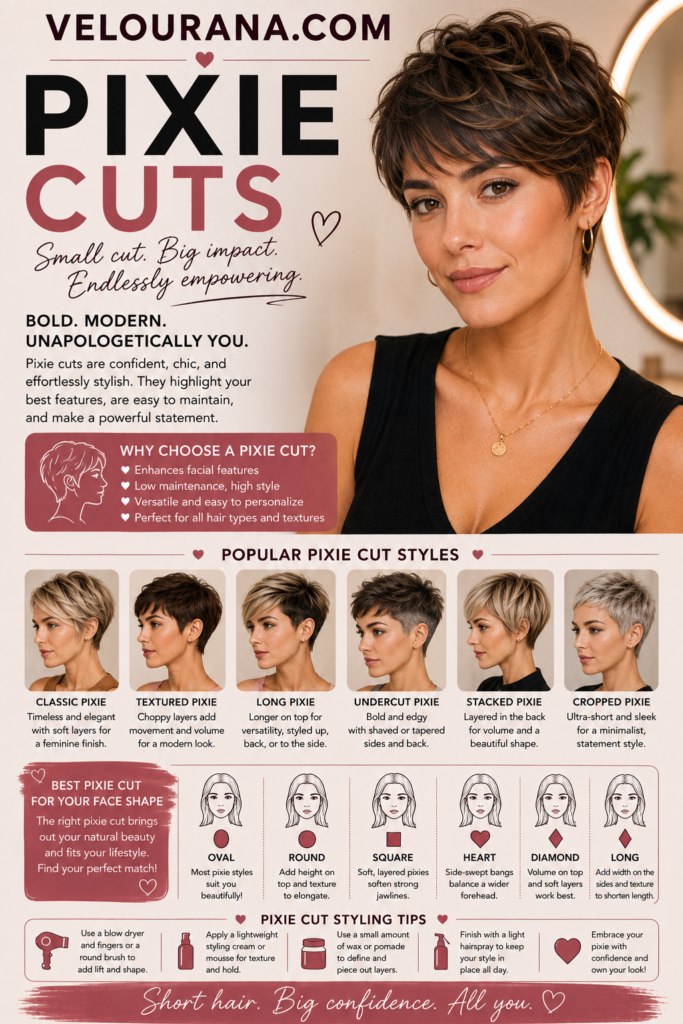
CATEGORY: Pixie Cuts
A pixie cut may remove most of the length associated with traditional face framing, but that does not mean the face is left without softness, movement or variety. In short hair, the fringe takes over many of the roles that longer front layers perform in medium and long styles. It can frame the forehead, move toward the cheekbones, create asymmetry, introduce texture and completely alter the balance of the haircut.
This makes bangs one of the most important design choices within a pixie.
A pixie with a very short fringe can feel compact and precise. Leave the front longer and the haircut immediately becomes softer and more fluid. A side-swept fringe can create dramatic movement across the forehead while the sides and back remain extremely short. Wispy bangs can soften a structured crop. Curly bangs can bring natural texture directly toward the face.
The overall haircut may remain almost identical behind the front hairline, yet changing the bangs can make it appear entirely different.
This happens because short hair concentrates attention around the head. There is no long perimeter extending toward the shoulders to compete with the front. The fringe occupies a significant proportion of the visible hairstyle, so relatively small changes in its length or direction have an unusually strong effect.
The most successful pixie with bangs therefore begins by treating the fringe as part of the entire haircut rather than as an additional section cut afterward.
The Fringe Establishes the First Impression
When looking at a pixie from the front, the relationship between the fringe and the face is immediately visible.
A short fringe exposes most of the forehead and keeps the silhouette compact. A brow-length fringe creates a stronger horizontal presence. Longer bangs begin moving toward the eyes and temples, introducing greater softness. Extend the front farther and it can sweep diagonally toward the cheekbone.
Each version changes the character of the haircut without requiring the crown, sides or nape to change significantly.
This gives a pixie unusual adaptability.
Someone who likes an otherwise simple short haircut can use the front as the primary area of expression. The fringe can be changed over time while the basic pixie remains familiar.
It can also provide a useful way to experiment.
Growing short bangs longer gradually transforms the haircut. Cutting a long fringe shorter creates an immediate change. The front becomes an area where the style can evolve without repeatedly redesigning the entire head.
Short Bangs Create a Compact Pixie
A short fringe keeps the visual weight close to the hairline.
The forehead remains largely visible and the haircut can feel crisp and intentional.
When the sides and back are also relatively close, the entire silhouette becomes compact. The crown may provide some texture, but there is no long front section dominating the shape.
Straight hair can make this structure look particularly precise.
Natural waves soften it.
Curly hair creates an entirely different interpretation because short curls form their own irregular perimeter around the forehead.
The exact length matters considerably.
On a pixie, the difference between a fringe sitting well above the eyebrows and one approaching them is visually significant. There is very little surrounding length to dilute the change.
For someone who enjoys strong haircut structure, this precision can be part of the attraction.
Micro Bangs Make the Fringe an Intentional Feature
Micro bangs take the short-fringe idea further by creating a deliberately high perimeter across the forehead.
Combined with a pixie, the result can be striking because both elements emphasize the shortness of the haircut rather than trying to soften it.
The fringe can be relatively straight and graphic or broken into textured pieces.
The rest of the pixie may remain smooth, creating contrast with the front, or carry similar texture throughout.
This is a style that depends strongly on proportion.
A micro fringe should feel connected to the crown and sides rather than appearing like a narrow strip removed independently from the haircut.
The transition around the temples is particularly important because it determines how the short front becomes part of the rest of the silhouette.
Wispy Bangs Bring Softness Without Much Weight
Not every pixie fringe needs to be dense.
Wispy bangs use smaller amounts of hair to create a lighter frame across the forehead.
The skin remains partially visible between the strands, preventing the fringe from becoming a dominant block.
This can work beautifully with a soft pixie containing delicate texture through the crown and sides.
Fine hair may particularly benefit from this restraint.
Creating an extremely heavy fringe requires taking a larger section from the top and front. On lower-density hair, this can reduce fullness elsewhere.
A lighter fringe preserves more hair for the surrounding structure while still changing the relationship between the haircut and face.
The important distinction is between deliberately airy and simply sparse.
The strands should still form an intentional shape.
A Long Fringe Creates an Entirely Different Pixie
One of the most versatile pixie structures keeps the sides and back short while allowing the front to remain substantially longer.
This creates contrast.
From the back, the haircut may look unmistakably compact.
From the front, the longer fringe introduces movement more commonly associated with longer styles.
It can sweep across the forehead.
It can be pushed upward.
It can separate toward the sides.
It can fall forward for a softer finish.
With enough length, it may even approach the cheekbone.
This is particularly useful for someone who wants short hair without feeling that every styling possibility has disappeared.
There may be no ponytail, but the front can still be changed significantly from one day to another.
Side-Swept Bangs Give the Pixie Flow
A long side-swept fringe creates a diagonal line across the front.
This immediately introduces asymmetry and movement.
The direction can follow the natural growth of the hair, making the style relatively easy to reproduce when the hair already prefers moving toward one side.
The sweep can be smooth and polished or separated into textured sections.
The longer the fringe becomes, the more dramatic the movement.
A section reaching toward the temple creates a subtle effect. One approaching the cheekbone begins behaving almost like the face-framing section of a much longer haircut.
The shorter sides make this length appear even more pronounced.
Contrast becomes part of the design.
A Deep Side Part Can Amplify the Effect
Moving the part farther toward one side places more hair into the fringe.
The heavier side gains volume and movement while the opposite side becomes more exposed.
This can transform a relatively simple pixie without changing the cut.
Straight hair may create a smooth sweep.
Wavy hair can develop a large bend through the front.
Curly hair may create a cluster of curls moving toward one side.
The asymmetry gives the haircut a different silhouette from every angle.
Someone who enjoys changing their part may therefore prefer a pixie with enough front length to accommodate more than one position.
A Center-Parted Pixie Can Create a Curtain Effect
Longer pixie bangs do not have to move sideways.
When sufficient length remains at the front, the hair can separate near the center and move toward both temples.
The result resembles a compact version of curtain bangs.
The shortest central sections may sit around the forehead while the outer pieces gradually become longer.
This creates a soft opening around the face.
The haircut begins approaching the territory of a long pixie or bixie, particularly when the sides also retain some length.
It can be an appealing choice for someone who likes the movement of curtain bangs but wants the neck and back to remain short.
The Temples Connect the Bangs to the Haircut
The transition around the temples is one of the most important details in a pixie with bangs.
If the fringe is treated as completely separate from the sides, the change in length can appear abrupt.
Sometimes that contrast is deliberate.
More often, a gradual transition creates greater harmony.
The bangs become slightly longer or shorter as they approach the temples, depending on the design. Those sections then connect with the hair around the ears.
This creates continuity.
The fringe feels as though it grows naturally out of the pixie rather than sitting on top of it.
Straight Hair Can Make the Fringe Highly Defined
Straight hair displays the shape of bangs clearly.
A short fringe reveals its perimeter.
A long fringe creates a smooth directional line.
Wispy bangs show individual separation.
Because there is relatively little natural curvature to disguise transitions, the quality of the shape becomes important.
Straight pixie bangs can also respond dramatically to small styling changes.
A fringe dried forward looks completely different when directed sideways.
Lift the roots and the front becomes more voluminous.
Smooth them and the haircut becomes flatter and sleeker.
The same few centimeters of hair can therefore create several distinct appearances.
Fine Hair Benefits From Thoughtful Distribution
Fine hair can look excellent in a pixie because shortening removes weight and allows the hair to gain movement near the scalp.
But the amount assigned to the fringe matters.
Taking an extremely large front section may create impressive bangs while reducing fullness through the crown.
A smaller, carefully shaped fringe can preserve balance.
Longer bangs can also create the impression of substance because the strands overlap as they sweep toward one side.
The crown can retain enough density to provide coverage and lift.
The haircut should distribute the available hair strategically rather than assuming that every area needs maximum texture.
Thick Hair Can Support a Luxurious Fringe
Dense hair gives the fringe substantial presence.
A full side sweep can look rich and dramatic.
Short bangs can form a strong front perimeter.
Longer sections can carry enough weight to move smoothly rather than separating too easily.
But density can also make the fringe physically heavy.
Too much hair falling toward the forehead may feel warm or difficult to control.
The solution is not necessarily to thin it aggressively.
The section size, length and internal distribution can be adjusted so that the bangs retain their richness without becoming cumbersome.
The rest of the pixie should balance that density.
A large fringe combined with equally bulky sides can overwhelm the compact shape, while more controlled sides allow the front to become the deliberate focal point.
Wavy Hair Makes Bangs Naturally Less Predictable
Waves introduce variation into a pixie fringe.
One section may curve strongly while another remains almost straight.
The ends may move in different directions.
This can create a relaxed, individual result.
The key is recognizing how the wave changes after the hair is shortened.
Long hair carries weight that stretches texture.
Once the fringe is cut, the same section may rise or bend more strongly.
The final dry position therefore matters more than the stretched measurement.
A wavy fringe does not need to imitate a perfectly straight one.
Allowing its natural movement to remain visible often creates a more convincing relationship with the rest of the haircut.
Curly Bangs Can Become the Signature of the Cut
Curly pixies with bangs can be especially expressive because the front curls become part of the overall shape rather than forming a conventional straight fringe.
Some curls may fall toward the forehead.
Others move toward the temples.
A longer curl may sit close to the brow while another contracts considerably higher.
This variation can look intentional and natural.
The major consideration is shrinkage.
A curl cut while stretched may settle much shorter than expected.
Removing length also reduces weight, potentially increasing contraction further.
The fringe should therefore be judged in its natural state.
The objective is not identical curl length.
It is balanced placement.
Cowlicks Matter More When the Fringe Is Short
A front cowlick can remain almost invisible when the hair is long because weight pulls the strands downward.
Cut those strands into bangs and the growth pattern becomes much more influential.
One section may lift.
The fringe may separate automatically.
Hair may prefer moving sideways rather than forward.
This does not automatically rule out bangs.
It may simply indicate which type will work most naturally.
A side-swept fringe can use directional growth.
A longer fringe has enough weight to become more controllable.
A naturally separating hairline may support curtain-style bangs.
Understanding the pattern before cutting can prevent the fringe from becoming a daily argument with the hair.
Bangs Can Balance a Very Short Back and Sides
A pixie with closely cropped sides and nape can feel dramatically short.
Keeping additional length at the front changes that perception.
The wearer still experiences the practicality and exposed neck of short hair, but the fringe introduces softness and movement around the face.
This balance can make a dramatic cut feel more adaptable.
The contrast can also be visually striking.
The back remains neat.
The sides stay controlled.
The front becomes expressive.
Instead of distributing interest evenly across the haircut, the design concentrates it where it is most visible.
The Fringe Can Carry Texture While the Rest Remains Sleek
A pixie does not need the same finish everywhere.
The sides can remain smooth and compact while the fringe is separated into individual pieces.
The crown can provide a small amount of lift without becoming heavily textured.
This creates contrast between controlled and expressive areas.
The opposite is possible as well.
A smooth side-swept fringe can sit above a more textured crown.
These combinations give short hair complexity without requiring additional length.
Different sections perform different visual roles.
Bangs Can Change How a Pixie Grows Out
Growth is particularly visible in the fringe because of its relationship with the eyes and brows.
Short bangs gradually approach the eyebrows.
They can then become softer, longer bangs.
As they continue growing, they may be moved sideways.
Eventually they can behave like a long pixie fringe.
Later still, they begin resembling face-framing sections in a bixie or bob.
This progression can be used deliberately.
Someone planning to grow a pixie does not necessarily need to keep shortening the front while waiting for the rest to catch up.
The changing fringe can become part of each new stage.
Long Bangs Can Make the Transition Toward a Bixie Easier
When the front is already relatively long, growing the rest of the pixie can feel more cohesive.
The sides gradually reach the ears.
The back becomes fuller.
The crown gains weight.
Meanwhile, the long fringe already provides movement and can tuck away as necessary.
The haircut slowly begins behaving like a bixie.
This can make a long-fringed pixie appealing even for someone who does not intend to keep extremely short hair permanently.
It provides a style in its own right while offering a convenient route toward greater length.
Short Bangs Require a Different Kind of Maintenance
The shorter the fringe, the more quickly growth changes its apparent proportions.
A small increase in length can move the ends noticeably closer to the eyebrows.
A micro fringe loses some of its distinctive character as it grows.
Someone who wants to preserve an exact short shape may therefore need fringe maintenance before the rest of the haircut feels ready for a full reshaping.
A longer side fringe is generally more forgiving.
Growth simply creates a longer sweep.
This difference is worth considering when choosing between a precise short fringe and a softer long one.
Humidity Can Change the Front Before the Rest of the Hair
Bangs sit near the forehead and are particularly exposed to heat, moisture and perspiration.
Straight hair may develop bends.
Waves can become stronger.
Curls may contract.
Fine bangs may separate.
This can make the fringe behave differently from the rest of the pixie during the day.
A style that cooperates with natural texture generally handles these changes more gracefully.
Someone living in a warm or humid environment may also appreciate a fringe that can be moved sideways or away from the forehead when necessary.
Glasses Become Part of the Composition
Because a pixie exposes more of the face and ears, glasses can become a stronger visual element.
Bangs interact directly with the frames.
A short fringe remains above them.
Longer pieces may approach the upper edge.
Side-swept bangs can move toward the temples where the arms of the glasses sit.
This does not create a rule about which fringe should be worn with glasses.
It simply means the relationship is worth considering.
A small adjustment in length can prevent constant interference while preserving the intended style.
Earrings Become More Visible as the Sides Shorten
A pixie often exposes the ears partially or completely.
This changes the visual relationship between the fringe, side sections and earrings.
A long sweeping front combined with exposed ears creates a particularly strong contrast.
Soft pieces around the ears produce another effect.
Because the haircut no longer extends down the neck and shoulders, accessories can become more prominent than they were with long hair.
This is one of the broader transformations created by cutting short.
A Fringe Can Make the Pixie Feel Different Without Changing Its Practicality
Most of the practical advantages of the pixie remain regardless of bang style.
There is still little hair to wash.
Drying remains quick.
The neck stays free.
There are no long ends to detangle.
Yet the visual result can change substantially according to the front.
This makes the fringe an efficient way to redesign a pixie while preserving the lifestyle advantages that made short hair appealing in the first place.
Air-Drying Works Best When the Bangs Respect Natural Direction
A fringe that naturally wants to sweep sideways will usually be easier to air-dry in that direction than straight down.
A natural center separation can support curtain-style bangs.
Curly sections should be allowed to contract into their actual pattern.
The more closely the haircut follows these tendencies, the less intervention it requires.
This is especially valuable with a pixie because there is no need for elaborate styling if the structure already works.
A few minutes can transform short hair, but those minutes should be optional whenever possible rather than required simply to make the haircut functional.
Styling a Pixie Fringe Can Be Remarkably Fast
When a more polished result is wanted, the small amount of hair involved makes styling relatively quick.
The roots can be redirected.
The fringe can be smoothed or lifted.
Individual sections can be separated.
A side sweep can be strengthened.
The entire front may require less time than one large section of long hair.
This is one of the reasons bangs can be so effective on a pixie.
They create a large visual transformation using a very small amount of hair.
The Same Fringe Can Produce Several Personalities
A long pixie fringe worn smooth and sideways can feel refined.
Push it upward and the haircut becomes more dramatic.
Separate it into textured pieces and it becomes relaxed.
Bring it forward and the silhouette becomes more compact.
A softer center separation creates another interpretation.
This variety comes from direction rather than length.
Short hair responds powerfully to small positional changes because every section occupies a significant proportion of the hairstyle.
The Fringe Should Belong to the Entire Silhouette
The most convincing pixie with bangs is one in which the front makes sense in relation to everything behind it.
A very short fringe can echo closely cropped sides.
A long fringe can balance a compact nape.
Wispy bangs can complement soft texture through the crown.
Curly bangs can continue the natural pattern of the upper section.
The design does not need every part to look identical.
It needs the contrasts to appear intentional.
That is what turns bangs from an isolated feature into part of the haircut.
When a Few Centimeters Change Everything
A pixie demonstrates how little hair is actually required to create enormous visual change.
The difference between a cropped fringe and a brow-length one may be only a few centimeters.
The difference between brow-length bangs and a cheekbone sweep may be several more.
Yet each version can make the same underlying pixie feel like a completely different haircut.
This is the power of concentrating the design around the face.
The fringe becomes movement, framing and personality all at once.
It can soften an extremely short structure or make it even more graphic. It can use natural waves and curls rather than hiding them. It can become the focal point of the haircut or blend quietly into the crown and sides.
A pixie may have very little length overall, but the front proves that short hair does not need large amounts of material to create variety.
Sometimes a few carefully chosen centimeters are enough to transform everything.
The End
Velourana.
 Discover More From Our Family of Websites
 ZodiacBearing (Astrology, Tarot, Numerology, Angel Numbers & Spiritual Guidance)
 Velourana (Beauty, Makeup, Hair Care, Skincare & Beauty Tips)
 HavenBearing (Home, Living, Organization, Décor & Everyday Inspiration)
 PawBearing (Pet Care, Dog Breeds, Animal Health, Training & Pet Products)
 PsyCatherine (Notes From the Journal of a Psychologist on Real Life)

