
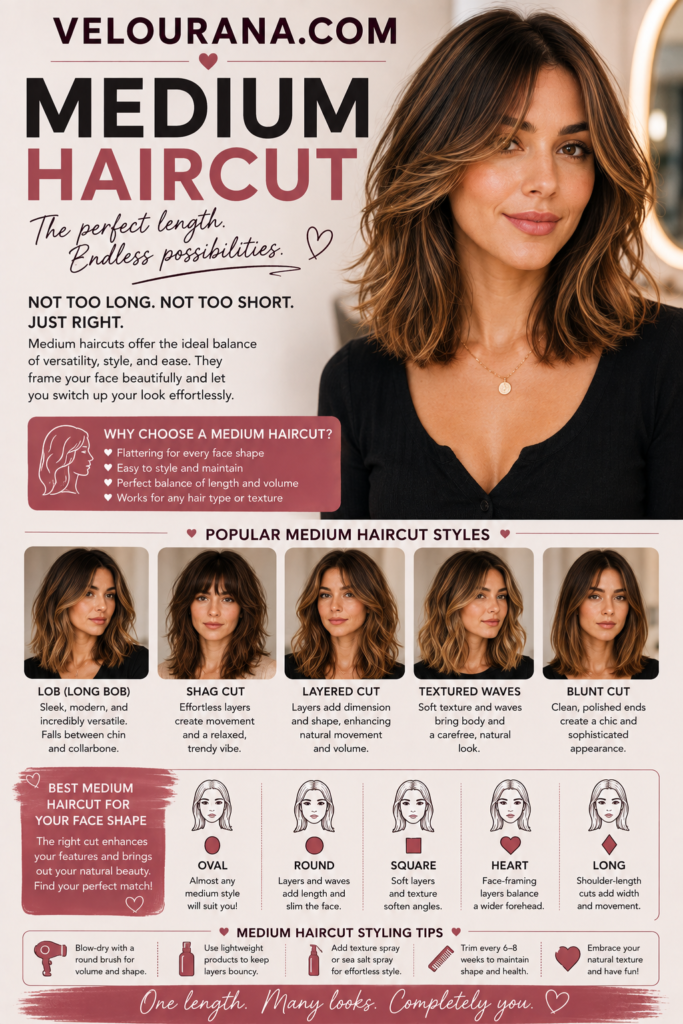
CATEGORY: Medium Haircuts
Medium hair already occupies a remarkably adaptable position. It has enough length to move, to be tied back, to support layers and to create the flowing effect associated with longer hair, yet it remains compact enough for relatively small changes to alter the entire silhouette. Few changes demonstrate this more clearly than bangs.
A fringe can transform medium hair without requiring the overall length to move at all.
The perimeter may remain at the shoulders or collarbones. The back may remain completely unchanged. Most of the density can stay exactly where it was. Yet introducing a much shorter section around the forehead immediately changes how the haircut relates to the face.
This contrast is what makes bangs so powerful.
A blunt fringe creates a strong horizontal feature above a medium-length perimeter. Wispy bangs introduce softness without dominating the haircut. Curtain bangs create movement through the front and can merge naturally into face-framing layers. A longer side-swept fringe produces asymmetry while retaining enough length to be moved away from the face.
The choice is not simply between “bangs” and “no bangs.”
Length, density, texture, parting and the way the fringe connects with the rest of the haircut all determine the final result.
Medium hair provides an especially useful foundation because there is enough distance between the forehead and perimeter for the shorter sections to transition gradually. Bangs can become the beginning of a larger progression rather than appearing as an isolated piece placed in front of otherwise unrelated hair.
Why Bangs Have Such a Strong Effect on Medium Hair
A haircut is experienced primarily from the front.
Someone may have beautifully shaped layers through the back, but when looking into a mirror, the relationship between the hairline, face and front sections dominates the immediate impression.
Bangs alter this area directly.
They introduce hair into a space that may previously have been open. They create a new visible endpoint around the forehead, brows, eyes or cheekbones. They can change how the parting appears and how the surrounding layers move.
On medium hair, this contrast is particularly noticeable because the perimeter is not extremely far away.
A fringe around the brows can progress through cheekbone-length sections, then toward the jaw and eventually into a collarbone perimeter.
The entire front can therefore become one connected structure.
This creates opportunities for both dramatic and extremely subtle transformations.
A Full Fringe Creates the Strongest Contrast
A relatively full fringe makes an immediate statement.
The front section is brought forward and shortened significantly compared with the rest of the hair.
On a blunt shoulder-length cut, this can create a highly defined silhouette. There is a strong line around the forehead and another around the shoulders.
The result can feel graphic and deliberate.
Adding layers to the medium lengths changes the effect.
The fringe remains strong, but the surrounding hair becomes softer and more mobile.
Natural texture changes it again.
A full fringe on wavy or curly medium hair can become less geometric and more expressive because the strands do not form one perfectly straight line.
Density matters.
A very dense fringe removes a meaningful amount of hair from the sections that would otherwise contribute to the sides and perimeter.
On thick hair, this may have little visible consequence.
On fine or lower-density hair, taking too large a section can leave the sides thinner than expected.
The fringe should therefore be proportioned according to the available hair rather than copied mechanically from another person.
Wispy Bangs Offer a Softer Introduction
Someone curious about bangs but reluctant to create a heavy front can begin with a lighter, more separated fringe.
Wispy bangs use less density.
The forehead remains partially visible between strands.
The result can feel softer and less dominant than a full fringe.
This can work particularly well with medium hair because the lightness of the bangs can be echoed through subtle face framing.
The fringe does not need to form a hard boundary.
It can gradually become longer toward the temples and merge into the surrounding haircut.
Fine hair may benefit from this restraint because a smaller amount is removed from the longer sections.
The trade-off is that very sparse bangs can separate easily, particularly on hair that becomes oily quickly or has strong growth patterns.
The objective is softness, not a fringe so thin that it appears accidental.
Curtain Bangs Create a Natural Bridge Into Medium Lengths
Curtain bangs are particularly compatible with shoulder and collarbone hair because their structure already depends on progression.
The shortest sections usually sit closer to the center.
They become longer toward the sides.
Those outer pieces can continue into cheekbone, jaw or chin-length framing.
From there, the haircut flows naturally toward the perimeter.
This creates one of the most cohesive ways to combine bangs with medium hair.
The fringe does not look separate from the haircut.
It becomes its beginning.
A center part produces the most recognizable curtain effect, but the structure can also work slightly off-center depending on the natural growth pattern.
When styled outward, the front opens around the face and creates sweeping movement.
When worn naturally, the effect can become much softer.
As the bangs grow, they gradually turn into longer face-framing pieces, making the transition relatively forgiving.
Long Curtain Bangs Can Provide the Effect Without a Short Fringe
Not everyone wants hair sitting near the eyebrows or eyes.
Long curtain pieces can begin around the cheekbones instead.
Technically, they may feel closer to short face-framing layers than traditional bangs, but visually they can create a similar opening around the front.
This version has practical advantages.
The pieces are easier to tuck behind the ears.
They may reach a ponytail sooner.
They are less likely to interfere with the eyes.
The difference between styled and unstyled hair can also be smaller because the sections have enough weight to fall naturally.
For someone uncertain about committing to a fringe, longer curtain pieces can provide a useful intermediate step.
Side-Swept Bangs Change the Balance of the Haircut
A side-swept fringe creates asymmetry.
Instead of dividing around the center, the front travels predominantly toward one side.
This can create immediate movement even when the rest of the haircut is relatively simple.
A long side fringe can blend into a shoulder-length or collarbone cut without requiring dramatic layers throughout the back.
The additional hair on one side can also create visible volume around the front.
Growth patterns matter strongly with this style.
Someone whose hair naturally moves toward one side may find the fringe relatively easy to maintain.
Someone fighting a strong cowlick in the opposite direction may need more styling.
Working with the natural hairline generally produces a more sustainable result than forcing the fringe into a position it constantly tries to leave.
The Hairline Matters More With Bangs Than With Many Other Haircut Features
The front hairline contains growth patterns that may have been almost irrelevant when all the hair was long.
Once bangs are cut, those patterns become important.
A cowlick can cause one section to rise.
Another area may naturally separate.
Some hairlines direct the strands strongly to one side.
These characteristics do not necessarily prevent someone from having bangs.
They influence which type will be easiest to wear.
A longer, softer fringe can accommodate natural movement more easily than a highly precise short line.
Curtain bangs may work with a central separation.
A side-swept fringe may use a directional growth pattern rather than fighting it.
Understanding the hairline before cutting can prevent a fringe from becoming a daily battle.
Straight Hair Gives Bangs Precision
Straight hair can display the shape of bangs extremely clearly.
A blunt fringe becomes graphic.
Wispy bangs show deliberate separation.
Curtain bangs can create smooth sweeping lines.
Because the texture does not disguise the perimeter strongly, precision matters.
The length also becomes immediately noticeable as the fringe grows.
A difference of a centimeter around the eyebrows can change the appearance significantly.
This may mean the front needs maintenance before the rest of a medium haircut does.
The advantage is control.
Straight bangs can often be styled into a very polished result with relatively little manipulation if the natural growth pattern cooperates.
Wavy Bangs Can Look Softer and More Individual
Wavy hair introduces natural irregularity.
Instead of every strand finishing at exactly the same apparent level, bends create variation.
This can make bangs feel relaxed and integrated with a textured medium haircut.
The important consideration is contraction.
A section cut to a particular point while wet or stretched may rise once the wave returns.
The fringe should therefore be designed according to its natural dry behavior.
Trying to make wavy bangs behave like perfectly straight bangs every day can create unnecessary styling work.
Allowing some natural movement often produces a more harmonious relationship with the rest of the haircut.
Curly Bangs Can Completely Change a Medium Curly Cut
Curly bangs can create a strong connection between the front and the overall volume of a medium curly haircut.
Instead of leaving the forehead completely open while the curls begin farther back, selected curls move forward and become part of the silhouette.
The effect can be dramatic.
But shrinkage is crucial.
A curl that appears long enough while stretched may rise several centimeters after release.
Different curls can also contract differently.
For this reason, conservative cutting is particularly important.
The finished fringe does not need every curl to end at an identical point.
A naturally irregular arrangement can look more appropriate than attempting to impose a rigid line on a highly dimensional texture.
Bangs and a Blunt Medium Cut Create Deliberate Structure
Combining bangs with a strong shoulder or collarbone perimeter creates clear visual architecture.
The haircut contains two important boundaries.
One sits around the forehead.
The other establishes the overall length.
Straight hair emphasizes this contrast most clearly, but the concept can work across textures.
The simplicity can be striking.
There may be very little internal layering.
The haircut relies on proportion rather than complexity.
This can also help preserve density.
Most of the longer hair continues toward the perimeter, while only the front section is significantly shortened.
For fine hair, keeping the fringe relatively light can prevent too much hair from being removed from the sides.
Bangs and Layers Create a Softer Progression
A layered medium haircut allows the fringe to merge more gradually into the rest of the style.
Instead of moving directly from short bangs to long side sections, intermediate lengths create a transition.
The fringe becomes longer around the temples.
Face framing continues toward the cheekbones and jaw.
Layers then connect those pieces with the shoulder or collarbone perimeter.
The result can appear extremely fluid.
This is especially effective with curtain bangs because their shape already moves outward.
During a blowout, the different lengths create overlapping curves.
With natural texture, the transition may appear more relaxed but still connected.
Fine Hair Needs Careful Fringe Density
Bangs require hair to be taken from somewhere.
The larger the fringe section, the less hair remains available for the surrounding lengths.
On dense hair, this may be barely noticeable.
On fine or lower-density hair, it can matter considerably.
A heavy fringe may look beautiful from the front but leave the temples and sides unexpectedly sparse.
This is why lighter bangs can sometimes create a better overall result.
The objective should be to improve the entire haircut, not to create one impressive feature at the expense of everything around it.
A modest fringe combined with a strong medium perimeter can produce a balanced, substantial appearance.
Thick Hair Can Support More Dramatic Bangs
Dense hair offers greater freedom.
A substantial front section can be shortened while enough density remains through the sides and back.
Full bangs can therefore look particularly rich.
Curtain bangs can involve larger sections and create dramatic movement.
But thickness introduces another issue: bulk.
A very dense fringe can feel physically heavy on the forehead.
It may require careful shaping to prevent it from becoming overwhelming.
The objective is not simply to include as much hair as possible.
The fringe should have enough density to achieve the desired effect while remaining comfortable and responsive.
The Forehead Is Not Something That Needs to Be Corrected
Discussions of bangs are often framed around hiding or correcting particular features.
That can make haircut decisions unnecessarily restrictive.
A fringe changes the visual relationship between the hair and face, but it does not need to serve as camouflage.
Some people enjoy the strong line of blunt bangs.
Others prefer an open forehead with curtain pieces moving toward the sides.
Some want short expressive curls around the front.
Others want barely visible wisps.
The decision can be aesthetic rather than corrective.
The most useful question is what kind of relationship the wearer wants between the hair and face.
Glasses Change the Practical Experience of Bangs
Someone who wears glasses regularly may want to consider how the fringe interacts with the frames.
Long pieces around the temples can overlap the arms of the glasses.
A fringe sitting close to the eyes may occasionally touch the upper frame.
Curtain bangs may move outward and interact with the sides.
None of these issues necessarily makes bangs impractical.
They simply influence the ideal length and density.
A slightly shorter or longer section can sometimes prevent constant contact.
This is another example of why everyday life matters as much as the salon photograph.
Bangs Behave Differently in Heat and Humidity
The fringe sits directly against or near the forehead, which makes it more affected by perspiration, skin oils and humidity than much of the rest of the hair.
A perfectly styled fringe in the morning may separate later in the day.
Natural waves or curls can become stronger in humidity.
Fine bangs may lose volume.
Dense bangs may feel warmer.
These practical realities are worth considering, particularly for someone living in a warm climate or exercising frequently.
A longer fringe can often be moved away from the face more easily when necessary.
Short blunt bangs offer less flexibility but create a stronger visual statement.
The preferred balance between appearance and adaptability is personal.
Blow-Drying Can Make Curtain Bangs Dramatic
Curtain bangs are often shown with considerable outward movement.
That effect usually depends partly on styling.
The roots are lifted.
The front sections are directed away from the face.
The outer pieces merge into face-framing layers.
On medium hair, the movement can continue through the entire haircut.
The result is a flowing front with multiple levels of curvature.
Without the blowout, the same bangs may sit much closer to the face.
This does not mean the haircut has failed.
It means the styled photograph represents one interpretation of the structure rather than its permanent state.
Air-Dried Bangs Need to Work With Natural Texture
Someone who rarely styles their hair should consider how the fringe behaves naturally.
Does it separate in the center?
Does it wave?
Does it curl upward?
Does one side move more strongly than the other?
These behaviors should influence the design.
A fringe that works only after being forced into a completely different texture every morning may become tiring quickly.
When the haircut cooperates with natural movement, bangs can become much easier to maintain.
Styling can still create alternative finishes when desired.
Bangs Change the Experience of a Ponytail
One of the advantages of medium hair is the ability to tie most of it back.
Bangs create a separate front element.
A full fringe remains visible even when everything else is secured.
Curtain bangs may fall around the cheeks.
Longer pieces can sometimes be tucked behind the ears or eventually reach the ponytail.
This can transform a very simple tied hairstyle.
Instead of the face being completely exposed, the fringe provides a deliberate frame.
For someone who enjoys this effect, bangs can make ponytails more interesting.
For someone who needs every strand secured, longer framing may be more practical.
Growing Bangs Out Is a Sequence of Styles
One reason people hesitate before cutting bangs is the fear of growing them out.
The process takes time, but it does not need to consist of one long awkward stage.
A short fringe becomes longer.
It can then be moved sideways.
As it approaches the eyes and cheekbones, it can become curtain bangs.
Later, it turns into face-framing layers.
Eventually those layers reach the jaw, chin and shoulders.
Medium hair provides an especially useful background for this progression because the fringe has several natural lengths into which it can evolve.
The haircut changes gradually rather than suddenly becoming unusable.
The Fringe May Need Maintenance Before the Rest of the Hair
A medium perimeter can often grow several centimeters without looking dramatically different.
Bangs are less forgiving because their relationship with the features changes quickly.
A fringe that sits above the brows eventually reaches them.
Then it approaches the eyes.
Curtain bangs move from cheekbone framing toward the jaw.
Someone who wants to preserve one exact fringe shape may therefore need front maintenance independently from the rest of the haircut.
This does not necessarily mean the entire haircut needs frequent trimming.
The bangs can operate on their own schedule.
A Fringe Should Fit the Routine as Well as the Haircut
The visual appeal of bangs can be strong, but the everyday routine determines whether they remain enjoyable.
Someone who already styles their hair regularly may find a few additional minutes insignificant.
Someone accustomed to washing, air-drying and leaving the hair untouched may experience a precise fringe very differently.
Natural texture, climate, hairline, exercise habits and preferred tied styles all contribute.
There is no universally easy type of bangs.
There is only the type that asks for an amount of attention compatible with the person wearing it.
Medium Hair Makes It Possible to Change the Front Without Losing the Back
One of the most attractive qualities of bangs on medium hair is how much change can occur while the overall length remains untouched.
The shoulders or collarbones still carry the main perimeter.
The ponytail remains.
The movement of medium hair remains.
Yet the mirror shows something entirely different because the front has been redesigned.
This makes bangs one of the most efficient transformations available within the medium-length range.
They can be bold or subtle.
They can create structure or softness.
They can become the first stage of a layered progression or deliberately contrast with a blunt perimeter.
When the Fringe Becomes Part of the Whole Haircut
The most successful medium haircuts with bangs do not feel as though two separate decisions were made: one haircut for the lengths and another for the forehead.
The elements communicate.
A blunt fringe can intentionally echo a strong perimeter.
Wispy bangs can reflect soft texture through the ends.
Curtain bangs can flow into face-framing layers.
Curly bangs can become part of the overall distribution of volume.
The relationship is what makes the haircut feel complete.
Medium length provides enough space for that relationship to develop while remaining compact enough for the fringe to influence the entire appearance.
This is why bangs can transform shoulder and collarbone hair so effectively.
They do not need to remove the length that makes medium hair practical. They do not require the back to become heavily layered. They simply change where the haircut begins.
And when that beginning connects naturally with everything that follows, a familiar medium haircut can feel entirely new without moving the main perimeter by a single centimeter.
The End
Velourana.
 Discover More From Our Family of Websites
 ZodiacBearing (Astrology, Tarot, Numerology, Angel Numbers & Spiritual Guidance)
 Velourana (Beauty, Makeup, Hair Care, Skincare & Beauty Tips)
 HavenBearing (Home, Living, Organization, Décor & Everyday Inspiration)
 PawBearing (Pet Care, Dog Breeds, Animal Health, Training & Pet Products)
 PsyCatherine (Notes From the Journal of a Psychologist on Real Life)

