
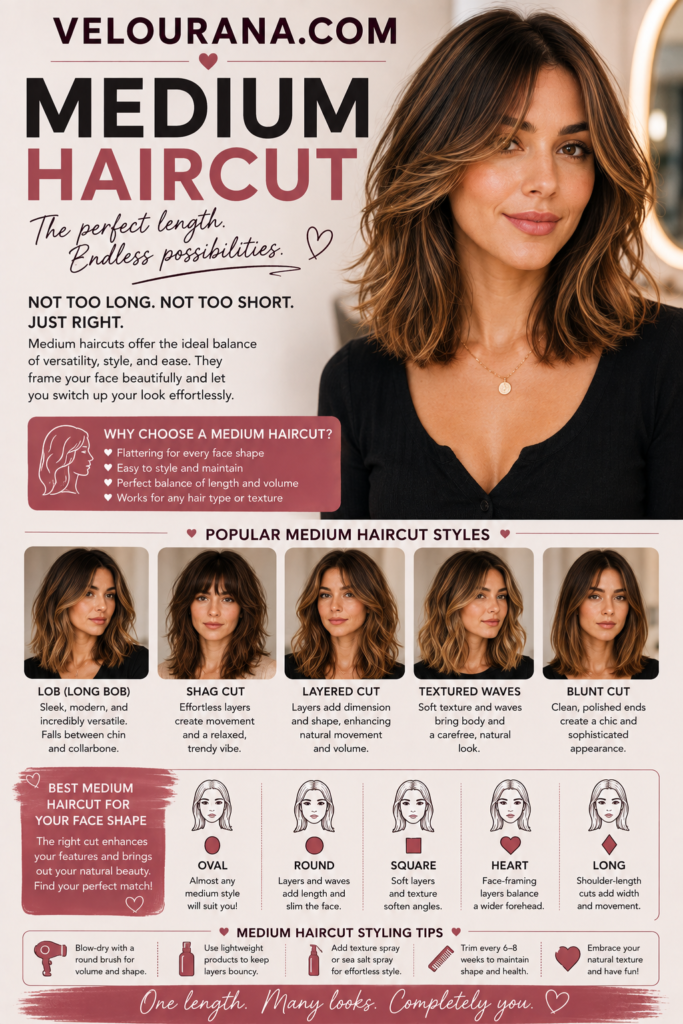
CATEGORY: Medium Haircuts
Medium hair is sometimes described as though it were simply a temporary stage between short and long. Hair grows beyond a bob, reaches the shoulders, and eventually becomes long enough to earn another description. Yet treating medium length as an unfinished journey overlooks what makes it such a useful haircut in its own right.
Sitting somewhere around the shoulders, collarbones or upper chest, medium hair occupies a remarkably flexible territory. It has enough length to move, curl, wave, braid and usually tie back, but it does not carry the same physical or visual weight as very long hair. It can maintain the strong perimeter of a shorter cut while also accommodating layers, face framing and substantial styling movement.
That balance gives medium hair an unusual ability to change personality.
A sleek shoulder-length cut can look clean and sophisticated. The same length with soft layers becomes lighter and more relaxed. Add curtain bangs and face framing and the entire front changes. Natural waves can make the haircut appear casual and textured, while a smooth blowout can transform it into a polished, flowing style.
The important point is that “medium” describes a range of lengths rather than one haircut.
A cut finishing just above the shoulders behaves differently from one sitting directly on them. Collarbone-length hair has another character again, while hair reaching the upper chest begins approaching the movement of long hair.
Within those relatively small differences are many possibilities.
Choosing the right medium haircut therefore involves more than deciding how many centimeters should remain. The perimeter, density, texture, layering and everyday routine all determine whether the finished result feels effortless or requires constant adjustment.
Where Medium Hair Actually Begins and Ends
There is no universal measurement defining medium-length hair.
The proportions of the individual matter.
Shoulder length on one person may represent a different number of centimeters than it does on someone with a longer neck or different body proportions. The more useful way to describe the haircut is according to where it finishes on the body.
Hair ending slightly above the shoulders behaves somewhat like a long bob. It hangs freely without repeatedly colliding with the shoulders.
Move the perimeter downward and physical contact begins changing the way the ends behave.
Hair landing directly on the shoulders may turn outward because the body interrupts its natural fall.
At the collarbones, the strands gain enough additional length to move past some of this interference.
Extend the haircut toward the upper chest and it begins acquiring many of the flowing qualities associated with longer hair while remaining relatively manageable.
These differences may appear small, but they can significantly affect the experience of wearing the haircut.
Someone who dislikes ends flipping outward may discover that the problem is not the styling technique at all. The perimeter may simply be sitting at a point where the shoulders constantly redirect it.
Moving the haircut slightly higher or lower can change that behavior.
The Collarbone Cut Has Become a Modern Classic for a Reason
Among the many versions of medium hair, collarbone length has particular versatility.
It is long enough to move beyond the shoulders but short enough to retain a clearly defined shape. Most of the hair can usually be gathered into a ponytail, and there is enough length for waves, curls and a variety of updos.
At the same time, the ends remain close enough to the face and shoulders that the perimeter still contributes strongly to the haircut.
This creates a useful balance.
A blunt collarbone cut can emphasize density.
Soft layers can create movement without making the hair feel dramatically long.
Face-framing pieces have enough distance to progress from the cheekbones or jaw toward the perimeter.
Curtain bangs can connect naturally into those front layers.
The haircut can therefore support many different aesthetics without changing its fundamental length.
For someone leaving long hair behind, collarbone length can feel like a substantial transformation without the commitment of a short cut.
For someone growing out a bob, it can become a destination rather than merely another stage.
The Perimeter Determines Whether Medium Hair Feels Strong or Soft
A medium haircut with a strong perimeter has a very different personality from one with heavily textured ends.
When most of the hair reaches approximately the same level, the lower edge appears substantial. This can make the haircut feel polished and dense.
Fine hair often benefits from this structure because the perimeter concentrates the available strands.
A straighter baseline creates the strongest effect.
A subtly curved perimeter can soften the outline while retaining much of the same density.
As more texture is introduced through the ends, the silhouette becomes lighter.
Individual sections move more independently.
The haircut can feel more relaxed and less geometric.
Neither approach is inherently better.
The question is what the hair needs.
Someone with very thick medium-length hair may find a completely solid perimeter too bulky.
Someone with fine hair may discover that excessive texturing removes the fullness they were trying to create.
The strongest haircut uses the perimeter deliberately rather than treating the ends as an afterthought.
A Blunt Medium Cut Can Make Hair Look Substantially Fuller
A blunt or predominantly one-length medium haircut can be particularly effective when the goal is visual density.
Because relatively few strands are shortened into layers, a large proportion of the hair reaches the lower edge.
The perimeter appears stronger.
This can make fine or lower-density hair look fuller than it did at a much longer length.
The effect is partly a consequence of removing older, thinner ends.
Hair that reached well below the shoulders may have gradually lost density toward the bottom. Cutting it to the collarbones can move the perimeter upward to a point where significantly more strands are present.
The hair has not become denser at the scalp.
The haircut has simply positioned the ends where the existing density is stronger.
This distinction explains why a medium cut can sometimes create such a dramatic impression of healthier, thicker hair.
Layers Can Change Medium Hair Without Changing Its Overall Length
Medium hair provides enough space for layering but not so much that the layers disappear inside enormous lengths.
This makes their effect particularly visible.
Long layers can soften a blunt shape while preserving substantial fullness.
Shorter layers can introduce more movement through the upper and middle sections.
Face framing can create another level of variation without requiring the back to become heavily layered.
The amount of layering should reflect density.
Fine hair may need only subtle differences in length.
Dense hair can often support more dramatic movement.
Natural texture matters as well.
Waves and curls may become stronger when weight is removed.
Straight hair may reveal every transition clearly.
The purpose of layering should therefore be established before the first section is shortened.
Is the goal movement?
Volume?
Reduced bulk?
Stronger natural texture?
Face framing?
A softer perimeter?
Layers work best when they solve a specific problem rather than being included automatically.
Medium Hair Gives Face Framing Enough Room to Develop
Face-framing layers can transform a medium haircut because the progression between the shortest and longest pieces happens within a relatively compact distance.
A section beginning around the cheekbones can become longer around the jaw and then merge toward the collarbone.
The entire front develops movement.
Longer framing beginning around the chin creates a more conservative effect.
This can be particularly useful for someone who wants a visible change while keeping every piece long enough to manage easily.
The size of the face-framing section matters as much as its length.
A small section creates softness without dramatically affecting the density of the sides.
A larger section creates more obvious movement but removes more hair from the perimeter.
Fine hair often benefits from restraint.
Thick hair can usually support a more substantial frame.
The goal is to make the front feel connected to the face without leaving the rest of the haircut unexpectedly sparse.
Curtain Bangs and Medium Hair Naturally Connect
Curtain bangs have an obvious relationship with medium hair because there is enough length available for the fringe to transition gradually into the rest of the haircut.
The shortest pieces can begin around the forehead or eyes.
They lengthen toward the temples and cheekbones.
From there, the shape continues toward the jaw and eventually the shoulders or collarbones.
This creates a continuous front rather than an isolated fringe.
The result can be dramatic after a blowout, when each section curves away from the face at a different level.
It can also be much softer when allowed to follow natural texture.
Another advantage is growth.
As curtain bangs become longer, they simply turn into face-framing layers.
The haircut evolves rather than reaching an abrupt awkward stage.
Fine Hair and Medium Length Can Be an Excellent Partnership
Growing fine hair very long can sometimes make the lower section appear increasingly sparse.
Medium length provides an opportunity to move the perimeter upward while retaining enough hair to create movement and versatility.
This does not mean everyone with fine hair should cut it.
Healthy fine hair can look beautiful at great lengths.
But when the ends have become noticeably less dense, a medium cut can create a significant visual reset.
A strong perimeter is often useful.
Layers can remain restrained.
A few face-framing pieces may provide enough movement without removing unnecessary density from the back.
The haircut can then gain volume through styling rather than relying on numerous short layers.
This is important because cutting more layers does not create more hair.
It merely redistributes the hair already present.
Fine hair usually looks strongest when that redistribution is deliberate.
Thick Medium Hair Requires Control Without Over-Removal
Very thick hair can behave differently after being cut from long to medium length.
Removing substantial length also removes weight.
Without that weight pulling downward, the hair may expand more than expected.
This is especially noticeable with coarse, wavy or curly textures.
A medium haircut therefore needs to anticipate the volume that may emerge.
Layers can redistribute density and prevent the perimeter from becoming excessively bulky.
But aggressive thinning can create another problem.
Short internal sections may expand while the lower edge becomes unexpectedly sparse.
The haircut then contains volume in places where it was not wanted and lacks it where fullness would have been useful.
Thick hair should be shaped rather than simply reduced.
Its density is an advantage.
The objective is to position that density effectively.
Straight Medium Hair Can Move Between Minimal and Glamorous
Straight hair at medium length can create a particularly clean silhouette.
A strong perimeter emphasizes smoothness and shine.
Subtle layers create movement without disrupting the polished surface.
Face framing prevents the front from feeling too heavy.
The same haircut can then be transformed with styling.
A blowout reveals layers that appeared almost invisible when the hair was sleek.
Large bends create volume around the shoulders.
The ends can be turned inward for a controlled finish or allowed to move outward for something more relaxed.
Changing the part can also have a significant effect.
A center part creates symmetry.
A side part redistributes volume and can make the upper section appear fuller.
Medium straight hair therefore does not need dramatic cutting to offer variety.
Wavy Hair Often Comes Alive Around the Shoulders
Natural waves can respond beautifully when long hair is brought to medium length.
The reduction in weight may allow the wave pattern to contract more strongly.
Movement that previously appeared only near the ends can begin higher.
The haircut can suddenly seem much more textured.
Layers may increase this effect further.
Shorter sections weigh less and can form stronger bends.
However, more texture is not always the goal.
Someone who wants a relatively controlled wavy silhouette may need enough weight to prevent excessive expansion.
This is why the haircut should be evaluated after the natural texture is understood.
The objective is not automatically to maximize the wave.
It is to create the amount of movement the wearer actually wants.
Curly Medium Hair Is Primarily About Volume Placement
With curls, the position of the perimeter tells only part of the story.
The distribution of volume determines the overall shape.
A relatively one-length curly cut may collect substantial fullness around the shoulders.
The upper sections can appear more elongated because they carry greater weight.
Layers can move some of that volume upward.
The silhouette becomes rounder and more balanced.
Shorter face-framing curls can bring movement toward the cheeks and jaw.
But shrinkage must be considered carefully.
A curl that appears shoulder length while stretched may settle considerably higher when dry.
The difference becomes especially important around the face.
A conservative cutting approach allows the natural position to reveal itself before additional length is removed.
Shoulder-Length Hair Has a Unique Relationship With the Body
Hair does not exist in empty space.
At shoulder length, it physically encounters the body.
This interaction can influence the ends every day.
A strand may naturally travel downward until it reaches the shoulder, where it is pushed outward.
The result can be a flip that seems impossible to eliminate permanently.
Heat styling may temporarily redirect it, but the physical contact remains.
Rather than treating this automatically as a problem, the movement can become part of the haircut.
Soft outward ends can give medium hair energy.
Alternatively, shifting the perimeter slightly above or below the point of strongest contact can reduce the effect.
This is one reason trying several nearby medium lengths can produce surprisingly different results.
Medium Hair Is Long Enough to Tie Back but Short Enough to Feel Light
Practicality is one of the greatest advantages of medium hair.
Many cuts around the collarbone can still be gathered into a ponytail or bun.
This makes the length useful for work, exercise and warm weather.
At the same time, the ponytail contains less weight than very long hair.
Drying is usually faster.
Detangling can become easier.
The hair is less likely to become trapped beneath clothing, bags or the body.
Layers affect this practicality.
Short face-framing pieces may escape from the tie.
Shorter crown layers can create texture in buns but may require pins for a polished finish.
Someone who frequently wears their hair tied should therefore consider the shortest sections carefully.
The overall length alone does not determine whether the haircut will be convenient.
Medium Hair Can Make a Dramatic Cut From Long Hair Feel Less Intimidating
For someone who has worn very long hair for years, cutting to the shoulders can feel enormous even though the result is not technically short.
The visual difference is significant because so much of the vertical length disappears.
Yet medium hair preserves many familiar possibilities.
It can still move around the shoulders.
It can often still be tied.
It can be curled, waved, straightened and braided.
This makes it an effective transitional choice for someone curious about shorter hair but uncertain about a bob or pixie.
There is also no requirement to make the entire transformation in one appointment.
Long hair can first be brought toward the upper chest.
Later, it can move toward the collarbones.
Only then, if desired, does it need to reach the shoulders.
Gradual change provides time to understand how the texture responds as weight disappears.
Growing Out a Bob Naturally Leads Into Medium Territory
Medium hair is equally useful from the opposite direction.
Someone growing a bob eventually reaches the stage where the perimeter begins interacting with the shoulders.
This period is sometimes dismissed as awkward, but the haircut can be reshaped rather than simply tolerated.
The perimeter can be refined.
Layers can be adjusted as they grow.
A fringe can become curtain bangs.
Curtain bangs can become face framing.
The haircut can gradually develop into a deliberate collarbone shape.
This turns the growing process into a sequence of hairstyles rather than a period spent waiting for long hair.
Medium Hair Offers a Natural Reset for Damaged Lengths
When the lower portion of long hair has experienced substantial heat, chemical processing or mechanical wear, cutting to medium length can remove a large amount of compromised hair at once.
The result can feel dramatically different.
The ends become stronger.
The perimeter appears denser.
Styling may become easier because less damaged length needs to be managed.
This does not repair the remaining hair in a biological sense, but it can remove sections that no longer contribute positively to the appearance.
The decision does not need to be framed as losing long hair.
It can be understood as establishing a stronger foundation from which the hair can either remain medium or begin growing again.
The Blowout Is Particularly Effective at Medium Length
Medium hair has enough length for a blowout to create flowing movement but not so much that extreme weight immediately pulls the shape downward.
This can make the haircut highly responsive to styling.
Face-framing sections can sweep away from the cheeks.
Layers can create fullness through the sides.
The ends can curve at different levels.
Root lift can change the entire silhouette.
The finished effect may appear significantly more layered than the haircut looks when worn straight.
This is important when choosing inspiration photographs.
A highly voluminous image may represent both the haircut and substantial styling.
The natural version will usually be softer.
That does not make the haircut less successful.
It simply means the styling is contributing part of the visual effect.
Air-Dried Medium Hair Can Be Equally Successful
A medium haircut should not automatically depend on heat.
When the structure works with the natural texture, air-drying can produce a completely different but equally intentional finish.
Straight hair may settle into a clean shape with subtle movement.
Waves can create separation naturally.
Curls can form the silhouette without being stretched.
The key is designing the cut around the way the hair actually behaves.
Someone who rarely blow-dries should communicate that before choosing layers based on a highly styled reference image.
A haircut that requires twenty minutes of manipulation every morning is not low maintenance simply because its length is convenient.
Medium Hair Makes Experimentation Easier
Because the length sits between short and long, it provides an excellent foundation for trying changes without combining too many commitments at once.
Someone can introduce face framing while keeping the back relatively blunt.
Bangs can be added without changing the perimeter.
Layers can be increased gradually.
A straight shoulder-length cut can evolve into a softer layered shape.
A collarbone cut can eventually become a shag-inspired style.
The part can move from center to side.
The ends can be styled sleek, curved or textured.
Medium hair allows the wearer to explore these differences while retaining a familiar amount of length.
Maintenance Depends More on Precision Than the Word Medium
There is no single maintenance schedule for medium hair.
A highly precise blunt perimeter may begin looking different as soon as growth changes its relationship with the shoulders.
A soft layered collarbone cut may remain attractive for considerably longer because the shape evolves gradually.
Bangs may need attention before the rest of the haircut.
Face-framing sections can be refreshed independently.
Someone growing the hair longer may need only conservative trims to maintain the condition of the ends.
Someone maintaining one exact shoulder-length position will naturally need more frequent reshaping.
The design determines maintenance more than the general length category.
Choosing Medium Hair Means Choosing a Relationship With the Shoulders
The most useful question is not simply whether the hair should be “medium.”
It is where the perimeter should sit and what it should do there.
Above the shoulders, the haircut gains freedom from physical contact.
At the shoulders, natural flips and movement become part of the equation.
At the collarbones, the hair gains additional flow while remaining clearly manageable.
Toward the upper chest, it begins moving closer to long-hair territory.
Once that position is chosen, the rest of the design can follow.
Should the perimeter be strong or soft?
Should the front remain long or become framed?
Should layers remain subtle or create obvious movement?
Should bangs connect into the sides?
Should natural texture expand or remain relatively controlled?
These decisions create the haircut.
The In-Between Length That Does Not Need to Be In Between
Medium hair deserves more than being treated as a compromise.
It combines qualities that become harder to maintain at either extreme.
There is enough length for movement but not so much that weight dominates every styling decision.
There is enough hair for ponytails and many updos while drying and handling remain relatively manageable.
The perimeter can create a strong statement.
Layers have enough space to develop.
Face framing can transform the front.
Straight hair can appear sleek, waves can gain freedom and curls can be shaped through volume.
Perhaps most importantly, medium hair can change without losing its identity.
It can become polished, textured, glamorous, casual, blunt or layered while remaining within the same practical range of length.
That flexibility is what makes it more than a halfway point.
A successful medium haircut does not look as though someone is waiting for their hair to grow or preparing to cut it shorter.
It looks complete exactly where it is.
And when the perimeter, texture and movement are designed to work together, that position between short and long can become one of the most versatile places for hair to be.
The End
Velourana.
 Discover More From Our Family of Websites
 ZodiacBearing (Astrology, Tarot, Numerology, Angel Numbers & Spiritual Guidance)
 Velourana (Beauty, Makeup, Hair Care, Skincare & Beauty Tips)
 HavenBearing (Home, Living, Organization, Décor & Everyday Inspiration)
 PawBearing (Pet Care, Dog Breeds, Animal Health, Training & Pet Products)
 PsyCatherine (Notes From the Journal of a Psychologist on Real Life)

