
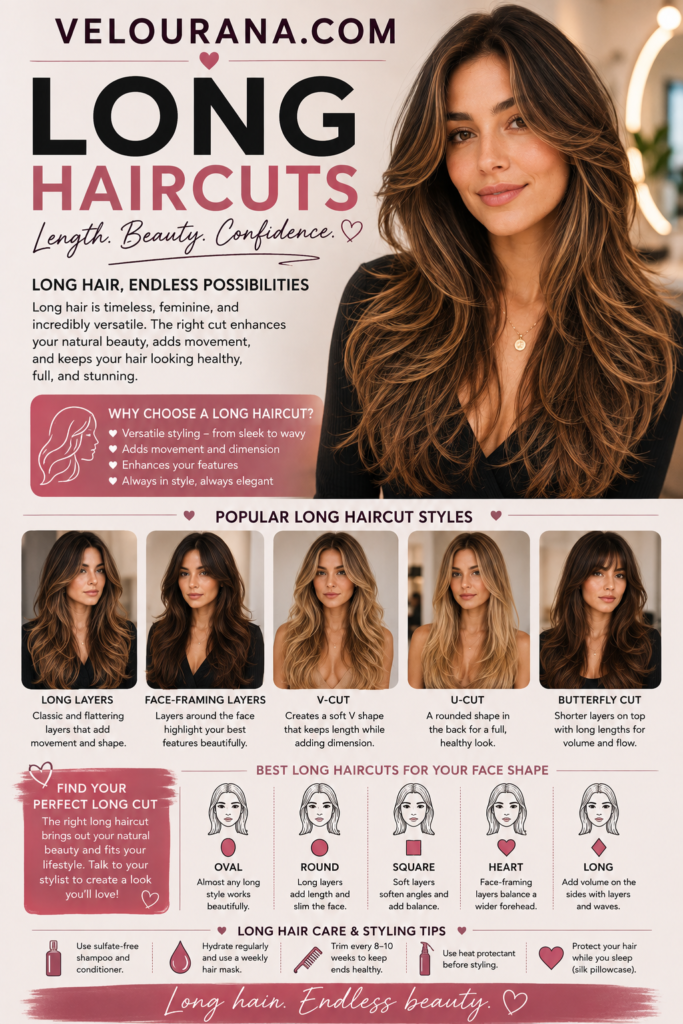
CATEGORY: Long Haircuts
Long hair has a visual presence that few other haircut lengths can reproduce. It moves across the shoulders, changes dramatically when gathered or braided, and can create an uninterrupted line extending far beyond the face. For many people, reaching a genuinely long length also represents years of patience, which makes the idea of a haircut surprisingly complicated. They may want healthier ends, better movement or a more intentional shape, but they do not want to leave the salon feeling that the very thing they valued most has disappeared.
This is where the difference between long hair and a long haircut becomes important.
Simply allowing hair to grow produces length. Designing that length produces a haircut.
The distinction may be subtle from a distance, but it becomes obvious in the way the hair falls. The perimeter can be strong and substantial or soft and tapered. The front can remain almost as long as the back or gradually shorten around the face. The ends can form a straight line, a rounded curve or a more pronounced V. Layers can be almost invisible or become a major part of the style.
None of these choices necessarily requires sacrificing significant overall length.
A well-designed long haircut works with the hair that has already been grown. It decides where density should remain, where movement would improve the silhouette and how the front, sides and back should relate to one another. The result can still look unmistakably long while feeling considerably more polished.
Length Alone Does Not Determine How Long Hair Looks
It is easy to assume that the longest strand determines whether hair appears impressively long. In reality, the condition and density of the lower section matter just as much.
Hair can technically reach the waist while becoming increasingly sparse through the final portion. Another person's hair may finish several centimeters higher but maintain a dense, healthy-looking perimeter. The second haircut can actually appear more substantial because the eye sees a clear body of hair rather than a small number of strands extending below the main mass.
This is why protecting every centimeter is not always the same thing as protecting the appearance of length.
Hair does not grow as one permanent collection of strands. Individual hairs are at different stages of their growth cycles, and everyday mechanical wear accumulates over time. The ends of very long hair are also the oldest part of the strand. They have experienced years of washing, drying, brushing, friction, environmental exposure and styling.
Eventually, the lowest section may no longer represent the density found higher in the hair.
A carefully chosen trim can move the perimeter upward to a point where it looks stronger while leaving the overall impression unmistakably long.
The objective is not to remove length unnecessarily. It is to distinguish valuable length from ends that are no longer contributing positively to the haircut.
The Perimeter Creates the Foundation
Before considering layers, bangs or elaborate styling, a long haircut needs a perimeter.
This is the lowest visible boundary of the hair, and its shape has a major influence on the overall silhouette.
A relatively straight perimeter creates the strongest horizontal line. It keeps more hair reaching approximately the same level and can therefore make the ends appear especially substantial.
This can work beautifully on fine or medium-density hair when preserving fullness is important.
A gently rounded perimeter softens that horizontal line. The middle remains slightly longer while the outer sections rise gradually. From the back, the hair develops a subtle curve rather than ending abruptly across one level.
A more pronounced U shape increases that effect.
The center retains significant length, while the sides gradually become shorter. This can give very long hair greater movement while avoiding the dramatic point associated with a V-shaped cut.
The V shape creates the strongest difference. The central back section becomes the longest point, while the perimeter rises toward the sides.
This can look dramatic on dense hair, particularly when the hair is viewed from behind.
The trade-off is that fewer strands reach the absolute longest point.
Someone who values a thick-looking lower edge may therefore prefer a straighter or softer U-shaped perimeter, while someone who prioritizes dramatic length and movement may enjoy a more pronounced taper.
A U-Shaped Cut Can Soften Very Long Hair
The U-shaped perimeter is popular for good reason.
It creates enough variation to stop very long hair from looking like a single rectangular sheet while preserving substantial density through the lower section.
From behind, the center appears longest. The perimeter then rises gradually toward the sides rather than forming an abrupt point.
This gradual curve can complement natural movement particularly well.
When the hair shifts across the back, the ends do not all compete for one horizontal level. The silhouette feels softer.
A U shape also provides a natural foundation for long layers. The internal movement can follow the same general flow, allowing the haircut to feel connected from the upper lengths through the perimeter.
The depth of the U can be adjusted.
A shallow curve may be almost indistinguishable from a straight cut when the hair is brought forward.
A deeper curve creates more visible variation.
The appropriate version depends on density and how much fullness should remain around the sides.
The V-Shaped Cut Creates Drama but Changes Density
A V-shaped long haircut emphasizes the center length.
From the back, the hair travels toward a distinct lower point, producing a dramatic silhouette.
On exceptionally thick hair, this can be striking because enough density remains throughout the shape to support the taper.
The haircut can also create natural movement because the side sections finish progressively higher.
However, the dramatic point comes with a structural consequence.
The longest part contains less hair than it would in a straight perimeter.
On lower-density hair, this can make the final section appear thin.
The V may become less like a deliberate geometric shape and more like a sparse tail.
This does not mean fine hair can never have a V-shaped perimeter, but the depth may need to be reduced.
A softer V or U can preserve the idea while protecting more density.
This is an example of why haircut shapes should be adapted rather than copied mechanically from photographs.
The same outline behaves differently according to how much hair is available to create it.
One-Length Long Hair Has Its Own Strength
Layering receives enormous attention, but there is nothing incomplete about long hair with minimal layering.
A predominantly one-length haircut can be exceptionally beautiful.
Its strength comes from density and continuity.
Most of the hair reaches the perimeter, producing a substantial lower edge. Straight hair can look particularly sleek in this structure because the uninterrupted lengths create a smooth surface.
Fine hair may also benefit because relatively little density is removed from the bottom.
The potential disadvantage is weight.
Very dense or naturally textured hair may begin to feel heavy. Waves can become stretched. The front may lack movement because the strands travel such a long distance before ending.
This does not automatically mean extensive layering is necessary.
Small adjustments around the face or subtle internal movement may be enough.
A strong long haircut can remain predominantly one length while still being personalized.
Long Layers Can Create Movement Without Taking Away the Length
For someone who wants more movement while preserving the overall length, long layers provide one of the most versatile options.
The longest perimeter remains intact or nearly intact.
Selected sections above it are shortened enough to move independently.
When the difference is subtle, the layers may barely show while the hair is straight. Their effect becomes more apparent during movement or styling.
A wave can develop at a different level.
A blowout can create overlapping curves.
The ends can separate rather than falling together as one heavy mass.
The position of the shortest layer determines how dramatic the effect becomes.
Layers beginning relatively low preserve more density.
Layers beginning higher create greater movement but remove more hair from the lower perimeter.
There is no reason to introduce short layers simply because the hair is long.
The amount of layering should reflect the density available and the amount of movement desired.
The Front Can Change While the Back Remains Very Long
One of the most effective ways to modernize long hair without sacrificing the back length is to concentrate shaping around the face.
Face-framing pieces can begin around the cheekbones, jaw, chin or collarbone and gradually connect with the longer sections.
From behind, the haircut may remain almost unchanged.
From the front, it can look entirely different.
The face becomes integrated into the hairstyle rather than surrounded by two uninterrupted curtains of hair.
This can also improve styling.
Shorter front pieces can curve away during a blowout, develop stronger natural waves or remain loose around a ponytail.
Someone cautious about losing length can begin with longer framing around the chin or collarbone.
The effect can always be increased later.
Starting conservatively is particularly useful because short pieces around the face can feel far more dramatic than the same amount removed from the perimeter.
Long Hair and Bangs Create an Intentional Contrast
Bangs provide another way to transform long hair while leaving most of its length untouched.
The contrast can be dramatic.
Very long hair establishes a strong vertical silhouette, while a fringe introduces a much shorter element around the forehead.
A full blunt fringe creates the strongest distinction.
Wispy bangs produce a softer transition.
Curtain bangs can blend gradually into face-framing layers and eventually into the full length.
This last approach is particularly versatile because the front becomes a continuous progression rather than a separate section.
Bangs do require their own maintenance.
A perimeter that changes only slightly over several months may still look attractive, while a fringe can move through its intended position relatively quickly.
Someone who wants the visual transformation without frequent bang maintenance may prefer longer curtain pieces or face framing.
Fine Long Hair Benefits From Protecting What It Has
Fine long hair can be extraordinarily beautiful, but haircut decisions need to respect density.
The desire for dramatic movement can lead to excessive layering, which removes strands from the perimeter and leaves the lower lengths increasingly transparent.
A stronger approach often keeps the back relatively full.
The perimeter may be straight or gently rounded.
Layers, if used, can remain long and restrained.
Face framing can create visible movement without requiring extensive layering throughout the entire head.
The condition of the ends is particularly important.
Keeping damaged ends purely for length can sometimes make fine hair appear thinner than trimming back to a healthier, denser level.
Styling also influences the result.
Fine long hair can be weighed down easily by excessive product. Lightweight conditioning and careful handling may preserve movement more effectively than trying to manufacture volume with large quantities of styling product.
The goal should not be to make fine hair look like a completely different density.
It should be to make its own density look as strong as possible.
Thick Long Hair Offers Enormous Possibilities
Thick hair provides more material with which to create shape.
A strong perimeter can look exceptionally rich.
Long layers can become more dramatic without immediately making the ends appear sparse.
Face framing can involve larger sections.
A U or V shape can become more pronounced.
But abundance also creates practical challenges.
Very long thick hair can be physically heavy. Washing and drying require time. Natural texture may be stretched by the weight, and a one-length structure can become extremely dense through the lower portion.
Layering can redistribute some of this weight.
The key is not to confuse thoughtful redistribution with indiscriminate thinning.
Removing too much internal density can create short sections that expand unpredictably while leaving the ends thinner than intended.
The beauty of thick hair lies partly in its abundance.
The haircut should organize that abundance rather than eliminate it.
Straight Long Hair Emphasizes Condition and Precision
Long straight hair places considerable attention on the surface and perimeter.
There may be less texture to disguise irregular ends or uneven transitions, so the condition of the hair becomes highly visible.
A strong perimeter can create a sleek, luxurious appearance.
Subtle layers can introduce movement while retaining the clean surface.
More dramatic layers become especially visible because each difference in length can be seen clearly.
This does not mean straight hair should avoid layering.
It simply means blending and density management become important.
The haircut can also be transformed considerably through parting.
A center part reinforces symmetry.
A side part redistributes volume and changes the relationship between the hair and face.
Even without shortening the hair, this can alter the entire impression.
Waves Can Become More Visible When Long Hair Is Shaped
Long wavy hair often changes when excess weight is removed.
The wave pattern may become stronger.
Movement can begin higher.
Sections that previously appeared almost straight can develop visible bends.
A layered long haircut can encourage this effect, but the amount of layering needs to be balanced carefully.
Removing too much weight may cause some textures to expand more than expected.
Keeping too much can continue stretching the wave downward.
The best result usually comes from understanding where the natural movement already exists.
Hair rarely has an identical wave pattern everywhere.
The underneath may be curlier.
The surface may be straighter.
One side may form stronger bends.
The haircut should accommodate these differences rather than expecting perfect symmetry.
Curly Long Hair Is Defined by Both Length and Volume
Long curls create a three-dimensional silhouette.
The longest point matters, but so does the distribution of volume around the head.
A largely one-length curly haircut may carry much of its fullness toward the lower section because the upper curls are stretched by weight.
Layers can redistribute that volume upward.
This can create a rounder and more balanced shape while preserving significant length.
Shrinkage remains essential to consider.
A curl that reaches a particular point while stretched may settle considerably higher when dry.
The more dramatic the natural shrinkage, the more cautiously shorter layers should be approached.
The desired silhouette also matters.
Not everyone wants maximum crown volume.
Some people prefer the elongating effect of heavier long curls.
Others want expansive, rounded movement.
The haircut should support the preferred shape rather than applying a universal rule to curly hair.
Extremely Long Hair Requires a Different Kind of Maintenance
Once hair extends toward the waist, hips or beyond, preserving it becomes increasingly connected with protecting the oldest parts of the strands.
The ends have been present for years.
They encounter friction from clothing, chairs, bedding and everyday movement.
Detangling requires patience because aggressive handling can create mechanical damage.
Long hair can also become trapped beneath bags, clothing or the body itself.
A haircut cannot prevent all of this, but maintaining the perimeter can stop accumulated damage from gradually dominating the appearance.
Small trims can remove compromised ends without dramatically changing the overall length.
The frequency does not need to follow one universal schedule.
Someone with relatively healthy ends and minimal damage may need less frequent intervention than someone who regularly uses high heat or experiences significant breakage.
The condition of the hair should determine the decision rather than the calendar alone.
Long Hair Does Not Need to Be Cut Frequently Just Because It Is Long
There is sometimes a belief that everyone needs a haircut after a fixed number of weeks.
Long hair does not operate according to a universal timetable.
Someone maintaining a precise short bob may notice growth quickly because a few centimeters change the silhouette.
On very long hair, the same growth may have far less visual impact.
The need for a trim depends on the condition of the ends, the shape of the haircut and the desired appearance.
If the perimeter remains healthy and the layers still sit well, there may be no aesthetic reason for an aggressive cut.
If the ends are splitting, breaking or becoming visibly sparse, waiting purely to preserve length may be counterproductive.
Maintenance should preserve the quality of the hair rather than simply satisfy a predetermined schedule.
Heat Styling Becomes a Bigger Commitment With More Hair
Long hair offers many styling possibilities, but the amount of hair means heat exposure can accumulate.
Creating waves, curls or a completely straight finish across very long lengths may require repeated passes and significant time.
Appropriate heat protection and sensible temperature choices become particularly important when the same ends have already survived years of styling.
A haircut that works with natural texture can reduce this dependency.
Long layers may encourage existing waves.
Face framing can create movement without curling the entire head.
A strong perimeter can look polished even with relatively simple styling.
The most sustainable long haircut is often one that looks intentional without requiring the hair to be transformed completely after every wash.
Tied Hairstyles Are Part of the Long-Hair Experience
One of the practical advantages of long hair is the ability to create ponytails, braids, buns and numerous forms of updos.
The haircut influences all of them.
Predominantly one-length hair can be easier to contain because fewer short pieces escape.
Layers create texture in braids and buns but may also produce more loose sections.
Face-framing pieces can soften a ponytail beautifully while remaining intentionally free around the face.
Bangs add another independent element.
These consequences should be considered when designing the haircut.
Someone who wears their hair tied most days may prefer longer front pieces that can still reach the ponytail.
Someone who enjoys relaxed updos may deliberately choose shorter framing because the loose pieces create the desired effect.
The haircut should work both down and up.
A Major Cut Should Be Considered Differently From a Maintenance Trim
When someone has grown their hair for years, deciding to remove a substantial amount can feel very different from routine maintenance.
It is worth distinguishing between wanting healthier long hair and wanting a genuinely shorter hairstyle.
If the objective is simply to improve the condition and shape, there may be no reason to make a dramatic reduction.
A stronger perimeter, subtle layers or face framing can create significant change while preserving most of the length.
If the desire is truly to experience medium or short hair, that is a different decision.
The distinction matters because cutting thirty centimeters when five would have achieved the actual objective cannot be reversed quickly.
Long hair provides the luxury of gradual experimentation.
Shape can be introduced first.
More can always be removed later.
Growing Long Hair Is Easier When the Shape Evolves With It
People sometimes treat growing hair as a period during which no haircut should occur.
That can leave the hairstyle feeling increasingly shapeless.
Instead, the haircut can evolve while the length increases.
A shoulder-length cut can become a long bob.
The long bob can develop into medium-length hair.
Layers can gradually become longer.
The perimeter can be maintained while moving downward.
Face-framing pieces can evolve without preventing the back from growing.
This approach allows the hair to look intentional throughout the process.
Growth and haircutting are not opposites.
A haircut can support the journey toward longer hair by maintaining shape and removing only what is genuinely necessary.
Choosing a Long Haircut Means Deciding What You Want to Preserve
The most useful starting question is not simply, “How long do I want my hair?”
It is, “What do I value most about having long hair?”
For one person, the answer is maximum possible length.
For another, it is a thick perimeter.
Someone else values dramatic movement.
Another person wants long hair primarily because of the styling possibilities.
These priorities can lead to different haircuts even when the final length is identical.
Maximum length may favor conservative trimming.
Maximum density may justify removing sparse ends.
Movement may call for layers.
Versatility may favor long face framing rather than very short sections.
The haircut becomes more successful when these priorities are clear.
Long Hair Can Be Both Dramatic and Deliberate
There is nothing inherently unfinished about very simple long hair.
A strong, nearly one-length shape can be as intentional as an elaborate layered cut.
What matters is whether the structure supports the desired effect.
A straight perimeter can emphasize density.
A U shape can introduce softness.
A V can create drama.
Long layers can add movement.
Face framing can transform the front.
Bangs can create contrast.
Natural waves and curls can become central to the silhouette.
These options demonstrate that maintaining long hair does not mean avoiding haircuts.
It means using them differently.
When Length and Shape Work Together
The most successful long haircut does not ask the wearer to choose between impressive length and beautiful shape.
It uses one to strengthen the other.
The perimeter gives the length a clear destination.
Layers introduce movement without unnecessarily sacrificing density.
Face framing connects the hair to the features.
Natural texture determines how the shape behaves rather than being treated as an inconvenience.
Maintenance protects the oldest sections without automatically removing more than necessary.
The result remains undeniably long.
But it no longer relies on length alone for its impact.
That distinction can transform hair that has simply been growing into hair that feels deliberately designed.
Long hair is already visually powerful. A thoughtful haircut does not need to compete with that power or remove it.
It simply gives all that length somewhere beautiful to go.
The End
Velourana.
 Discover More From Our Family of Websites
 ZodiacBearing (Astrology, Tarot, Numerology, Angel Numbers & Spiritual Guidance)
 Velourana (Beauty, Makeup, Hair Care, Skincare & Beauty Tips)
 HavenBearing (Home, Living, Organization, Décor & Everyday Inspiration)
 PawBearing (Pet Care, Dog Breeds, Animal Health, Training & Pet Products)
 PsyCatherine (Notes From the Journal of a Psychologist on Real Life)

