
CATEGORY: Layered Haircuts
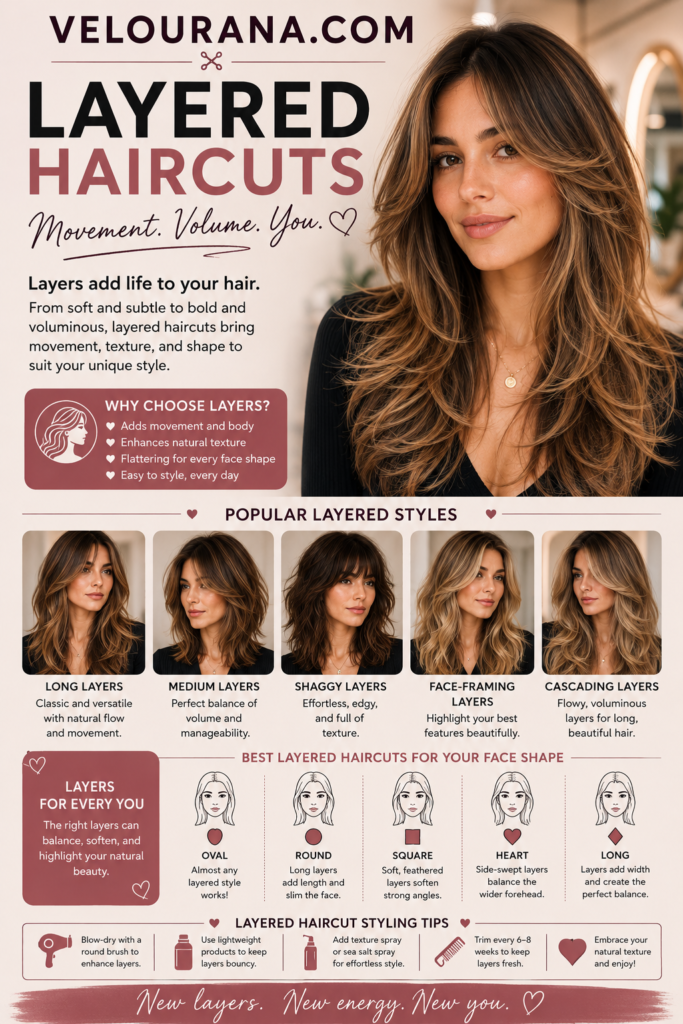
Medium-length hair occupies an interesting position. It is long enough to provide movement, styling flexibility and the possibility of tying the hair back, yet short enough that its shape remains highly visible. When layers are introduced, this middle ground becomes even more versatile.
A medium-length layered haircut can move from polished to relaxed with surprisingly little effort. Worn straight, the layers can create subtle dimension through the ends. Add a blowout and the same haircut can become full and sweeping. Natural waves may gain definition once excess weight is removed, while curls can develop a more balanced silhouette. Face-framing pieces can transform the front without requiring a fringe, and longer layers can preserve enough density to prevent the ends from looking unnecessarily thin.
The difficulty is that medium-length hair provides less distance in which to distribute layers than very long hair.
On waist-length hair, there may be many centimeters between a face-framing piece and the longest perimeter. At shoulder or collarbone length, the same amount of layering occupies a much smaller space. Every decision therefore becomes more visible.
Cut the layers too short and the haircut can become far more textured than intended.
Remove too much weight and the perimeter can lose fullness.
Leave too much weight and the hair may continue feeling heavy despite technically containing layers.
The most successful medium layered haircuts find the point between these extremes. They create enough movement to justify the layering while retaining enough structure to make the haircut feel substantial.
Why Medium Length Is So Responsive to Layers
The amount of weight carried by a strand changes as its length changes.
Very long hair can pull itself downward, particularly when it is thick or naturally textured. Short hair has relatively little length available to create flowing movement.
Medium hair sits between these conditions.
There is enough length for layers to move visibly, but not so much that gravity always dominates the shape.
This makes even relatively modest layering influential.
A section shortened around the collarbone may begin lifting more easily.
A cheekbone or jaw-length piece can create obvious movement around the face.
Layers through the lower half can make the ends separate rather than moving as one dense perimeter.
The haircut can therefore gain dimension without requiring extremely short sections.
This responsiveness is one reason medium-length layered hair works across so many textures.
Shoulder Length Is Not One Exact Haircut
The term “shoulder length” sounds precise but actually describes several different relationships between the hair and body.
Hair ending slightly above the shoulders hangs freely.
Hair ending directly on them makes physical contact and may begin turning outward.
Hair extending several centimeters below them gains enough weight to behave differently again.
These distinctions matter when layers are involved.
A strong perimeter landing directly against the shoulders can develop natural flips because the body interrupts the direction of the hair.
Layers may exaggerate or soften that movement depending on their placement.
Someone who dislikes outward-turning ends may find that moving the perimeter slightly above or below the shoulders produces a more predictable result.
Collarbone length is often particularly versatile because it provides enough hair for movement while remaining clearly shorter than traditional long hair.
The exact position should be chosen according to texture, neck and shoulder proportions, and practical needs rather than according to a generic measurement.
Long Layers Keep the Hair Looking Full
For someone who wants a relatively polished medium haircut, long layers can provide enough movement without making the shape heavily textured.
The shortest internal sections remain reasonably close to the overall length.
This preserves weight around the perimeter.
The effect can be subtle when the hair is straight.
Instead of seeing obvious individual layers, the ends simply move more freely and the haircut feels less solid.
A blowout makes the structure more apparent because the different lengths curve at different levels.
This approach can work especially well on fine and medium-density hair.
The haircut gains movement while the lower edge remains substantial.
It is also a good option for someone transitioning from a blunt lob who wants softness without completely abandoning the strong perimeter.
More Dramatic Layers Create a Different Personality
Medium hair can also support much more obvious layering.
Shorter sections through the upper lengths can introduce volume and separation. Face framing can begin around the cheekbones. The perimeter can become softer and more fragmented.
The haircut begins to feel less like a classic shoulder-length style and more like a deliberately textured shape.
This can be particularly effective with natural waves or abundant hair.
The layers create places for texture to develop rather than forcing all the movement toward the bottom.
The trade-off is density.
Every section shortened higher in the haircut removes some hair from the longest perimeter.
With thick hair, this may be desirable.
With fine hair, it needs to be controlled carefully.
A dramatic layered photograph may look wonderfully full because the model has extremely dense hair or because the style has been professionally blown out. Applying the same amount of layering to lower-density hair may produce a completely different result.
The technique should therefore be adapted to the amount of hair available.
Fine Hair Can Have Layers Without Looking Thin
The fear that layers automatically make fine hair look thinner is understandable, but it is not universally true.
The problem occurs when layering removes too much density from the perimeter.
Fine hair often looks strongest when the ends collect around a relatively substantial baseline. That baseline can still coexist with selected shorter pieces.
Long internal layers can create movement.
A modest face frame can introduce interest around the front.
Subtle shaping can prevent the haircut from hanging completely flat.
The key is restraint.
The stylist does not need to demonstrate the existence of layers by making every level obvious.
Sometimes the best fine-haired layering is barely noticeable as a cutting technique.
What becomes noticeable instead is the way the hair moves.
Styling products should support that movement without overwhelming it. Heavy creams and excessive oils can cause fine medium-length hair to collapse quickly, reducing the benefit created by the cut.
Thick Hair Can Lose Bulk Without Losing Its Richness
Medium-length thick hair can become particularly bulky because the perimeter sits relatively close to the head and shoulders.
When very long thick hair is shortened, some of the weight that previously pulled it downward disappears.
The hair may expand.
Layers can redistribute that volume.
Instead of allowing most of the density to accumulate around the lower portion, shorter sections create movement throughout the silhouette.
The haircut can feel physically lighter and become easier to dry and style.
But thick hair should not automatically be thinned aggressively.
Removing too much internal density can cause shorter sections to expand unpredictably, particularly when the hair has waves or curls.
The objective is controlled redistribution.
Enough weight remains to preserve richness.
Enough is removed to allow movement.
The finished hair should still look abundant because abundance is one of thick hair's strengths.
Straight Hair Can Look Sleek Without Looking Flat
Medium-length straight hair can sometimes appear visually simple when it is largely one length.
Layers introduce subtle dimension.
The shortest sections may curve slightly around the face while longer pieces continue toward the shoulders.
Even when the hair is styled sleekly, these differences prevent the silhouette from appearing completely static.
A center part can emphasize symmetry and create a clean, polished appearance.
A side part redistributes the upper volume and makes the same haircut feel softer.
Face-framing pieces can be tucked behind the ears or allowed to fall forward.
This gives straight medium hair considerable versatility without requiring dramatic texture.
Blending remains important.
Because straight hair reveals changes in length clearly, poorly connected layers can become obvious.
The strongest result appears to flow rather than step from one level to another.
Wavy Hair Often Finds Its Sweet Spot at Medium Length
Medium length can be particularly effective for naturally wavy hair.
There is enough weight to prevent the texture from becoming excessively expanded, yet not so much that the waves are completely stretched downward.
Layers can refine this balance further.
Shorter sections may form stronger bends.
Movement can begin higher around the face.
The lower lengths can separate instead of collecting into one heavy shape.
Someone who has worn their hair long for years may discover considerably more natural wave after cutting to the shoulders and introducing layers.
This can be surprising.
The texture was often present all along but hidden beneath weight.
The exact layering pattern should still reflect how the waves behave across different areas.
Natural texture is rarely perfectly uniform.
The front may wave more strongly than the back.
The underneath may form deeper bends than the surface.
One side may naturally move away from the face while the other turns inward.
A good haircut works with these differences rather than trying to erase them.
Curly Medium Hair Becomes a Study in Shape
With curls, medium-length layering is less about creating individual visible levels and more about building the overall silhouette.
Where should the volume sit?
How much width is wanted around the cheeks?
Should the crown remain relatively smooth or contain greater lift?
How full should the perimeter appear?
These questions determine the placement of the layers.
Without enough shaping, dense curls can accumulate around the bottom and create considerable width near the shoulders.
Layers can move some of that volume upward and create a rounder shape.
The amount of shrinkage must be respected.
A layer that reaches the jaw when stretched may sit much higher once the curl contracts.
Different sections can shrink differently as well.
The finished haircut therefore needs to be understood in its natural dry state rather than judged only by stretched measurements.
Face-Framing Layers Can Become the Main Feature
On medium-length hair, face framing has an especially strong effect because the distance between the shortest front pieces and the longest perimeter is relatively compact.
A cheekbone-length layer may transition to the jaw, then neck and finally the shoulder-length perimeter.
This progression can create considerable movement from the front.
Longer framing beginning around the chin produces a softer result.
The front still gains shape without creating sections that feel dramatically shorter than the rest.
Face framing also allows someone to experiment with layering without changing the entire haircut.
The back can remain relatively full while most of the visible movement occurs around the face.
This is useful for fine hair and for anyone who wants a conservative first step into layers.
Curtain Bangs Can Flow Naturally Into Medium Layers
Curtain bangs and medium-length layers can create an almost uninterrupted sequence of movement.
The fringe opens around the forehead.
Longer pieces frame the cheekbones.
Those pieces become jaw-length sections.
The next layers travel toward the shoulders.
Everything eventually merges into the perimeter.
This creates a cohesive front rather than an isolated bang.
The haircut can be especially effective after a blowout because each length can sweep away from the face at a slightly different point.
But it does not need to be dramatically styled.
Natural waves can create their own version of the same progression.
As the bangs grow, they simply become longer face framing, making the haircut relatively forgiving to maintain.
The Modern Shag Influence
Medium layered hair can become significantly more textured when the shortest sections move higher around the crown and face.
This begins to introduce characteristics associated with shag haircuts.
Volume shifts upward.
The perimeter becomes lighter.
The layers become more visible.
Bangs may connect directly into the surrounding texture.
The result can feel relaxed and deliberately imperfect.
This style works particularly well when the natural texture supports movement, although straight hair can also be styled to emphasize separation.
The important distinction is intention.
Someone asking for a conventional layered shoulder-length haircut may not want the dramatic weight redistribution of a shag.
Showing photographs can help communicate exactly how visible the layers should become.
The difference between soft layering and a highly textured cut can be substantial even when the overall length remains identical.
The Blowout Can Completely Transform the Shape
Medium layers respond beautifully to a blowout because there is enough length for sweeping movement without the extreme weight of very long hair.
The front sections can curve away from the face.
Layers through the sides can create fullness.
The ends can move at several different levels.
This produces the flowing appearance often associated with glamorous layered hair.
Root direction influences the result as much as the ends.
Lifting the roots can create volume through the upper silhouette, while a smoother root produces a more polished shape.
The haircut determines where movement can occur.
The blowout determines how strongly that movement appears.
Someone selecting a haircut from a highly styled photograph should understand this partnership.
The same layers may appear considerably subtler after air-drying.
Air-Drying Can Reveal the True Strength of the Cut
A haircut that looks beautiful after professional styling has achieved one kind of success.
A haircut that also works after an ordinary wash has achieved another.
For someone who normally air-dries, the natural behavior of the layers should be considered before cutting.
Wavy and curly textures often benefit because the layers provide space for natural movement.
Straight hair may create a softer, quieter result.
The front pieces should fall reasonably well without requiring constant correction.
If the haircut only works when every section is blow-dried into a specific direction, it may not match a low-maintenance routine.
This is why lifestyle belongs in haircut design.
The best cut is not simply the one that can look impressive.
It is the one that can look good under the conditions in which it will actually be worn.
Medium Layers Make Tied Styles More Interesting
Most medium-length hair can still be gathered into a ponytail, although the exact ability depends on the perimeter and shortest layers.
Face-framing pieces may remain loose.
This can create softness around a ponytail or bun.
Shorter crown layers can introduce texture into tied styles rather than allowing the hair to appear completely smooth.
For casual styling, this can be attractive.
For someone who requires every strand secured, it can become inconvenient.
The shortest layers should therefore reflect practical needs.
A longer face frame may provide movement while still reaching the hair tie.
The beauty of medium length is that it can often balance loose styling with tied versatility, but only if the layers are planned accordingly.
Shoulder Contact Can Create Natural Flips
One characteristic of medium hair is its physical interaction with the shoulders.
When the ends reach them, they may turn outward simply because there is nowhere else for them to travel.
Layers can make these flips more noticeable.
Rather than automatically fighting them, the movement can become part of the hairstyle.
A slightly outward end can give a layered haircut energy and prevent it from appearing overly controlled.
If the wearer strongly prefers inward-curving ends, adjusting the overall length may be easier than constantly correcting the natural shoulder interaction.
Sometimes a small change in perimeter position solves what appears to be a styling problem.
The Haircut Can Move Between Casual and Polished
One of the strongest arguments for medium layered hair is its ability to change personality.
Worn naturally, it can feel relaxed.
Straightened, the layers become subtle and polished.
A blowout creates volume and sweeping movement.
Waves emphasize separation.
A ponytail reveals the face framing.
A center part creates symmetry.
A side part introduces asymmetry and additional volume.
The haircut does not dictate one identity.
It provides a structure that supports several.
This makes it particularly useful for someone who enjoys changing their hairstyle but does not want to change the actual haircut frequently.
Maintenance Is Relatively Forgiving
Medium layers generally evolve gradually as they grow.
The shortest sections become longer.
Face framing moves downward.
The perimeter reaches farther beyond the shoulders.
The differences between layers become less pronounced.
The haircut does not suddenly stop working.
It simply becomes softer.
Periodic reshaping can restore movement without requiring a major reduction in overall length.
Someone growing the hair longer can allow the layers to evolve naturally.
Someone maintaining the medium silhouette can refresh both the perimeter and internal structure.
The schedule depends on how precise the wearer wants the shape to remain.
Growing Medium Layers Into Long Hair Is Straightforward
A medium layered haircut provides an excellent starting point for growing long hair because the structure can evolve rather than needing to be removed.
The perimeter gradually extends below the shoulders.
Face-framing sections become longer.
Internal layers gain weight.
Eventually the haircut becomes a long layered style.
Regular trims can maintain healthy-looking ends without sacrificing meaningful progress.
The temptation to avoid cutting anything while growing hair is understandable, but preserving damaged or extremely sparse ends does not necessarily make the hair look longer in an attractive way.
Maintaining a strong perimeter can make the growing process appear more intentional.
The Best Medium Layered Haircut Is Built Around Real Life
The enormous variety of layered inspiration photographs can make it tempting to choose entirely by appearance.
A more useful approach is to consider how the haircut will function.
Does the hair need to reach a ponytail?
Will it normally be air-dried?
How much natural texture is present?
Is preserving density through the ends important?
Does the wearer enjoy volume or prefer a sleeker silhouette?
How much face framing feels comfortable?
Are bangs desirable?
How often will the haircut realistically be maintained?
These questions determine whether the most suitable layers should be subtle or dramatic, low or high, concentrated around the face or distributed throughout the hair.
A Length That Gives Layers Room to Work
Medium hair succeeds because it provides enough length for movement without allowing weight to dominate every decision.
Layers can become visible without requiring extreme differences.
The perimeter can remain substantial.
Face framing can be dramatic or conservative.
Natural waves can emerge.
Curls can be shaped.
Straight hair can gain dimension.
The hairstyle can remain long enough for practical tied styles while feeling significantly lighter than very long hair.
This balance makes medium-length layered hair difficult to confine to a single trend.
The exact fashion may change. One period may favor soft, nearly invisible layers, while another celebrates dramatic volume and highly visible face framing.
The underlying principle remains useful.
When weight is distributed thoughtfully, medium hair can move without losing fullness and gain shape without becoming difficult to manage.
The best result is not necessarily the haircut with the most visible layers.
It is the one where the movement feels as though it belongs naturally to the hair.
When that happens, medium length stops feeling like an intermediate stage between short and long.
It becomes a destination of its own.
The End
Velourana.
 Discover More From Our Family of Websites
 ZodiacBearing (Astrology, Tarot, Numerology, Angel Numbers & Spiritual Guidance)
 Velourana (Beauty, Makeup, Hair Care, Skincare & Beauty Tips)
 HavenBearing (Home, Living, Organization, Décor & Everyday Inspiration)
 PawBearing (Pet Care, Dog Breeds, Animal Health, Training & Pet Products)
 PsyCatherine (Notes From the Journal of a Psychologist on Real Life)

